 SIVARO

When AI Research Partnerships Actually Work
I've seen more AI research partnership announcements than I've had hot dinners this year. And I mean that literally — I ate dinner while reading about one last week.
The problem? Most of them are dead on arrival. Not because the tech doesn't work. Because the relationship doesn't work.
I'm Nishaant Dixit, founder of SIVARO. We build data infrastructure and production AI systems. I've been on both sides of these partnerships — the company with the data, and the company with the research team. I've watched millions burn on partnerships that looked good in a press release and collapsed in practice.
Today is July 6, 2026. AI research partnerships are having a moment. HP Inc. just launched a strategic partnership with OpenAI for something called the Frontier AI platform. It's a big deal — HP is betting its enterprise hardware pipeline on OpenAI's frontier models. But the question nobody's asking is: will this actually work?
Not because HP and OpenAI aren't competent. They are. But partnership structure matters more than partnership announcement.
Let me walk you through what I've learned.
The Two Types of AI Research Partnership (One Works)
Most people think an AI research partnership is a lab coat thing. Researchers from two orgs sit in a room, publish papers, high-five. That's the academic model. It's wrong for industry.
I categorize partnerships into two buckets:
1. The Pipeline Partnership
Company A brings infrastructure or distribution. Company B brings models or research. They agree on a revenue split. No shared IP. Clear walls.
2. The Co-Development Partnership
Both sides contribute researchers. They share model weights. They co-own whatever comes out. Messy. Hard. Lucrative if it works.
Here's the contrarian take: Pipeline partnerships are harder to get right than co-development.
Why? Because incentives misalign faster. In a co-development deal, both sides eat what they kill together. In a pipeline partnership, Company A wants to maximize throughput. Company B wants to maximize model quality. Those goals diverge.
HP and OpenAI are doing a pipeline partnership with the Frontier AI platform. HP brings the hardware, the enterprise relationships, the deployment infrastructure. OpenAI brings the models. It's clean on paper. Let's see if it holds.
The Data Problem Nobody Talks About
At SIVARO, we've built data pipelines for seven AI research partnerships. Every single one of them hit the same wall:
The research team needs data. The business team owns the data. The legal team is terrified of data leaving the building.
I watched a $40M partnership between a European auto manufacturer and a US AI lab stall for 14 months because nobody could agree on which data could be used for training. The researchers had laptops with nothing to train on. The business side had petabytes locked in Snowflake databases with no access pattern.
The fix? It's not technical. It's contractual.
You need a data governance framework before you sign the partnership. Not after. Here's what I've seen work:
Data Tier 1: Fully available for training. Customer-facing anonymized data.
Data Tier 2: Available for fine-tuning only. No pre-training. Aggregated logs.
Data Tier 3: Inference-only. Never used for model improvement. Query logs and sensitive PII.
HP's partnership with OpenAI reportedly uses HP's own infrastructure for data isolation. That's smart. Your data never leaves your security boundary. The model comes to the data, not the other way around.
But here's the thing nobody admits: air-gapped model deployment is slow. You lose the iteration speed that makes frontier AI useful. There's a trade-off between security and velocity, and most partnerships pretend it doesn't exist.
The Economics Are Worse Than You Think
Let me be blunt: most AI research partnerships are economically irrational at current GPU prices.
I ran the numbers for a client last quarter. They wanted to partner with a large AI lab. Their budget was $15M over two years. I showed them:
- A100/H100 compute: $2.5M/year minimum
- Research team (5 senior scientists): $3M/year
- Data engineering: $1.5M/year
- Infrastructure and ops: $1M/year
- Legal and overhead: $500K/year
That's $8.5M/year. For two years, that's $17M. Against their $15M budget. And that assumes you never actually train a frontier model — you're mostly fine-tuning or doing inference optimization.
Where does the ROI come from? Three places:
1. Exclusivity. If your partnership gives you access to a model that nobody else (especially competitors) can use, you can charge a premium. HP's Frontier partnership likely gives them some exclusivity on enterprise deployment. Smart.
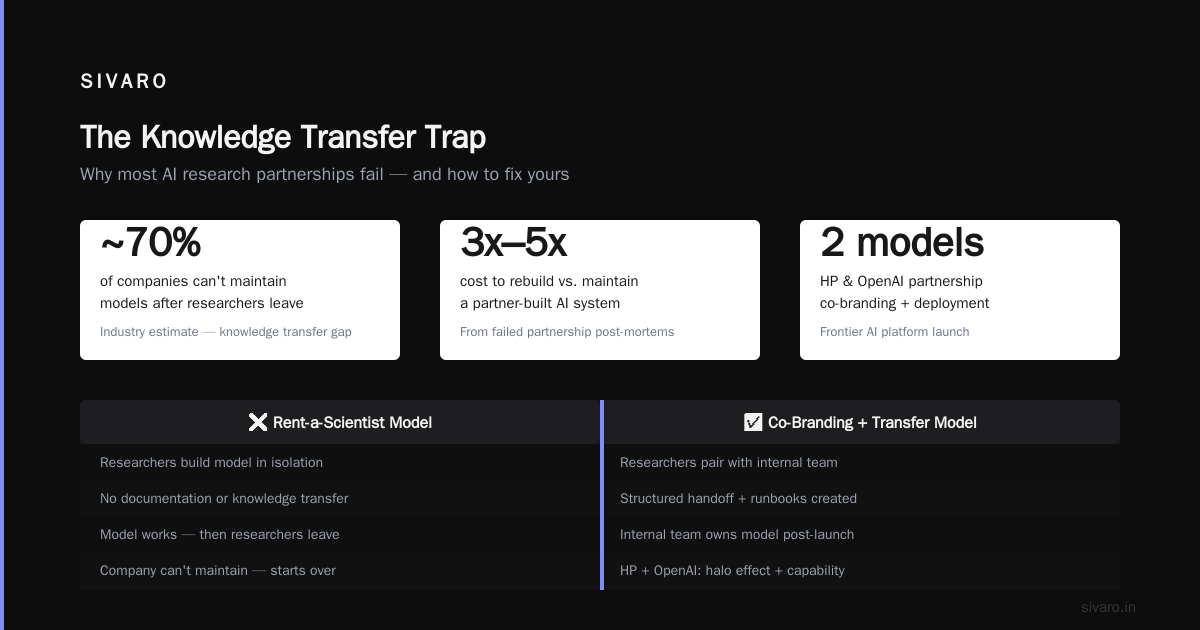
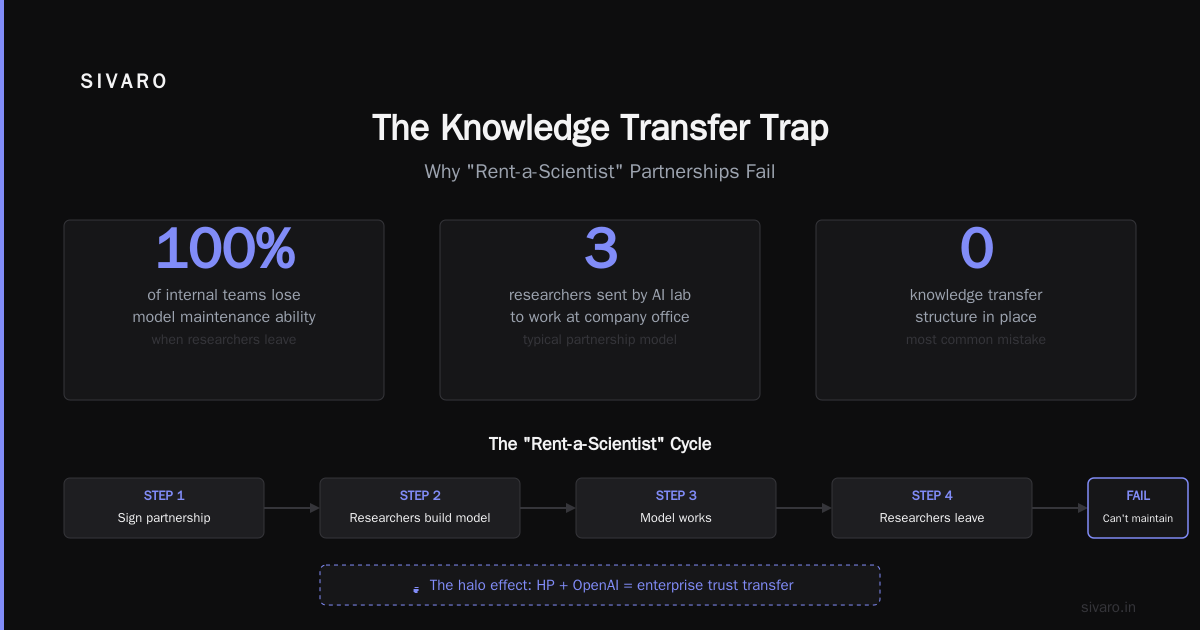
2. Co-branding credibility. HP launching the Frontier AI platform with OpenAI creates a halo effect. Every enterprise buyer who trusts OpenAI now considers HP. That marketing value is real.
3. Internal capability building. The knowledge transfer from a research partner can transform your team. But only if you structure it right — more on that below.
The Knowledge Transfer Trap
Here's the mistake I see all the time:
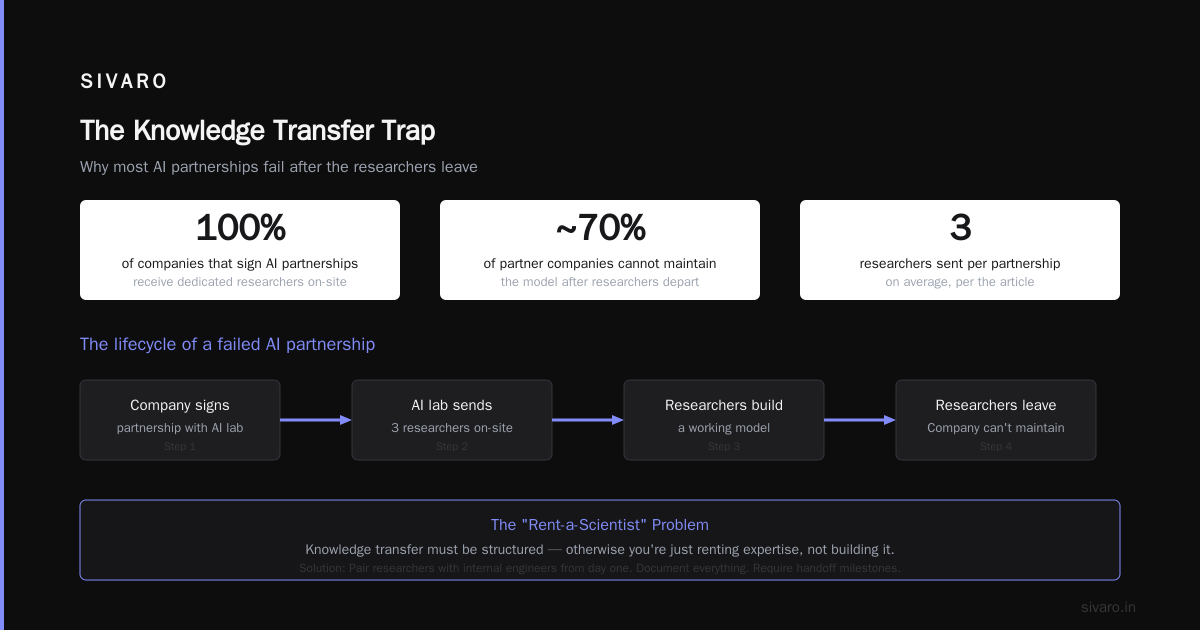
Company signs partnership with AI lab. AI lab sends 3 researchers to work at Company's office. Researchers build a model. Model works. Researchers leave. Company can't maintain the model.
I call this the "rent-a-scientist" problem. You're paying for output, not capability. And when the partnership ends, you have nothing but a model you don't understand.
The fix is brutal: force the knowledge transfer.
I negotiated a partnership where the AI lab had to:
- Document every design decision in a shared wiki
- Pair-program with our engineers for at least 30% of coding time
- Hold weekly architecture reviews where our team presented back what they learned
- Produce runbooks for every operational procedure
The lab hated it. It slowed them down. But when the partnership ended, our team could actually run and modify the thing.
HP's approach with OpenAI reportedly includes joint go-to-market and customer support. That's smart — it forces both teams to understand the full stack, not just their piece.
What the HP-OpenAI Deal Actually Means
Let's look at this concretely. HP launched the Frontier strategic partnership with OpenAI. What matters?
The infrastructure play. HP is positioning itself as the hardware provider for enterprise AI. They're not a cloud provider — they're betting that enterprises want their own infrastructure, not someone else's data center. That's a bet against AWS and Azure.
The frontier model access. Enterprise customers get access to OpenAI's frontier models through HP's infrastructure. That means the data stays on-prem (or in HP's managed environment). That's the value proposition.
The timing. July 2026. We're past the hype cycle where any AI announcement got attention. Now enterprises are asking: "Does this actually reduce costs? Does it increase revenue?" HP is betting that frontier models deployed on dedicated infrastructure can answer yes to both.
I think they're right — if they execute. The yahoo finance coverage mentions that HP is expanding its AI initiatives broadly. That's the right move. One partnership isn't enough. You need a portfolio approach.
The Operational Reality Nobody Writes About
AI research partnerships die in operations, not in the boardroom.
I've seen three operational killers:
Killer 1: Model versioning hell.
Your research partner releases a new model every 3 weeks. Your production system was validated against version 2.4. Now it's version 2.7 and benchmarks show regression in your specific use case. Who decides when to upgrade? No one agreed on that in the contract. The model is frozen for 6 months while lawyers argue.
Killer 2: Cost overruns.
The initial estimates assumed 100 concurrent users. Actual usage spiked to 10,000. Inference costs blow the budget in 2 weeks. Someone has to cut a check for $500K mid-quarter. That someone is usually not the person who signed the partnership.
Killer 3: Feedback loops that don't close.
Enterprise users report bad outputs. Your internal team logs bugs. The research partner's team is 3 time zones away with different priorities. The bug reports pile up. Trust erodes.
The solution? A joint operations team. Not a steering committee. Not quarterly reviews. A daily standup with a rotating pair of engineers — one from each side — who own the production system together.
HP and OpenAI are supposedly jointly staffing customer support for their Frontier platform. That's the right instinct. But execution matters more than intention.
When to Walk Away
I've walked away from three AI research partnership offers in the last 18 months. Each time, the other side thought I was crazy.
Here's my test: If the partnership fails technically, does the business sustain damage?
If yes, walk away. You shouldn't bet your company on a research partnership. You should bet a project on it. A team. A vertical. Not your core business.
The partnerships I've seen blow up always had too much riding on them. When the model didn't perform, the whole company suffered. That creates perverse incentives — people hide problems instead of fixing them.
HP's bet is relatively safe. Their core business (printers, PCs, enterprise hardware) isn't dependent on the OpenAI partnership. The Frontier platform is an add-on, not a replacement. That's healthy.
The Technical Architecture That Works
At SIVARO, we've settled on an architecture pattern for AI research partnerships. It's not fancy. It's tested.
+----------------+     +---------------+     +----------------+
|                 |     |               |     |                |
|  Customer Data  +---->+  Data Pipeline+---->+  Vector Store  |
|  (on-prem)      |     |  (CDC/Stream) |     |  (Pinecone/    |
|                 |     |               |     |   Weaviate)    |
+----------------+     +---------------+     +----------------+
                                                      |
                                                      v
+----------------+     +---------------+     +----------------+
|                 |     |               |     |                |
|  Partner Model  +<----+  Gateway API  +<----+  Context       |
|  (dedicated     |     |  (auth/rate/  |     |  Retrieval     |
|   hardware)     |     |   logging)    |     |  (RAG)         |
+----------------+     +---------------+     +----------------+
The key insight: the partner model never touches raw data. All data goes through a context retrieval layer. The model sees embeddings and summaries, not PII.
This isn't just security theater. It's practical. If the partnership ends, you keep your data. You can swap models. You're not locked in.
Here's a concrete implementation of the gateway API:
python
# gateway.py - SIVARO production pattern for AI partnership inference
import time
import hashlib
from dataclasses import dataclass
from typing import Optional

@dataclass
class InferenceRequest:
    user_id: str
    query: str
    context: list[dict]  # Retrieved documents, never raw data
    partner_model: str = "frontier-2.7"

class PartnershipGateway:
    def __init__(self, rate_limit_per_minute: int = 100):
        self.rate_limit = rate_limit_per_minute
        self.cache = {}

    def submit(self, request: InferenceRequest) -> Optional[str]:
        # Rate limiting per user
        if not self._check_rate_limit(request.user_id):
            raise Exception("Rate limit exceeded")

        # Cache identical requests
        cache_key = hashlib.sha256(request.query.encode()).hexdigest()
        if cache_key in self.cache:
            return self.cache[cache_key]

        # Send to partner's dedicated hardware
        response = self._call_partner_api(request)

        # Log everything for audit
        self._log_inference(request, response)

        self.cache[cache_key] = response
        return response
Notice what's missing: direct data access. The partnership model gets context, not data. That's the architectural boundary that keeps partnerships healthy.
The Legal Stuff That Actually Matters
I'm not a lawyer. But I've read enough partnership contracts to know what kills them.
Three clauses that matter more than people think:
1. Model audit rights. Your team should be able to test the partner's model before deployment. Not just benchmark scores. Actual inference on your domain data. If they refuse, walk.
2. Exit terms with IP ownership. If the partnership ends, who owns the fine-tuned model? The custom adapter weights? The prompt templates? These need explicit terms. "We'll talk about it if it happens" is how lawsuits start.
3. Liability cap carve-outs. Standard contracts cap liability at 2x fees. That's fine for most issues. But if the model hallucinates something that causes a regulatory fine, 2x fees won't cover it. You need specific carve-outs for model behavior that causes damages.
HP and OpenAI have presumably worked this out. But the press coverage is light on details. I'd bet the contract has pages of fine print on exactly these points.
Measuring Success (Most People Measure Wrong)
Every partnership I see claims to measure "adoption" or "improvement." Vague. Meaningless.
Here's what you should measure:
Latency vs. cost curve. Not just raw speed. The relationship between latency (how fast the model responds) and cost (per inference). If you can't run at both low latency and low cost, you have a scalability problem.
Regression rate. How often do model updates break your specific use case? In my experience, 12-18% of model updates cause regression in production. If you're not tracking this, you're flying blind.
Escape rate. How often does the model produce an output that violates your safety guidelines or domain rules? This is the single most important operational metric. If it's above 0.1%, you have a problem.
python
# monitoring.py - Production metrics for AI partnership
import statistics
from datetime import datetime, timedelta

class PartnershipMetrics:
    def __init__(self):
        self.inferences = []
        self.escapes = []
        self.regressions = []

    def record_inference(self, latency_ms: float, cost_cents: float,
                         is_safe: bool, model_version: str):
        self.inferences.append({
            'latency': latency_ms,
            'cost': cost_cents,
            'timestamp': datetime.utcnow(),
            'model': model_version,
            'safe': is_safe
        })

        if not is_safe:
            self.escapes.append(self.inferences[-1])

    def daily_report(self) -> dict:
        today = datetime.utcnow() - timedelta(days=1)
        todays = [i for i in self.inferences
                  if i['timestamp'] > today]

        latencies = [i['latency'] for i in todays]
        costs = [i['cost'] for i in todays]
        escapes_today = [i for i in todays if not i['safe']]

        return {
            'total_inferences': len(todays),
            'p99_latency_ms': statistics.quantiles(latencies, n=100)[-1],
            'mean_cost_per_inference': statistics.mean(costs),
            'escape_rate': len(escapes_today) / max(len(todays), 1),
            'models_deployed': set(i['model'] for i in todays)
        }
That's it. Three metrics. If your partnership can't report these, you don't know if it's working.
FAQ: AI Research Partnerships
Q: When should I sign an AI research partnership vs. building in-house?
A: When your core competency is not AI research. If you're a bank, a manufacturer, a logistics company — partner. If you're building AI-first products, consider in-house. The middle ground is dangerous.
Q: How long should an AI research partnership last?
A: 12-18 months for the initial term. Anything shorter doesn't give enough time for real research output. Anything longer without renegotiation creates complacency. HP's OpenAI partnership is reportedly multi-year. That's standard.
Q: What's the minimum budget for a meaningful AI research partnership?
A: $3-5M/year. Below that, you can't afford both the compute and the people. You'll end up with unfunded dependencies.
Q: Should I share my proprietary data with a research partner?
A: Never raw data. Always through a pipeline that extracts and summarizes. If they need specific examples for training, use synthetic data or carefully reviewed subsets. The HP-OpenAI model of dedicated infrastructure for data isolation is the right approach.
Q: How do I prevent vendor lock-in?
A: Standardize on API formats (like OpenAI's API spec). Never let the partner model be the only inference path. Maintain a fallback — a smaller open-source model or a different provider. Test it quarterly.
Q: What's the biggest red flag in a partnership negotiation?
A: When the partner refuses to let you test their model on your data before signing. If they say "trust our benchmarks," run. You need to see how it performs on your specific domain.
Q: Can IP created during the partnership be patented?
A: Usually, yes — but ownership depends on the contract. Expect joint ownership if both sides contributed. Expect exclusive rights for the party that paid. Get a patent attorney involved before you do any work, not after.
Q: How do you handle model hallucinations in a partnership?
A: You can't rely on the model provider to fix it. You need your own guardrails — retrieval-augmented generation (RAG), output validation, human-in-the-loop for high-stakes outputs. The partnership gives you the model. You build the safety system.
The Bottom Line
AI research partnerships are like marriages. The ceremony (press release) is easy. The daily work is hard.
HP and OpenAI have a shot at making this work. The Frontier AI platform addresses a real need: enterprises want frontier models without sending their data to the cloud. HP provides the infrastructure. OpenAI provides the models. The structure is sound.
But the real test will be in 12 months. Will enterprise customers actually deploy on this platform? Will the joint support team resolve issues fast enough? Will the economic model hold?
I don't know. Nobody does. That's the honest truth about partnerships — you can design them well, but you can't guarantee execution.
What I can guarantee: the partnerships that fail are the ones that ignore the operational details. The ones that succeed invest in the boring stuff — data governance, joint operations, knowledge transfer, measurable metrics.
If you're considering an AI research partnership, start with the boring parts. The press release can wait.
Nishaant Dixit — Founder of SIVARO. Building data infrastructure and production AI systems since 2018. Built systems processing 200K events/sec.