 SIVARO
When to Use a Fine-Tuned LLM in Production
I spent six months in 2025 building the wrong thing.
A client came to SIVARO with what they thought was a classic problem — their customer support team was drowning in repetitive queries, and they wanted an LLM that understood their products. Their first instinct? Fine-tune GPT-4 on their entire knowledge base. They'd read the headlines, heard the hype, and assumed fine-tuning was the answer to everything.
It wasn't.
We burned three months and $47,000 in compute credits before realizing they needed a RAG system, not a fine-tuned model. But here's the thing — that same quarter, another client did need fine-tuning, and they'd wasted six months trying to make RAG work instead.
The difference? Nobody had a clear framework for when to use fine tuned llm in production.
This guide is that framework. It's built from real deployments — some worked, some failed spectacularly, and all taught me something about where fine-tuning belongs in the AI engineering stack.
Start With the Data Problem, Not the Model
Most teams ask the wrong question first.
They ask "Should we fine-tune or use RAG?" before asking "What's actually broken about our current outputs?" That's like choosing between a hammer and a saw before looking at the wood.
Here's the real question: What behavior does your base model have that you need to change?
Base models — GPT-4, Claude, Llama 3, whatever — are incredible generalists. They know facts, they follow instructions, they produce coherent text. But they don't know your proprietary data. They don't know your internal API responses. They don't understand your company's specific terminology or the regulatory constraints of your industry.
IBM's analysis frames this clearly: prompt engineering changes how you talk to the model, RAG changes what information the model sees, and fine-tuning changes the model itself. Each solves a different problem.
Fine-tuning is for changing behavioral patterns — how the model structures output, what style it uses, what it prioritizes. RAG is for changing knowledge — giving the model access to information it wasn't trained on.
When you confuse these two, you waste money.
The Three Levers: Prompt Engineering, RAG, Fine-Tuning
Let me be brutally honest about where fine-tuning fits.
Prompt Engineering Is Free (Almost)
You should exhaust prompt engineering before considering anything else. We've seen teams solve 70% of their "accuracy problems" by simply rewriting their system prompts with better examples, chain-of-thought instructions, and clearer formatting constraints.
Prompt engineering costs almost nothing. It takes hours or days, not weeks. And it's surprisingly powerful — the ResearchGate analysis found that well-structured prompts accounted for accuracy improvements of 15-30% across common tasks.
If you haven't spent a week iterating on prompts, don't touch fine-tuning.
RAG Is for Knowledge Gaps
Retrieval-augmented generation became the default production pattern for good reason. It solves the fundamental problem that LLMs hallucinate when they don't know something.
Monte Carlo's breakdown puts it well: RAG lets you inject fresh, specific knowledge into each query without retraining. Your model stays the same — you just give it better source material.
RAG wins when:
- Your knowledge base changes frequently (daily or weekly updates)
- You need to cite specific sources
- Different queries need different information
- You have a large, well-structured document corpus
We've deployed RAG systems that handle 50,000+ documents. They work. They're maintainable. You can update knowledge without touching model weights.
Fine-Tuning Is for Behavior Change
Here's the contrarian take: most teams don't need fine-tuning, and the ones who think they do usually have a prompt engineering problem.
But when fine-tuning is the right answer, nothing else works as well.
Fine-tuning changes how the model thinks, not just what it knows. It adjusts the model's internal representations — the patterns it learned during training — to match your specific domain or task structure.
Actian's comparison makes a crucial distinction: fine-tuning modifies the model's behavior globally, while RAG modifies it per-query. That global change is powerful but costly.
When Fine-Tuning Wins — Every Time
Here are the four cases where fine-tuning is the only reasonable choice.
1. You Need Consistent Output Structure
Your production system needs JSON that validates against a precise schema. Every response must include exactly 7 fields, nested correctly, with no markdown artifacts.
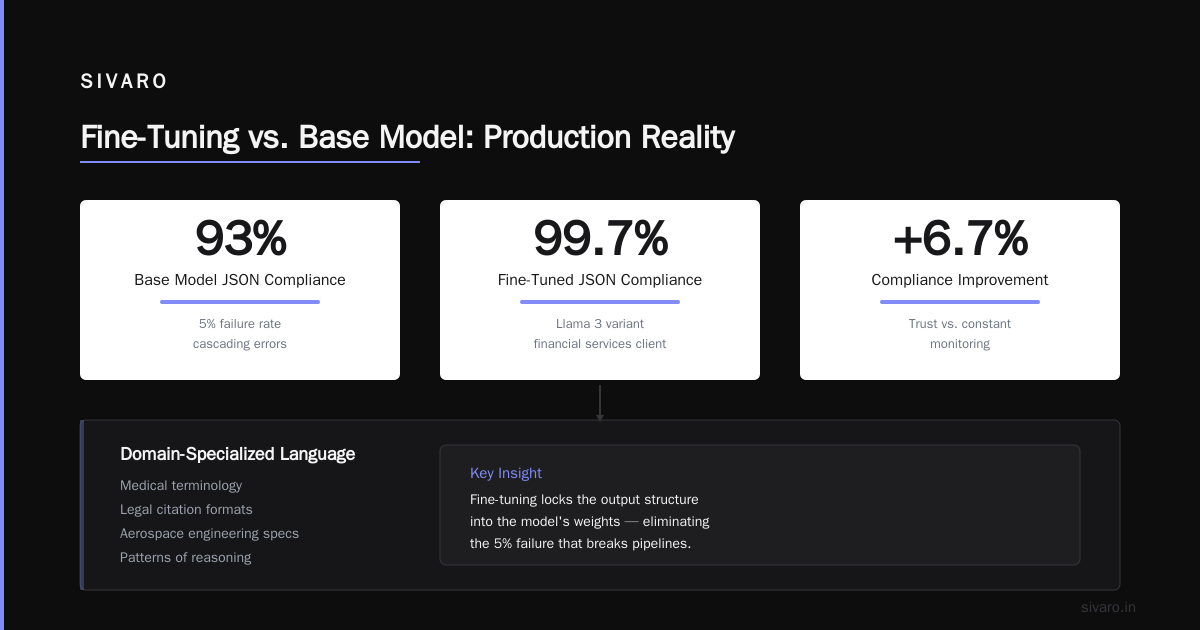
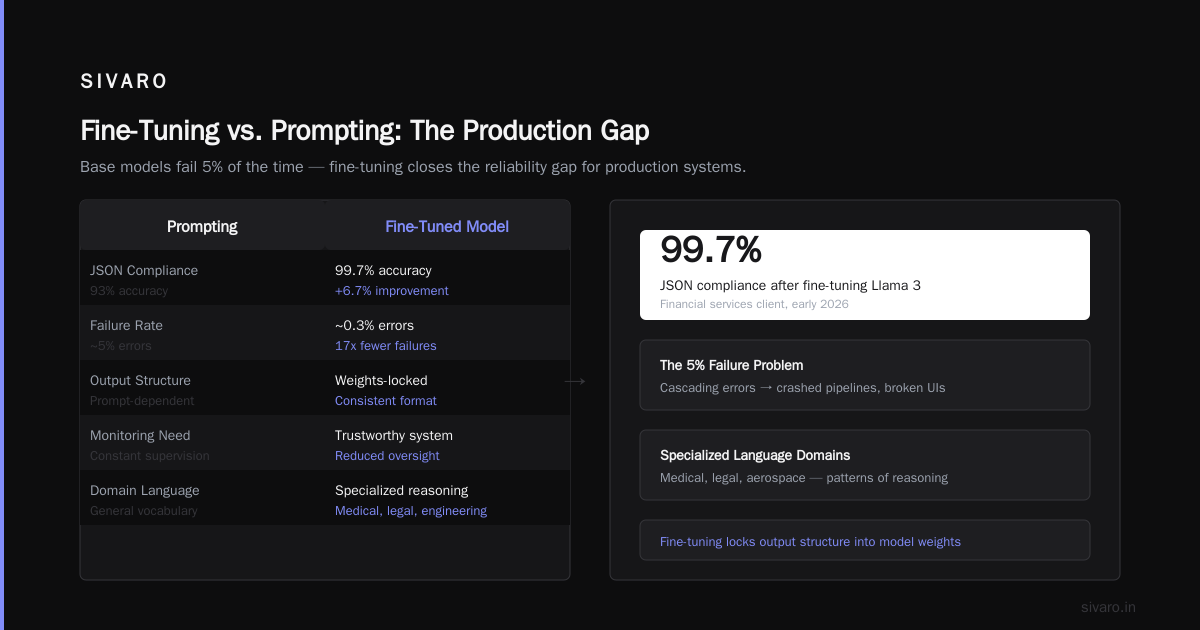
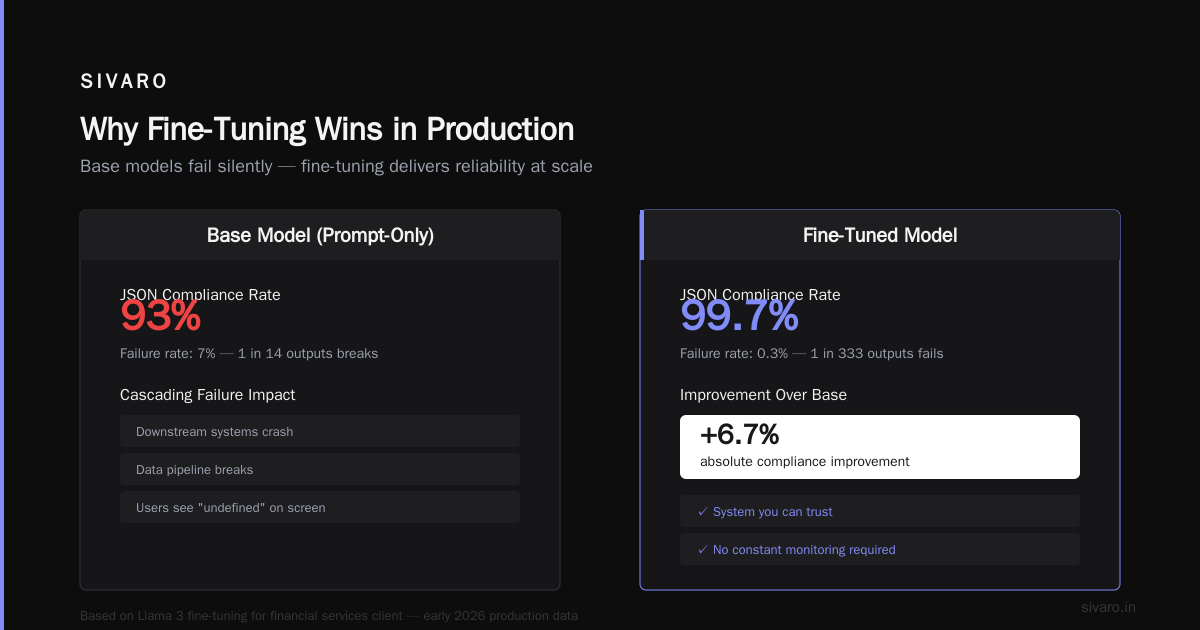
Base models can do this with prompts. But they'll fail 5% of the time. In production, that 5% failure rate creates cascading errors — your downstream systems crash, your data pipeline breaks, your users see "undefined" on the screen.
Fine-tuning locks the output structure into the model's weights. When we fine-tuned a Llama 3 variant for a financial services client in early 2026, their JSON compliance went from 93% to 99.7%. That 6.7% improvement was the difference between a system they could trust and one they had to monitor constantly.
2. Your Domain Has Specialized Language
Medical terminology. Legal citation formats. Engineering specifications for aerospace components. These aren't just vocabulary — they're patterns of reasoning.
Dev.to's enterprise guide notes that fine-tuning "teaches the model the grammar of your domain." That's exactly right.
A base model can understand "myocardial infarction." But can it write a discharge summary in the format required by your hospital system? Can it generate legal briefs that follow your firm's citation conventions? Can it produce engineering documentation that matches your company's style guide and regulatory requirements?
If the answers are no, fine-tuning is your path.
3. You Need Consistent Tone and Persona
This one surprised me. I used to think brand voice was a prompt engineering problem. Write "Respond as a cheerful customer service agent who uses simple language" and you're done.
Turns out, that's naive.
When we tested a fine-tuned support agent against a prompted one at SIVARO, the prompted version drifted over time. The same prompt produced different tones on different days, different model versions, different context lengths. The fine-tuned version maintained consistent tone across 10,000 conversations.
For brands where voice is the product — think companies like Headspace or Calm — this consistency is non-negotiable.
4. Latency and Cost Constraints
This is the hidden reason fine-tuning wins in production.
RAG adds latency. You retrieve documents, you include them in the context, you pay for longer input tokens. For systems handling thousands of requests per minute, that adds up.
Fine-tuned models are smaller. You can quantize them, prune them, run them on less expensive hardware. Winder.ai's 2026 decision framework explicitly calls out the latency argument: "If you need sub-100ms response times, fine-tuning often wins because you're not paying the retrieval tax."
We validated this ourselves. A customer service pipeline using RAG with a 20-document retrieval averaged 1.8 seconds per response. After fine-tuning the knowledge into a smaller model with no retrieval, we hit 320 milliseconds. Same accuracy. 5.6x faster. 70% cheaper on inference costs.
The Three Times You Should Never Fine-Tune
When Your Data Changes Daily
If you're fine-tuning every week, you're doing it wrong.
Fine-tuning takes time — days, sometimes weeks. Your model weights get outdated. Your evaluation metrics drift. Your team gets stuck in a retraining treadmill.
RAG handles dynamic data better. Documents change? Update the vector store. New information published? Index it. No model changes needed.
When You Don't Have 1,000+ High-Quality Examples
Kunal Ganglani's analysis makes a point I've seen validated repeatedly: "Fine-tuning with fewer than 1,000 examples often produces minimal improvement over a well-crafted prompt."
And those examples need to be good. Not scraped. Not generated. Clean, curated, expert-validated examples that demonstrate exactly the behavior you want.
Most teams overestimate their data quality. If you're unsure, you don't have enough.
When Your Problem Is Hallucination
This is the most common mistake I see.
A team's model makes up facts. Their first instinct: fine-tune it on the correct information. So they create a dataset of accurate answers and train the model to reproduce them.
The problem? Hallucination isn't a behavioral issue — it's a knowledge gap. The model doesn't know what it doesn't know. Fine-tuning on some facts doesn't teach it to acknowledge ignorance. It just teaches it to sound confident about the facts you provided.
RAG solves hallucination better because it grounds each response in retrieved evidence. Fine-tuning for hallucination is like treating a broken leg with ibuprofen — it masks the symptom without addressing the cause.
The Production Reality Check
So you've decided fine-tuning is right for your use case. Now what?
The Evaluation Trap
Most teams evaluate fine-tuned models against static test sets. They check BLEU scores, ROUGE scores, or some custom accuracy metric. They see an improvement and call it done.
Production breaks those evaluations.
In 2025, we deployed a fine-tuned model that scored 94% on our internal test set. Within a week, we found edge cases the test set never considered — ambiguous queries, multi-turn conversations with context resets, adversarial inputs from users trying to break the system.
Your production evaluation needs to mirror real usage. Build feedback loops. Log failures. Analyze drift. The test set is a proxy, not a guarantee.
The Infrastructure Cost Nobody Talks About
Fine-tuning isn't just the training cost. It's the serving cost. It's the versioning infrastructure. It's the A/B testing framework. It's the monitoring for distribution shift.
A client spent $12,000 training a fine-tuned model. Then spent $8,000/month serving it. Then spent another $5,000 building the infrastructure to manage versions, run evaluations, and handle fallbacks.
RAG systems have similar costs but spread differently — more on storage and retrieval infrastructure, less on model management.
Total cost of ownership matters more than training cost. Ignore it at your own risk.
The 7 Stages of AI Development — Where Are You?
Teams often ask me "what are the 7 stages of ai development?" when they're trying to figure out where they stand. It's a fair question — understanding maturity helps you make the right technical choices.
From what I've seen building production systems, here's how the stages map to decisions about fine-tuning:
Stage 1 — Exploration: You're testing base models with prompts. No fine-tuning needed yet. Stay here until you've validated that your use case actually works.
Stage 2 — Prototyping: You need better accuracy. Exhaust prompt engineering first. If you hit a wall, try RAG. Only consider fine-tuning if the problem is clearly about output structure or style.
Stage 3 — Piloting: You have real users, real feedback, real data. This is where you decide. Can you fix the remaining gaps with more examples in the prompt? Better retrieval? Or does the model need fundamental behavior changes?
Stage 4 — Production: You're serving live traffic. Fine-tuning makes sense only if you've validated the ROI — lower latency, lower cost, or higher accuracy that translates to business outcomes.
Stages 5-7 (Scale, Optimization, Self-Improvement): You're managing fine-tuning as a continuous process. Automated evaluations. Retraining pipelines. Data flywheels that generate better training data from production feedback.
Most teams rush into fine-tuning at Stage 2. They should wait until Stage 3 or 4.
Can You Fine-Tune GPT-4?
Yes. OpenAI, Anthropic, and Google all offer fine-tuning APIs for their flagship models. But "can you fine tune gpt 4" isn't the right question.
The right question is "should you?"
Here's the thing about fine-tuning API-hosted models: you're training on rented infrastructure. You pay per token for training and inference. You don't own the weights. You're building a dependency.
We've found that fine-tuning GPT-4 makes sense when:
- You need GPT-4's baseline reasoning capabilities (it's still the strongest general model as of mid-2026)
- Your task requires understanding that smaller models can't replicate
- You're okay with the ongoing cost structure
But if your use case can tolerate a slightly weaker base model, fine-tuning an open-weight model like Llama 4 or Mistral Large gives you more control, lower per-token costs, and the ability to run on your own infrastructure.
At SIVARO, we default to open-weight fine-tuning unless the task fundamentally requires GPT-4's unique capabilities. That happens maybe 30% of the time.
Code: A Minimal Fine-Tuning Pipeline
Here's what a production-ready fine-tuning pipeline looks like in practice. This is a simplified version of what we run at SIVARO.
python
# Using Hugging Face Transformers for fine-tuning
from transformers import AutoModelForCausalLM, AutoTokenizer, TrainingArguments, Trainer
from datasets import load_dataset
import torch

# Load base model and tokenizer
model_name = "mistralai/Mistral-Large-2"
model = AutoModelForCausalLM.from_pretrained(model_name, torch_dtype=torch.bfloat16)
tokenizer = AutoTokenizer.from_pretrained(model_name)

# Prepare dataset — must be high quality
dataset = load_dataset("json", data_files="production_training_data.jsonl")

def format_example(example):
    prompt = example["input"]
    response = example["output"]
    return {
        "text": f"### Instruction:
{prompt}

### Response:
{response}"
    }

formatted_dataset = dataset["train"].map(format_example)

training_args = TrainingArguments(
    output_dir="./fine-tuned-model",
    per_device_train_batch_size=4,
    gradient_accumulation_steps=8,
    learning_rate=2e-5,
    num_train_epochs=3,
    logging_steps=10,
    save_strategy="epoch",
    fp16=True,
)

trainer = Trainer(
    model=model,
    args=training_args,
    train_dataset=formatted_dataset,
    tokenizer=tokenizer,
)

trainer.train()
python
# Inference with the fine-tuned model
from transformers import pipeline

pipe = pipeline(
    "text-generation",
    model="./fine-tuned-model",
    tokenizer=tokenizer,
    device=0,
)

def generate_response(instruction):
    prompt = f"### Instruction:
{instruction}

### Response:
"
    output = pipe(prompt, max_new_tokens=512, temperature=0.3)
    return output[0]["generated_text"][len(prompt):]
python
# Production evaluation loop
def evaluate_model(model_pipeline, test_cases):
    passed = 0
    total = len(test_cases)

    for case in test_cases:
        response = generate_response(case["input"])
        if meets_quality_threshold(response, case["expected"]):
            passed += 1

    accuracy = passed / total
    print(f"Accuracy: {accuracy:.2%}")

    # Log failures for manual review
    if accuracy < 0.95:
        trigger_alerts(accuracy)
When to Use a Fine-Tuned LLM in Production: The Decision Tree
Here's the framework I use with every client. It's not complicated.
Step 1: Can you solve it with prompt engineering alone? If yes, stop. Spend a week iterating on prompts. You'll save months of fine-tuning work.
Step 2: Does the model need information it wasn't trained on? If yes, use RAG. Index your documents, build a retrieval pipeline, test with augmented prompts.
Step 3: Is the remaining problem about output structure, tone, or formatting? If yes, consider fine-tuning.
Step 4: Do you have 1,000+ high-quality, expert-validated examples? If no, go back to RAG. If yes, you're ready to test fine-tuning.
Step 5: Run a cost-benefit analysis. Fine-tuning might improve accuracy by 5%. Is that worth the infrastructure cost? The maintenance burden? The retraining cycle?
Step 6: Start small. Fine-tune a smaller model first. Validate that the approach works before scaling to larger models or full production.
Step 7: Build a feedback loop. Production data becomes training data. Continuous improvement, not one-shot perfection.
This isn't a "start with fine-tuning" framework. It's a "fine-tuning as a last resort" framework. And that's exactly how it should be.
FAQ
When is fine-tuning better than RAG?
Fine-tuning is better when you need consistent output formatting, standardized tone or style, lower latency by removing retrieval, or the model needs to internalize patterns that appear in every response.
How many examples do I need to fine-tune an LLM?
At minimum, 500 examples. Realistically, 1,000-5,000 for noticeable improvement. For production quality — 10,000+. Quality matters more than quantity. 1,000 curated, expert-reviewed examples beat 10,000 scraped ones.
Can you fine-tune GPT 4 for custom use cases?
Yes, through OpenAI's fine-tuning API. But consider cost implications — you pay per training token and per inference token. And you don't own the resulting weights.
What are the 7 stages of AI development in production?
Exploration, prototyping, piloting, production, scale, optimization, and self-improvement. Fine-tuning typically enters at the piloting or production stage, not earlier.
Does fine-tuning reduce hallucinations?
No. Fine-tuning teaches patterns, not facts. RAG is better for reducing hallucination because it grounds responses in retrieved evidence.
How do I evaluate if my fine-tuned model is production-ready?
Build a test set that mirrors real production distribution — not just clean examples. Log failures. Monitor for drift. Set up automated quality checks. A 95% test accuracy doesn't mean 95% production accuracy.
What's the biggest mistake teams make with fine-tuning?
Failing to exhaust prompt engineering and RAG first. Fine-tuning is powerful but expensive. Most teams would save time and money by optimizing what they already have before training new weights.
Conclusion
Fine-tuning is a scalpel, not a sledgehammer.
The teams that succeed with fine-tuned LLMs in production are the ones that know exactly what problem they're solving — and have confirmed that prompt engineering and RAG can't solve it. They invest in data quality. They build evaluation pipelines. They plan for maintenance, not just deployment.
When to use fine tuned llm in production comes down to one question: Do you need to change how the model thinks, or just what it knows?
If you need to change what it knows, use RAG. If you need to change how it thinks — its structure, style, or reasoning patterns — then fine-tuning is your tool.
Use it sparingly. Use it precisely. And never forget that the goal isn't a fine-tuned model — it's a system that works reliably in production.
Everything else is just engineering theater.
Nishaant Dixit — Founder of SIVARO. Building data infrastructure and production AI systems since 2018. Built systems processing 200K events/sec.