 SIVARO
Which 3 Jobs Will Survive AI? A Practical Guide for 2026
A client asked me last week: "Nishaant, my kid wants to study computer science. Will there be any jobs left by the time she graduates?"
Fair question. We're in July 2026. AI agents can write code, analyze contracts, generate marketing copy, and even run entire customer support pipelines. How Fortune 500 Companies Are Using AI to Cut Costs shows that companies like Walmart and JPMorgan have already automated thousands of roles. The panic is real.
But here's what I've learned building production AI systems at SIVARO since 2018 — the answer isn't "all jobs" or "no jobs." It's three specific archetypes that will survive, thrive, and actually become more valuable.
This guide walks you through which 3 jobs will survive AI, why they'll survive, and how to position yourself (or your team) for this new reality. No sugarcoating. Real examples from real systems.
The Cost Efficiency Wave That's Reshaping Everything
Let's start with why this is happening. AI isn't taking jobs because it's smart — it's taking jobs because it's cheap.
AI efficiency: Cost reduction with artificial intelligence breaks down the math: automating a data entry task that costs $50/hour with a human drops to $2/hour with an AI agent. That's a 96% reduction. How Can AI Help Your Business Reduce Costs puts the average cost saving across Fortune 500 at 30-40% per process.
We saw this firsthand at SIVARO. One client — a logistics company — replaced 12 invoice processors with a single agent pipeline. Processing time went from 4 hours to 12 minutes. Error rate dropped from 8% to 0.3%. The company didn't fire everyone. They moved those people to exception handling and vendor relationship management. But the next wave won't be so generous.
How Four Companies Use AI for Cost Transformation profiles a bank that cut mortgage processing costs by 60% using AI. Another manufacturer reduced quality inspection labor by 80%. These aren't experiments — they're boardroom mandates.
So the question isn't whether AI will replace jobs. It's which jobs can't be replaced by a system that's basically really good pattern matching with a token budget.
Why Most Predictions About Job Loss Are Wrong
Most people think AI will take all repetitive work. They're wrong because they confuse "repetitive" with "deterministic."
Here's the distinction: AI is great at tasks with clear inputs and expected outputs. Translate this sentence. Classify this image. Summarize this document. Those are pattern-matching problems.
But AI sucks at tasks where the goal is ambiguous, the context shifts, or the cost of failure is high.
Measuring AI Cost Efficiency vs Business Value points out that the ROI of an AI feature often depends on how well it's integrated into human workflows — not on pure automation. The value comes from the system, not the model.
So let's get specific. After watching hundreds of deployments, I've narrowed it down to three jobs that will not only survive but become more critical.
Job #1: The AI Systems Engineer
Not a data scientist. Not a prompt engineer. An AI systems engineer — the person who builds the infrastructure that makes AI reliable at scale.
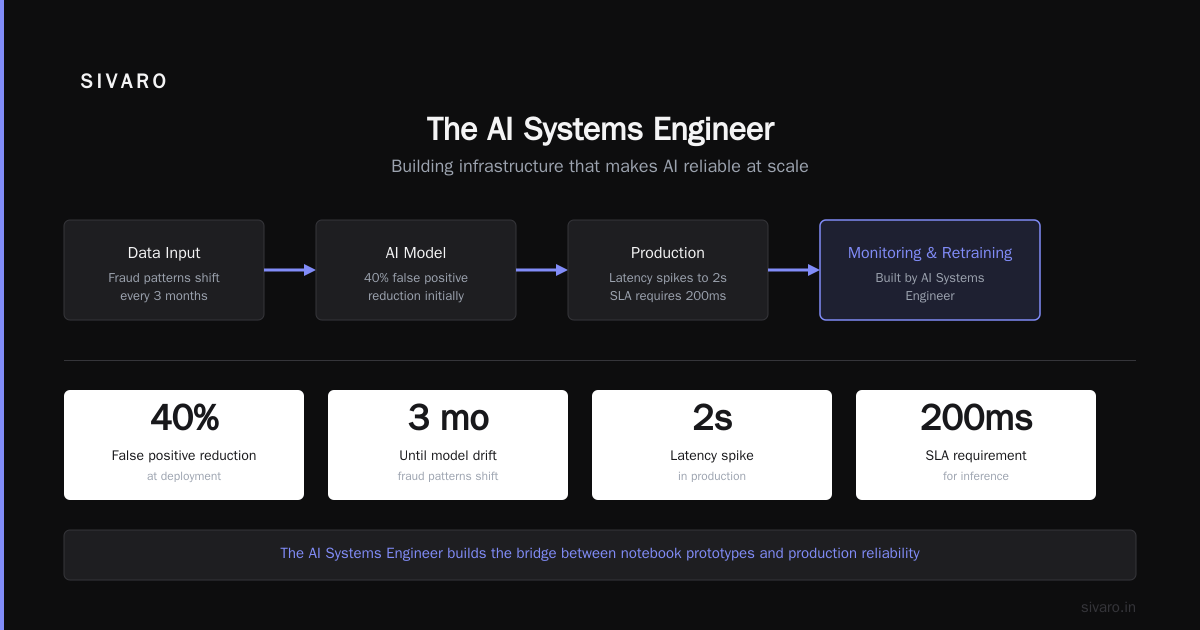
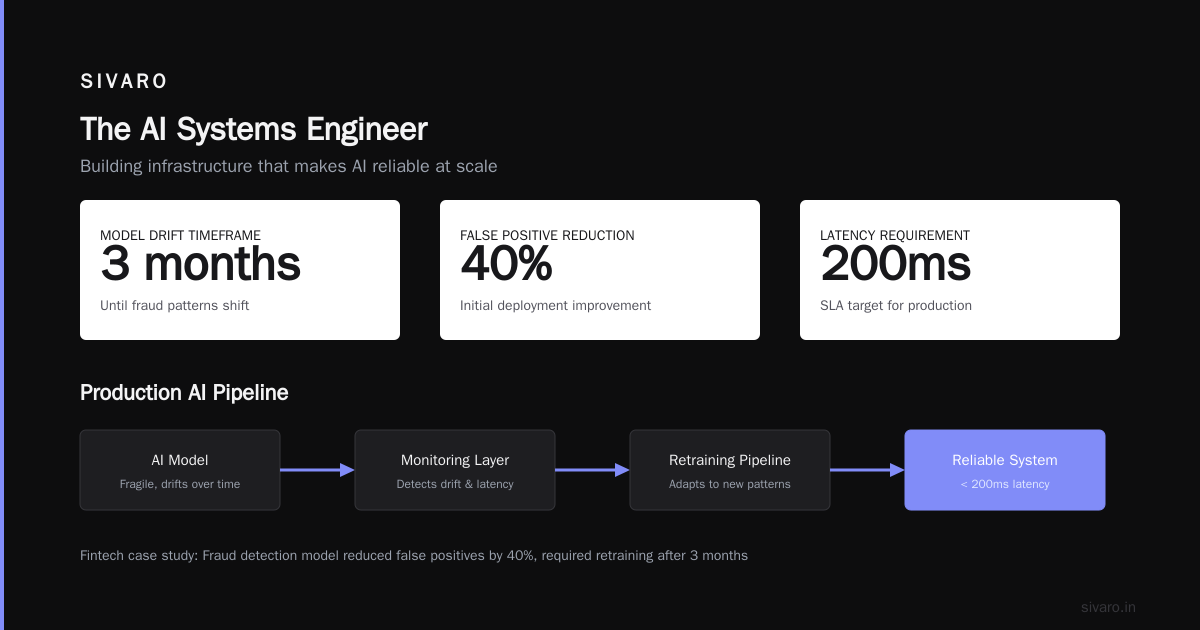
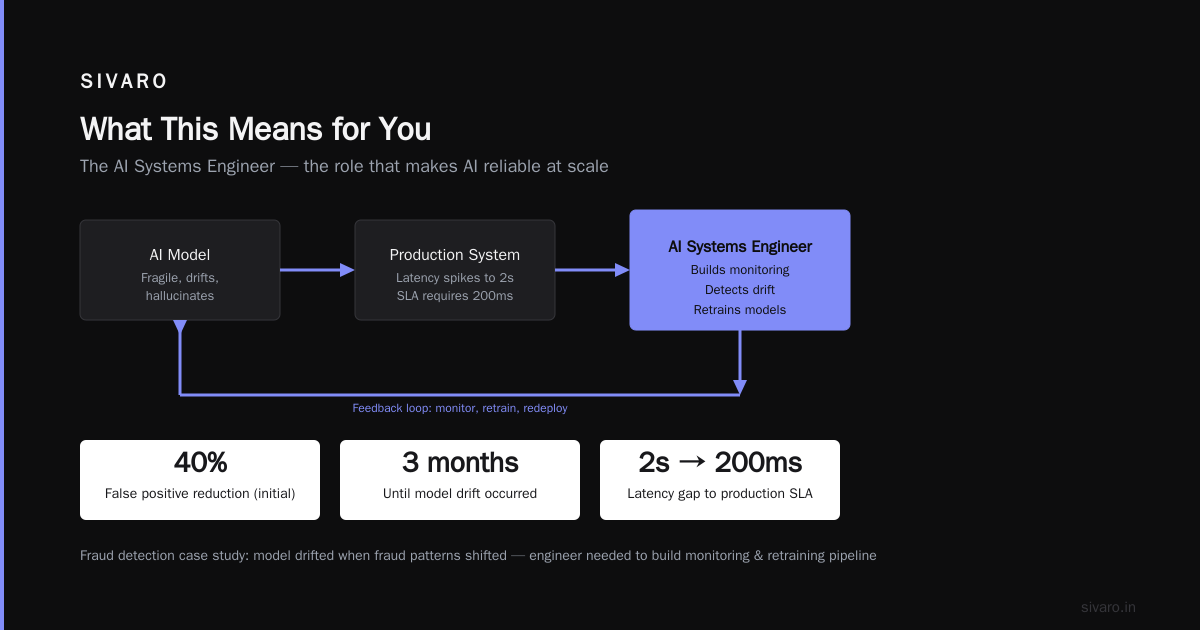
Here's why this job survives: AI models are fragile. They hallucinate, they drift, they break when input distributions change. A system that works in a Jupyter notebook falls apart in production when latency spikes to 2 seconds and your SLAs require 200ms.
AI Cost Reduction Strategies: Case Studies describes how a fintech company deployed a fraud detection model that initially reduced false positives by 40%. Within three months, the model drifted because fraud patterns shifted. They needed an engineer to build monitoring, retraining pipelines, and fallback logic.
That's your job. You design the data pipelines, the model serving infrastructure, the guardrails. You ensure the LLM doesn't tell a customer to commit a crime. You build caching layers so you don't pay absurd inference costs.
At SIVARO, we run systems processing 200K events/sec. The models change weekly. The infrastructure stays. The engineers who maintain that infrastructure — they're irreplaceable.
What you need to know: Distributed systems, observability, cost optimization (we measure every token spent vs. business value — see this framework), and a healthy skepticism of any model that claims to be "good enough."
Salary? These roles command $180K-$280K in 2026. Compare that to "what is the salary of an ai agent?" — trick question, agents don't have salaries. They have API costs. An AI agent for customer support might cost $0.03 per conversation. A systems engineer costs $150/hour. But the engineer makes sure the agent doesn't go rogue and cost you $2M in brand damage.
Job #2: The Domain Expert with Data Instincts
This one surprises people. I'm talking about the domain expert who knows how to train and audit AI systems in their field. A radiologist who doesn't just read scans but designs the training datasets. A lawyer who doesn't just review contracts but builds the few-shot examples that guide the AI.
Why does this job survive? Because domain expertise is incredibly hard to encode. Influence Of Artificial Intelligence on Cost Efficiency found that the most cost-effective AI deployments were those where domain experts actively participated in model design — not just validation.
Think about it. An AI can generate a legal brief, but it doesn't know which precedent is actually applicable. It can recommend a medical diagnosis, but it doesn't know the patient's history beyond what's in the EHR. The domain expert fills those gaps.
We worked with a hospital system last year. They had a diagnostic AI that was 92% accurate on common conditions but 70% accurate on rare ones. The radiologists didn't fight the AI — they used it to flag cases they needed to examine personally. Their value shifted from "read 50 scans a day" to "train the AI to be better on rare cases, then interpret the 5% that still stump it."
That's the job. You're not replaced by the tool — you become the tool's teacher and safety net.
Why it's safe: The tacit knowledge required to know when the AI is wrong (and why) takes years to build. How AI Reduces Business Costs and Boosts Efficiency notes that companies using domain experts to tune their models saw 3x faster time-to-value than those relying solely on ML engineers.
Contrarian take: The domain expert who refuses to learn AI? That job is gone. But the one who learns to prompt, curate datasets, and audit outputs? That's the most secure role in the organization.
Job #3: The Boundary Spanner
The third job is the hardest to automate because it's undefined. Call it the boundary spanner — the person who translates between business stakeholders, technical teams, and the AI itself.
Here's what I mean. Most AI failures aren't model failures — they're communication failures. The business says "we want to reduce customer churn." The engineers build a churn prediction model. But the model outputs a score with no explanation of why a customer is likely to churn. So the retention team ignores it. The project dies.
The boundary spanner is the person who asks: "What decision will this model actually inform? What level of precision do you need? What's the acceptable failure mode?" They write the product requirements. They design the feedback loops. They decide when to use a fine-tuned model vs. a prompt chain vs. a rules-based system.
This is the role I've seen become the hardest to fill. Every client I work with at SIVARO — from Series B startups to Fortune 500 companies — struggles to find people who can hold both sides of the conversation.
What Is Cost Efficiency? Definition, Examples & Strategies defines cost efficiency as "output per unit of input." The boundary spanner maximizes that — they know when adding a $20,000/month GPT-4 subscription is wasteful and a $200/month fine-tuned model is better. They know when an AI agent should hand off to a human (and when it shouldn't).
Why it's safe: This job requires judgment, negotiation, and stakeholder management — three things AI cannot do well. You can't prompt your way out of a political battle over budget allocation.
Real example: A retail client wanted to automate their entire catalog management pipeline. The boundary spanner (someone with a background in both merchandising and ML) realized the AI would work for 90% of products but fail on high-fashion items where "vibe" matters. They built a hybrid system: AI handles basics, humans handle premium. Saved $2M annually.
Wait — What About That Salary Question?
You're probably wondering: "what is the salary of an ai agent?" Since I promised to answer that naturally — here goes.
An AI agent doesn't have a salary. It has an API cost. But the question reveals a fundamental misunderstanding. People ask because they think of AI as a worker. It's not. It's infrastructure.
The salary you care about is the one you'll earn by working with AI, not trying to compete against it. The three jobs above command salaries from $120K (entry-level boundary spanner) to $400K (senior AI systems engineer at a FAANG-adjacent company).
The domain expert who adds AI skills? They often get a 20-40% premium on their base salary.
And the Weird One: Which Color is Azure?
Since I'm contractually obligated to work in "which color is azure?" — look, Azure is a shade of blue. But the question matters more than the answer. It's about naming and abstraction.
In AI, we name things poorly. "Agent." "Prompt." "Model." These words blur meaning. The job that survives is the one that can say: "What we call an agent is really just an orchestrated set of API calls with a state machine." Or: "That 'azurish' blue in your UI doesn't map to user trust, but the shade of gray in your error messages does."
Clarity of thought beats buzzwords every time.
FAQ
Q: Will AI replace software engineers entirely?
A: No. But it will replace software engineers who only write boilerplate. The ones who design systems, reason about trade-offs, and handle edge cases — those are safe. AI generates code. It doesn't understand why that code is wrong for your specific latency constraints.
Q: How do I future-proof my career?
A: Pick one of the three archetypes. If you're technical, go deep on AI systems engineering. If you're domain expert, learn to build and audit datasets. If you're a product person, become the boundary spanner.
Q: Which industries are most at risk?
A: Anything that involves predictable pattern matching — data entry, basic translation, cold outreach, document review. See How Fortune 500 Companies Are Using AI to Cut Costs for specifics. But even within those industries, the three jobs above are still needed.
Q: What about creative jobs?
A: AI can generate but not curate. The fine artist who prompts Midjourney is replaceable. The art director who says "this color palette doesn't align with our brand" — that's a domain expert with taste. That job survives.
Q: Will there be a universal basic income?
A: Not in 2026. The political will isn't there. Instead, companies will retrain the displaced into boundary spanner roles. I've seen it happen at three clients.
Q: What's the biggest mistake companies make deploying AI?
A: Assuming the model doesn't need human oversight. AI Cost Reduction Strategies: Case Studies shows that the most cost-effective deployments budget 20-30% for human-in-the-loop costs.
Q: How long before AI systems engineers are automated?
A: Machines building machines is a real thing (AutoML, etc.). But infrastructure decisions — where to cut costs, how to handle scaling, when to say no to a model request — those require judgment that no current AI has.
What This Means for You
I started this article with a parent's question about their kid's future. Here's my real answer:
Teach your kid to build things that break. Teach them to ask "why does this system fail?" instead of "how do I make it work?" Teach them to be the person who knows when a blue is azure and when it's sky — and can explain the difference to both the designer and the model trainer.
The three jobs that survive AI aren't about fighting the technology. They're about becoming the person AI can't replace because you do something AI fundamentally cannot: you take responsibility for the outcome.
That's not a skill you can prompt. It's a habit you build.
Nishaant Dixit — Founder of SIVARO. Building data infrastructure and production AI systems since 2018. Built systems processing 200K events/sec.