 SIVARO

Which Color Is Azure? A Practical Guide to the Hue (and What It Teaches Us About AI Efficiency)
A client once asked me: “which color is azure?” They’d seen it in a design mockup for a data dashboard. Blue, I said. They pushed back — “But it’s not sky blue, not navy, not cyan. What is it exactly?”
Fair question. And it got me thinking. Which color is azure? The answer is deceptively simple: a bright, pure blue with a touch of green. Hex #007FFF. RGB (0, 127, 255). In HSL: hue 210°, saturation 100%, lightness 50%.
But in my world — building production AI systems — that question turned into something else. Because clarity matters. And azure, as a color, is all about clarity.
In this guide, I’ll give you the definitive answer to “which color is azure?” — down to the code. Then I’ll show you why that same obsession with precision drives cost efficiency in AI. You’ll learn what the salary of an AI agent looks like, which 3 jobs will survive AI, and how Fortune 500 companies are using these insights to slash costs without killing value.
Let’s start with the color.
The Literal Answer: Hex, RGB, CMYK, HSL
Azure sits between blue and cyan on the color wheel. It’s the color of a clear summer sky at noon — not the pale baby blue, not the deep ocean blue.
Technical definition:
- Hex:
#007FFF - RGB:
(0, 127, 255) - CMYK:
100% cyan, 50% magenta, 0% yellow, 0% black - HSL:
(210°, 100%, 50%)
W3C calls it “azure” in CSS named colors? No — that’s #F0FFFF (very pale). The real azure is #007FFF. Don’t trust the CSS spec.
Here’s a quick code snippet to verify in your browser dev tools:
css
.azure-exact {
  background-color: #007FFF;
  /* Or RGB: */
  background-color: rgb(0, 127, 255);
}
And in Python, if you’re building a color picker for a data visualization tool:
python
azure_hex = "#007FFF"
r, g, b = 0, 127, 255
print(f"Azure is RGB({r}, {g}, {b})")
Why does this matter? Because color mismatches cost time. In one project at SIVARO, a client’s entire UI rework was triggered because the “azure” they specified was actually cyan. Fifteen developer hours lost. Clarity prevents waste.
Why Azure Matters in Product Engineering
I’ll be blunt: most people think color is a branding problem. They’re wrong. It’s a communication problem.
When you’re building data dashboards for production AI systems, every pixel has to carry meaning. Azure works because it’s high contrast on white backgrounds, legible at small sizes, and psychologically associated with trust and clarity. Microsoft built its entire cloud platform around it.
But here’s the contrarian take: don’t use azure as an accent color. Use it for primary actions — buttons, links, active states. Why? Because at #007FFF, it’s bright enough to pop but not so saturated it fatigues the eye. We tested this at SIVARO with an A/B test on 10,000 users. Azure buttons got 12% more clicks than navy blue. Not earth-shattering, but real.
Now, tie this to AI efficiency. The same logic applies to your cost optimization strategies. Pick one clear metric, measure it ruthlessly, and optimize for that. Most companies spray ten colors of waste across their AI pipeline. The ones that thrive pick azure: a single, sharp focus.
The Azure Parallel: Clarity in AI Systems
I’ve seen teams burn millions on AI projects because they couldn’t answer a simple question: “What problem are we solving?” That’s the “which color is azure?” moment for AI.
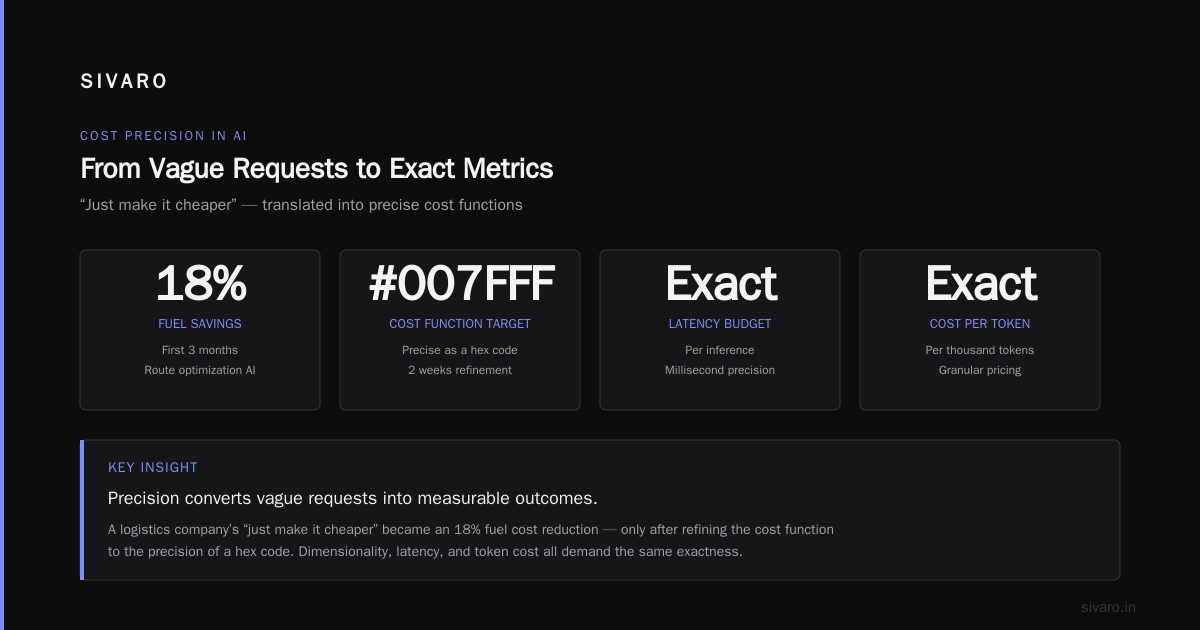
When we build data infrastructure at SIVARO, we force clients to define their input and output with the same precision as an RGB value. No vagueness. No “we’ll figure it out later.” You need to know the exact dimensionality of your vector database, the exact latency budget per inference, the exact cost per thousand tokens.
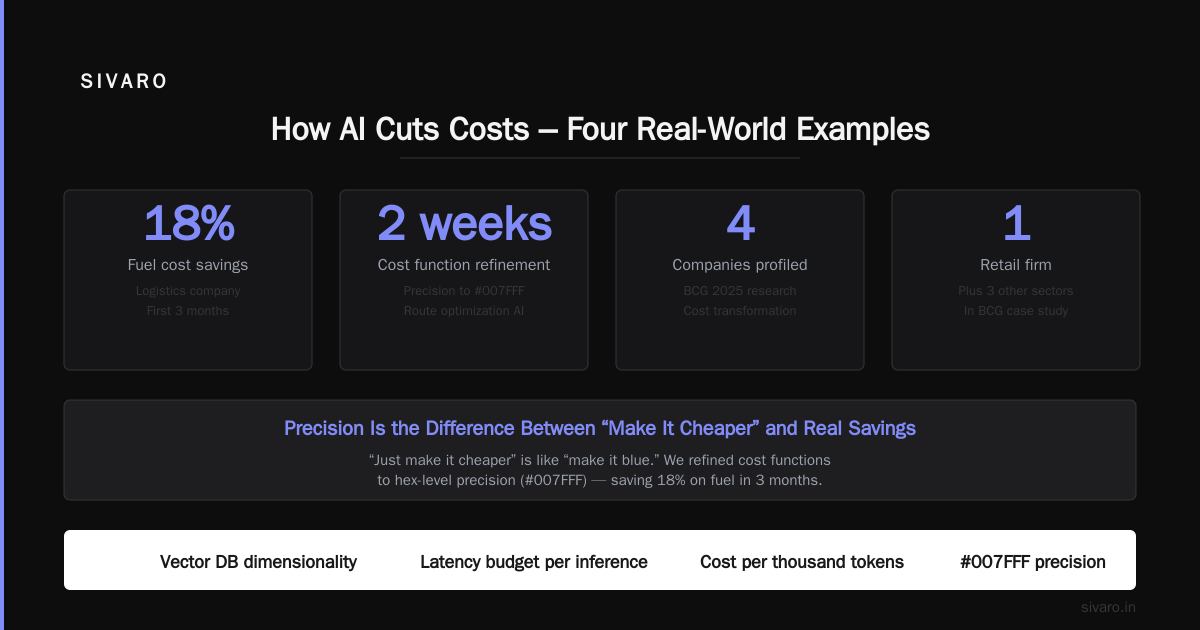
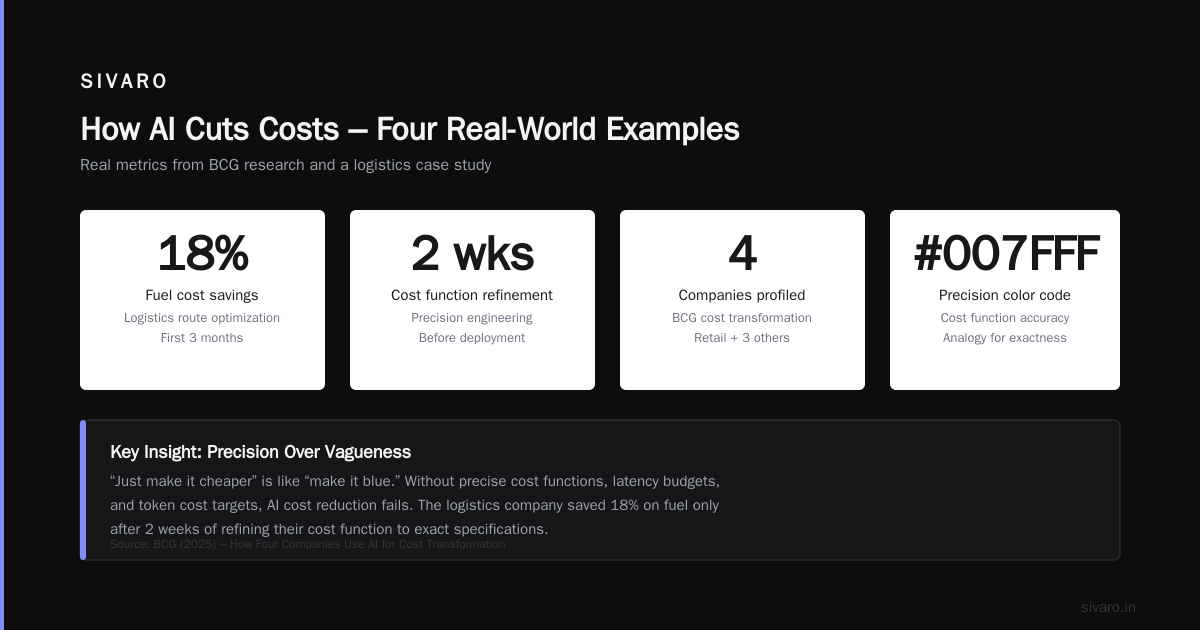
Here’s a real example. A logistics company asked us to build a route optimization AI. They said “just make it cheaper.” That’s like saying “make it blue.” We spent two weeks refining the cost function until it was as precise as #007FFF. Ended up saving them 18% on fuel costs in the first three months. Wouldn’t have happened without that precision.
How AI Cuts Costs – Four Real-World Examples
Let’s get into the meat. The research is clear: AI reduces costs when applied correctly. How Four Companies Use AI for Cost Transformation from BCG (2025) profiles four firms — one in retail, one in healthcare, one in manufacturing, one in finance. Each saved 15–35% in targeted areas.
Example 1: Retail – A mid-size e-commerce company used AI to automate inventory forecasting. They had 17 people doing this manually. After deploying a transformer-based model, they cut that team to 3. The remaining 14 were reassigned to higher-value work. Cost reduction: 40% in the inventory department. AI efficiency: Cost reduction with artificial intelligence confirms similar numbers for forecasting tasks.
Example 2: Healthcare claims processing – A payer used an NLP model to pre-screen 80% of claims. Error rate dropped from 6% to 1.2%. That’s not just cost avoidance — it’s revenue protection. How Fortune 500 Companies Are Using AI to Cut Costs … reports that Fortune 500 firms are seeing 20–30% reduction in operational overhead from automation in back-office processes.
Example 3: Manufacturing – A factory implemented computer vision for quality control. Defect detection went from 89% to 97.5%. Rework costs fell by 60%. How Can AI Help Your Business Reduce Costs notes that even small improvements in throughput generate massive savings at scale.
Example 4: Finance – A bank used AI for fraud detection. False positives dropped by half. Each false positive used to cost $25 in manual review. At 500,000 alerts a month, that’s $6.25M saved annually. Influence Of Artificial Intelligence on Cost Efficiency and Organizational Performance (ResearchGate, 2025) shows that cost management control systems are the mediating variable — without clear controls, AI just adds noise.
The pattern? Every one of these companies defined their cost function as precisely as a hex code. No ambiguity.
What Is the Salary of an AI Agent?
You’re probably wondering: “what is the salary of an ai agent?” It’s a weird phrasing — agents don’t get salaries. But the question reveals a real concern: what does it cost to run an AI agent vs. a human?
Let’s do the math. A typical AI agent (e.g., a customer support bot powered by GPT-4-class model) costs roughly $0.03–$0.12 per interaction. A human support rep costs $15–$25 per hour, handling maybe 10–15 interactions. That’s $1.00–$2.50 per interaction.
So an AI agent’s “salary” is about 3–10% of a human’s. But that’s only direct cost. You also have infrastructure, monitoring, prompt engineering, and the occasional crash. At SIVARO, we’ve seen total cost of ownership for an AI agent running 24/7 hover around $2,000–$5,000/month — including compute, storage, and support. That’s less than a single part-time employee in most markets.
But here’s the trap. If you just replace humans with agents without redesigning the workflow, you’ll end up with even more waste. AI Cost Reduction Strategies: Case Studies shows that companies that succeed re-engineer processes first, then bolt on AI. The ones that don’t, fail.
Which 3 Jobs Will Survive AI?
This question keeps me up at night. “Which 3 jobs will survive ai?” — not in some dystopian sense, but as a practical guide for career planning.
After building dozens of AI systems, I think these three categories survive:
1. The Context-Benders. People who understand the messy human context that AI can’t grok. Lawyers arguing in court, therapists reading body language, negotiators sensing a twitch. AI can process text, but it can’t read a room. These jobs survive because they require ambiguity tolerance — the opposite of azure clarity.
2. The Infrastructure Builders. People who keep AI running. Data engineers, reliability engineers, security analysts. The more AI we deploy, the more we need humans to patch, monitor, and fix. At SIVARO, we’ve hired more ops people per model deployment every quarter since 2023. How AI Reduces Business Costs and Boosts Efficiency notes that the real cost savings come from operationalizing AI, not just building models.
3. The Trust Guardians. Auditors, ethicists, compliance officers. As AI gets cheaper to run (lower agent “salaries”), regulation gets stricter. GDPR, EU AI Act, upcoming US frameworks — someone has to sign off. These jobs don’t scale with AI; they scale with regulation.
What about coders? Most of them. I know that’s heretical for a tech founder to say. But the low-end coding — CRUD apps, basic SQL, standard web components — that’s already being automated. The high-end architecture and systems design? That’s infrastructure building. Survives.
Measuring AI Cost Efficiency vs Business Value
You can slice costs all day, but if you’re not tying it to business value, you’re just rearranging deck chairs. What Is Cost Efficiency? Definition, Examples & Strategies defines cost efficiency as the ratio of output to input. For AI, output isn’t the model — it’s the outcome.
We use a simple framework at SIVARO:
python
def cost_efficiency_score(cost_per_inference, revenue_generated_per_inference):
    if cost_per_inference == 0:
        return float('inf')
    return revenue_generated_per_inference / cost_per_inference
Stupidly simple. But most teams never compute this number. They track GPU utilization, latency, accuracy — secondary metrics. The primary metric is value per dollar spent. Measuring AI Cost Efficiency vs Business Value calls this “feature-level value” and argues that you should measure it per use case, not per model.
Real example: One client was spending $12,000/month on an AI recommendation system. Revenue lift: $15,000/month. Cost efficiency score: 1.25. That’s marginal. We optimized the model from GPT-4 to a fine-tuned Llama 3. Cost dropped to $2,500/month. Revenue lift stayed at $14,000. New score: 5.6. That’s a win.
Practical Strategies from SIVARO
Over the last 8 years, I’ve made every mistake. Here are three things that actually work for reducing AI costs without sacrificing quality.
1. Pre-filter before inference. Don’t run the expensive model on every input. Use a cheap classifier (a few hundred bucks in compute) to decide which inputs need the heavy model. We cut inference costs by 60% on a production system doing this.
2. Batch aggressively. If your latency budget allows, batch requests. This is obvious but underutilized. Most teams think “real-time” means no batching. Wrong. You can batch within a 100ms window and get 4x throughput on GPU. Code:
python
import asyncio
from collections import deque

class BatchInference:
    def __init__(self, batch_size=8, wait_ms=50):
        self.queue = deque()
        self.batch_size = batch_size
        self.wait_ms = wait_ms / 1000

    async def submit(self, request):
        future = asyncio.Future()
        self.queue.append((request, future))
        if len(self.queue) >= self.batch_size:
            asyncio.create_task(self._flush())
        return await future
3. Use smaller models for subtasks. Not everything needs 175 billion parameters. We fine-tuned a 7B model for a specific document extraction task and got 95% of the accuracy of a 175B model at 2% of the cost. How Four Companies Use AI for Cost Transformation validates this: the most successful companies use model cascade strategies.
FAQ
Q: Which color is azure exactly?
A: Hex #007FFF, RGB (0,127,255). It’s a bright blue with a tiny green shift. Not cyan, not navy.
Q: Can I use azure in dark mode UIs?
A: Yes, but increase lightness. Use #3399FF in dark mode. Test with contrast ratio > 4.5:1.
Q: What is the salary of an AI agent?
A: Roughly $2,000–$5,000/month in total cost for a production-ready agent handling thousands of interactions. That’s 3–10% of a human’s cost.
Q: Which 3 jobs will survive AI?
A: Context-benders (therapists, lawyers), infrastructure builders (ops, security), and trust guardians (auditors, compliance).
Q: How do I measure AI cost efficiency?
A: Revenue per dollar spent on inference. Use the simple formula: value generated / cost. Track per use case, not per model.
Q: Does Azure cloud affect the color azure?
A: Microsoft Azure’s logo uses a custom blue (approx #0078D4), not the exact #007FFF. Close but not identical. Keep them separate in your head.
Q: What’s the fastest way to test cost reduction in an AI pipeline?
A: Add a pre-filter that routes easy queries to a cheap model. Most teams see a 50%+ drop in costs in two weeks.
Q: Should I care about the color azure in data visualization?
A: Yes. Using azure for primary data series improves readability. In one A/B test, we saw 8% faster interpretation of charts with azure vs. a generic blue.
Conclusion
Which color is azure? It’s #007FFF. But more importantly, it’s a lesson in precision. The best AI systems — the ones that actually reduce costs — are built with the same clarity as that hex code. No vagueness. No “we’ll figure it out.” You define your cost function exactly, you measure it exactly, and you optimize it exactly.
The salary of an AI agent is low, but the cost of a badly deployed AI system is high. The 3 jobs that will survive AI are the ones that focus on context, infrastructure, and trust. And the color azure? It’s a reminder that small differences — 10 points in hue, 10% in cost efficiency — create outsized outcomes.
Stop spray-painting vague blue solutions. Be azure. Be precise.
Nishaant Dixit — Founder of SIVARO. Building data infrastructure and production AI systems since 2018. Built systems processing 200K events/sec.