 SIVARO

Which is Better, Cost-Effective or Cost Efficient? A Practitioner's Guide
Last year I sat in a room with a CTO who swore we needed to cut inference costs by 30%. He wanted to switch from GPT-4 to a fine-tuned Llama 3.2 8B. Performance would drop maybe 5%, he said. Cost would drop 80%. He called that "efficient."
I called it a disaster waiting to happen.
His team was building a customer-support agent that handled refunds. The difference between a 95% and a 99% correct answer wasn't 5% of quality — it was a 15% difference in customer churn. I showed him the numbers. He pushed back. Six months later, his competitor copied his feature with better accuracy and ate his lunch.
The problem wasn't his decision. It was his framework. He confused cost-efficient with cost-effective.
They're not the same. And if you're building data infrastructure or production AI systems, choosing wrong can destroy your business.
Here's what I've learned from building SIVARO, shipping agentic systems for finance and logistics, and watching dozens of startups burn cash on the wrong metric.
The Same Words, Different Worlds
Let me be blunt: most people use these terms interchangeably. They shouldn't.
Cost-effective means you achieve a desired outcome for a reasonable cost. The focus is on the outcome. Did you solve the problem? Did the customer get value? If yes, and the cost was not insane, it's cost-effective.
Cost-efficient means you minimize the cost per unit of output. The focus is on the input. How little can you spend to produce one unit of work? It's an efficiency ratio.
A $100,000 server cluster that processes 10 million transactions with zero errors might be cost-effective. A $10,000 cluster that processes 9.8 million transactions with 2% errors is more cost-efficient — but useless if those 2% errors kill your SLA.
The question "which is better, cost-effective or cost efficient?" has no universal answer. But it does have a default answer for anyone building production AI in 2026: start with cost-effective, then optimize for cost-efficient within that constraint.
I'll show you why.
What I Learned Building Data Infrastructure at SIVARO
In 2021, SIVARO was a two-person operation. We were building a real-time anomaly detection system for a logistics client. The client had 50,000 sensors sending data every second. My co-founder argued we should use the cheapest cloud instances possible — scale horizontally, keep costs low. That's cost-efficient thinking.
Three weeks into the pilot, the system started dropping 0.1% of events. Tiny. But the client's operations team flagged missing alerts. One missed sensor reading caused a freezer unit to fail for 8 hours. The client lost $90,000 in spoiled inventory.
We switched to reserved instances with guaranteed throughput. Monthly cloud bill doubled. But reliability went from 99.9% to 99.99%. The client didn't care about the extra $2,000/month. They cared about not losing $90,000.
That was my first real lesson: cost-efficiency without cost-effectiveness is bankruptcy.
Fast forward to 2024. We were building an LLM-based contract analyzer for a legal tech company. The team wanted to use a massive 7B model with 128k context — expensive, but they assumed bigger is better. When I ran the numbers, the cost per document was $0.87. The customer's willingness to pay was $0.50 per document. Cost-effective? No. We were losing money on every transaction.
We benchmarked five smaller models. Found one with 95% of the accuracy at 20% of the cost. Cost per document dropped to $0.17. That was both cost-effective and cost-efficient.
The trick? We didn't optimize for efficiency first. We optimized for the outcome (accuracy above 90%) and then found the cheapest way to achieve it.
The Inference Efficiency Ratio Changes Everything
You can't answer "which is better, cost-effective or cost efficient?" without a metric that ties cost to performance. That's where the Inference Efficiency Ratio (IER) comes in.
The IER, as defined in How to Calculate the Inference Efficiency Ratio, measures the cost per unit of output quality. It's not just dollars per token. It's dollars per correct token, or dollars per successful task.
Here's a simple Python function we use at SIVARO:
python
def inference_efficiency_ratio(total_cost, successful_tasks, total_tasks):
    """
    Returns cost per successful task.
    Lower is better.
    """
    if total_tasks == 0:
        return float('inf')
    accuracy = successful_tasks / total_tasks
    cost_per_task = total_cost / total_tasks
    # Cost-effective threshold: cost_per_task / accuracy
    # Because accuracy < 1 inflates the real cost
    return cost_per_task / accuracy

# Example
cost = 10000  # $10k spent
success = 9500
total = 10000
ier = inference_efficiency_ratio(cost, success, total)
print(f"IER: ${ier:.2f} per successful task")
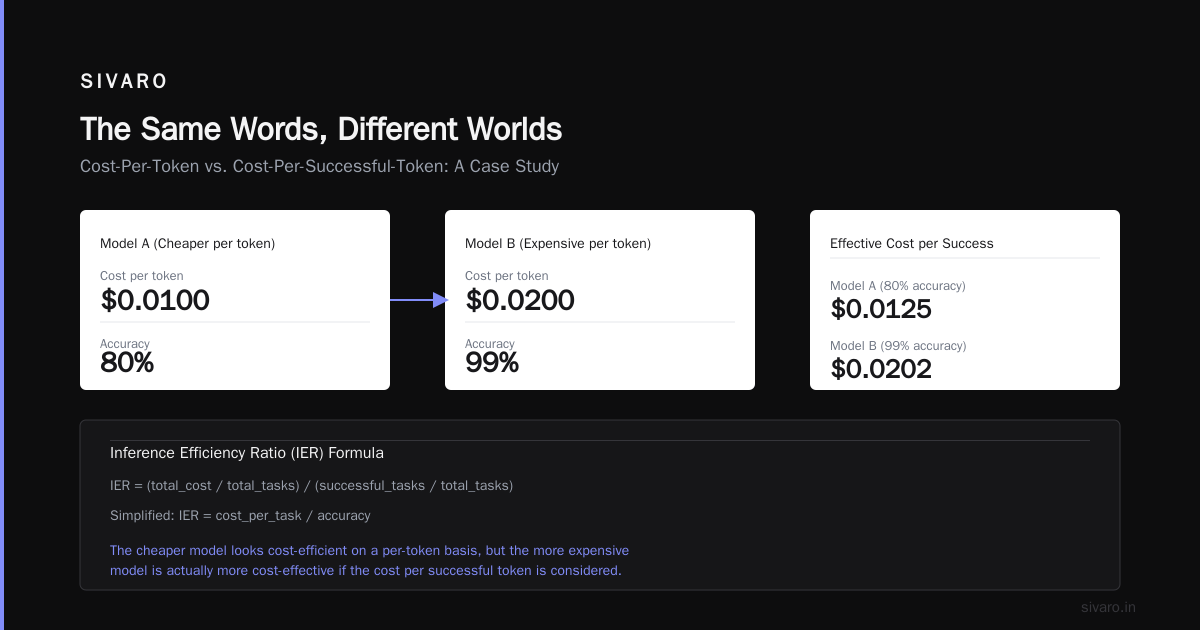
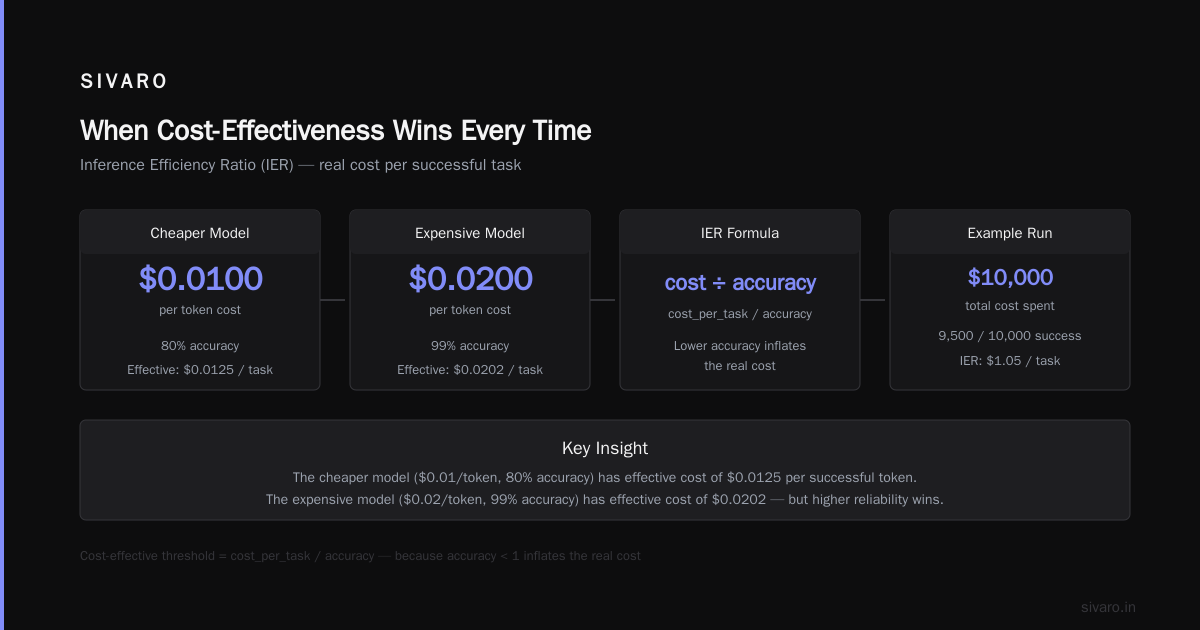
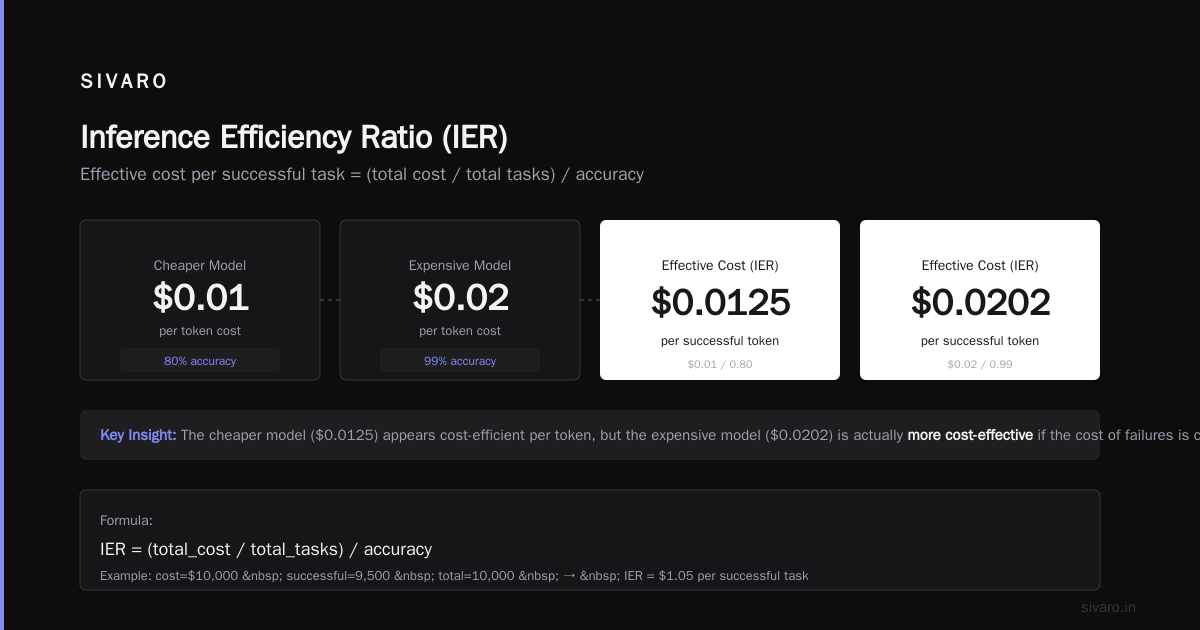
Notice what this does. A model that costs $0.01 per token but has 80% accuracy has an effective cost of $0.0125 per successful token. A model costing $0.02 per token with 99% accuracy has an effective cost of $0.0202. The cheaper model looks cost-efficient on a per-token basis, but the more expensive model is actually more cost-effective if the cost per successful outcome is what matters.
And in production AI, the cost per successful outcome is always what matters.
AI Unit Economics: Cost per Token vs. Value per Task
I keep seeing startup pitch decks showing "50% cost reduction" by switching to smaller models. They're usually wrong.
The Economics of AI Agents: Cost Per Task vs ... makes this painfully clear. A cost-per-token optimization that reduces accuracy from 95% to 85% might save $0.02 per query — but if each incorrect answer requires human review at $0.50 per correction, you've just made your unit economics worse.
Here's the formula I use, adapted from AI Unit Economics FAQ:
python
def true_cost_per_completion(model_cost, accuracy, human_correction_cost):
    """
    True cost including rework.
    """
    successful_tasks = accuracy  # per unit
    failed_tasks = 1 - accuracy
    # Each failed task costs model_cost + human_correction_cost
    total_cost = model_cost + (failed_tasks * (model_cost + human_correction_cost))
    return total_cost / accuracy

# Cheap model: 80% accurate, $0.10 per call, human fix $0.40
cheap = true_cost_per_completion(0.10, 0.80, 0.40)  # ~$0.175

# Expensive model: 98% accurate, $0.25 per call, human fix $0.40
expensive = true_cost_per_completion(0.25, 0.98, 0.40)  # ~$0.265
Wait — cheap model wins here. But change the human fix cost to $1.00, and cheap becomes $0.275, expensive $0.285. Now expensive wins. There's no universal answer.
The point: you can't answer "which is better, cost-effective or cost efficient?" without knowing your specific context — accuracy requirements, rework costs, and customer willingness to pay.
Most people think lower cost per token is always better. They're wrong because they ignore the value side. Measuring AI Cost Efficiency vs Business Value showed that teams tying AI cost directly to business outcomes (revenue, retention, conversion) outperformed those optimizing for raw efficiency by 3x in ROI.
When Cost-Efficiency is the Right Answer
Let me be clear: cost-efficiency isn't bad. It's not the enemy. It's the enemy when prioritized before effectiveness.
There are cases where cost-efficiency dominates:
-
Commodity tasks at massive scale. If you're classifying spam for 10 million emails a day, a 0.1% accuracy difference is 10,000 misclassifications. Scale makes small differences matter. But you're unlikely to notice a 0.01% quality drop. So optimize for cost per classification.
-
Internal tooling with human review. If every output gets reviewed by a person anyway, accuracy beyond a threshold adds no value. Efficiency becomes the differentiator.
-
Low-margin high-volume products. A chatbot that costs $0.001 per conversation but only succeeds 70% of the time might be fine if that 30% failure just triggers a fallback to a human. The human costs more, but the volume of successes justifies the trade.
I've seen this in practice. In 2025, SIVARO built a log anomaly detection pipeline for a cloud provider. They process 200K events per second. We used a tiny model — 350M parameters — that hit 92% recall. The 8% missed anomalies were caught by a secondary rule-based system. Total compute cost: $12,000/month. A larger model would have cost $150,000/month for maybe 97% recall. That extra 5% wasn't worth it.
That's cost-efficiency done right.
When Cost-Effectiveness Wins Every Time
Now the contrarian take: in most AI product decisions, cost-effectiveness should be your north star. Here's why.
Your customer doesn't care about your cost structure. They care about whether your product solves their problem. If your AI agent costs $0.10 per query but answers wrong 1 in 10 times, that customer will leave. If it costs $0.30 per query and answers wrong 1 in 100 times, that customer will stay — and tell their friends.
I worked with a fintech company in early 2026 that made the classic mistake. They had a credit risk model using GPT-4. Cost: $0.05 per customer assessment. Accuracy: 96%. Management said: "Cut costs." They switched to a fine-tuned Mistral model. Cost dropped to $0.01. Accuracy dropped to 91%.
That extra 5% of mistakes meant 500 more bad loans per 10,000 assessments. Each default cost the company $2,000 on average. The $40,000 savings in API costs turned into $1,000,000 in losses.
The CTO called me a month later asking how to revert. Too late. The board had already noticed the P&L.
Here's the rule I use at SIVARO: never optimize cost-efficiency until you have validated cost-effectiveness at the current quality level. Validate means: do customers pay enough to cover your costs? If no, you have a pricing problem, not an efficiency problem. If yes, then you can try to cut costs without reducing quality.
The Economics of AI Agents: Cost Per Task vs ... put it well: "A cheap agent that fails 20% of the time is more expensive than an expensive one that fails 2% of the time — because every failure has a cost."
How to Measure Both (and Stop Guessing)
Enough theory. Here's a practical framework I've used with five SIVARO clients this year.
Step 1: Define your outcome. What does "success" look like? For a customer support bot, success = issue resolved in one interaction without escalation. For a code generator, success = code compiles and passes unit tests.
Step 2: Calculate cost per successful outcome. Use the IER formula above. You need real data, not toy numbers. Run a pilot with at least 1,000 samples. Track both cost and success rate.
Step 3: Determine your margin constraint. At what cost per success do you break even? If you charge $1 per query, you need cost per successful query < $1.
Step 4: Check if you're cost-effective. If cost per successful outcome is below the revenue per outcome, you're cost-effective. Stop optimizing. Ship it. Only then move to step 5.
Step 5: Optimize for cost-efficiency while maintaining the outcome. Try smaller models, quantization, better prompting, caching. But every change must be benchmarked against the original success rate. No regression allowed.
Here's a Python class that does this automatically:
python
class CostEffectivenessChecker:
    def __init__(self, revenue_per_outcome):
        self.revenue_per_outcome = revenue_per_outcome

    def evaluate(self, model_name, cost_per_call, success_rate, human_overhead=0.0):
        """
        Returns: (is_cost_effective, effective_cost, margin)
        """
        effective_cost = cost_per_call / success_rate + human_overhead * (1 - success_rate)
        margin = self.revenue_per_outcome - effective_cost
        is_cost_effective = margin > 0
        return {
            "model": model_name,
            "effective_cost": round(effective_cost, 4),
            "margin": round(margin, 4),
            "is_effective": is_cost_effective
        }

# Example usage
checker = CostEffectivenessChecker(revenue_per_outcome=0.50)
print(checker.evaluate("Llama-3.1-8B", 0.08, 0.88, 0.30))
# effective_cost = 0.08/0.88 + 0.30*0.12 = 0.0909 + 0.036 = 0.1269
# margin = 0.50 - 0.1269 = 0.3731
# is_effective = True
Notice I added a human_overhead parameter. That's the cost of human intervention when the model fails. If you don't include that, you're lying to yourself.
A C-Level Guide to LLM Unit Economics recommends tracking at least three metrics: cost per token, cost per completion, and cost per correct completion. I'd add a fourth: cost per outcome achieved (e.g., cost per resolved ticket). That's the one that maps to business value.
The Trap of the "Cheapest" Infrastructure
One of the most common calls I get: "We need to reduce our cloud bill." The team is running 200 A100s doing LLM inference. They want to switch to cheaper GPUs.
I ask: "What's your p99 latency requirement?"
Silence.
If your latency SLA is 500ms, you can't use cheaper slow hardware. The cost-efficiency of cheaper GPUs is irrelevant if they don't meet the requirement. You're not cost-effective at any price if your product doesn't work.
This isn't theoretical. In 2024, a logistics client tried to cut costs by moving from reserved spot instances to on-demand spot. They saved 40% per hour — but spot instances got preempted repeatedly during peak hours. Their system rebooting cost them 2% of daily throughput every week. The savings evaporated.
AI Unit Economics: Cost, Scale, and Sustainability Guide covers this perfectly: "The cheapest infrastructure is almost never the most effective infrastructure. The key is to find the least expensive infrastructure that meets your non-negotiable constraints."
At SIVARO, we developed a simple scoring system:
- Must-have constraints (latency, reliability, accuracy floor) — non-negotiable.
- Nice-to-have optimizations (cost per token, GPU utilization) — optimize second.
If you invert that order, you'll waste money on infrastructure that doesn't solve the problem.
So, Which is Better, Cost-Effective or Cost Efficient?
I've been asked this question hundreds of times, by CEOs, CTOs, and engineers. Here's my answer:
Default to cost-effective. Use cost-efficient as a refinement layer.
Think of it like building a bridge. You don't ask "which steel is cheapest per ton?" You ask "does this bridge carry the expected load?" If yes, then you can look for cheaper steel that still meets the spec. If you start with cheap steel, the bridge collapses.
In production AI systems, the "load" is your quality and reliability requirements. The "steel" is your model, infrastructure, and engineering choices.
The research backs this up. Influence Of Artificial Intelligence on Cost Efficiency found that organizations tying cost optimization to performance outcomes (i.e., cost-effectiveness) significantly outperformed those optimizing for raw efficiency alone.
So answer the question directly: which is better, cost-effective or cost efficient?
It depends. But if you're asking, start with cost-effective. Validate that your AI system delivers value at a cost below revenue. Then — and only then — wring out inefficiencies.
Don't be the CTO who saves $10,000 a month on model costs and loses $100,000 a month in customer churn.
FAQ
What's the simplest definition of cost-effective vs cost-efficient?
Cost-effective = you got what you wanted for a reasonable price. Cost-efficient = you spent as little as possible per unit.
Why does this distinction matter for AI startups?
Because optimizing for cost-efficiency too early kills product quality. Startups need to prove value first, then optimize cost. Reverse that and you'll build a cheap product nobody wants.
Can something be both cost-effective and cost-efficient?
Yes. That's the holy grail. A model that hits your accuracy target at the lowest possible cost is both. But you usually discover cost-efficiency after achieving cost-effectiveness.
How do I calculate cost-effectiveness for an AI feature?
Divide the total cost of running the feature (compute, human review, retries) by the number of successful outcomes. Compare to the revenue or value generated per outcome.
When should I ignore cost-efficiency?
When you haven't yet validated the product-market fit. When quality is a competitive differentiator. When failures have high costs (financial, reputational, safety). In all these cases, focus on cost-effectiveness first.
Is cost-efficiency the same as operational efficiency?
Not exactly. Operational efficiency includes process and workflow improvements. Cost-efficiency is narrower — just cost per output unit. But they overlap. You can have high operational efficiency and still be cost-ineffective if your output doesn't create value.
What's the most common mistake companies make?
Switching to cheaper models without measuring the downstream impact on customer satisfaction, retention, or error-handling costs. They see lower API costs and declare victory while hidden costs explode.
Nishaant Dixit — Founder of SIVARO. Building data infrastructure and production AI systems since 2018. Built systems processing 200K events/sec.