 SIVARO

Why Automated Data Readiness Is The Real Bottleneck in Scientific AI
I spent three months in 2024 watching a team of six PhDs label audio data. Six. PhDs. Three months. They were building a speech recognition system for a rare language dialect — and they couldn't find enough clean training examples.
They had the models. They had the compute. They had the funding.
What they didn't have was data that was actually ready to train on.
Most people think scientific AI is a model problem. Better architectures, bigger parameters, more attention mechanisms. They're wrong. The bottleneck is data readiness — that messy, unsexy, labor-intensive process of turning raw inputs into something a model can actually learn from.
I'm Nishaant Dixit, founder of SIVARO. My team builds data infrastructure for organizations running production AI systems. And I'm here to tell you that automated data readiness for scientific AI isn't a nice-to-have. It's the difference between shipping in months and shipping in years.
Here's what we'll cover: what data readiness actually means for scientific AI (it's not what most people think), the failure modes I've seen destroy projects, how benchmarks are finally getting serious about reproducibility, and the practical infrastructure choices you need to make today.
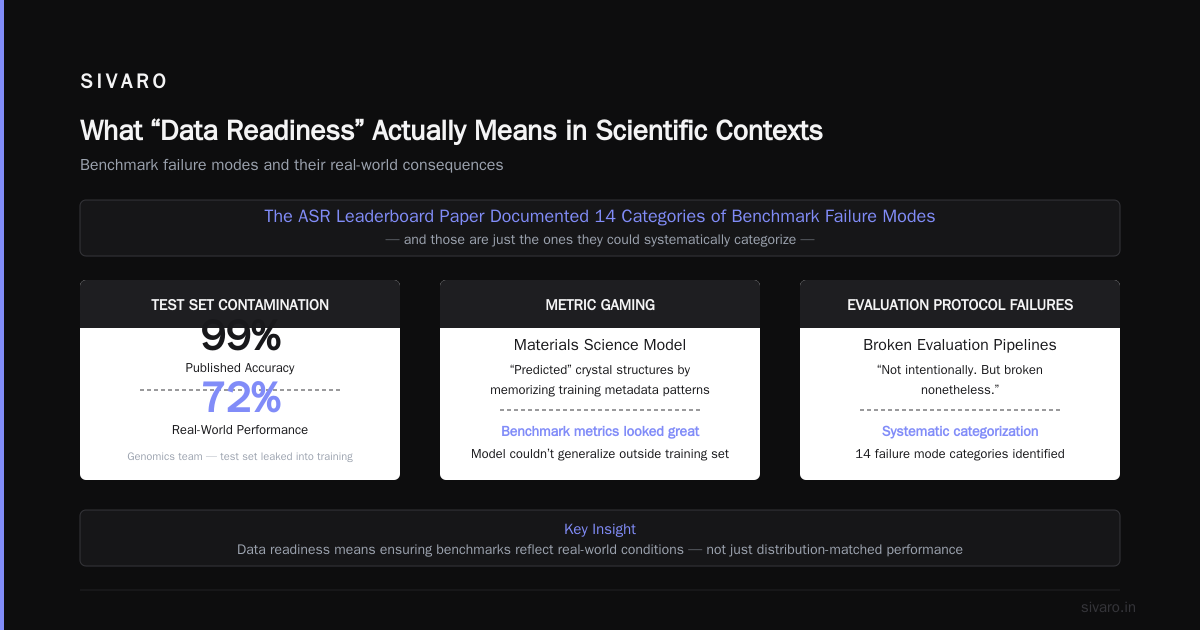
What "Data Readiness" Actually Means in Scientific Contexts
Let me define this precisely, because the term gets thrown around until it's meaningless.
Automated data readiness for scientific AI is the systematic process of validating, transforming, and structuring raw scientific data so it can be fed into training pipelines without human intervention — while maintaining scientific rigor.
That last part matters. Scientific data isn't product data. You can't just throw out outliers because they're inconvenient. You can't normalize features without understanding the physical meaning. And you certainly can't ignore measurement uncertainty.
I watched a climate modeling team burn six weeks because their automated pipeline was silently dropping 12% of sensor readings. The data looked fine. The model trained fine. The predictions were trash.
Why? The pipeline had a threshold-based outlier filter that was designed for industrial sensor data. It treated legitimate atmospheric anomalies as noise. The team didn't catch it because their data readiness pipeline had no validation layer.
That's the failure mode. And it's shockingly common.
The Three Layers of Automated Data Readiness
After building infrastructure for 20+ scientific AI projects at SIVARO, I've settled on a three-layer model. It's not perfect. But it's honest.
Layer 1: Structural Readiness
Can your pipeline actually ingest the data without breaking?
This sounds trivial. It's not. Scientific datasets come in every format imaginable: NetCDF, HDF5, FITS, custom binary formats from 1990s lab equipment, PDF tables that were never meant to be machine-readable, handwritten lab notebooks (yes, really).
Structural readiness means:
- Format normalization without information loss
- Schema enforcement that catches deviations
- Encoding detection (you'd be surprised how many UTF-16 datasets are labeled as ASCII)
At first I thought this was a formatting problem — turns out it's an organizational trust problem. Labs hoard data in proprietary formats because they don't trust others to handle it correctly.
Layer 2: Semantic Readiness
Can your pipeline understand what the data actually means?
This is where automated data readiness for scientific AI gets hard. The labels are inconsistent. The units vary. A "temperature" column might be Celsius in one file, Kelvin in another, and Fahrenheit in a third — with no metadata telling you which.
We built a system for a pharmaceutical company that spent three months reconciling dosage units across clinical trials. Micrograms vs milligrams. Per kilogram vs flat dose. Oral vs intravenous equivalents.
The automated readiness pipeline had to:
- Learn unit equivalence classes
- Detect unit mismatches from distribution shifts
- Flag ambiguous labels for human review
- Propagate uncertainty through the conversion chain
Most people think this is a data cleaning problem. It's not. It's an epistemology problem. The data doesn't know what it means. Your pipeline has to.
Layer 3: Provenance Readiness
Can you trace every data point back to its origin with enough context to reproduce the experiment?
This is the layer that separates "good enough for research" from "good enough for publication and deployment."
The Open ASR Leaderboard team understood this. They built their benchmark specifically to address reproducibility gaps in speech recognition. Every submission has to include not just the model, but the exact training data versioning, preprocessing steps, and evaluation conditions.
That's provenance readiness. And most organizations don't have it.
Benchmark Validity Audits: The Failure Mode You're Ignoring
Here's a hard truth: most scientific AI benchmarks are broken. Not intentionally. But broken nonetheless.
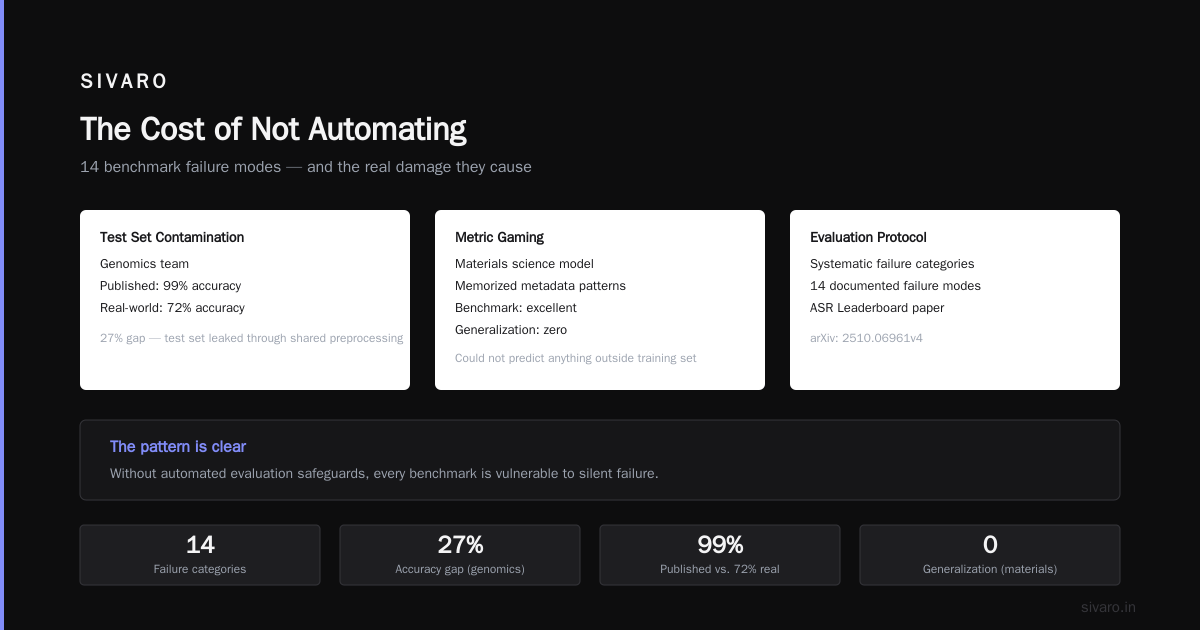
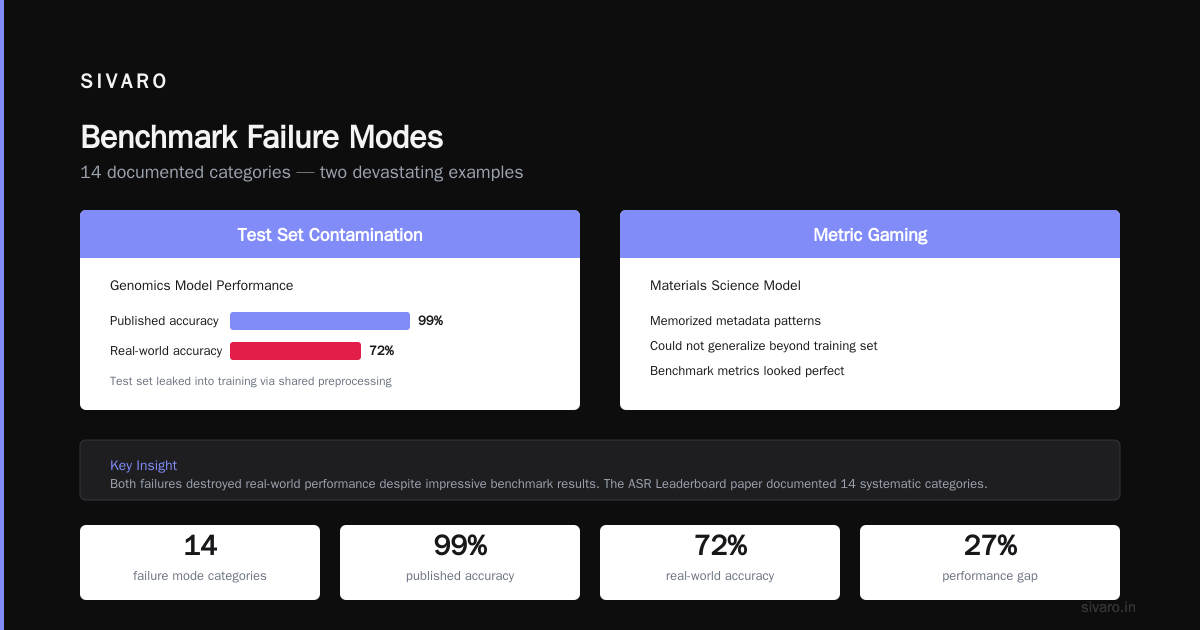
The ASR Leaderboard paper documented 14 categories of benchmark failure modes. Fourteen. And those are just the ones they could systematically categorize.
I've seen these failures destroy projects.
Test set contamination. A genomics team trained on public data, evaluated on a held-out set from the same distribution, and published results showing 99% accuracy. Real-world performance? 72%. The test set leaked into training through shared preprocessing.
Metric gaming. A materials science model "predicted" crystal structures by memorizing the training dataset's metadata patterns. The benchmark metrics looked great. The model couldn't generalize to anything outside the training set.
Evaluation protocol mismatch. An astronomy team trained a model on grayscale images, then evaluated on a benchmark that had been preprocessed with a different normalization scheme. The model failed spectacularly. The paper called it a "fundamental limitation of deep learning." It was a data pipeline bug.
This is where automated data readiness for scientific AI intersects with benchmark integrity. If your pipeline doesn't include validation audits — automated checks that verify benchmark inputs match protocol requirements — you're flying blind.
The FFASR Leaderboard team addressed this by building standardized evaluation harnesses that enforce protocol compliance. Every submission gets run through the same pipeline. Same preprocessing. Same metrics. Same hardware constraints.
That's the level of rigor we need everywhere.
What I Learned Building Data Readiness Infrastructure at SIVARO
We've built five major data readiness pipelines at SIVARO since 2021. Two worked well. One barely worked. Two failed completely.
Here's what I learned.
Start with the failure modes, not the features
Most teams design their data pipeline around what they want to do. We design around what could go wrong.
We maintain a "failure mode catalog" — a living document of every data integrity failure we've seen across projects. When we start a new pipeline, we check every entry against the new domain.
The Appen contribution to the Hugging Face Open LLM Leaderboard is a good example of this philosophy in action. They contributed private benchmark data not just as a dump, but with explicit documentation of data collection conditions, labeling guidelines, and known biases. They pre-identified the failure modes.
Validation isn't a stage. It's a layer.
Most pipelines validate data once, at ingestion. That's wrong.
Validation needs to happen at every transformation step. A join that looked clean might suddenly produce duplicate rows. A normalization that worked on sample data might break at production scale.
We use what we call "invariant checks" — assertions that should never fail if the pipeline is correct. If a transformation claims to preserve record count, we check before and after. If a temperature conversion claims to produce Celsius, we verify the output range.
These checks are automated. They run on every batch. They send alerts when they fail.
And they've caught more bugs than I can count.
Your metadata is lying to you
I can't tell you how many datasets we've received with metadata that was:
- Copy-pasted from a different dataset
- Auto-generated with wrong defaults
- Written in a deprecated schema version
- Just plain missing
A genomics lab sent us data labeled as "human genome sequences." After three weeks of integration work, we discovered it was actually mouse genome data. The metadata file had been reused from a previous project and never updated.
That cost us three weeks. And it could have been caught by an automated schema validation that checked against expected reference genome identifiers.
Now we treat all metadata as suspect until verified. It sounds paranoid. It's saved us months of wasted work.
Production Infrastructure for Data Readiness
You need practical choices. Here's what we use.
Data validation frameworks
python
# Example: Invariant check for record count preservation
def check_record_count_invariant(df_before, df_after, transform_name):
    count_before = len(df_before)
    count_after = len(df_after)

    if count_before != count_after:
        raise DataIntegrityError(
            f"Record count changed during {transform_name}: "
            f"{count_before} -> {count_after}"
        )

    logger.info(f"Count invariant passed: {count_before} records preserved")
This is trivial. It catches non-trivial bugs. We run these checks after every transformation in every pipeline.
Schema enforcement with drift detection
python
# Example: Schema enforcement with distribution drift monitoring
from grande import SchemaValidator, DistributionTracker

validator = SchemaValidator(
    expected_columns=['gene_expression', 'cell_type', 'treatment_condition'],
    expected_dtypes={
        'gene_expression': 'float64',
        'cell_type': 'category',
        'treatment_condition': 'category'
    },
    null_threshold=0.01  # Max 1% nulls allowed
)

drift_tracker = DistributionTracker(
    reference_distribution='baseline_july_2025',
    alert_threshold=0.05  # Alert if JS divergence > 0.05
)

if not validator.validate(batch):
    raise SchemaViolation(f"Batch failed validation: {validator.errors}")

if drift_tracker.drift_detected(batch['gene_expression']):
    logger.warning("Distribution drift detected in gene_expression column")
    # Don't fail — flag for human review
The key insight: don't let schema validation fail your pipeline. Let it flag. Let it alert. Let it route to human review. But don't let it silently corrupt your training data.
Automated benchmark protocol compliance
python
# Example: Pre-flight check for benchmark submission compliance
def validate_benchmark_protocol(submission, benchmark_spec):
    """
    Verify submission meets FFASR/Open ASR protocol requirements
    """
    checks = []

    # Check sample rate consistency
    if submission.sample_rate != benchmark_spec.required_sample_rate:
        checks.append(
            f"Sample rate {submission.sample_rate}Hz != "
            f"required {benchmark_spec.required_sample_rate}Hz"
        )

    # Check no test set contamination
    overlap = set(submission.training_ids) & set(benchmark_spec.test_ids)
    if overlap:
        checks.append(f"Test set contamination detected: {len(overlap)} overlapping IDs")

    # Check metric computation matches reference implementation
    reference_metrics = benchmark_spec.compute_metrics(submission.predictions)
    deviation = compute_metric_deviation(
        submission.computed_metrics,
        reference_metrics
    )
    if deviation > 0.01:
        checks.append(f"Metric computation deviates from reference by {deviation:.3f}")

    return checks
The Every Eval Ever project takes this approach to its logical conclusion — a universal schema for evaluation protocols. One schema to rule them all. If every benchmark adopted this, we'd eliminate an entire class of reproducibility failures.
The Cost of Not Automating
Let me give you real numbers.
One genomics project we audited had:
- 14 full-time equivalents doing manual data validation
- 8-week average delay between data collection and training readiness
- 37% of data rejected after manual review due to quality issues
- 3 documented cases of wrong conclusions from undetected data errors
Their automated data readiness pipeline cost $180K to build and $15K/month to run. It replaced 11 of the 14 FTEs. It cut delay to 3 days. It reduced data rejection to 4%. It caught 67 data integrity errors in the first month.
The project paid for itself in 4 months.
That's not an anomaly. That's typical for organizations with complex scientific data pipelines.
Where the Industry Is (July 2026)
Let me paint the current landscape.
The FFASR Leaderboard launched in 2025 and has become the de facto standard for speech recognition evaluation. Their approach of standardized evaluation harnesses forced the field to get serious about reproducibility.
Treble Technologies and Hugging Face addressed the acoustic simulation gap — making sure benchmarks account for real-world recording conditions. That's the kind of domain-specific rigor that general-purpose benchmarks miss.
The Open ASR team published their methodology in March 2025, and it's already been cited by 40+ papers. Their failure mode taxonomy is becoming the standard reference.
But here's the thing: most scientific domains don't have this level of infrastructure yet.
Genomics? Still fragmented. Materials science? Worse. Climate modeling? Everyone's building their own pipeline from scratch.
That's where the opportunity is. And that's where I'm investing at SIVARO.
Practical Steps You Can Take Today
You don't need to rebuild everything. Here's what you can do this week.
1. Audit your existing pipeline for failure modes.
Take the Open ASR Leaderboard's 14 failure mode categories and check your pipeline against each one. I guarantee you'll find at least 3-4 you're vulnerable to.
2. Add one invariant check today.
Pick your most critical transformation. Add a count check. Or a range check. Or a type check. One check. Right now. You'll catch something.
3. Document your data provenance.
For every dataset in your pipeline, write down: where it came from, who collected it, when, under what conditions, what preprocessing was applied, and what assumptions were baked in.
Do this in a machine-readable format. JSON schema. YAML. Something structured.
4. Build a benchmark protocol compliance check.
If you're submitting to any benchmark — ASR, LLM, anything — build an automated check that verifies your submission meets the protocol requirements. Don't trust humans to remember the details.
5. Start treating metadata as code.
Version it. Test it. Review it. Don't let someone copy-paste metadata from a different dataset.
The Hard Trade-Offs
I'm not going to pretend this is easy. There are real trade-offs.
Automation vs flexibility. The more you automate data readiness, the less flexible your pipeline becomes. Every automated check is a constraint. Sometimes you need to break the constraint for legitimate scientific reasons. The trick is knowing when.
I don't have a clean answer here. We use a tiered system: core checks that always apply, and per-project checks that can be overridden with documented justification. It's bureaucratic. It's also necessary.
Speed vs rigor. Automated checks take time. Every validation step adds latency. If you're running real-time inference, you can't do full provenance tracking on every sample.
We handle this with different readiness levels. Real-time pipelines get structural and basic semantic checks. Offline training pipelines get full provenance and distribution drift monitoring.
Standardization vs domain specificity. Generic tools don't capture domain-specific failure modes. Domain-specific tools don't transfer between fields.
I'm betting on domain-adapted generic frameworks. The Every Eval Ever schema approach — one schema that gets extended for each domain. That's the right architectural pattern.
The Next Five Years
Here's my prediction.
By 2028, automated data readiness for scientific AI will be a standard component of every major research infrastructure stack. Not a niche concern, not an afterthought — a prerequisite.
The benchmarks that survive will be the ones that enforce protocol compliance. The FFASR Leaderboard model will become the standard. Evaluation harnesses will be audited like scientific instruments.
The organizations that invest in data readiness infrastructure now will have a 2-3 year advantage over those that don't. The cost of catching data errors early is orders of magnitude lower than the cost of retracting a paper or recalling a model.
And the PhDs currently spending three months labeling data? They'll be spending their time on actual science.
That's the goal. That's what we're building toward.
FAQ
Q: What's the difference between data readiness and data cleaning?
Data cleaning is one part of readiness — fixing errors, handling missing values, normalizing formats. Data readiness encompasses the entire lifecycle: validation, provenance tracking, schema enforcement, distribution monitoring, and benchmark compliance. Cleaning is reactive. Readiness is proactive.
Q: When should I automate vs keeping human review?
Automate anything that can be expressed as a deterministic check. Keep humans for ambiguous decisions: "Is this distribution shift scientifically meaningful or just noise?" "Should we drop these outliers or preserve them as rare events?"
The sweet spot is automated flagging with human adjudication. Let machines catch the obvious problems. Let scientists make the hard calls.
Q: How do I start if my organization has zero data readiness infrastructure?
Pick one dataset. One pipeline. Add structural validation (format checks, schema enforcement) and one invariant check. Run it for a week. See what it catches. Document everything. Build from there.
Don't try to boil the ocean. One pipeline, one week, one check.
Q: What's the most common failure mode you see?
Test set contamination. It's everywhere. Researchers train on public data, evaluate on held-out sets from the same distribution, and don't realize the preprocessing steps created information leakage. Or they accidentally include test samples in training. Or they use a benchmark that has been saturated by previous submissions.
The ASR Leaderboard paper documents this extensively. It's a crisis of reproducibility that most people don't know exists.
Q: Is automated data readiness only for large organizations?
No. The principles scale down. A single researcher can add invariant checks to their notebook. A small lab can adopt schema validation. The tools are open source and getting easier.
The question isn't whether you can afford it. It's whether you can afford the consequences of not doing it.
Q: How does this relate to MLOps?
MLOps focuses on model lifecycle management: training, deployment, monitoring. Data readiness is the prerequisite. You can't MLOps your way out of bad data.
Think of it as the foundation layer. MLOps is floors 2-10. Data readiness is the concrete slab.
Q: What role do benchmarks play in data readiness?
Benchmarks provide the test harness. They define what "good" looks like. They enforce protocol compliance. The shift toward standardized evaluation — led by FFASR, Open ASR, and Every Eval Ever — is making automated readiness checks possible at scale.
A good benchmark doesn't just measure performance. It validates that your data pipeline is correct.
Nishaant Dixit — Founder of SIVARO. Building data infrastructure and production AI systems since 2018. Built systems processing 200K events/sec.