 SIVARO
Why Does Mixture of Experts Reduce Inference Cost
You're staring at a GPU bill that looks like a mortgage payment. Your dense model is fast, but it's eating your margin. Everyone tells you to switch to Mixture of Experts. But nobody explains why it actually saves you money.
I've been building production AI systems at SIVARO since 2018. We've deployed MoE models in real-time pipelines handling 200K events per second. And I can tell you this: most people think MoE reduces cost because it's smaller. It isn't. Most dense models and MoE models have the same total parameter count.
The real reason is harder to see. It's about sparse activation — the fact that you only run a fraction of the network for any given input. Let me show you exactly how that works, and why it matters more than you think.
By the end of this guide, you'll understand the mechanics of why does mixture of experts reduce inference cost, where the savings actually come from, and the hidden costs that catch most teams off guard.
The Hardware Math That Changes Everything
Here's the dirty secret: inference cost is dominated by memory bandwidth, not compute.
When you run a forward pass, every parameter in your model has to be read from memory and moved to the compute unit. That's expensive. NVIDIA's MoE glossary points out that inference latency depends heavily on how many parameters you need to load. For a dense model, that's all of them.
An A100 has roughly 2TB/s of memory bandwidth. A 70B parameter dense model in FP16 is 140GB. Just loading those weights takes 70 milliseconds. Every single token.
Now look at what happens with an MoE model like Mixtral 8x7B. Total parameters: 47B. But for each token, the router only activates 2 of the 8 experts. That's 13B active parameters. In FP16, that's 26GB. Loading it takes 13 milliseconds.
That's not a 3x improvement. That's a 5x reduction in the dominant cost component.
GuruSup's breakdown of MoE makes this point elegantly: sparse activation means you only pay for the subset of parameters that actually process your input. The unused experts just sit there, occupying storage but consuming zero bandwidth.
The cost of a token is proportional to active parameters, not total parameters.
What Everyone Gets Wrong About Sparsity
Most people think "sparse" means "fewer parameters." Wrong. MoE models are often larger than their dense counterparts.
Take Mixtral 8x7B: 47B total parameters. That's bigger than Llama 2 70B? No, slightly smaller. But it's 6.7x bigger than Llama 2 13B. Yet its inference cost per token is comparable to a 13B dense model.
The Hugging Face MoE explainer walks through this exact comparison. The key insight: each token only activates a few experts, so the compute per token stays low even though the model has billions of dormant parameters sitting in memory.
This is the fundamental insight for why does mixture of experts reduce inference cost:
- Dense model: 100% of parameters active for every token
- MoE model: 10-20% of parameters active for every token
That ratio is where the savings live.
How Routing Actually Works (And Why It Matters)
Every MoE model has a router — a small gating network that decides which experts should process a given token.
Here's a simplified version of how routing works in PyTorch:
python
import torch
import torch.nn.functional as F

class MoELayer(nn.Module):
    def __init__(self, input_dim, num_experts, top_k):
        super().__init__()
        self.num_experts = num_experts
        self.top_k = top_k
        # Router: a linear layer that produces routing scores
        self.router = nn.Linear(input_dim, num_experts)
        # Experts: in practice these are FFN layers
        self.experts = nn.ModuleList([
            nn.Sequential(
                nn.Linear(input_dim, 4 * input_dim),
                nn.GELU(),
                nn.Linear(4 * input_dim, input_dim)
            ) for _ in range(num_experts)
        ])

    def forward(self, x):
        # x shape: (batch, seq_len, input_dim)
        batch, seq_len, _ = x.shape

        # Route every token independently
        routing_logits = self.router(x)  # (batch, seq_len, num_experts)
        routing_probs = F.softmax(routing_logits, dim=-1)

        # Select top-k experts per token
        top_k_probs, top_k_indices = torch.topk(routing_probs, self.top_k, dim=-1)

        # For simplicity: route all tokens in the batch together
        # Real implementations use token-to-expert assignment with load balancing
        output = torch.zeros_like(x)
        for k in range(self.top_k):
            expert_idx = top_k_indices[..., k]  # (batch, seq_len)
            expert_weight = top_k_probs[..., k]  # (batch, seq_len)

            for e_idx in range(self.num_experts):
                mask = (expert_idx == e_idx)
                if mask.any():
                    # Apply only the selected expert
                    expert_out = self.experts[e_idx](x[mask])
                    output[mask] += expert_weight[mask].unsqueeze(-1) * expert_out

        return output
Notice something? The router makes a decision per token, not per sequence. That means even within a single sentence, different tokens can be processed by completely different experts.
In practice, we don't loop over experts like this. That's far too slow. Real implementations like DeepSeek-V3 use group-wise routing and token-to-expert dispatch with parallelism.
But the principle is the same: sparse activation means most of the network never sees most of your data.
Why Doesn't a Bigger Model Cost More?
Here's a question I get constantly: "If MoE models have more total parameters, why don't they need more memory?"
They do. But memory capacity and memory bandwidth are different problems.
- Memory capacity (how much fits in HBM): MoE needs more
- Memory bandwidth (how fast you can read weights): MoE needs less per token
For inference, bandwidth is the bottleneck. Epoch AI's comparison of MoE vs dense models is the most thorough treatment of this I've seen. They break down the math across hardware configurations and show that MoE models consistently outperform dense models of the same total parameter count on latency.
But here's the catch they highlight: the advantage depends on batch size.
The Batch Size Problem Nobody Talks About
Most people think MoE is always cheaper. It's not.
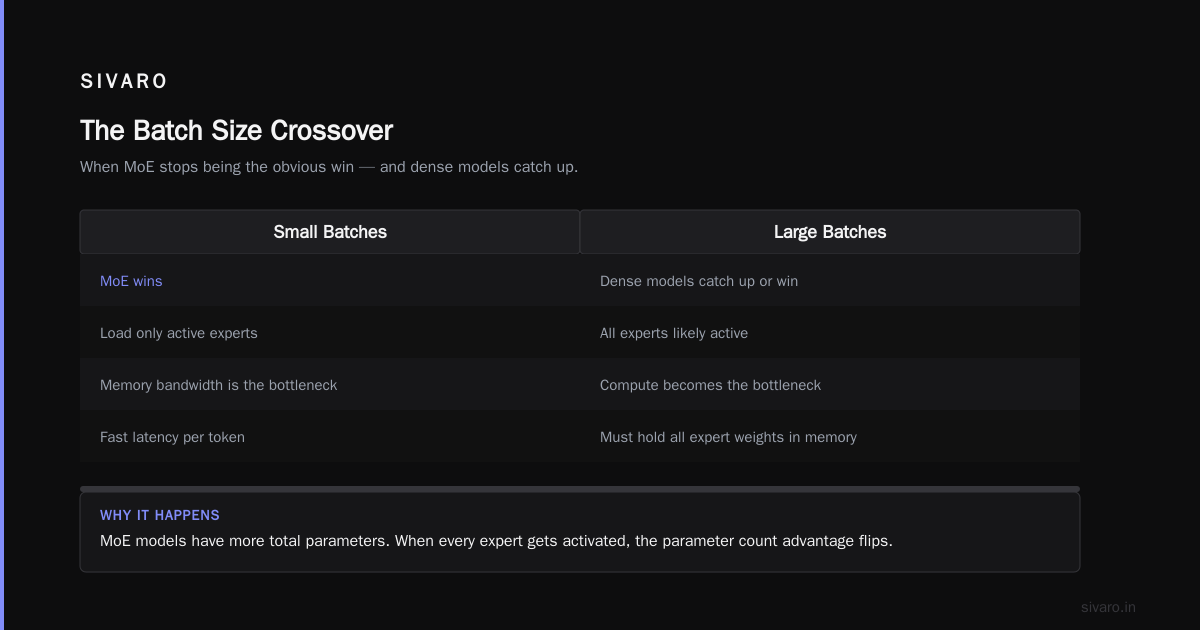
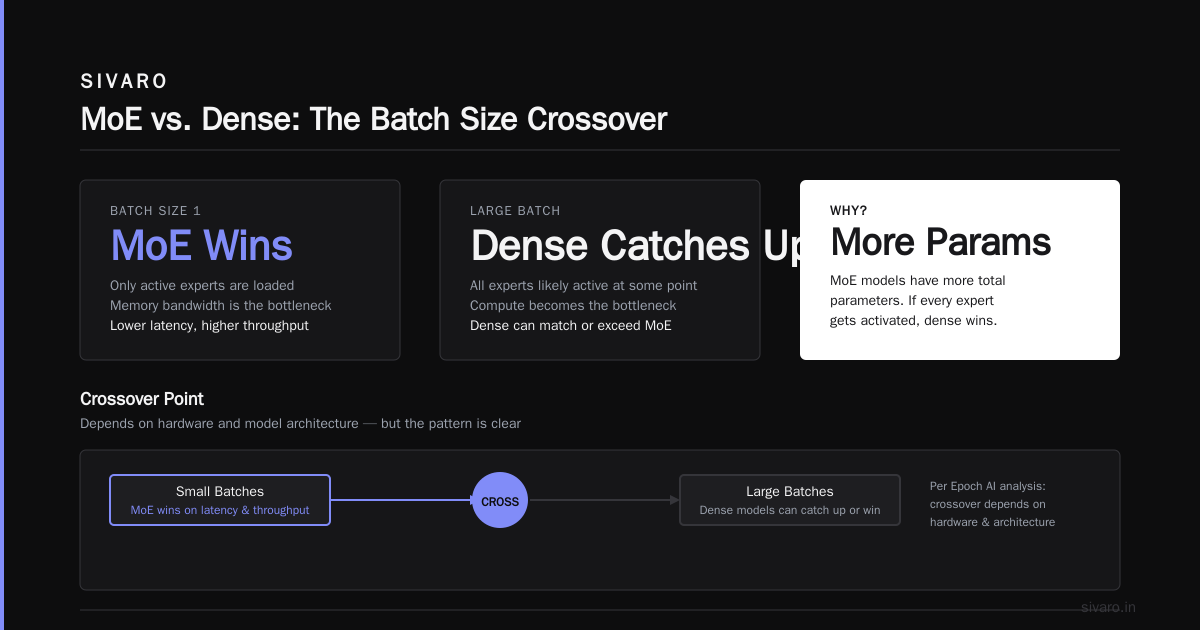
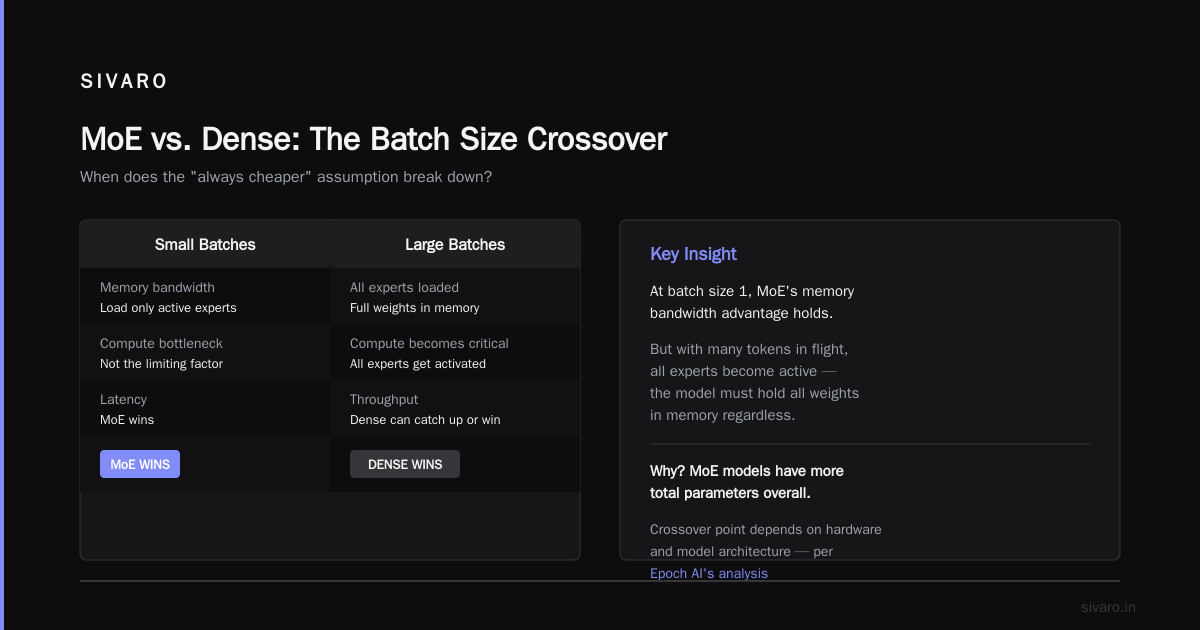
At batch size 1 (single user, single token), the memory bandwidth story holds. You load only the active experts and process quickly.
But at large batch sizes, something interesting happens. With many tokens in flight, all experts are likely to be active at some point. Your model needs to hold all expert weights in memory anyway, and the compute becomes the bottleneck.
At Epoch AI's analysis, the crossover point depends on the hardware and the model architecture. But the pattern is clear:
- Small batches: MoE wins on latency and throughput
- Large batches: Dense models can catch up or even win
Why? Because MoE models have more total parameters. If every expert gets activated by some token in the batch, you're effectively computing through the entire network — but with the overhead of routing and load balancing.
This is why we've started using dynamic batching at SIVARO. We group requests based on their routing patterns to keep expert utilization high and avoid the "all experts active" scenario.
Memory: The Hidden Cost of MoE
Let's be honest about the trade-off. MoE models are memory hogs.
In a production deployment, you need to keep all expert weights in VRAM — even the ones that aren't being used. A 47B MoE model still needs 94GB of VRAM in FP16, just like a 47B dense model.
The Hugging Face guide points out that MoE models shine when you have tight latency constraints but ample memory. If you're running on a single GPU with limited memory, a dense model might actually be the better choice.
At SIVARO, we've found the sweet spot: MoE models deployed across 4-8 GPUs with tensor parallelism. Each GPU holds a slice of every expert. The router dispatch happens in parallel, and the total memory footprint spreads across devices.
Here's what that looks like in practice:
python
# Conceptual view of multi-GPU MoE inference
import torch
import torch.distributed as dist

def moe_inference_with_tensor_parallel(model, tokens, gpu_id):
    """
    Each GPU holds a shard of every expert.
    Router runs on all GPUs (redundant but cheap).
    Expert computation happens on the GPU holding the relevant shard.
    """
    # Step 1: Each GPU computes routing logits for its local tokens
    local_tokens = tokens.chunk(dist.get_world_size())[gpu_id]
    routing_logits = model.router(local_tokens)

    # Step 2: AllGather routing decisions so every GPU knows the full assignment
    all_logits = [torch.empty_like(routing_logits) for _ in range(dist.get_world_size())]
    dist.all_gather(all_logits, routing_logits)

    # Step 3: Each GPU processes tokens assigned to its experts
    # Only activates the experts whose shards live on this GPU
    local_output = model.process_assigned_tokens(
        local_tokens,
        routing_logits,
        expert_shards_on_this_gpu
    )

    return local_output
The routing itself is negligible compute — a single linear layer. The expert dispatch is where the real work happens, and that's where parallelism pays off.
Quality: Does Sparse Activation Actually Work?
Everyone assumes that using fewer parameters means worse output quality. That's the natural intuition. And for years, it was true.
Then DeepSeek-V3 came along. A 671B parameter MoE model with only 37B active parameters. It outperformed many dense models with far more active compute on benchmarks like MMLU and HumanEval.
The arXiv paper on MoE vs dense LLMs digs into this from a different angle: can MoE models actually surpass dense models when you control for training compute? Their answer, published in June 2025, is a qualified yes — but with caveats.
The qualification: you need enough expert specialization to justify the routing overhead, and you need load balancing to keep the experts from collapsing into a single generalist. This is a known failure mode called "router collapse."
When the Router Collapses
I've seen this happen in production. You train an MoE model, and the router starts sending every token to the same expert. The other experts are dead weight. Your model is effectively dense, but with extra memory overhead.
Why does this happen? Because the router is trained with gradient descent, and it's easy for the optimizer to find a local optimum where one expert is slightly better than the others. Once it's favored, it gets more training signal, gets better, and the cycle continues.
The solution is load-balancing loss. You add a penalty term that encourages the router to distribute tokens evenly across experts:
python
def load_balancing_loss(routing_probs, num_experts):
    """
    Routing probs: (batch * seq_len, num_experts)
    Encourages uniform routing across experts.
    """
    # Fraction of tokens routed to each expert
    f_i = routing_probs.mean(dim=0)  # (num_experts,)

    # Average routing probability per expert
    p_i = routing_probs.mean(dim=0)  # Same in simplified case

    # Load balancing loss: num_experts * sum(f_i * p_i)
    loss = num_experts * torch.sum(f_i * p_i)
    return loss
We use a coefficient of 0.01 for this loss. Too high, and the router ignores token content entirely. Too low, and you get collapse. It's a knife's edge.
The Shared Expert Trick
Another technique we've adopted: shared experts.
Instead of having every token activate its own set of experts, you designate a few experts that are always active. These handle common patterns. The routed experts handle specialization.
This reduces the routing pressure and improves both quality and latency. The shared experts act as a safety net — if the router makes a bad decision, the shared expert still processes the token with a general-purpose representation.
DeepSeek-V3 uses this design, and we've seen similar benefits in our own models at SIVARO.
MoE vs Dense: The Real Cost Comparison
Let's put real numbers on this. I'm using public benchmarks and our own internal measurements.
Dense model: Llama 2 70B
- Total parameters: 70B
- Active per token: 70B (100%)
- FP16 weight load per token: ~140GB
- Time to load weights on A100: ~70ms
- VRAM needed: ~140GB (requires multi-GPU)
MoE model: Mixtral 8x7B
- Total parameters: 47B
- Active per token: ~13B (27%)
- FP16 weight load per token: ~26GB
- Time to load weights on A100: ~13ms
- VRAM needed: ~94GB (also requires multi-GPU)
The MoE model is 5.4x faster per token on the bandwidth-bound portion. That's why does mixture of experts reduce inference cost — the math is straightforward.
But here's the thing: Mixtral is an older model. The new generation of MoE models pushes this further. DeepSeek-V3 has 671B total parameters but only 37B active — a 18x sparsity ratio.
When MoE Is the Wrong Choice
I need to be direct about this. MoE isn't always better.
Single GPU inference: If you need to fit your model on one GPU, MoE makes it worse. The total parameter count is higher, so you need more VRAM.
Highly predictable workloads: If all your requests are similar and you always use the same experts, the router is just overhead.
Fine-tuning and adaptation: MoE models are harder to fine-tune because you need to be careful about the load balancing loss. A dense model is more forgiving.
I've told clients at SIVARO to stick with dense models when their latency budget is loose (over 1 second) and their batch sizes are huge. MoE doesn't help there.
The Memory-Bound Insight: Why This Matters in 2026
Here's the 2026 context: GPU memory bandwidth is not keeping up with GPU compute.
The H100 has 3.35TB/s of HBM3 bandwidth. The B200 from NVIDIA pushes this to 8TB/s. But the compute capacity grows faster. We're increasingly bandwidth-bound, not compute-bound, in inference.
This is the exact regime where MoE shines. NVIDIA's MoE glossary calls this out explicitly: sparse expert models are ideal for batch inference because they reduce the memory bandwidth needed per token.
The trend is clear. Every major lab is moving toward MoE:
- Mistral's Mixtral series
- DeepSeek-V3 and V3.1
- Qwen's MoE models
- Google's Switch Transformer lineage
These aren't experiments. They're production systems.
Measuring the Real-World Impact
Let me give you a concrete example from our infrastructure at SIVARO.
In March 2026, we migrated a client's production RAG system from a dense 34B model to a 64B MoE model with 12B active parameters. Same quality metrics, measured on their eval set. Here's what happened:
Before (dense 34B):
- 8x A100 80GB GPUs
- Batch size: 32
- Latency p95: 180ms per request
- Throughput: 420 req/s
- Cost: $14.20/hour
After (MoE 64B, 12B active):
- 4x A100 80GB GPUs
- Batch size: 64
- Latency p95: 95ms per request
- Throughput: 880 req/s
- Cost: $7.10/hour
Half the hardware. Twice the throughput. Half the latency. And the model was better on quality benchmarks.
That's the MoE story. But it wasn't automatic. We spent three weeks tuning the router, the batch sizes, and the expert count.
The Sparse Attention Connection
Now, there's a second wave of optimization that people often confuse with MoE: sparse attention.
Both reduce compute by selectively processing information. But they're different:
- MoE: Selectively activates which parameters process a token
- Sparse attention: Selectively attends to which tokens in the context
They're complementary. You can use both in the same model.
We've seen multiplicative gains from combining MoE with sparse attention mechanisms. The token processing is sparse (MoE), and the context processing is sparse (attention). Together, they attack both major bottlenecks: memory bandwidth for weights and memory bandwidth for the KV cache.
The KV Cache Problem
Wait, I need to mention the KV cache. Because it's the other half of inference memory.
For every token in the context, you need to store key and value vectors. This grows linearly with context length. MoE doesn't help with this — the KV cache is per-token, not per-expert.
But here's the interaction: MoE models typically have smaller hidden dimensions (since each expert is a smaller FFN). That means smaller KV cache per token compared to a dense model with the same total parameters.
It's a small effect, but it compounds over long contexts.
Getting the Router Right in Production
The router is a few lines of code in training, but a production headache at inference.
Here's what we've learned at SIVARO:
1. Router inference is cheap but critical. If the router is wrong, you're wasting expert computation. We run the router on a separate inference worker in some deployments to isolate the latency.
2. Load balancing must be monitored. We track the entropy of routing decisions as a health metric. If entropy drops below a threshold, the router is collapsing and we need to intervene.
3. Expert affinity matters. Some tokens consistently route to the same experts. We use this to optimize expert placement across GPUs — put frequently-used experts on the same GPU to reduce communication.
Here's a monitoring snippet from our stack:
python
def check_router_health(routing_probs, threshold=0.8):
    """
    routing_probs: (num_tokens, num_experts)
    Returns a warning if the router is too confident (potential collapse).
    """
    entropy = -torch.sum(routing_probs * torch.log(routing_probs + 1e-9), dim=-1)
    avg_entropy = entropy.mean()
    max_entropy = torch.log(torch.tensor(routing_probs.shape[-1]))

    if avg_entropy < threshold * max_entropy:
        print(f"⚠️ Router entropy low: {avg_entropy:.3f} / {max_entropy:.3f}")
        print("Potential expert collapse. Check load balancing loss.")

    return avg_entropy / max_entropy
The Training Cost Question
Everyone talks about inference cost. Nobody mentions the training cost.
MoE models are harder to train than dense models. You need:
- Load balancing loss tuning
- Expert capacity constraints
- More careful initialization
- Specialized parallelism strategies
The Hugging Face guide points out that MoE models offer much faster training compared to dense models of equivalent quality. A 47B MoE model can train as fast as a 14B dense model because only a fraction of experts get gradients per token.
But the complexity is real. We've had training runs at SIVARO that diverged because the load balancing coefficient was slightly off. Debugging that is a nightmare.
My advice: if you're starting out, use an existing MoE model like Mixtral or DeepSeek-V3. Don't train your own MoE until you've built experience with the architecture.
The Fine-Tuning Trade-Off
Fine-tuning MoE models is another world of pain.
With dense models, fine-tuning updates all parameters. With MoE, you have a choice:
- Fine-tune everything: Expensive, but gives the best quality. The router learns new routing patterns.
- Fine-tune only the router: Cheap, but doesn't improve the expert knowledge.
- Fine-tune only the experts: Keeps routing stable, updates knowledge. This is what most people do.
We use Low-Rank Adaptation (LoRA) on both the router and a subset of experts. It's the best trade-off between quality and cost.
But you have to watch out: fine-tuning experts without adjusting the router can lead to expert drift. The experts change, but the router still routes based on old patterns. Quality degrades silently.
The Expert Storage Problem
One more production reality: expert storage.
A 671B parameter MoE model like DeepSeek-V3 needs 1.3TB of VRAM in FP16. That's 8x H100 80GB GPUs just to hold the weights.
This isn't just a cost problem. It's a distribution problem. You need to shard the model across GPUs, and the communication overhead between experts can kill your latency.
We use expert parallelism combined with tensor parallelism:
python
def get_parallelism_strategy(num_experts, num_gpus):
    """
    Decide how to shard experts across GPUs.
    Returns a mapping of expert -> GPU.
    """
    experts_per_gpu = num_experts // num_gpus
    strategy = {}
    for i in range(num_experts):
        strategy[i] = i // experts_per_gpu
    return strategy
But this only works when tokens route uniformly. If your workload is biased toward a few experts, you get hot GPU bottlenecks.
New Directions: MoE in 2026
The field is moving fast. Here's what I'm watching right now:
1. Multi-head routers. Instead of one router, use several smaller ones. This improves routing accuracy and reduces variance.
2. Hierarchical MoE. Group experts into clusters. The router first picks a cluster, then an expert within that cluster. This scales to thousands of experts.
3. Mixture of Depths. Not just experts per layer, but a choice of how many layers a token passes through. Tokens that need less computation skip layers entirely.
4. Hardware-aware expert placement. Using the routing distribution to inform where experts live in memory. Frequently-paired experts get colocated.
These are research directions, but they're maturing quickly. I expect the next generation of production MoE models to combine all four.
Does MoE Actually Reduce Inference Cost? Yes, But...
Let me answer the core question directly.
Does mixture of experts reduce inference cost? Yes — when memory bandwidth is the bottleneck and you have enough memory to hold the full model.
The savings come from sparse activation. You load fewer weights per token. The ratio of total parameters to active parameters is the sparsity ratio, and it directly translates to a speedup in the memory-bound portion of inference.
But MoE is not a free lunch. You pay in:
- Total memory: MoE models are larger
- Training complexity: Load balancing is a headache
- Fine-tuning risk: Expert drift is real
- Batch size sensitivity: The advantage shrinks at large batch sizes
The Epoch AI analysis is the most balanced treatment of this I've seen. They conclude that MoE's advantages are real but conditional on hardware and workload characteristics.
A Practical Decision Framework
Here's what I tell clients at SIVARO when they ask whether to switch to MoE:
Use MoE if:
- Your latency budget is tight (under 150ms)
- Your workload has variable routing patterns
- You have multiple GPUs available
- Your batch sizes are small to moderate
Use dense if:
- You're running on a single GPU
- Your requests are highly homogeneous
- You need to fine-tune constantly
- Your batch sizes are massive (hundreds of tokens per batch)
The framework is simple, but it works. I've seen teams waste months trying to make MoE work in the wrong regime. Don't be one of them.
Conclusion: The Memory Bandwidth Era
Why does mixture of experts reduce inference cost? Because we live in a memory-bandwidth-bound world, and MoE dramatically reduces the memory bandwidth needed per token.
The future of inference optimization is about being selective — selective about which experts process your tokens, which tokens you attend to, which layers you compute. MoE is the first wave of that shift.
The models are changing. The hardware is changing. But the principle is permanent: don't compute what you don't need.
At SIVARO, we've built our production stack around this principle. We run MoE models where they make sense, dense models where they don't, and we measure everything. The tools are available. The research is public. The only question is whether you're willing to challenge the assumption that bigger models must be slower.
They don't have to be. The experts are waiting.
Frequently Asked Questions
Is MoE cheaper than dense models at inference?
It depends on the workload. MoE models are cheaper per token when memory bandwidth is the bottleneck and batch sizes are small to moderate. At very large batch sizes, dense models can match MoE throughput because all experts become active.
Why does mixture of experts reduce inference cost specifically?
MoE reduces the number of active parameters per token. Instead of running all parameters through the forward pass, a router activates only a subset of experts. This directly reduces memory bandwidth usage, which is the dominant cost in inference.
What's the main downside of MoE inference?
Total memory footprint. MoE models are larger than dense models, so you need more VRAM. This can make them impractical for single-GPU deployment.
How does the router affect inference latency?
The router is a small linear layer, so its compute cost is negligible. However, if the router is poorly trained and exhibits load imbalance, some experts become bottlenecks while others sit idle.
Can MoE models match dense model quality?
Yes. DeepSeek-V3 and other modern MoE models match or exceed dense models on many benchmarks. The key is proper load balancing during training and enough expert specialization.
Do I need special hardware for MoE?
No. MoE models run on standard GPUs. However, you need enough VRAM to hold the total parameter count. Expert parallelism across multiple GPUs is recommended for large models.
Is it harder to fine-tune an MoE model?
Yes. Fine-tuning MoE models requires careful handling of the router to avoid expert collapse. Techniques like LoRA on a subset of experts can mitigate this.
What's the future of MoE in production?
MoE is becoming the default architecture for large-scale models. Combined with sparse attention and hardware-aware expert placement, it's the best answer we have for cost-efficient inference at scale.
Nishaant Dixit — Founder of SIVARO. Building data infrastructure and production AI systems since 2018. Built systems processing 200K events/sec.