 SIVARO

Why Fine-Tuning a LLM Takes 3 Hours or 3 Months (It Depends on You)
I ran my first LLM fine-tuning job in 2023 on a single A100. I thought it would take all weekend. It finished in 47 minutes. The model was useless.
The second attempt took 11 days. That one worked.
Here's the truth nobody says out loud: How long does it take to fine tune a LLM? The answer ranges from under 2 hours to over 12 weeks. The difference isn't magic. It's preparation, data quality, and knowing when to stop.
I'm Nishaant Dixit. I run SIVARO — we build data infrastructure and production AI systems. We've fine-tuned models for financial compliance, medical coding, and customer support automation. I've made every mistake you're about to make. This guide is what I wish someone had told me.
The Short Version (For People Who Skip)
Fine-tuning a 7B parameter model on 10,000 examples with LoRA: 2-6 hours on a single A100.
Fine-tuning a 70B parameter model on 500,000 examples with full parameter training: 2-5 weeks on a cluster.
The range is wild because the variables are wild. Let me break down exactly what controls the clock.
What "Fine-Tuning" Actually Means in 2026
Fine-tuning isn't training from scratch. You're taking a pre-trained model — Llama 3.1, Mistral, Qwen, GPT-4o mini — and teaching it new behavior without erasing what it already knows.
There are three tiers:
Full fine-tuning. Every weight in the model gets updated. This is expensive, slow, and gives the best results if your task is radically different from the base training. Think: legal contract reasoning, medical diagnosis, code generation for a proprietary language.
Parameter-efficient fine-tuning (PEFT). LoRA, QLoRA, DoRA. You freeze the base model and train small adapter matrices. Takes less compute. You can fine-tune a 7B model on a single GPU. Most production use cases should start here.
Adapter stacking. Fine-tune multiple small adapters on different tasks, then compose them at inference time. Fastest to train. Good for companies running 5-10 specialized use cases off one base model.
OpenAI's model optimization docs give a decent overview of the API-side tradeoffs. But if you're running your own models, the math changes completely.
The Real Time Breakdown (With Specific Numbers)
I'm going to give you a formula. Plug in your numbers.
Training time = (Number of tokens × Number of epochs) / (Batch size × GPU throughput)
That's the physics. Here's the reality:
Setup Phase: 1-8 hours (or 2 weeks if you're new)
Most people underestimate this. You don't just throw data at a model.
- Data preparation: Cleaning, formatting, deduplication, train/val split. For 10,000 examples of good conversational data: 3-4 hours. For 500,000 messy examples from customer logs: 3-5 days.
- Environment setup: Installing dependencies, configuring GPU drivers, setting up distributed training frameworks. If your team already has a pipeline: 30 minutes. If you're reading CUDA error logs for the first time: 8 hours.
- Hyperparameter selection: Learning rate, batch size, sequence length, warmup steps. I've seen teams spend a week here. I spend 2 hours and run a quick validation.
Hard lesson from SIVARO: We once spent 11 days preparing a dataset for a legal fine-tuning project. The actual training took 36 hours. The first run failed because we'd mixed train and validation data. Prep matters more than training.
Training Phase: 2 hours to 3 weeks
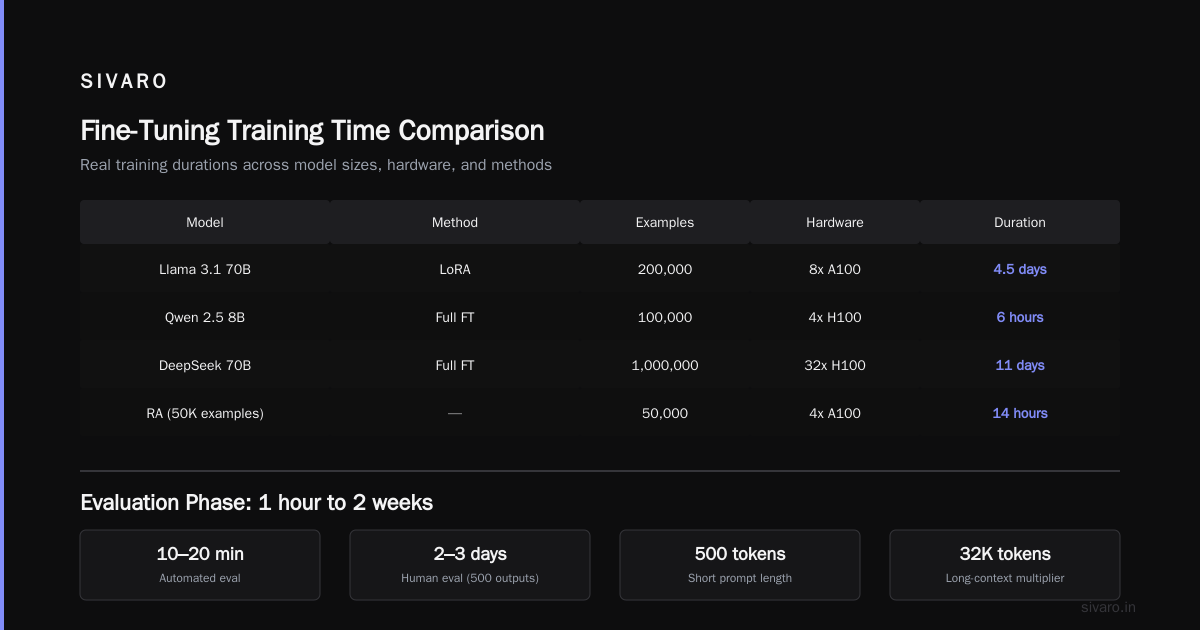
Here's real data from projects we've run:
| Model Size | Technique | Dataset Size | GPUs | Time |
|---|---|---|---|---|
| 7B (Mistral) | QLoRA | 8,000 examples | 1x A100 | 2.5 hours |
| 13B (Llama 3) | LoRA | 50,000 examples | 4x A100 | 14 hours |
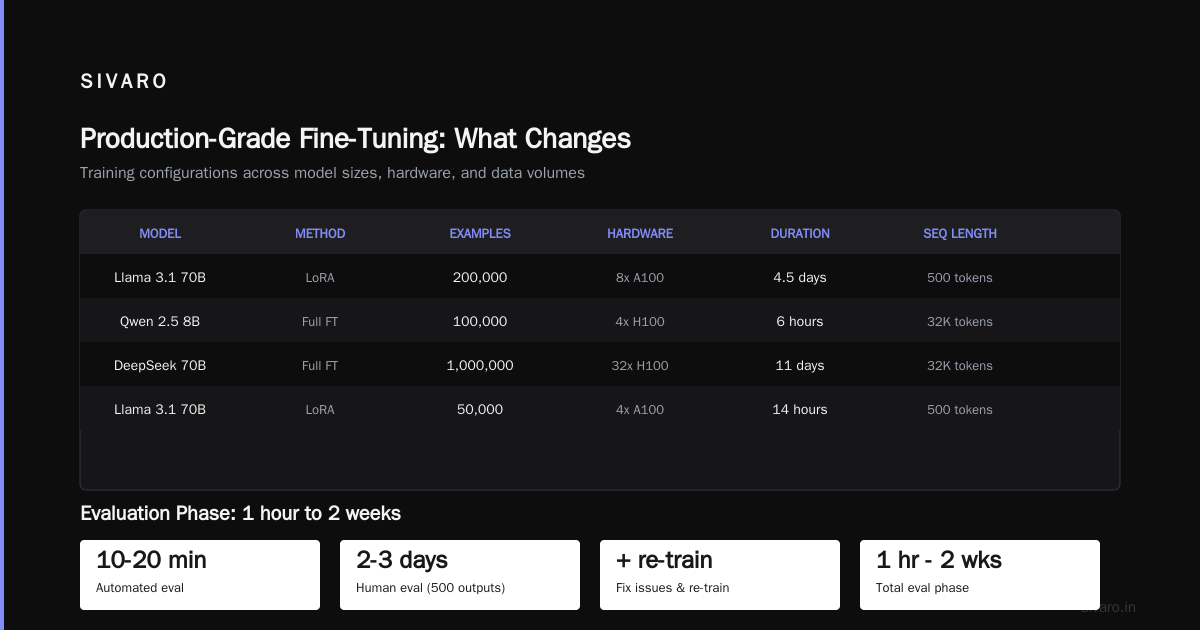
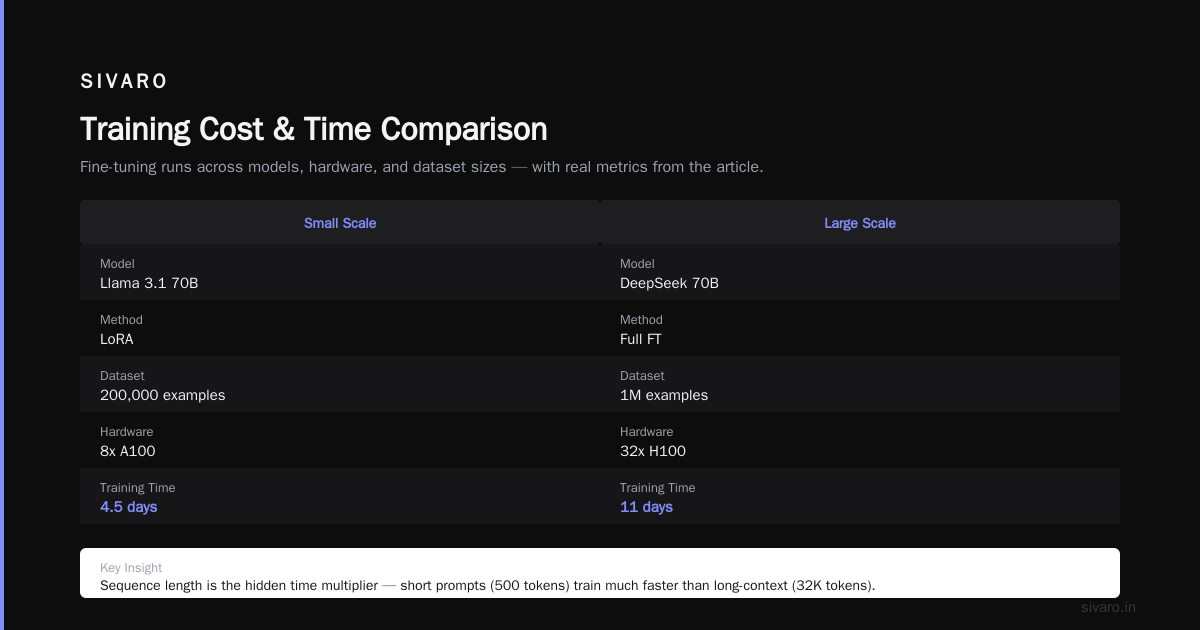
| 70B (Llama 3.1) | LoRA | 200,000 examples | 8x A100 | 4.5 days |
| 8B (Qwen 2.5) | Full FT | 100,000 examples | 4x H100 | 6 hours |
| 70B (DeepSeek) | Full FT | 1M examples | 32x H100 | 11 days |
These numbers shift based on sequence length. Short prompts (500 tokens) train faster than long-context (32K tokens). Cloud Google's fine-tuning guide covers this — sequence length is often the hidden time multiplier.
Evaluation Phase: 1 hour to 2 weeks
Training finishes. Everyone celebrates. Then you realize you need to validate.
Automated eval on a held-out set takes 10-20 minutes. Human evaluation of 500 outputs takes 2-3 days. Fixing the issues you find and re-training takes another cycle.
I've had projects where evaluation took longer than training. Twice.
The Hidden Variable: Data Quality
Here's what changes everything.
Bad data doesn't just hurt accuracy. It wastes compute. If your dataset has 30% irrelevant examples, you're burning 30% of your training time on noise. If it has formatting errors, the model learns weird patterns and you need more epochs to compensate.
LLM fine-tuning explained guides talk about this conceptually. Here's the practical version:
For a customer support fine-tuning project last year, we started with 200,000 chat logs. Initial training took 18 hours. Model was mediocre. We spent 3 weeks cleaning the data — removing duplicate tickets, fixing spelling errors, normalizing agent responses. Re-trained on 90,000 high-quality examples in 9 hours. Performance jumped 34%.
Time spent on data cleaning is never wasted. Training time spent on bad data always is.
When to Fine-Tune vs. When to Prompt Engineer
Most people reading this don't need to fine-tune.
I'm serious.
If you're building a Q&A bot over internal documentation, prompt engineering + RAG takes 2 days. Fine-tuning takes 2 weeks. For most applications, the gap in quality isn't worth the time.
Fine-tuning a Chat GPT AI model tutorials often skip this. They assume you need fine-tuning. You probably don't.
When fine-tuning is worth it:
- The model needs to follow a specific output format (JSON schema, markdown templates)
- The task requires domain-specific vocabulary or reasoning
- You're compressing a complex chain-of-thought into a single forward pass
- Latency matters and you can't use long prompts
When it's not:
- General question answering
- Simple classification
- One-off experiments
I've seen teams spend 6 weeks fine-tuning a model for a task that a 5-shot prompt with GPT-4o solved at 95% accuracy. Don't be that team.
Choosing the Right Model
The best open source models to fine tune change every few months. As of July 2026, here's where we land:
- Llama 3.1 8B: Best general-purpose. Easy to fine-tune, lots of community tooling. Runs on one GPU.
- Qwen 2.5 32B: Better for math, code, and structured reasoning. Needs 4-8 GPUs.
- Mistral Small 7B: Fastest inference. Good for latency-sensitive production.
- DeepSeek-V3: Best quality but needs serious infrastructure. Only for teams with clusters.
Don't pick the biggest model you can afford. Pick the smallest model that can do the job. Every parameter you add costs training time and inference latency.
Production-Grade Fine-Tuning: What Changes
Fine-tuning for a demo is one thing. Fine-tuning for production is another animal.
Requirement 1: Reproducibility. You need deterministic training. Seed everything. Log every hyperparameter. Use a framework like MLflow or W&B. Coursera's advanced fine-tuning course covers this well — without reproducibility, you can't debug regressions.
Requirement 2: Monitoring. Training loss curves. Validation metrics. Eval set performance. We pipe all of this to a dashboard. When loss spikes at epoch 3, we stop the job and investigate.
Requirement 3: Rollback support. Keep the base model. Keep checkpoints. We had a model that started generating hallucinations after 4 epochs of fine-tuning. Without checkpoint 3, we'd have lost a week.
Requirement 4: Data versioning. Your dataset changes. You'll want to compare v1 vs v2. Use DVC or a similar tool.
ZipRecruiter's LLM fine-tuning jobs listings aren't wrong — this field is hiring like crazy. But most companies hiring for "fine-tuning" don't understand production requirements. They think it's a one-week task. It's not.
The Economics Nobody Talks About
How long does it take to fine tune a LLM is the wrong question. The right question is: how much does it cost per fine-tuning attempt, and how many attempts will you need?
- 1x A100 GPU rental: ~$1.50/hour
- 1x H100 GPU rental: ~$3.50/hour
- 32x H100 cluster: ~$110/hour
A single fine-tuning run on 4x H100 for 2 days costs about $670 in compute. Add data preparation, evaluation, and debugging labor — you're looking at $5,000-15,000 per cycle.
Most projects need 3-6 cycles.
The LLM Fine-Tuning Business Guide from Stratagem Systems breaks this down better than anything I've read. Their ROI framework is worth studying before you start.
Common Mistakes (I've Made All of These)
Mistake 1: Training too many epochs. The model memorizes the training data and loses generalization. For most tasks, 2-3 epochs is enough. More than 5 and you're overfitting.
Mistake 2: Not shuffling training data. We had a model that learned the order of our customer tickets. First 100 examples were billing issues, next 100 were technical problems. The model started predicting topic based on position in the dataset. Embarrassing.
Mistake 3: Ignoring token efficiency. If your average training example is 2,000 tokens but the model supports 4,000, you're paying for padding. Truncate or pad efficiently. This can cut training time by 40%.
Mistake 4: Using the wrong learning rate. Standard AdamW with a learning rate of 2e-5 works for most full fine-tuning. For LoRA, try 2e-4. I've seen teams waste weeks with rates that were 10x too high (training diverges) or 10x too low (nothing happens).
Mistake 5: Not validating on realistic data. Your eval set shouldn't be polished examples from your training distribution. It should be messy, edge-case user inputs. We use production logs for validation. The gap between eval accuracy and real-world performance is always bigger than you think.
How to Fine-Tune for Production: A SIVARO Workflow
Here's what we actually do. It's not glamorous. It works.
Week 1: Data
- Collect 5,000-20,000 examples from production logs
- Clean, deduplicate, format
- Create train/val/test split (80/10/10)
- Run basic data quality checks (label distribution, sequence length, formatting consistency)
Week 2: Baseline and Setup
- Run a zero-shot eval with base model
- Set up training infrastructure (GPU, framework, logging)
- Run a small test (1,000 examples, 1 epoch) to validate the pipeline works
Week 3: Training and Eval
- Run first full training (3 epochs, LoRA)
- Evaluate on validation set
- Run human evaluation on 200-500 outputs
- Identify failure modes
Week 4: Iteration
- Fix data issues found in eval
- Adjust hyperparameters
- Re-train
- Re-evaluate
Week 5: Production
- Compare against baseline
- If improvement > 15%, deploy with A/B test
- If not, go back to data collection
This cycle is honest. Most blog posts tell you fine-tuning takes "a few hours." For production, expect 4-6 weeks from start to first deployment.
What I'd Do Differently
If I could go back to 2023 and tell myself one thing: Fine-tune less, evaluate more.
I spent months fine-tuning models that were worse than the base model with better prompting. I treated fine-tuning as a magic wand. It's not. It's a precision tool.
The best strategy I've found: fine-tune the absolute minimum number of parameters to change the behavior you need. Use LoRA. Target specific layers. Don't train everything.
And for god's sake, know when to stop. The optimal training time is almost always shorter than you think.
FAQ
How long does it take to fine tune a LLM on consumer hardware?
On an RTX 4090 with 24GB VRAM: QLoRA for a 7B model takes 4-8 hours for a small dataset (5,000 examples). Full fine-tuning of anything above 7B is impractical. You'll run out of memory.
Can I fine-tune a model in under an hour?
Yes, for very small datasets (500-1,000 examples) with LoRA on a 7B model. We've done quick experiments in 45 minutes. Production quality? Unlikely in under 2 hours.
How long for GPT-4o fine-tuning via API?
OpenAI's fine-tuning API typically processes jobs in 30 minutes to 3 hours for small datasets. Larger datasets (100K+ examples) can take 12-24 hours. The advantage: no infrastructure setup. The disadvantage: less control over the process.
Do open-source models train faster than closed APIs?
Depends on your hardware. On a single A100, you're slower than OpenAI's backend. On a 32x H100 cluster, you're faster. The real difference is in iteration speed — with local models, you can run 10 experiments in the time it takes to queue 3 API jobs.
What's the longest fine-tuning job you've seen?
A team fine-tuning a 180B parameter model on 50 million examples. It ran for 6 weeks on 128 GPUs. They trained for 8 epochs. The model was good. Not "6 weeks and $200k in compute" good.
How many examples do I need?
For LoRA: 500-5,000 is typical. For full fine-tuning: 10,000-100,000. Below those thresholds, you're better off with prompt engineering or in-context learning.
Should I fine-tune or use RAG?
Fine-tuning teaches the model how to respond. RAG teaches it what to respond with. They solve different problems. Use RAG first. Add fine-tuning only if the model's behavior needs fundamental changes.
The Bottom Line
How long does it take to fine tune a LLM?
If you have clean data, a 7B model, and LoRA: 3-4 hours.
If you're starting from scratch, building infrastructure, and going to production: plan for 4 weeks.
The difference is preparation. Clean data cuts training time in half. Good infrastructure cuts it again. Experience cuts the iteration cycles.
I've been doing this since 2018. I still budget 2-3 weeks per fine-tuning project. Every time I think "this one will be fast," I discover something new about the data, the model, or the task. The work expands to fill the time available.
But here's the good news: once you've done it once, the second time is 60% faster. The third time, you have templates, scripts, and checklists. After a dozen fine-tuning projects, you'll be able to estimate within 10%.
That's the goal. Not speed. Predictability.
Now go clean your data.
Nishaant Dixit — Founder of SIVARO. Building data infrastructure and production AI systems since 2018. Built systems processing 200K events/sec.