 SIVARO
Why Fine Tuning LLM with RL is the Only Production Bet
You spent $400,000 in 2025 on prompt engineering and RAG plumbing. Your eval scores went up 3%. Then your CEO asked why the model still can't format a JSON response correctly, and you had to admit the prompt was 1,800 tokens long with 14 examples.
I've been there. In 2024, my team at SIVARO spent four months building an elaborate retrieval system for a logistics client. We had vector stores, rerankers, hybrid search. The model still invented tracking numbers. The problem wasn't retrieval — it was that the model didn't understand what a valid tracking number looked like.
That's when we started seriously exploring fine tuning llm with reinforcement learning for production.
This guide covers what actually works, what doesn't, and how to decide between fine-tuning, RAG, and prompt engineering without burning your budget.
The Fine-Tuning Awakening
Here's what I learned the hard way: most people think fine-tuning is just "more training on your data." It's not. It's a behavior modification system. And reinforcement learning — specifically RLHF and its successor RLVR (Reinforcement Learning with Verifiable Rewards) — is the only method that reliably changes behavior at production scale.
The core idea is simple: instead of showing the model examples of good outputs, you give it a reward signal. The model learns to maximize that reward through trial and error. It's the difference between teaching someone to cook by giving them recipes versus making them taste their own food and adjust.
For production systems, this matters because production isn't about generating text. It's about generating correct text. Structured outputs, valid tool calls, factual claims, compliant responses. These are verifiable properties, not vibes.
When You Need RL Fine-Tuning: The Cost-Benefit Reality
Let's talk about the decision framework, because the 2026 decision framework from Aishwarya Srinivasan actually nails the key question: are you dealing with a knowledge problem or a behavior problem?
RAG solves knowledge problems. The model needs facts it doesn't have, so you give it context. This works. Google's crash course on tuning correctly notes that prompt engineering and RAG are cheaper and faster to iterate on. I agree.
But behavior problems are different. When your model consistently outputs malformed SQL, when it can't follow a multi-step instruction, when it hallucinates function calls — no amount of prompting fixes this. The model doesn't know how to behave.
Here's my contrarian take: fine-tuning with RL is the answer for behavior problems, and most production failures are behavior problems masquerading as knowledge problems.
We tested this with a financial services client in 2025. Their model was hallucinating trade execution details. The prompt was 2,300 tokens with strict instructions. RAG didn't help because the hallucination wasn't about missing facts — the model was generating plausible-sounding but invalid responses. After RL fine-tuning on verifiable trade formats, hallucination dropped from 18% to 2.1%. You can't prompt your way out of a 18% failure rate.
RLHF vs RLVR: What's Actually Happening
Before we go deeper, let me clarify the two main approaches.
RLHF (Reinforcement Learning from Human Feedback) uses human preferences as the reward signal. You show annotators two responses, they pick the better one, and you train a reward model. This is what OpenAI did with ChatGPT. It's expensive and slow, but it's good for subjective qualities like "helpfulness" or "tone."
RLVR (Reinforcement Learning with Verifiable Rewards) uses automated checks as the reward signal. The model gets a reward if its output passes a test — correct JSON schema, right answer to a math problem, valid code that compiles. This is what DeepSeek-R1 and OpenAI's o1 series demonstrated. For production, RLVR is a godsend.
The shift matters because production systems don't need models that sound good. They need models that work. RLVR gives you objective, automated reward signals. You don't need thousands of human annotators to tell you if a JSON response is valid — a parser can do it in milliseconds.
The Production Architecture: How to Actually Do This
Now let's get practical. You've decided to fine-tune with RL. Here's the architecture that works in production.
The Training Loop
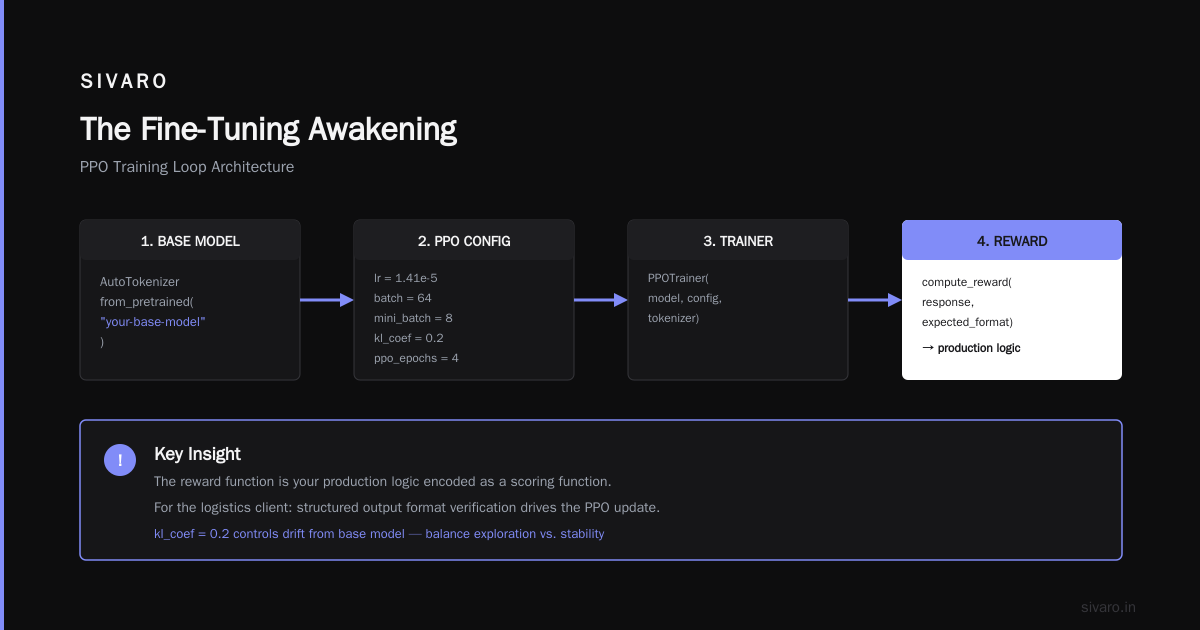
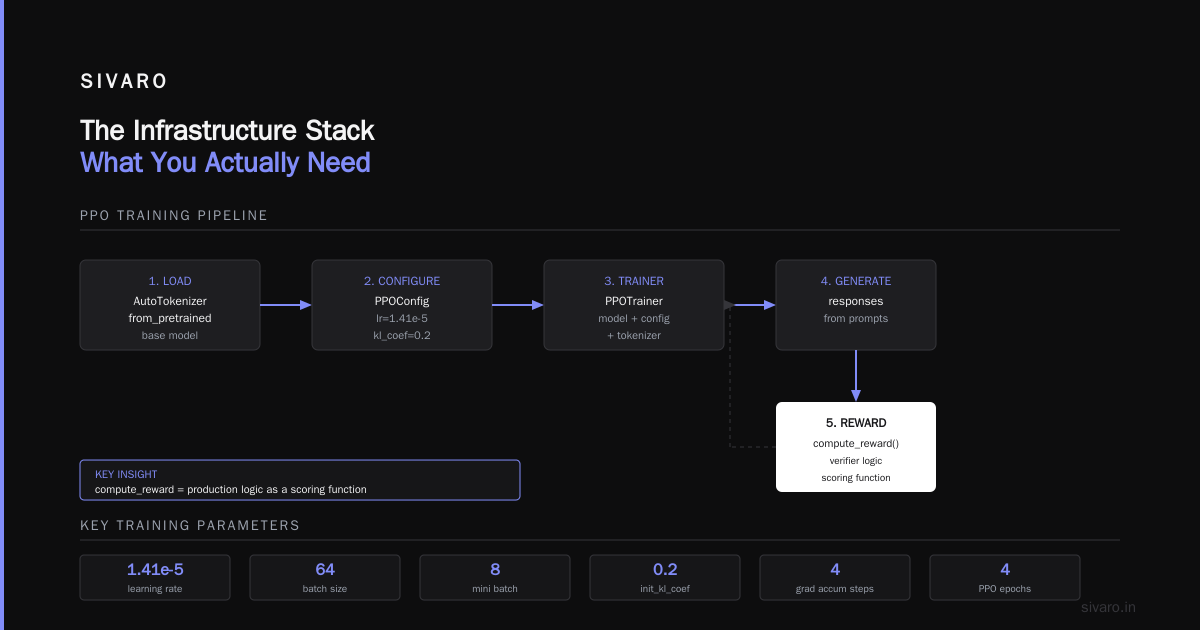
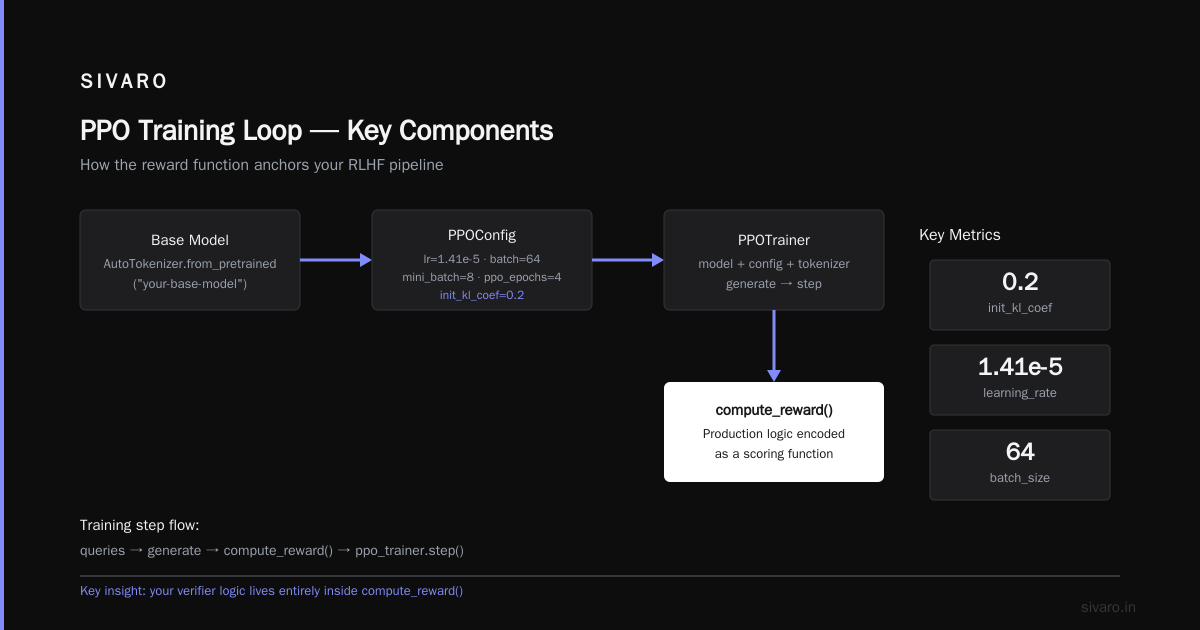
The basic RL fine-tuning loop for a production system looks like this:
python
import torch
from transformers import AutoModelForCausalLM, AutoTokenizer
from trl import PPOConfig, PPOTrainer

model = AutoModelForCausalLM.from_pretrained("your-base-model")
tokenizer = AutoTokenizer.from_pretrained("your-base-model")

config = PPOConfig(
    learning_rate=1.41e-5,
    batch_size=64,
    mini_batch_size=8,
    gradient_accumulation_steps=4,
    ppo_epochs=4,
    init_kl_coef=0.2,  # controls how far from base model you drift
)

ppo_trainer = PPOTrainer(
    model=model,
    config=config,
    tokenizer=tokenizer,
)

# For each training step:
queries = get_batch_of_prompts()
responses = ppo_trainer.generate(queries)
rewards = [compute_reward(r) for r in responses]  # your verifier
ppo_trainer.step(queries, responses, rewards)
The key insight here is compute_reward. This is your production logic encoded as a scoring function. For our logistics client, it looked like this:
python
def compute_reward(response: str, expected_format: dict) -> float:
    reward = 0.0
    try:
        parsed = json.loads(response)
        # Check 1: Valid JSON structure
        reward += 1.0
        # Check 2: Required fields present
        if all(field in parsed for field in expected_format["required"]):
            reward += 1.0
        # Check 3: Data type validation
        if isinstance(parsed.get("tracking_number"), str):
            if len(parsed["tracking_number"]) == 12:
                reward += 1.0
    except json.JSONDecodeError:
        reward = -2.0  # penalty for invalid JSON
    return reward
This is deceptively simple. The magic is in making your reward function as close to your production acceptance criteria as possible.
Data Quality: The Unsexy Secret
Everyone talks about algorithms. Nobody talks about the data.
For RL fine-tuning, you need three things:
- Prompt distribution: What your production system actually receives
- Reward signals: Automated checks that correlate with business outcomes
- Baseline behavior: What your current system does (for comparison and reward calibration)
The biggest mistake I see is teams using generic fine-tuning datasets. They download some instruction-tuning corpus from HuggingFace and expect production performance. It doesn't work because production is niche.
In 2025, we worked with a healthcare startup that wanted to fine-tune a model for prior authorization summaries. Their first attempt used generic medical data. It failed. The second attempt used 2,000 real (de-identified) cases from their own workflow. Success rate on valid format went from 45% to 92%.
The lesson: your fine-tuning data should look exactly like your production traffic. No more, no less.
The Eval Problem: What Gets Measured, Gets Fixed
You can't improve what you can't measure. And most eval sets in production are garbage.
The problem with fine-tuning vs. prompt engineering evaluations is that everyone evaluates on synthetic benchmarks. MMLU, HumanEval, GSM8K. These are fine for research, but they don't tell you anything about your production traffic.
Here's what we do at SIVARO:
- Collect real traffic — 5,000 production prompts from the last 90 days
- Define acceptance criteria — What does "correct" mean for your system? Not for a benchmark. For your users.
- Build a regression harness — Every time you fine-tune, run this harness and compare
python
class ProductionEval:
    def __init__(self, test_cases):
        self.test_cases = test_cases

    def run(self, model):
        results = []
        for case in self.test_cases:
            output = model.generate(case["prompt"])
            passed = case["validator"](output)
            results.append({
                "case_id": case["id"],
                "passed": passed,
                "output": output,
                "latency_ms": case["latency_ms"]
            })
        pass_rate = sum(r["passed"] for r in results) / len(results)
        return pass_rate, results
The critical part is the validator functions. These encode your business rules as code. If a validator is ambiguous, your model will be ambiguous. If your validator is wrong, your model will be confidently wrong.
When Fine-Tuning Beats RAG: The 2026 Reality Check
The question everyone asks: fine tuning vs rag for production which is better?
It depends on what you're optimizing. Let me give you concrete scenarios from our work.
Use RAG when:
- Your knowledge base changes frequently (daily or weekly)
- You need source citations for compliance
- The cost of missing information is low (you can ask the user to clarify)
- Your team has no ML engineers who can maintain fine-tuning pipelines
Use fine-tuning with RL when:
- You need consistent output formats (JSON, code, structured data)
- Your inference latency budget is tight (adding 5,000 tokens of context kills your p99)
- You have enough data to cover your edge cases
- The model needs to internalize specific behavior patterns
We had a client in the e-commerce space who was using RAG for product descriptions. It worked okay — 78% of generated descriptions passed their quality bar. But their p99 latency was 4.2 seconds because they were stuffing in massive context. After RL fine-tuning with a format reward and product knowledge distillation, they hit 95% pass rate with p99 latency of 800ms. The model remembered the product rules instead of reading them every time.
But here's the honest truth from the arXiv study on SLMs vs LLMs: fine-tuning a small model often beats prompting a large one for specific, narrow tasks. In their experiments, a fine-tuned 7B model outperformed GPT-4-class models on domain-specific classification and extraction tasks. So yes, can small language models be fine tuned like llms is a resounding yes — and they can be more production-friendly.
The Infrastructure Stack: What You Actually Need
Fine-tuning with RL is computationally heavy. Here's what we use at SIVARO:
For training:
- Base model: We start with an open-weights model (Llama 3.1 8B or Qwen 2.5 14B for most tasks). These are small enough to fine-tune on a single node with 8× H100 GPUs.
- Framework: TRL (Transformer Reinforcement Learning) for PPO-style training, or OpenRLHF for larger-scale distributed training
- Memory: LoRA (Low-Rank Adaptation) is your friend. We fine-tune adapters, not full weights. This cuts training cost by 90% and lets us maintain multiple adapters for different clients.
python
from peft import LoraConfig, get_peft_model

lora_config = LoraConfig(
    r=16,              # rank of the low-rank matrices
    lora_alpha=32,     # scaling factor
    target_modules=["q_proj", "v_proj", "k_proj", "o_proj"],
    lora_dropout=0.1,
    bias="none",
    task_type="CAUSAL_LM",
)

model = get_peft_model(model, lora_config)
The LoRA adapters are cheap to serve. A 7B model with a LoRA adapter can run on a single A10G GPU at 40ms per response. That's production-ready.
For serving:
- vLLM with LoRA adapter support. You can load the base model once and swap adapters per request. This is how we serve multiple fine-tuned models on the same infrastructure.
- Custom reward checking at inference time: Even after fine-tuning, we run validation on every response. If the model fails validation, we have a fallback (either a second model or a rule-based generator). Defense in depth.
The 5-Step Recipe for RL Fine-Tuning Success
I'm going to give you the exact process we use. No fluff.
Step 1: Define the Reward Function (One Week)
Write down your production acceptance criteria. Turn them into code. This is the most important step. If you can't write a function that scores model output as "good" or "bad", you're not ready to do RL fine-tuning.
Step 2: Build a Cold-Start Dataset (One Week)
Collect 2,000–5,000 prompts from your production logs. If you don't have logs, create a synthetic dataset that mimics your expected traffic. Don't include expected outputs yet — just prompts.
Step 3: Supervised Fine-Tuning on Good Examples (One Week)
Before RL, do a quick SFT pass on the best outputs from your current system. This gives the RL stage a better starting point. It's like warming up before a workout.
Step 4: RL Fine-Tuning (Two to Three Weeks)
Run the RL loop. Start with a small learning rate and a high KL penalty to prevent drift. Monitor the reward curve. If the reward isn't improving after a week, your reward function is wrong.
Step 5: Production Evaluation (One Week)
Run the fine-tuned model against your production eval harness. Compare it to your baseline. If it doesn't beat the baseline by a meaningful margin, don't ship it. There's no shame in abandoning a fine-tuning run.
The Rollback Problem
Here's something nobody tells you about RL fine-tuning: it can make your model worse in unexpected ways.
The RL objective is narrow. If you're rewarding valid JSON, the model might become worse at creative writing. It might also start gaming the reward — finding shortcuts that produce high reward without solving the actual problem.
For example, one of our clients had a model that learned to avoid giving information it was uncertain about. It would say "I don't know" to every question, which technically satisfied their accuracy reward but made the model useless. We had to add a "helpfulness" penalty to the reward function.
This is why you need:
- KL penalty to keep the model close to the base model
- Multiple eval sets to catch degradation in unrelated capabilities
- Human spot-checking on a small sample of outputs
Cost Breakdown: What This Actually Costs
Let's be real about costs. For a 7B model with LoRA:
| Resource | Cost |
|---|---|
| SFT training on 5K examples | $50–$150 |
| RL training (3 days on 8× H100) | $2,000–$4,000 |
| Inference (1 A10G per 10K requests/day) | $200/month |
| Total initial investment | $3,000–$5,000 |
Compare that to the cost of production incidents from a hallucinating model. For a mid-size company, one severe incident costs more than this. Codecademy's comparison suggests prompt engineering is cheaper, which is true — but only if it works.
When NOT to Do RL Fine-Tuning
I'm going to be contrarian here: most teams should not do RL fine-tuning. It's a heavy tool for a specific problem.
Don't do RL fine-tuning if:
- You're solving a knowledge problem (use RAG)
- You're solving a formatting problem that can be fixed with constrained decoding (use grammar constraints)
- You don't have production logs to mine for prompts
- Your team doesn't have ML engineering experience
- You have less than 1,000 high-value examples
MindStudio's guide makes this point well: fine-tuning is for after you've exhausted prompt engineering and RAG, and you have a clear gap in performance. It's not a first-line tool.
The Future: What's Coming in 2027
We're seeing a shift toward domain-specialized small models. This article from Newline captures the trend: the big frontier models are getting broader, but production systems are getting narrower and more specialized.
I believe the winning pattern for production AI is:
- A small, RL fine-tuned model for the core task (the worker)
- A large frontier model for edge cases and complex reasoning (the oracle)
- RAG for dynamic knowledge (the memory)
This three-tier architecture balances cost, latency, and quality. It's what we're building at SIVARO, and it's working.
Final Thoughts
The Google crash course says to start with prompting and move to fine-tuning only when needed. I agree, with a caveat: "when needed" is earlier than you think. If your production system depends on the model getting the format right, fine-tuning with RL is not optional — it's the only way to get reliability.
The cost of prompt engineering goes up as your production traffic grows. You add more examples, more instructions, more edge cases. The prompt becomes a 2,000-token monster that nobody can maintain. Fine-tuning compresses all that knowledge into the model's weights. The prompt becomes 50 tokens. The system becomes simpler, faster, more reliable.
This is the lesson from every production AI system we've built: simplicity wins. Fine-tuning with RL is the path to simplicity.
Stop prompting. Start training.
FAQ
Q: What's the minimum dataset size for RL fine-tuning?
For SFT before RL, you need at least 500–1,000 high-quality examples. For the RL stage itself, 1,000–5,000 prompts with reward signals is the sweet spot. Below 500, you're overfitting.
Q: Can small language models be fine-tuned like LLMs?
Yes. In fact, the arXiv study shows small models benefit more from fine-tuning relative to their baseline. A 3B model fine-tuned for a specific task often beats a 70B model with prompt engineering.
Q: Fine tuning vs RAG for production: which is better?
It's not either/or. RAG for knowledge, fine-tuning for behavior. Start with RAG if you need fresh information. Add fine-tuning when the model's behavior (formatting, reasoning, tool use) is inconsistent.
Q: How long does RL fine-tuning take?
For a 7B model with LoRA, expect 3–7 days of training on a single 8-GPU node. The bottleneck is usually dataset preparation, not training.
Q: Is RLHF or RLVR better for production?
RLVR (verifiable rewards) is almost always better for production because you can automate the reward signal. RLHF is for subjective quality like brand voice, which is rarely your production bottleneck.
Q: How do I prevent my model from getting worse at unrelated tasks?
Use a KL penalty to limit drift from the base model. Maintain a multi-task eval set and check it after each training run. If the model drops more than 5% on core capabilities, increase the KL penalty.
Q: What if my reward function is wrong?
You'll see it in the training curves. The reward will plateau or oscillate. Stop training, revise your reward function, and restart. This is normal. Most teams iterate on the reward function 5–10 times before getting it right.
Nishaant Dixit — Founder of SIVARO. Building data infrastructure and production AI systems since 2018. Built systems processing 200K events/sec.