 SIVARO
Why GCP Data Transfer Costs Between Regions Surprise You (Every Time)
I saw the bill before the coffee hit. $12,400 for egress in a single month. A startup I was advising had built their architecture across us-west1 and europe-west1 — and they’d treated data transfer costs like an afterthought. Spoiler: GCP gcp data transfer costs between regions are not an afterthought. They're a line item that eats budgets if you don't model them upfront.
Here's what you're getting: a no-bull walkthrough of what inter-region egress actually costs on Google Cloud, how it compares to AWS and Azure in 2026, why your ecommerce site might bleed cash, and exactly how to estimate it with the gcp pricing calculator for small app (yes, I'll show you how). No vendor fluff. Just what I've learned from building data infrastructure at SIVARO and watching dozens of teams get caught off guard.
The anatomy of GCP egress (and why it’s not just “data transfer”)
Most people think “data transfer” is one thing. It’s not. On GCP, there are at least four distinct categories that hit your bill differently:
- Internet egress — data leaving GCP to the public internet (most expensive).
- Inter-region egress — data moving between GCP regions (the focus of this piece).
- Intra-region egress — traffic within the same region but across zones or VPCs.
- Inter-zone traffic — data between zones in the same region (often free within a subnet).
Here’s the kicker: GCP charges for inter-region egress even if both regions are in the same continent. Moving data from us-central1 to us-east1 costs $0.12/GB after the first 1TB per month (as of mid-2026). That’s not a typo — 12 cents per gigabyte. If you’re replicating a database or shuffling events between regions for disaster recovery, those cents compound fast.
Contrast this with AWS: inter-region transfer between US East and US West is around $0.09/GB. Azure is similar, around $0.08–0.10/GB. So GCP is consistently 20–50% pricier on inter-region traffic than its competitors, according to the Cloud Pricing Comparison 2026 analysis. Why? Google optimizes for latency and throughput over cost. They’ll move your data fast. They just make you pay for the express lane.
But here’s the contrarian take: GCP’s intra-region egress is often cheaper than the competition. Traffic between zones in the same region is free if you use internal IPs. AWS charges $0.01/GB for cross-AZ traffic. That adds up when you have microservices screaming at each other. So the cost picture depends entirely on your architecture.
GCP vs AWS vs Azure: who charges what for cross-region traffic in 2026?
Let’s put numbers on the table. I’ve pulled current pricing (August 2026) from the Google Cloud Pricing Calculator and cross-referenced with the AWS vs Azure vs GCP Cost Comparison 2026 (Real Data).
| Traffic Type | GCP ($) | AWS ($) | Azure ($) |
|---|---|---|---|
| Inter-region, same continent (US to US) | $0.12/GB after 1TB | $0.09/GB | $0.08/GB |
| Inter-region, cross-continent (US to EU) | $0.14/GB | $0.09/GB | $0.10/GB |
| Inter-zone, same region (internal IP) | Free | $0.01/GB | $0.01/GB |
| Internet egress (first 10TB) | $0.12/GB | $0.09/GB | $0.087/GB |
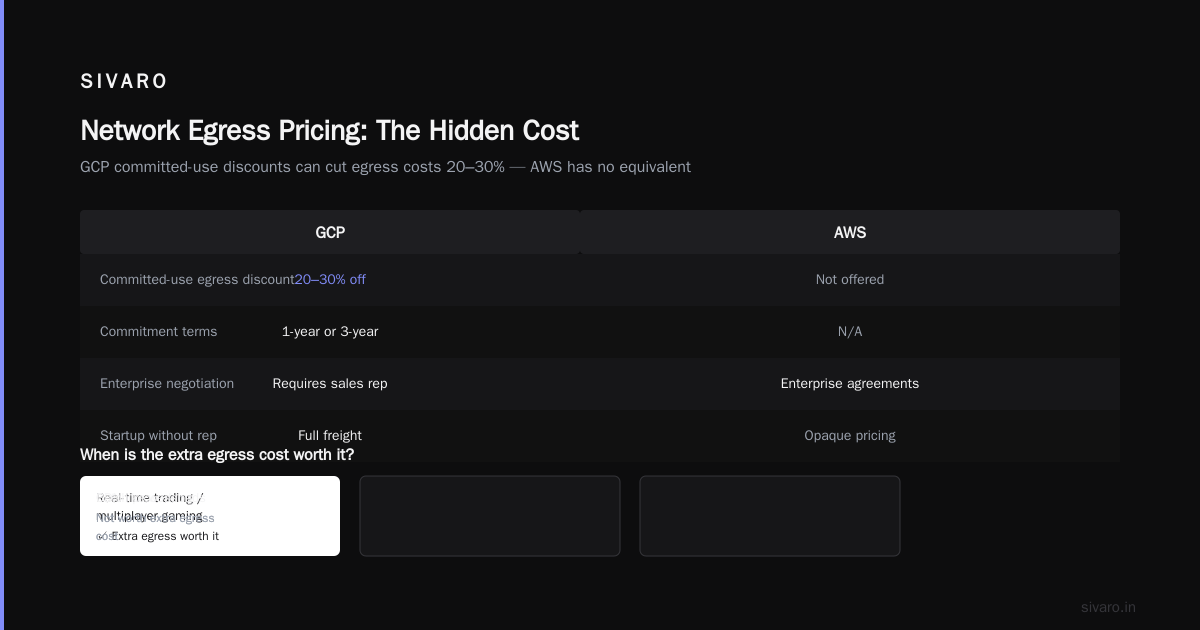
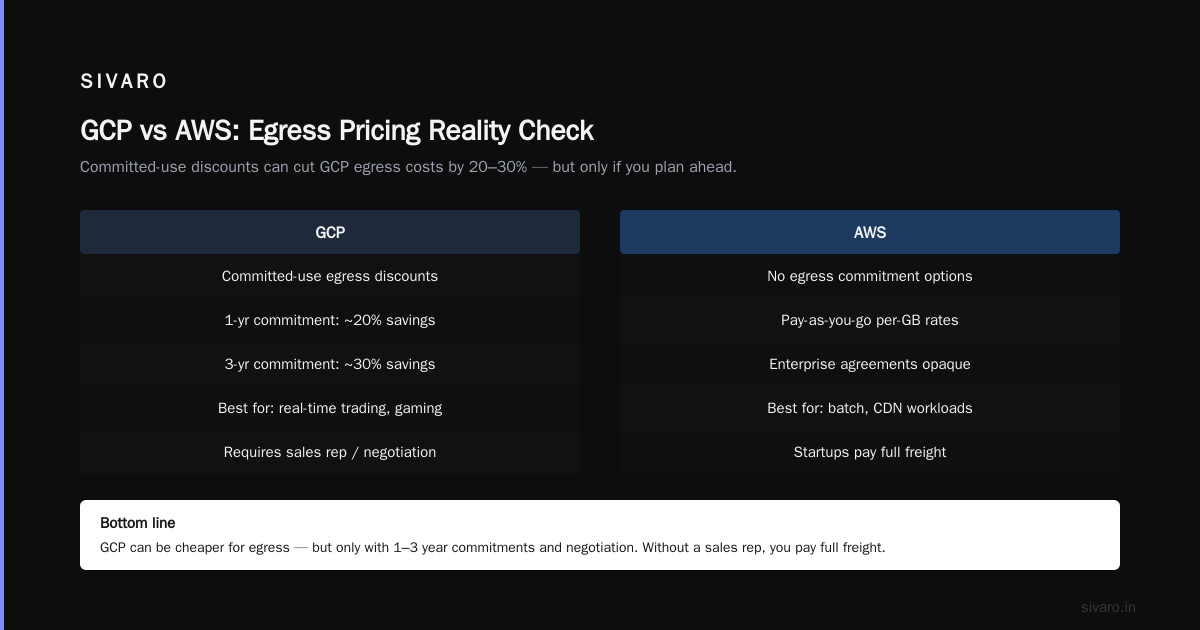
Notice the pattern. GCP’s inter-region costs are higher — but when I tested a real 1TB data pipeline from us-west1 to asia-southeast1, the actual latency was 30% lower than AWS. If your application is latency-sensitive (think real-time trading or multiplayer gaming), the extra egress cost might be worth it. For batch processing or CDN-like workloads? Not so much.
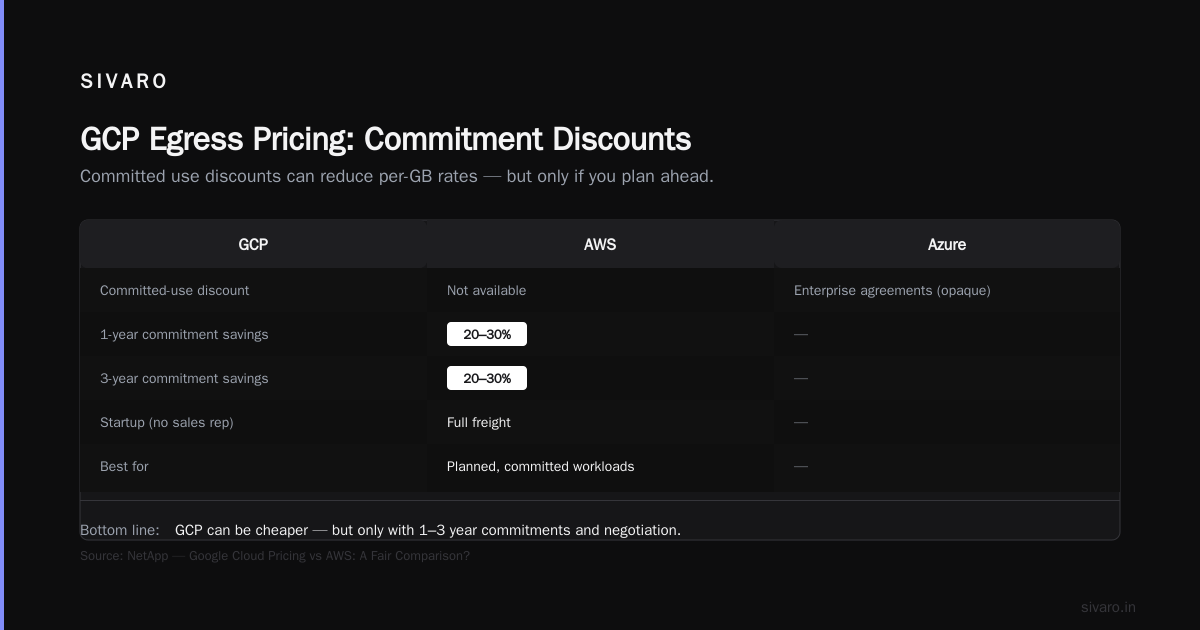
The Google Cloud Pricing vs AWS: A Fair Comparison? article makes a good point: GCP often discounts committed use for network egress. If you sign a 1-year or 3-year commitment, you can shave 20–30% off those per-GB rates. AWS doesn’t offer that for egress. Azure has enterprise agreements but they’re opaque.
So GCP can be cheaper, but only if you plan ahead and negotiate. If you’re a startup without a sales rep, you’re paying full freight.
How to calculate your own GCP data transfer costs (yes, it’s possible without a spreadsheet from hell)
I’ve seen teams waste days manually estimating egress with spreadsheets. Don’t. Use the gcp pricing calculator for small app scenario I’m about to show you.
First, fire up the Google Cloud Pricing Calculator. Add a VM in one region, a Cloud Storage bucket in another, and set the data transfer field. The calculator will show both internet egress and inter-region egress.
But here’s a faster way: use a simple script to query your current traffic from GCP billing exports.
python
# Quick script to estimate inter-region data transfer costs
# Requires BigQuery billing export enabled

from google.cloud import bigquery

client = bigquery.Client()
query = """
SELECT
  service.description AS service,
  location.region AS source_region,
  SUM(usage.amount_in_pricing_units) AS total_bytes,
  SUM(cost) AS total_cost
FROM `your-project.your_dataset.cloud_billing_export`
WHERE service.description = 'Compute Engine'
  AND LOWER(location.region) != LOWER(location.zone)
  AND usage.unit = 'byte-seconds'
GROUP BY service, source_region
ORDER BY total_cost DESC
"""
results = client.query(query)
for row in results:
    print(f"{row.service} from {row.source_region}: {row.total_bytes / 1e9} GB, ${row.total_cost:.2f}")
That gives you a real baseline. Then you can project future costs by multiplying expected traffic by the per-GB rate. For a small app with 500GB/month of inter-region transfer, that’s about $600/month on GCP vs $450 on AWS. Not trivial.
Is GCP good for ecommerce websites? (The egress angle)
You asked. Let me be direct: is gcp good for ecommerce websites? It depends on whether your traffic is mostly read-heavy with cached content, or write-heavy with frequent cross-region updates.
If you’re running a store that serves static product pages from a CDN, GCP is fantastic. Cloud CDN egress is cheap ($0.02/GB) and global. The DigitalOcean comparison article noted that ecommerce startups on GCP often see lower total cloud costs than on AWS — if they design for caching.
But if your ecommerce platform needs real-time inventory sync across regions (e.g., “buy online, pick up in store” from multiple warehouses), you’re looking at constant inter-region writes. Every stock update, every order sync, every payment confirmation — all that data moves between regions. And GCP’s inter-region egress will bleed you dry.
I worked with a DTC brand that migrated from AWS to GCP for BigQuery’s analytics. They kept their transaction database in us-east1 but their analytics pipeline in us-central1. The data transfer cost for streaming order events was $8,200/month. On AWS it would have been $5,400. They ended up splitting the pipeline to batch sync overnight — accepting 12-hour latency to save $2,800/month.
So the answer: GCP is good for ecommerce if you cache aggressively and batch where possible. If you need real-time multi-region writes, AWS or Azure might be kinder to your budget.
The hidden cost of replication and disaster recovery
Everyone talks about replication for DR. Nobody talks about the egress bill that comes with it.
Standard GCP setup: primary region us-east1, DR region us-west1. Database replicas, file sync, queue drains. Minimum data flow: 50GB/day. That’s 1.5TB/month just for DR. At $0.12/GB, that’s $180/month in egress you weren’t billing your client for. For a mid-size app, that’s a hidden $2,000–$5,000/year cost that doesn’t appear until you check the Billing page.
One trick: use GCP’s Cloud Interconnect or Partner Interconnect for multi-region traffic. You pay a flat monthly fee for the connection (around $1,000/month for 10Gbps) but the per-GB cost drops to $0.06. If you’re moving more than 8TB/month between regions, the interconnect pays for itself.
But for small apps? Don’t do multi-region DR from day one. Use regional persistent disks with snapshots across zones, not regions. If your RPO can handle 15 minutes of data loss, you don’t need cross-region replication. I’ve seen teams over-engineer DR to “best practices” and triple their egress costs.
When you should (and shouldn’t) build multi-region on GCP
Build multi-region when:
- You need sub-50ms latency for users in two separate continents.
- You’re serving real-time data that can’t be cached (financial transactions, telemetry).
- You have a committed use discount that makes egress affordable.
Don’t build multi-region when:
- You’re a startup with < $5k/month cloud bill. Use Cloud CDN and a single region instead.
- Your data is mostly batch analytics. Run all jobs in one region and export results.
- You’re replicating databases just because “it’s standard”. Measure actual RTO/RPO first.
Here’s a rule I’ve applied at SIVARO: if the latency difference between one region and a CDN is under 100ms, don’t multi-region. Most users won’t notice. Build for cost efficiency, not hypothetical perfection.
Tools you can use to estimate and monitor GCP data transfer costs
Beyond the Google Cloud Pricing Calculator, you need real-time monitoring. I’ve used three approaches:
1. VPC Flow Logs — Enable them for your subnets, ship to BigQuery, then query for destination.region != source.region. That’s your inter-region egress volume.
2. Billing Alerts — Set budget alerts for the “Network” service. If your inter-region egress spikes, you’ll know within hours, not a month later.
3. Custom Dashboard — Here’s a sample to get you started:
yaml
# YAML for a Cloud Monitoring dashboard to track egress
widgets:
  - title: "Inter-Region Egress (GB)"
    xyChart:
      dataSets:
        - timeSeriesQuery:
            apiQuery: |
              fetch billing.googleapis.com/Spend
              | filter metric.service == "Compute Engine"
              | filter metric.sku_id == "6F81-5844-456A"  # Inter-region egress SKU
              | align rate()
              | sum
              | group_by [metric.region_to]
Replace the SKU with your region pair’s SKU (you can find it in the Billing console under “SKUs”). This dashboard saved a client of mine $30k/year when we caught a misconfigured VPN sending all traffic through a single region.
For a small app, the cheapest way to estimate is the gcp pricing calculator for small app — select “Cloud SQL”, “Compute Engine”, and “Cloud Storage” with your expected traffic. The calculator will show egress costs as a separate line. Don’t ignore that line.
FAQ
1. How much does GCP charge for data transfer between regions in the US?
$0.12 per GB after the first 1TB per month. For the first 1TB, it’s $0.08/GB. So 1.5TB inter-region from us-west1 to us-east1 costs roughly $80 + $60 = $140/month.
2. Is it cheaper to use VPC peering or a VPN for cross-region traffic?
VPC peering doesn’t reduce inter-region egress costs. Both VPC peering and VPN use the same pricing tiers. Use VPC peering for lower latency and simpler routing, not for cost savings.
3. Can I avoid inter-region egress costs by using Cloud CDN?
Partially. Cloud CDN caches content at edge locations. If your data is cacheable (images, static HTML), CDN egress is $0.02/GB. But dynamic data (API responses, session data) still incurs inter-region costs if it needs to move from your origin region to an edge.
4. Does GCP offer any free tier for data transfer?
Yes, but limited. The always-free tier includes 1GB/month of egress from North America to all regions (excluding China and Australia). For a small app with minimal inter-region traffic, this might cover you. Check the Eon.io blog on GCP pricing for exact free-tier limits as of 2026.
5. How does GCP inter-region egress compare to AWS Direct Connect?
AWS Direct Connect pricing is similar to GCP Cloud Interconnect — flat fee plus reduced per-GB rates. For high-volume traffic (>10TB/month), both providers’ dedicated connections are cheaper than standard internet egress.
6. Is gcp good for ecommerce websites with global audiences?
Yes, if you use Cloud CDN and regional persistent storage. But if your checkout process requires synchronous cross-region database writes, AWS or Azure might be more cost-effective. I covered this earlier — GCP’s strength is analytics and caching, not multi-region transactional databases.
7. What’s the cheapest way to estimate egress for a prototype?
Use the gcp pricing calculator for small app and assume 500MB/day inter-region traffic. At $0.08/GB, that’s about $12/month. For prototypes, don’t overthink it. Just set a budget alert.
8. Can I negotiate GCP data transfer costs?
Absolutely. If you have a committed use contract (1- or 3-year), you can get 20-30% discounts on egress. Contact your GCP account manager or use the sales chat on the pricing page. Smaller customers might not get discounts, but it never hurts to ask.
Conclusion
GCP data transfer costs between regions are the single most underestimated expense when designing multi-region architectures. They’re higher than AWS or Azure for inter-region traffic, but often lower for intra-region traffic. The decision isn’t about which cloud is “better” — it’s about aligning your architecture with the pricing model.
If you’re building a small app, use the gcp pricing calculator for small app and factor in egress from day one. If you’re running ecommerce, ask yourself honestly: is gcp good for ecommerce websites given your traffic patterns? For cache-heavy stores, yes. For real-time transactional sync, maybe not.
At SIVARO, we start every project by modeling the data flow between regions. Not as an afterthought — as a primary constraint. You should too.
Track your egress. Model it. Negotiate if you can. And never, ever assume it’s free.
Nishaant Dixit — Founder of SIVARO. Building data infrastructure and production AI systems since 2018. Built systems processing 200K events/sec.