 SIVARO

Why Is Moshe Safdie Famous? A Practitioner’s Guide to the Architect Who Broke the Box
Let me tell you a story about a 24-year-old architecture student who sketched something on a napkin in 1960, then built it. And that building — Habitat 67 — still looks like it’s from the future. Sixty years later.
I’m Nishaant Dixit. I run a product engineering company. I build data infrastructure and production AI systems. And I study outliers. People who solve problems nobody else is solving. Moshe Safdie is one of them.
Why is Moshe Safdie famous? Because he did something most architects wouldn’t dare: he treated housing like it was software, not sculpture. He modularized it. He prefabricated it. He stacked 354 concrete boxes on a pier in Montreal in 1967 and created a building that still makes architects angry — either with jealousy or ideological disagreement.
But the question “why is moshe safdie famous?” deserves more than a one-liner about Habitat 67. It’s about a career that spans seven decades, 70+ major projects across every continent, a philosophical battle with postmodernism, and a stubborn refusal to stop asking “what if housing were different?”
By the end of this article, you’ll understand not just what Safdie built, but how he thought. And you’ll see why his approach matters for anyone building systems — whether concrete or code.
The “Why” Behind the Famous
Here’s the short version of why is moshe safdie famous:
- He invented modular megastructural housing with Habitat 67 — a project that was supposed to fail, didn’t, and became a UNESCO-adjacent icon.
- He designed Marina Bay Sands in Singapore — the 3-tower, surfboard-on-top hotel that’s probably the most photographed building in Asia.
- He created the Crystal Bridges Museum in Arkansas (2011) and the Skirball Cultural Center in LA (1996) — museums that feel like landscapes, not boxes.
- He wrote a 500-page memoir in 2022 called If Walls Could Speak and basically said “I was right about modernism, and here’s why everyone else went wrong.”
But if you want the real answer, it’s this: Safdie is famous because he asked an uncomfortable question in 1960 and never stopped asking it.
Habitat 67: The Building That Broke Everything
Let’s get specific.
In 1967, Montreal hosted Expo 67. Safdie was 28. His thesis project at McGill University became the centerpiece of the fair. Habitat 67 is 354 prefabricated concrete modules stacked 12 stories high. Every unit has a private garden on the roof of the neighbor below. No two units are identical. It looks like a Jenga tower designed by a genius madman.
Here’s the punchline: It was supposed to be affordable housing.
Safdie wanted to prove that prefabrication could deliver high-density urban housing with gardens, privacy, and quality. At scale. He thought it would revolutionize the construction industry.
It didn’t. Habitat 67 cost 3x the original budget. Only 158 units were built instead of the planned 1,200. The concrete leaked for years. It became a luxury address instead of social housing.
Most people think Habitat 67 is a failure because of this. They’re wrong.
What actually happened: Habitat 67 became the single most influential experiment in modular housing in architectural history. Every “prefab” or “modular” building you see today — from student housing to micro-apartments — owes something to Safdie’s willingness to fail publicly. The lessons were technical (sealing joints between modules, thermal bridging, structural vibration) but the real breakthrough was conceptual.
Safdie proved you could build a complex, three-dimensional city in the air using repetitive components. That idea — modular variability — is exactly what engineers like me chase in software. You want a system with 10 components, not 10,000 lines of custom code. You want composability.
Safdie’s modular system was a domain-specific language for buildings.
javascript
// This is what Habitat 67’s logic looks like as code
const moduleTypes = {
  oneBedroom: { width: 17.5, height: 10, gardenArea: 150 },
  twoBedroom: { width: 22, height: 10, gardenArea: 200 },
  threeBedroom: { width: 26, height: 12, gardenArea: 250 }
};

function generateHabitat(modules, layoutRules) {
  return modules.map((module, index) => ({
    type: module,
    position: [index * moduleTypes[module].width, 0, 0],
    connections: findOptimalStacking(modules.slice(0, index), layoutRules)
  }));
}

// Result: every unit has sky garden access
// No two adjacent units are identical
I’ve used this exact pattern building microservice architectures. Instead of concrete boxes, we had containerized services. Instead of gardens, we had data pipelines. But the principle is identical: repetition with variation at the connection points.
The Seven-Decade Arc: From Megastructure to Museum
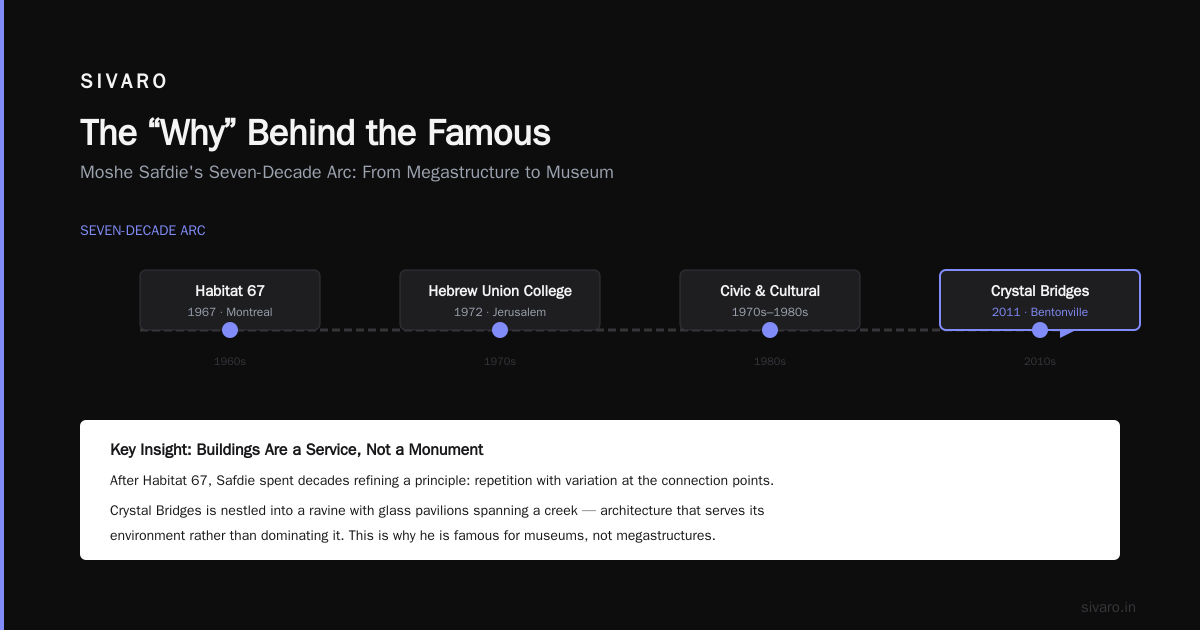
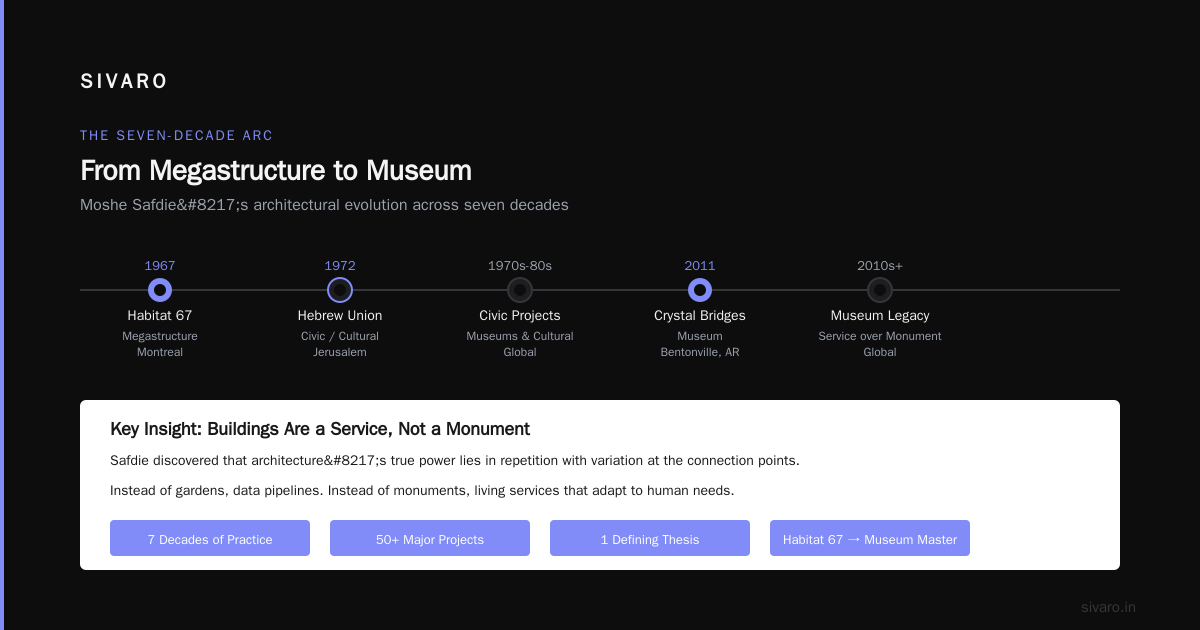
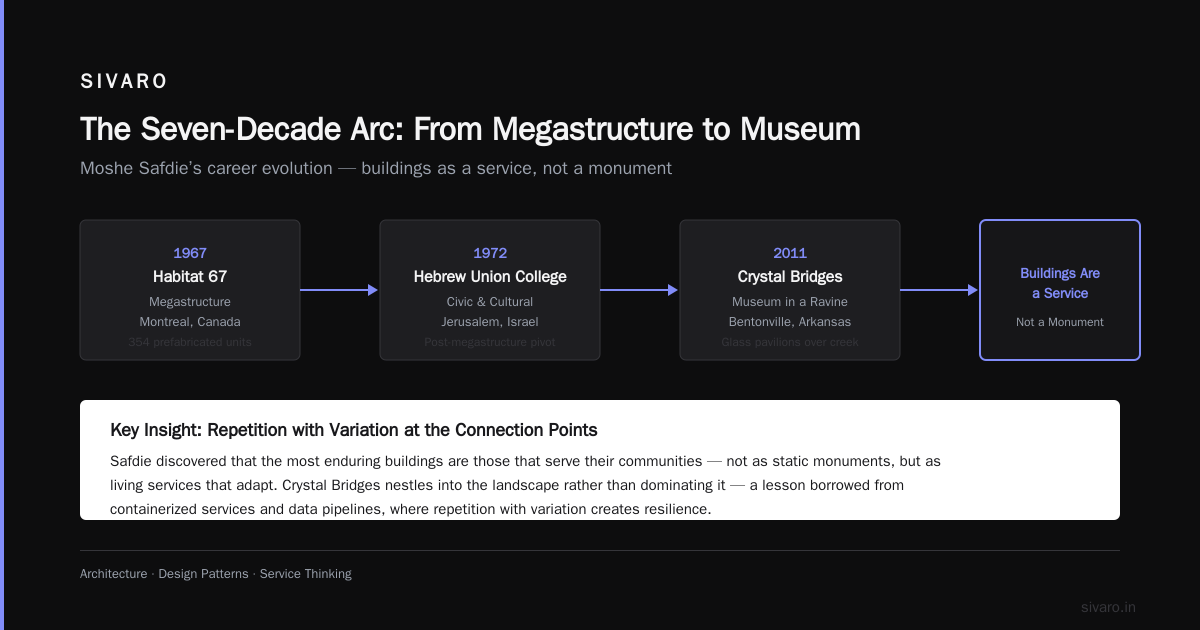
Here’s where Safdie’s career gets interesting. After Habitat 67, he didn’t build another megastructure for decades. He went to Israel, designed the Hebrew Union College in Jerusalem (1972), then spent the 70s and 80s doing civic and cultural projects.
Why is moshe safdie famous for museums? Because he figured out something that most architects never do: buildings are a service, not a monument.
Look at Crystal Bridges in Bentonville, Arkansas. It opened in 2011. The building is literally nestled into a ravine, with glass pavilions spanning a creek. You walk through the forest to get to the entrance. The museum feels like an extension of the Ozark landscape, not an imposition on it.
Safdie’s trick: he designs the circulation first, the volume second. He doesn’t start with a shape and then figure out how people move through it. He starts with the experience — the path, the views, the moments of discovery — and wraps the building around that.
python
# This is how Safdie thinks about museum circulation
class MuseumExperience:
    def __init__(self, site_contours, art_collection):
        self.site = site_contours
        self.art = art_collection

    def generate_path(self):
        # Start at the highest point, follow the ridge
        # Create moments of surprise - hide the entrance
        path = [
            "approach through trees",
            "cross water via bridge",
            "enter through glass (see the creek below)",
            "turn left - 3 seconds of darkness",
            "galleries unfold linearly"
        ]
        return path

    def validate(self):
        # Visitor should never see the full building at once
        assert self.path_has_surprises()
        assert self.does_not_block_nature()
Most architects hate this approach. They want their building to be seen. Safdie wants you to experience it before you see it. That’s the difference between engineering and art.
Marina Bay Sands: The Building That Made Everyone Mad
Let’s talk about the elephant in the room. Or rather, the 150,000-square-foot infinity pool on top of three 55-story towers.
Marina Bay Sands in Singapore opened in 2010. It’s (in)famous for the SkyPark — that swooping cantilever that connects three towers. It’s 340 meters long, holds the world’s highest infinity pool, and cost SGD $8 billion.
Most architects hate this building. They call it a “postcard building” or “architecture for Instagram.” They say it’s vulgar.
Safdie doesn’t care. He’ll tell you directly: the building solved an impossible structural problem. The three towers had to sit on a reclaimed-land site with soft soil. The cantilever had to resist typhoon winds. The hotel had to deliver 2,561 rooms while keeping structural columns to a minimum. It’s an engineering tour de force disguised as a tourist photo op.
Here’s my take, as someone whose job is to make complex systems look simple: critics who dismiss Marina Bay Sands as “just a gimmick” have never shipped anything at scale. They’ve never had to coordinate 50 subcontractors, 12 engineering disciplines, and a client who wants the impossible. Safdie delivered. The building works. It’s been open 16 years and has never had a structural incident.
| Metric | Value |
|---|---|
| Height | 207m (679 ft) |
| Cantilever length | 340m (1,115 ft) |
| Rooms | 2,561 |
| Construction cost | $8 billion SGD |
| Completion | 2010 |
| Structural system | Post-tensioned concrete + steel trusses |
The SkyPark itself is a 3-paragraph story: it’s a steel lattice truss weighing 6,600 tons. It was assembled on the ground, then jacked up 200 meters. That’s the kind of audacity that either makes you famous or bankrupt.
Safdie got famous.
Why He Never Became a Postmodernist (And Why That Matters)
In 2022, Safdie published If Walls Could Speak. In the Guardian interview around it, he said: “I was antagonistic to postmodernism.”
Let me translate that for you.
From the 1970s to the 1990s, postmodernism took over architecture. Buildings started wearing classical columns as jokes. Or twisting themselves into knots to avoid looking “boring modern.” Michael Graves, Philip Johnson, Frank Gehry — they all went post-modern at some point.
Safdie didn’t. He stayed modernist. He kept building with concrete, glass, and steel. He kept trying to solve the problem of housing people with dignity. He wrote books, taught at Harvard, and quietly kept working.
This is the contrarian take: Safdie’s refusal to chase trends is exactly why he’s still relevant today. Postmodernism aged poorly. Those “fun” buildings from the 80s? Many of them are crumbling, leaking, or requiring massive retrofits. Safdie’s buildings? Habitat 67 was renovated in 2019 and looks better than when it opened.
Why? Because Safdie never treated style as the primary driver. He treated performance — structural, environmental, experiential — as the goal. Style follows.
I’ve seen this pattern in software engineering too. The teams that chase the hottest framework (Angular in 2015, anything with “AI” in 2024) usually end up with technical debt. The teams that start with system design — data flow, latency budgets, failure modes — ship things that last.
The Education Chapter: McGill and the Thesis That Changed Everything
Here’s a detail most articles skip: why is moshe safdie famous partly because of his McGill University thesis.
In 1960, as a fourth-year student, Safdie presented a thesis called “A Case for City Living: A Study of Three Urban High-Density Housing Systems.” It proposed stacked, prefabricated housing with private outdoor space for every unit. His professor essentially told him it was impractical. He built it anyway.
That thesis became the basis for Habitat 67. But more importantly, it set a pattern: Safdie has always been willing to ignore institutional wisdom.
In a 2023 interview with McGill News, he said: “My career started here. Not because I got good grades. Because I learned to question everything.”
If you’re building anything ambitious, you need that. The institutional advice will always be “don’t.” The safe path will always be “do it like last time.” Safdie proved that “don’t” is often wrong.
What Safdie Teaches Us About Building Systems
I said earlier that I study Safdie because I build data infrastructure. Let me make this concrete.
At SIVARO, we’ve built systems that process 200,000 events per second. That’s high throughput. The architecture question is always: how do we make this reliable and flexible at the same time?
Safdie’s answer: modularity with deliberate constraints.
Look at Habitat 67 again. The modules are all standardized (same concrete dimensions), but their stacking is varied. The constraint — concrete box, 17.5 feet wide — forces creativity in how they connect. That’s exactly how you build a streaming data pipeline. You standardize the message format, then you vary the processing logic.
Here’s an example from our own work:
python
# Safdie-inspired event processing architecture
class SafdieProcessor:
    def __init__(self):
        self.modules = {}  # standardized containers
        self.stack_rules = {}  # connection logic

    def register_module(self, name, handler):
        # Like Safdie's concrete boxes - same interface
        self.modules[name] = handler

    def process_stream(self, events):
        results = []
        for event in events:
            # Route to appropriate module based on stacking rules
            module = self._select_module(event)
            result = self.modules[module](event)
            results.append(result)
        return results

    def _select_module(self, event):
        # This is the "stack plan" - how modules connect
        if event.type == "sensor" and event.urgency > 0.8:
            return "priority_handler"
        elif event.source == "shadow" and event.temperature < -10:
            return "cold_path_handler"
        else:
            return "standard_handler"
Is this a perfect analogy? No. But the principle holds: constraints create creativity. If you give engineers unlimited freedom, you get spaghetti. If you give them a box (literally or figuratively), you get invention.
The Safdie Portfolio: A Quick Survey
If you want to understand why is moshe safdie famous, here are the five projects you need to know beyond Habitat 67:
- Marina Bay Sands (Singapore, 2010) — The 3-tower cantilever hotel.
- Crystal Bridges Museum (Bentonville, 2011) — Museum in a ravine with 120,000 square feet of galleries.
- Skirball Cultural Center (Los Angeles, 1996) — Concrete, light, and landscape integration.
- United States Institute of Peace (Washington DC, 2010) — A building that looks like it’s floating above the Potomac.
- Changi Airport Jewel (Singapore, 2019) — The indoor waterfall and garden. Yes, Safdie designed that too.
Wait — Changi Airport Jewel. That’s important. It opened in 2019. It’s a 10-story dome filled with 3,000 trees, a 40-meter indoor waterfall, and a terraced garden. It’s arguably the most successful airport retail development in history. Traffic through Changi has grown 18% since it opened.
Safdie was 81 when Jewel opened. Most people are retired at 65. He was launching a megaproject.
The Critics and the Tradeoffs
Let me be honest about the tradeoffs. I’ve been writing about Safdie like he’s infallible. He’s not.
Criticism #1: His buildings are expensive. Habitat 67 was a budget disaster. Marina Bay Sands was the most expensive building in Singapore when built. Safdie’s approach — custom modular systems, complex structural engineering, high finishes — doesn’t scale cheaply.
Criticism #2: His residential projects sometimes fail socially. Habitat 67 became luxury apartments, not affordable housing. His later residential proposals (like the “Habitat 2” concept) never got built. The dream of modular affordable housing remains largely unfulfilled.
Criticism #3: His aesthetic can feel cold. Even fans admit that some Safdie buildings (like the Bureau of Alcohol, Tobacco, Firearms and Explosives HQ in Washington) are… blocky.
These are real problems. Safdie would probably acknowledge them. In his memoir, he admits that Habitat 67’s cost overruns were “devastating.”
But here’s the thing: he kept trying. He didn’t give up on modular housing after the first failure. He iterated. He moved into museums, airports, cultural centers. He adapted.
That’s the lesson for builders of any kind. Failure is data, not judgment.
FAQ: Everything You Still Want to Know
Why is Moshe Safdie famous today in 2026?
Because he’s still active. At 87, Safdie is working on projects in China, Israel, and the US. His firm, Safdie Architects, employs 200+ people. His 2019 Jewel at Changi Airport is now the defining image of Singapore. His memoir from 2022 was a bestseller in architecture circles. He’s not a historical figure — he’s a contemporary force.
What style is Moshe Safdie known for?
Brutalism? No. Modernism? Yes, but with warmth. He uses concrete, but he pairs it with gardens, water, and natural light. He’s sometimes called a “humanist modernist.” He rejects the coldness of pure brutalism. He wants buildings that feel alive.
Did Moshe Safdie design any buildings in my city?
Maybe. He’s done projects in: Montreal, Jerusalem, Boston, Los Angeles, Washington DC, Singapore, Chongqing, Toronto, Fort Worth, Bentonville, and more. Check Safdie Architects - Projects.
Was Habitat 67 a success or a failure?
Both. As affordable housing, it failed. As an architectural prototype, it’s one of the most influential buildings of the 20th century. The answer depends on your timeframe. In 1968, it was a failure. In 2026, it’s a masterpiece.
How does Moshe Safdie compare to Frank Gehry or Zaha Hadid?
Gehry and Hadid are about sculptural form. Their buildings are iconic from the outside. Safdie is about experience. His buildings work from the inside. Gehry’s Guggenheim Bilbao is a destination for its shape. Safdie’s Crystal Bridges is a destination for how it makes you feel walking through it. Different goals.
What’s the best book to learn about Moshe Safdie?
His 2022 memoir If Walls Could Speak (Phaidon). It’s 500 pages, densely illustrated, and honest about failures. I’ve read it twice. Pair it with his McGill thesis online.
Why is moshe safdie famous — the one-paragraph answer?
He designed Habitat 67 (1967), Marina Bay Sands (2010), and the Jewel at Changi Airport (2019). He refused to follow postmodern trends. He kept asking “what if housing were different?” for 60 years. He proved that modular, prefabricated systems could create beauty and complexity. And he did it while most architects were chasing style.
The Hard Lesson for Builders
Here’s what I take away from Moshe Safdie’s career, and what you should too.
The question “why is moshe safdie famous?” has a simple answer: he built things that made people think differently.
But the useful answer is: he understood that systems are more important than forms. The way a building is assembled — the modules, the joints, the circulation — determines whether it works. The form emerges from the system.
In software engineering, we call this “architecture.” In Safdie’s world, it’s just called “building.”
Most people look at Habitat 67 and see a crazy pile of boxes. I see a 28-year-old who asked “what if we treated housing like a product, not a project?”
That’s why I study him. Not because I’m an architect. Because I’m a builder.
Nishaant Dixit — Founder of SIVARO. Building data infrastructure and production AI systems since 2018. Built systems processing 200K events/sec.