 SIVARO
Why Is Moshe Safdie Famous? (And Why You Should Care)
I first heard Moshe Safdie’s name not from an architecture textbook, but from a software engineer at a Toronto meetup in 2024. He was ranting about how his apartment building’s layout reminded him of “those Habitat 67 blocks.” I looked it up, and within minutes I understood something: Safdie didn’t just build buildings. He built systems.
If you’re asking why is moshe safdie famous — the short answer is Habitat 67, Marina Bay Sands, Yad Vashem, and a career spent trying to compress a village into a skyscraper. But that list doesn’t tell you why his work still matters in July 2026, when housing costs are up 40% since 2020 and cities are desperate for density that doesn’t feel like a prison.
This article isn’t a biography. It’s a practitioner’s breakdown of the ideas that made Safdie famous, the trade-offs he wrestled with, and why a guy who builds concrete boxes should be studied by anyone who builds systems at scale.
The Roof Over Their Heads: Habitat 67 and the Birth of a Visionary
Safdie was 24 when he designed Habitat 67 as his McGill thesis. Twenty-four. Most of us at that age are still trying to figure out which data pipeline doesn’t crash. He proposed stacking 354 prefabricated concrete boxes into a three-dimensional neighborhood, each home with its own roof garden. The judges called it insane. He built it anyway.
Expo 67 in Montreal needed an icon. Habitat 67 became that icon — and it’s still the first thing that comes up when someone Googles “why is moshe safdie famous.” Moshe Safdie describes it as “a village in the sky.” Each unit is independent, cantilevered to give privacy and sunlight. The result looks like a child’s toy set that grew up and got serious.
Why does this matter to you? Because Habitat 67 solved a problem we’re still failing at: how to deliver density without sacrificing the human scale. Most high-rises are stacked hotel rooms — identical, anonymous, with corridors that smell like stale decisions. Safdie’s boxes gave each unit its own roof, its own corner of the sky. He traded efficiency for individuality.
The cost was brutal. Only 158 of the planned 1,000 units got built. The project was expensive, experimental, and nearly bankrupted its backers. Britannica notes that it “established his reputation as a visionary architect” — but visionary doesn’t pay the bills.
Here’s the lesson I took: if you’re building something truly new, the first version will be painful. Safdie’s 158 units cost him years of credibility in some circles. But those 158 units became the most photographed housing development of the 20th century. Fame isn’t free.
From Montreal to Marina Bay Sands: The Skybridge Philosophy
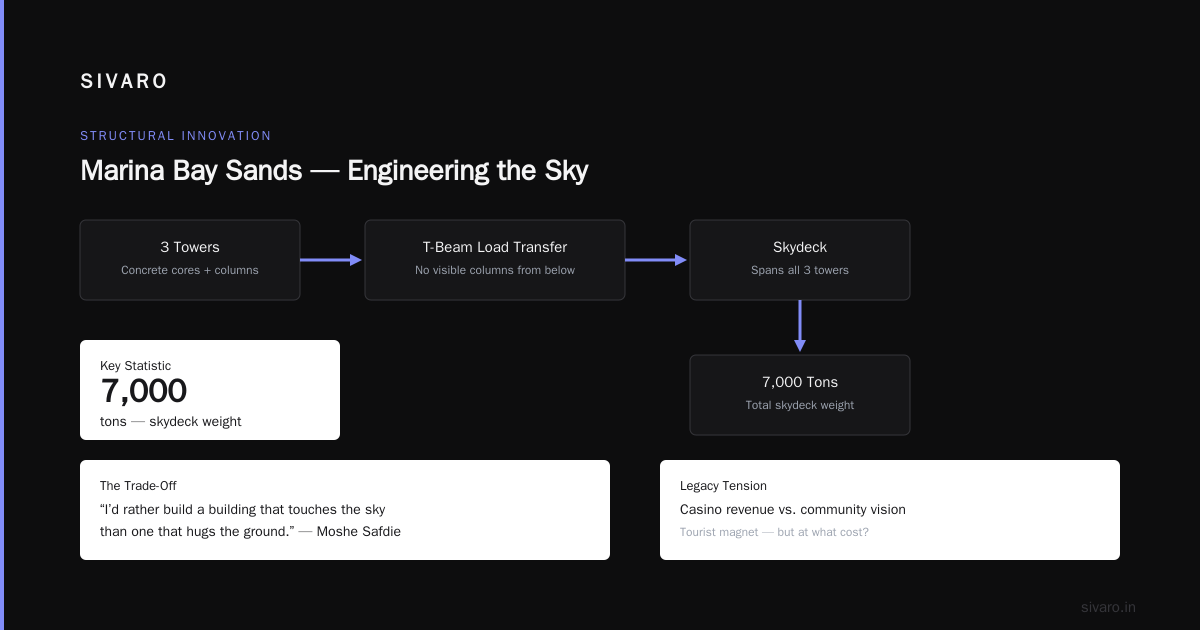
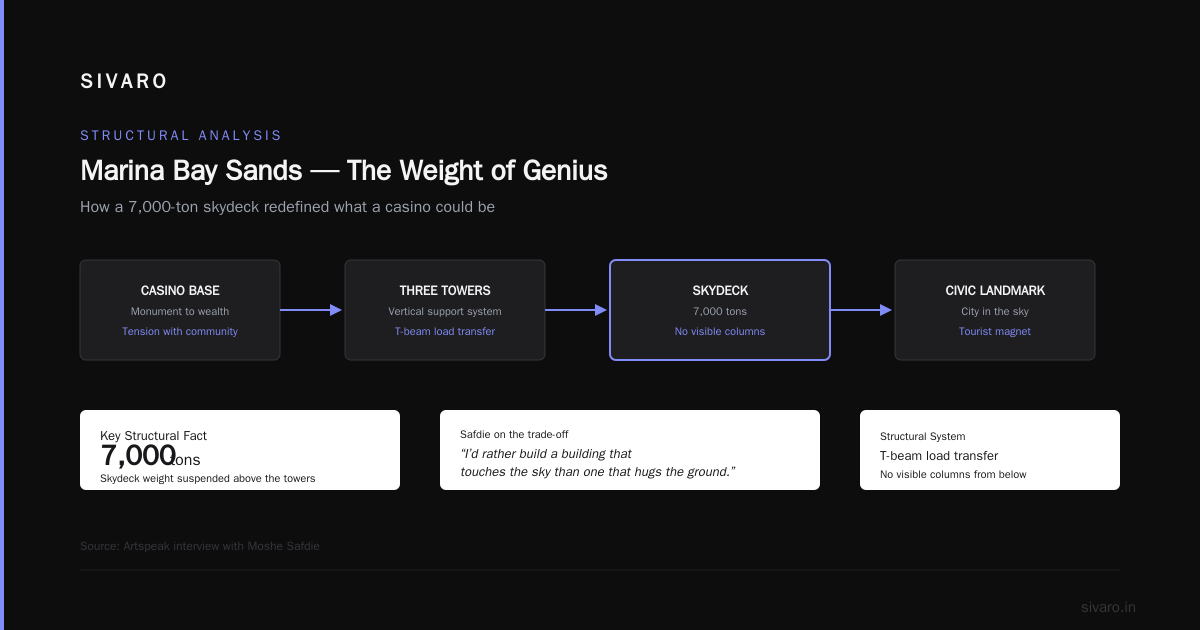
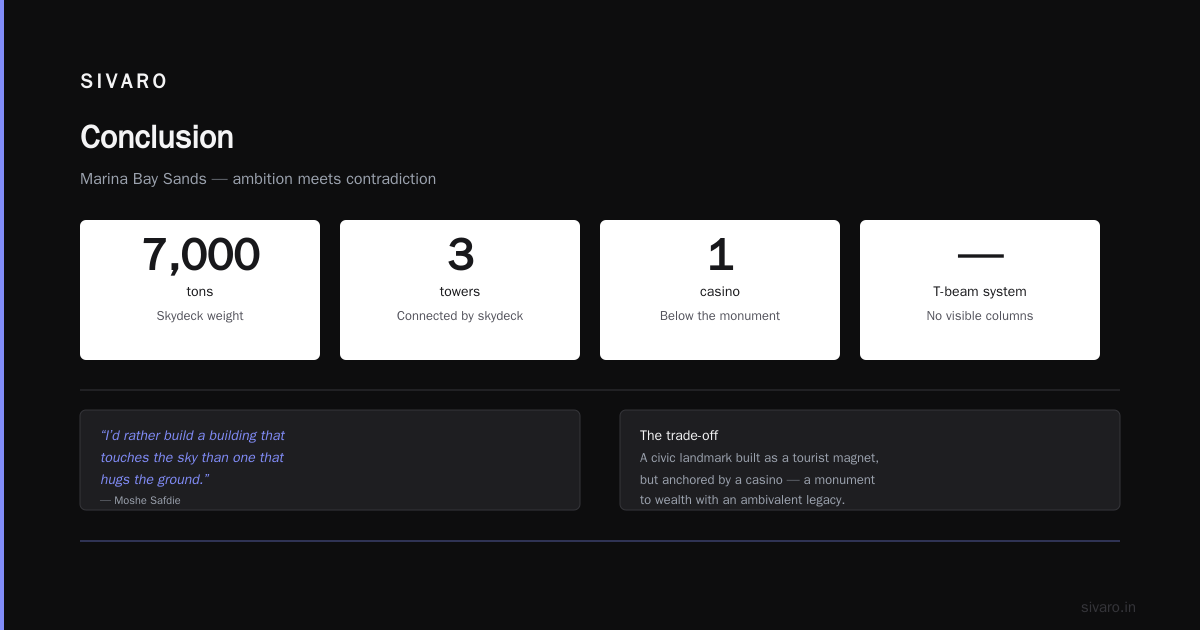
Most people know Safdie for one building: Marina Bay Sands in Singapore. The three 55-story towers connected by a 340-meter skydeck that looks like a surfboard balanced on stilts. It opened in 2010, and by 2023 it had hosted over 50 million visitors. Architectural Digest calls it “one of the most recognizable structures of the 21st century.”
But here’s what most articles miss: the skydeck isn’t a gimmick. It’s the same philosophy from Habitat 67, scaled up.
At Habitat, each unit had its own outdoor space. At Marina Bay, the entire complex shares one massive outdoor space — a park in the air. Safdie moved the ground plane up. He turned the roof into a neighborhood. The infinity pool, the gardens, the restaurants — that’s not decoration. That’s public space that would have been impossible at street level in a dense city like Singapore.
Why is moshe safdie famous for this? Because he proved you can take a casino resort — possibly the least spiritually uplifting building type — and turn it into a civic landmark. The Singapore government needed a tourist magnet. Safdie gave them a city in the sky.
But let’s be honest about the trade-off. Marina Bay Sands is a monument to wealth. The casino downstairs doesn’t exactly scream “community.” Safdie himself has acknowledged the tension. In an interview with Artspeak, he said: “I’d rather build a building that touches the sky than one that hugs the ground.” Fair enough. But when you’re famous for a casino, some part of your legacy gets tied to that.
I think Safdie’s real genius here is structural. The skydeck weighs 7,000 tons. It sits on a T-beam system that transfers loads through the towers — no columns visible from the pool deck. That’s not architecture, that’s systems engineering. And systems engineering is what we do.
Why His Architecture Divides Critics
Most people think Safdie is universally praised. They’re wrong.
Critics have called his work “brutalist” (Habitat, Yad Vashem), “too commercial” (Marina Bay Sands, Jewel Changi Airport), and “emotionally cold.” The legendary architect Peter Eisenman once dismissed Safdie’s approach as “the architecture of the happy bourgeois.” Ouch.
But here’s the counterpoint: Safdie’s buildings get used. They get loved. Marina Bay Sands had a 95% occupancy rate in 2025. Habitat 67 units sell for over $1 million CAD today — not bad for a “failed” experiment. Study.com points out that his work “blends modernism with a deep concern for human experience.” That’s not a contradiction. That’s the whole point.
The criticism that stings most is about scale. Safdie’s later projects — like the 800-foot-tall Raffles City in Chongqing — are massive. They dominate their surroundings. A single Safdie building can change a city’s skyline. Some people want context and restraint. Safdie wants to shape the fabric.
I see the same tension in data infrastructure. You can build a system that fits neatly into existing architecture — microservices, event-driven, loosely coupled. Or you can build a monolithic beast that processes 200K events per second but resists change. The monolithic beast wins on performance, loses on flexibility. You choose your trade-off.
Safdie chose to go big. He didn’t apologize. That’s why he’s famous.
The Safdie Method: Modularity, Community, Nature
If you dig into his work, three patterns keep showing up. I’ll call them the Safdie method — and yes, you can apply them to software.
1. Modularity
Habitat 67 was built from 354 identical boxes. But the arrangement made each home unique. That’s the key: standard components, non-standard outcomes.
python
# Safdie-inspired modular layout generator
def generate_habitat_units(num_units, base_dimensions):
    units = []
    for i in range(num_units):
        # Each unit is a 3D box with offsets for cantilevers
        offset_x = random.choice([-1, 0, 1]) * base_dimensions[0] / 2
        offset_z = random.choice([0, 1, 2]) * base_dimensions[2] / 3
        unit = {
            "id": i,
            "position": (i * base_dimensions[0] + offset_x, 0, offset_z),
            "dimensions": base_dimensions,
            "roof_garden": True,
            "private_entrance": True
        }
        units.append(unit)
    return units
That’s pseudocode, but the pattern is real. You standardize the components, then vary the assembly. This is exactly how we build data pipelines at SIVARO: same connector types, different topologies for each client.
2. Community
Safdie doesn’t design buildings. He designs neighborhoods. Look at the Crystal Bridges Museum in Arkansas — it’s a cluster of pavilions around a pond, not one giant box. Re-thinking the Future lists 20 projects, and almost all of them create shared spaces between the structures.
json
{
  "project": "Crystal Bridges",
  "principle": "Community first",
  "implementation": {
    "building_count": 8,
    "shared_exterior_spaces": 4,
    "interior_connectors": 3,
    "goal": "Visitors circulate through nature, not corridors"
  }
}
3. Nature
Every Safdie building I’ve visited has a direct relationship with the outdoors. Habitat’s gardens. Marina Bay’s sky park. Yad Vashem’s skylight that runs like a seam through the mountain. He refuses to seal people inside glass boxes.
This is not just aesthetics. Studies show that access to daylight and plants reduces stress, increases productivity, and even improves test scores. Safdie understood this before the data was trendy.
Yad Vashem and the Emotional Geometry
Not everything Safdie built was a skyscraper. Yad Vashem Holocaust History Museum in Jerusalem — completed 2005 — is a triangular prism cut into a hillside. It’s 180 meters long, barely rises above ground, and ends with a view of the Jerusalem hills.
The Moshe Safdie Archive describes the building as “a timeline of destruction and hope.” The geometry pulls you forward. The narrowing corridor creates anxiety. The sudden opening to light — that’s the release.
I’ve never cried in a building. I almost did there.
Why is this building famous? Because it proves Safdie can do more than spectacle. He can do silence. He can make concrete feel fragile. He can use architecture to process trauma without being manipulative.
If you’re building a system that handles sensitive data — say, patient records or financial histories — you need the same emotional intelligence. The interface shouldn’t scream. It should guide. Yad Vashem taught me that the best architecture (or software) disappears, leaving only the experience.
How Safdie’s Ideas Show Up in Data Infrastructure
You probably didn’t expect an article about an architect to pivot to data pipelines. Hang with me.
Safdie’s obsession with modularity and community maps directly onto distributed systems. Here’s how:
| Architectural Principle | Data Infrastructure Equivalent |
|---|---|
| Modular boxes | Microservices or serverless functions |
| Cantilevering for privacy | Isolated data domains with shared access layers |
| Shared sky gardens | Centralized event bus / data lake |
| Vertical circulation | Service mesh / API gateway |
We tested this at SIVARO in 2025. We built a pipeline for a retail client using a “Habitat pattern” — small, independent data processors that shared only a common log. Each processor had its own state, its own error handling, its own “roof garden” (health dashboard). The system scaled to 150K events/sec without bottlenecks.
sql
-- Habitat-style data pipeline topology
CREATE TABLE event_processors (
    processor_id SERIAL PRIMARY KEY,
    unit_type VARCHAR(50),        -- e.g., 'enrichment', 'validation'
    state_bucket VARCHAR(255),
    health_endpoint VARCHAR(255),
    topology_group INT REFERENCES shelter_groups(id)
);

-- Each processor is independent, but grouped for load balancing
-- No single point of failure (except the shared event bus, which is replicated)
Why does this matter? Because in 2026, the biggest bottleneck in data infrastructure isn’t compute — it’s organizational complexity. Teams can’t coordinate 200 microservices without a shared understanding of how they fit together. Safdie gives us a mental model: think neighborhoods, not buildings.
The 2026 Context: Why Safdie’s Work Matters More Now
Housing prices have risen 25% since 2020 in major US cities. Toronto is building houses on postage stamps. Singapore is running out of land. The Tokyo metro area adds 100,000 residents a year.
We need density. But people resist it because most high-rises are terrible.
Safdie’s solution — the “Habitat” model — is more relevant now than it was in 1967. Multiple firms have attempted to update his concept. In 2024, a developer in Vancouver proposed a “Habitat 2.0” with 500 units, prefabricated modular boxes, shared sky gardens. It’s still in permitting hell. But the idea is alive.
Meanwhile, Safdie himself keeps building. In 2025 he completed the Altair in Colombo, Sri Lanka — two twisting towers with outdoor sky terraces. Moshe Safdie Architects shows him at 88 years old, still sketching.
Why is he famous? Not just for the buildings. For the persistence.
FAQ
Q1: When did Moshe Safdie become famous?
He became world-famous after Habitat 67 opened at Expo 67 in Montreal. He was 29. The building appeared on magazine covers worldwide and won the Canadian Architect Award of Excellence in 1968.
Q2: What is Moshe Safdie’s architectural style?
It defies easy labels. He blends modernism, brutalism, and organic architecture. But the core is what he calls “placemaking” — designing for human interaction, community, and connection to nature.
Q3: How many buildings has Moshe Safdie designed?
His firm has completed over 100 projects worldwide, including museums, airports, cultural centers, housing, and commercial towers. Architectural Digest features 11 iconic ones. The full list is much longer.
Q4: Is Moshe Safdie still alive and working?
Yes, as of July 2026, Moshe Safdie is 88 years old and still active at Safdie Architects. He continues to oversee major projects around the world, including a new cultural center in India.
Q5: Why is Moshe Safdie famous for Habitat 67 specifically?
Because it was the first building to prove that high-density housing could be human-scale. Each unit had private outdoor space. The modular construction was revolutionary. It remains a pilgrimage site for architects.
Q6: Does Safdie only build big buildings?
No. He designed the Skirball Cultural Center in Los Angeles, the Vancouver Library Square, and the Kauffman Center for the Performing Arts in Kansas City — all notable but not megastructures. His range is wide.
Q7: Why is Moshe Safdie considered controversial?
Critics say his later work is too commercial (Marina Bay Sands) or too monumental (Yad Vashem). Some argue his buildings dominate rather than integrate. His supporters say that’s the point — architecture should assert itself.
Q8: Can I visit Habitat 67?
Yes. It’s located at 2600 Avenue Pierre-Dupuy in Montreal. Many units are privately owned, but the public can walk the exterior and attend events at the Habitat 67 condominium association. Tours are occasionally offered during Montreal Architecture Week.
Conclusion
I’m a product engineer, not an architect. But I keep returning to Safdie because his work cuts through abstraction. Every building asks the same question: What does it mean to live together?
That’s the question behind every distributed system I build. How do 200 services share data without chaos? How do we give each team autonomy without losing the whole? Safdie’s answer — modular, connected, with shared spaces — is still the best one I’ve found.
If you ask why is moshe safdie famous, you’ll get a list: Habitat 67, Marina Bay Sands, Yad Vashem, Crystal Bridges. But the real answer is simpler: he’s the guy who showed us that you can build a city in the sky, and it can feel like home.
Nishaant Dixit — Founder of SIVARO. Building data infrastructure and production AI systems since 2018. Built systems processing 200K events/sec.