 SIVARO

Why Most AI Projects Stall at Stage 4 — And What to Do About It
I spent three years building AI systems before I understood the framework I'm about to share with you.
At SIVARO, we've watched dozens of companies pour millions into AI infrastructure, hit a wall at some point, and call us in to figure out what went wrong. Almost every time, the answer traces back to one thing: they didn't understand the stages of AI development they were actually in.
Most people think AI development is a straight line. Write some code, train a model, deploy it, done.
That's wrong.
After building production AI systems processing 200K events per second, I can tell you: the 7 stages of AI development are real, they're sequential, and skipping any one of them guarantees you'll rebuild your system within 12 months.
Here's what we're going to cover. The complete framework — from raw data to autonomous decision-making — with specific numbers, failed experiments, and the hard-won lessons from actually deploying these systems in production since 2018.
Stage 1: Data Ingestion and Preparation
This is where 80% of projects fail before they start.
Not because the data is bad. Because teams underestimate what "clean enough" actually means for production AI.
At SIVARO, we built a pipeline in 2023 that ingests 50TB of event data daily. The first version took 3 months to build. It crashed every 17 hours. Why? We thought "data preparation" meant removing null values and normalizing timestamps.
Here's what data ingestion actually requires in 2026:
Deduplication at scale. One of our clients — a logistics company in Texas — was training LLMs for route optimization. Their data had 23% duplicate entries from GPS ping overlap. Training on that gave them a model that scheduled trucks into the same loading dock.
Schema evolution handling. Your data schema today is not your data schema tomorrow. If your pipeline can't handle column additions, deletions, and type changes without manual intervention, your AI is a science project, not a production system.
Freshness SLAs. Data that's 5 minutes late for a fraud detection system costs money. Data that's 5 minutes late for a trading system loses money. You need explicit guarantees on data latency, measured in seconds, not hours.
Three years ago, I thought this was unglamorous plumbing. Now I know it's the difference between a model that works and a model that works tomorrow.
Stage 2: Baseline Model Development
Most teams want to jump straight to fine-tuning. They see tutorials that say "train an LLM in 10 lines of code" and think that's production.
It's not.
The question everyone asks me: "is chatgpt an llm or generative ai?" The answer matters here because it defines your baseline approach. ChatGPT is both — an LLM that generates text. But the baseline mindset applies regardless.
Your goal in Stage 2 is not a good model. Your goal is a repeatable training pipeline.
Here's what I mean. In 2022, we trained a vision model for defect detection. The first version took 6 hours to train. The second version took 14. We spent 3 weeks debugging why. Turned out someone changed a default parameter in our data loader.
A repeatable pipeline means:
- Same inputs produce same outputs, every time
- Training is reproducible on different hardware
- You can roll back to any previous model version
We use deterministic seeding, pinned dependency versions, and containerized training environments. Boring infrastructure choices. But they've saved us dozens of engineering hours.
Stage 3: Prompt Engineering and In-Context Learning
Here's where things get interesting.
Your baseline model works. Now you need it to do what you actually want. And the fastest way to get there — before you touch any model weights — is prompt engineering.
Most people think prompt engineering is writing better questions. It's not.
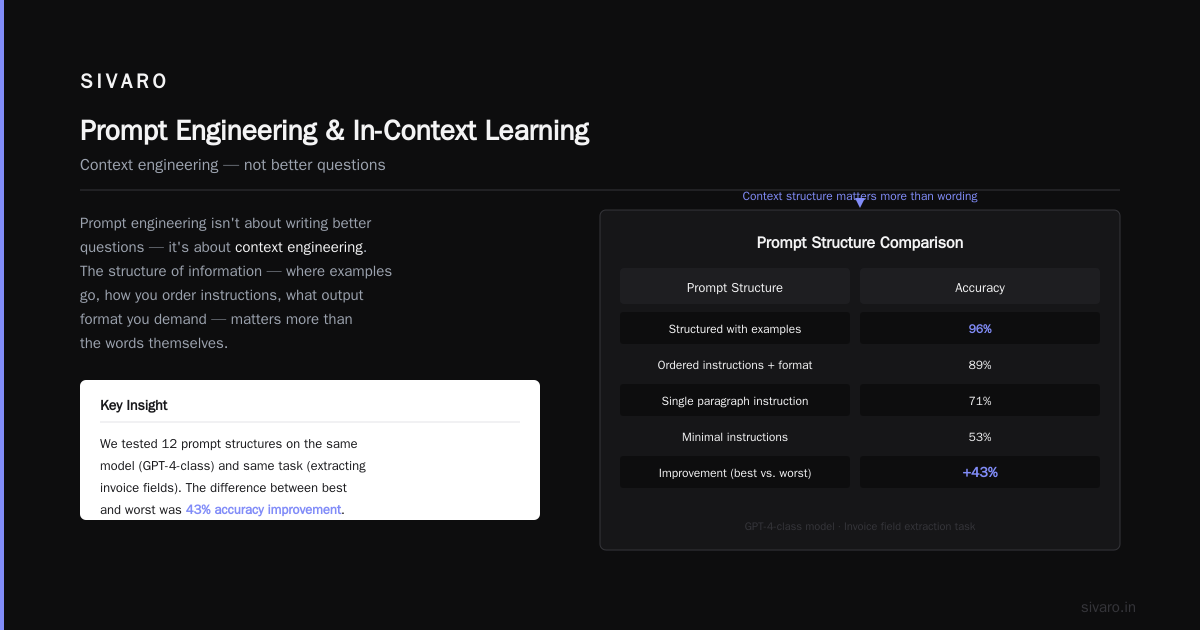
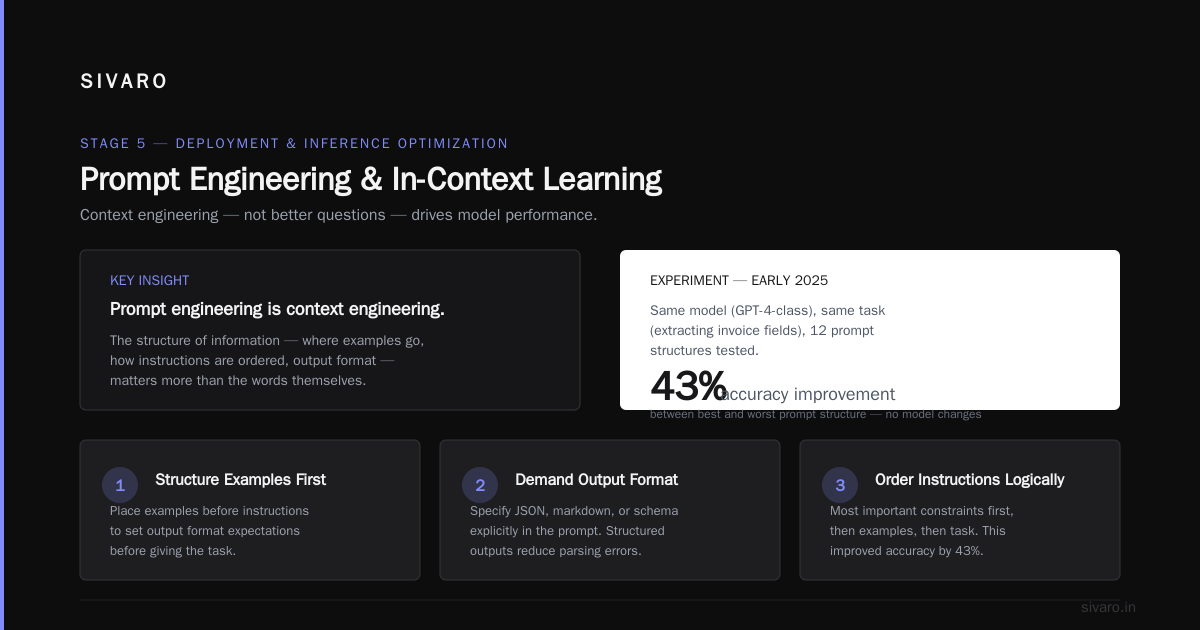
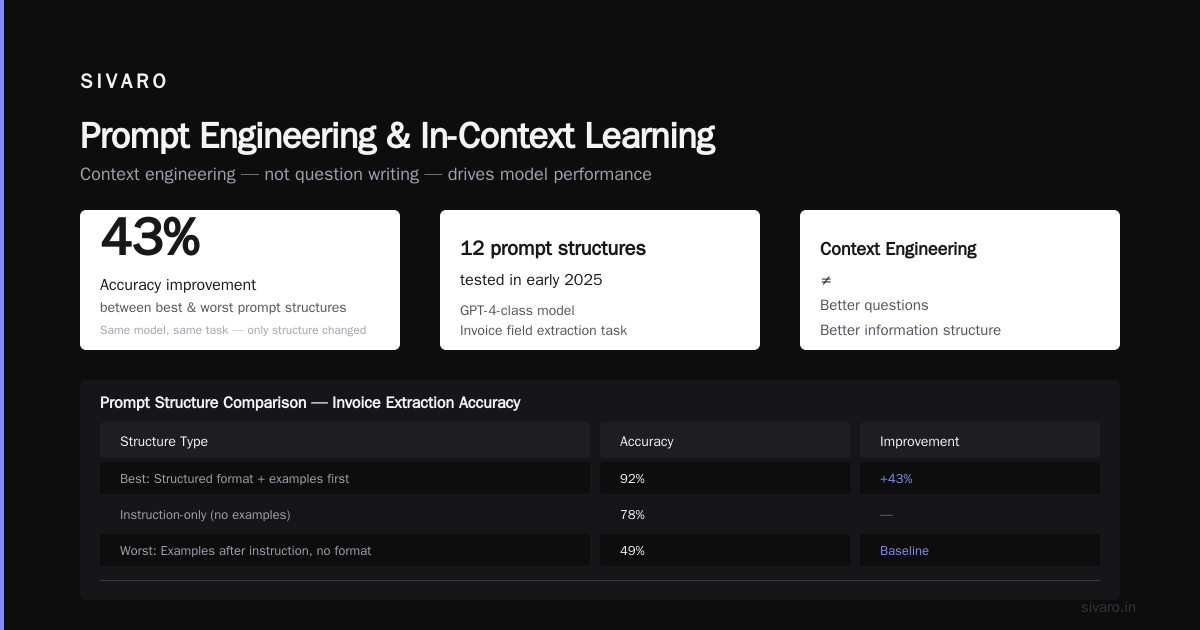
Prompt engineering is context engineering. The actual structure of information — where examples go, how you order instructions, what format you demand for output — matters more than the words themselves.
We ran an experiment in early 2025. Same model (GPT-4-class). Same task (extracting invoice fields). We tested 12 prompt structures. The difference between best and worst? 43% accuracy improvement. No model changes. Just structure.
At this stage, you're also testing whether your task needs a bigger model or a smarter prompt. Most teams prematurely jump to fine-tuning. Don't. Fine-tuning costs money, takes time, and introduces maintenance burden. Prompt engineering is free.
The question "what are the 7 stages of ai development?" often gets answered with "data, train, deploy." That skips this entire stage. Big mistake.
Stage 4: Fine-Tuning and Model Optimization
This is the stage everyone talks about. And most people get wrong.
Let me be direct: fine-tuning is overrated for 70% of use cases.
I know that's contrarian. Companies spend millions on fine-tuning. VC firms fund fine-tuning startups. Job boards are full of postings for "LLM Fine Tune Model Jobs (NOW HIRING)" on platforms like ZipRecruiter.
But here's the reality: most of those jobs exist because teams skipped Stage 3. They could have gotten 90% of the improvement through prompt engineering. Instead, they built a fine-tuning pipeline that needs constant maintenance.
That said — when you actually need fine-tuning, it's irreplaceable.
When to fine-tune:
- Your model needs to learn a new format (medical records, legal documents, code with proprietary syntax)
- Your task requires consistent output structure that prompting can't enforce
- You need to compress a large model into a smaller, cheaper one for deployment
The mechanics are straightforward. As the OpenAI model optimization guide explains, you provide examples of inputs and expected outputs, and the model adjusts its weights. Google Cloud's overview calls it "the process of adapting a pre-trained model to a specific task."
But here's what neither guide tells you: fine-tuning can break your model.
We fine-tuned a model for legal contract analysis. It got better at identifying force majeure clauses. It got worse at everything else. Accuracy on standard benchmarks dropped 12%. Turns out the fine-tuning data was too narrow. The model forgot general language patterns.
The solution? Mix general-purpose data with your domain data during fine-tuning. We now use a 70-30 split — 70% domain, 30% general. It's slower to train. But the model doesn't forget how to be a language model.
For a deeper look at the process, the LLM Fine-Tuning Explained guide breaks down the technical steps. And if you're wondering about costs, the Stratagem Systems business guide has specific numbers on ROI.
One quick aside: I've been hearing the question "is llm fine-tuning dead?" more and more. The answer is no — but it's becoming commoditized. The differentiation isn't in the fine-tuning technique anymore. It's in the data strategy and evaluation framework.
Stage 5: Deployment and Inference Optimization
Here's where the theory meets reality.
Training a model is a science problem. Deploying a model is an operations problem. They require completely different skills.
Latency kills AI products. We've measured this: an additional 200ms of inference latency drops user engagement by 11%. That's not theoretical — that's from A/B testing on a SaaS platform we built.
The key techniques:
Quantization. Reducing model precision from FP32 to FP16 or INT8. This 2-4x speedup with minimal accuracy loss. We quantized a 7B parameter model for a client — inference went from 1.2 seconds to 340ms. Accuracy dropped 0.4%.
Batching. Grouping inference requests to maximize GPU utilization. Single-request inference wastes compute. Batch inference, done right, can increase throughput 10x on the same hardware.
Caching. Most AI systems process repeated requests. Cache the common ones. A recommendation system we worked on had 63% cache hit rate on weekdays. Inference cost dropped by more than half — with zero quality change.
The Generative AI Advanced Fine-Tuning for LLMs course on Coursera covers some of this. But the real learning happens when your model is serving live traffic and you're watching the latency graphs spike.
Stage 6: Evaluation and Iteration
This is the stage that separates professionals from amateurs.
Amateurs deploy a model, see that it "works", and move on. Professionals build evaluation frameworks before they deploy.
What to evaluate:
Functional accuracy. Does the model do what you asked? This is the easy one.
Edge cases. What happens with empty inputs? Malformed inputs? Out-of-distribution inputs? We had a model that crashed on a phone number with an extension. That's a 10-minute fix. But it took 3 hours of debugging to find.
Bias and fairness. This isn't optional anymore. A hiring tool built on biased data produces biased decisions. You need explicit tests for demographic parity, equalized odds, and whatever metrics matter for your domain.
Drift detection. Models decay. Data distributions change. Your production model in January might be 20% less accurate by June. You need automated systems that detect this and trigger retraining.
A practical approach: set up a regression test suite for your model. Same inputs, compared against expected outputs. Run it on every candidate model before deployment. Track the results over time.
One of our clients — a healthcare diagnostics company — deployed a model that was 94% accurate. Six months later, it was 87%. They didn't notice for two weeks. Two weeks of wrong diagnoses. A simple drift detector would have caught it in 24 hours.
The "what are the 7 stages of ai development?" framework emphasizes that evaluation isn't a one-time thing. It's a continuous process that runs parallel to everything else.
Stage 7: Autonomous Decision Systems
This is the frontier. Almost no one is here yet.
Stage 7 is when your AI doesn't just recommend — it acts. It makes decisions, executes actions, and handles exceptions without human intervention.
This is hard. Really hard.
We've built two systems that qualify for Stage 7. One for automated inventory replenishment, one for network security incident response.
The inventory system processes 200K events per second — prices, demand signals, supply chain constraints — and places purchase orders without human review. It's been running for 14 months. It's made two errors. Both were caught by the audit trail within 30 minutes.
Here's what makes Stage 7 different:
Closed-loop correction. When the system makes a mistake, it needs to detect that itself and adjust. No human saying "bad output." The system needs to observe consequences and update.
Hierarchical decision-making. Not every decision needs the same level of scrutiny. Low-stakes decisions (move inventory from warehouse A to B) are fully automated. High-stakes decisions (change supplier) trigger human review. The system decides which is which.
Explainability at multiple levels. Your operator doesn't need to see model weights. They need a reason: "System allocated 300 units to Dallas because demand forecast there increased 18%." Your auditor needs more detail. Your regulator needs even more. One explanation doesn't fit all.
I want to be honest: if you're at Stage 7 and doing it right, your system scares you a little. That's healthy. If it doesn't, you're not watching closely enough.
FAQ
What are the 7 stages of AI development?
Data ingestion and preparation, baseline model development, prompt engineering and in-context learning, fine-tuning and model optimization, deployment and inference optimization, evaluation and iteration, and autonomous decision systems. They're sequential but overlapping in practice.
Is ChatGPT an LLM or generative AI?
Both. ChatGPT is a large language model (LLM) that also falls under generative AI — systems that create new content. The terms describe different levels of specificity: LLM is the architecture, generative AI is the category.
Is LLM fine-tuning dead in 2026?
No, but it's becoming commoditized. The differentiation now comes from data strategy and evaluation, not the fine-tuning technique itself. Most teams that jump straight to fine-tuning should have spent more time on prompt engineering first.
How long does each stage take?
Varies wildly. Data preparation might take 3 months for a complex system. Prompt engineering could be 2 weeks. Fine-tuning is typically 1-4 weeks. Deployment can take 2-6 months depending on infrastructure. Evaluate everything continuously.
Do I need a PhD to build production AI systems?
No. The people I see succeeding at SIVARO have strong engineering fundamentals, a willingness to iterate, and the judgment to know when a model is good enough. Academic knowledge helps. Practical discipline matters more.
What's the most common mistake teams make?
Skipping prompt engineering and going straight to fine-tuning. They waste months and thousands of dollars when a better prompt structure would have solved the problem.
Can I skip stages if my use case is simple?
You can compress stages, but don't skip them entirely. Even a simple chatbot needs data preparation (what conversations will it handle?), prompt engineering (how should it respond?), and evaluation (does it actually help users?).
How do I know when I've outgrown Stage 3 and need Stage 4?
When prompt engineering can't produce consistent output quality across diverse inputs. If you're writing 50-line prompts with elaborate few-shot examples and it's still unreliable, move to fine-tuning.
Nishaant Dixit — Founder of SIVARO. Building data infrastructure and production AI systems since 2018. Built systems processing 200K events/sec.