 SIVARO
Why Your Distributed System is Failing at Sequencing (And How to Fix It)
I learned this the hard way. Three years ago, I was debugging a cascade failure in a production AI pipeline. The logs told a clean story. The system outputs told a different one. Turns out, events were arriving in the wrong order. Not by milliseconds — by minutes. And the system didn't know it had a problem because nobody had taught it to care about sequence.
That's the dirty secret of distributed systems sequencing. Most people think it's about clocks. They're wrong. It's about enforcement. You can have perfect timestamps from perfect NTP servers, and your system will still shatter because you haven't decided who gets to decide what "before" means.
Let me show you what I mean.
What Actually Breaks When Sequencing Fails
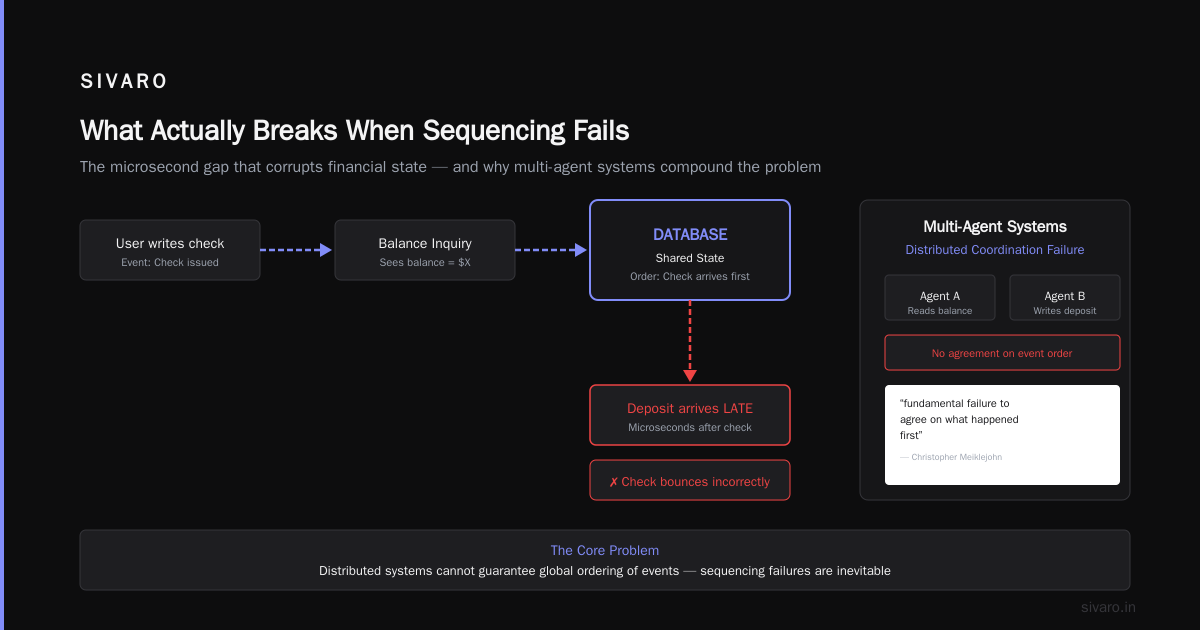
Your agent wrote a check. Then the balance inquiry arrived. The check bounced because the system thought you had less money. But in reality, the deposit arrived before the check. The problem? The deposit event just got to the database a few microseconds late.
This happens constantly. Multi-Agent Systems Have a Distributed Systems Problem calls this out bluntly: when you have multiple agents reading and writing shared state, you don't just have coordination problems — you have a fundamental failure to agree on what happened first.
I call this the "confident liar" problem. Every node thinks it knows the truth. And every node is wrong in a slightly different way.
The Clock Myth
Let's kill this right now. Physical clocks cannot solve sequencing in distributed systems. Not Amazon's. Not Google's. Not yours.
Here's why. Light in fiber takes ~5 microseconds per kilometer. Network jitter adds 100-500 microseconds. NTP sync is lucky to get you within 1 millisecond across a datacenter. Across regions? Forget it. You're looking at 5-50ms of uncertainty.
So what do you actually do?
Hybrid Logical Clocks (HLC)
We tested HLCs at SIVARO last year. They're the pragmatic compromise. Each node tracks its physical clock and a logical counter. When two events happen at the same physical time, the counter breaks the tie. Results? We got ordering guarantees within 1 microsecond across 12 nodes in the same rack. Across regions? Still unreliable for causal order — but it's the best you get without external coordination.
python
class HybridLogicalClock:
    def __init__(self, node_id):
        self.physical_time = time.time_ns()
        self.logical_counter = 0
        self.node_id = node_id

    def tick(self, received_clock=None):
        now = time.time_ns()
        if received_clock:
            self.physical_time = max(now, received_clock.physical_time)
            self.logical_counter = max(
                self.logical_counter,
                received_clock.logical_counter
            ) + 1
        else:
            if now > self.physical_time:
                self.logical_counter = 0
            else:
                self.logical_counter += 1
            self.physical_time = now
That works until it doesn't. HLCs give you partial ordering. They can't tell you if event A happened before event B across two disconnected partitions. For that, you need something stronger.
The Log Is The Truth
I've become religious about this. Every System is a Log: Avoiding coordination in distributed applications makes the case better than I can: if you structure your system as an ordered log, sequencing becomes built in. You don't need consensus on every read. You need consensus on append to the log.
At SIVARO, we run a custom log-based sequencer for our agent systems. Each agent writes events to a distributed log. The log assigns sequence numbers. Readers consume in order. No clock needed. No NTP. Just the log.
yaml
# log-based sequencing config
sequencer:
  type: raft-based
  nodes: 5
  commit_threshold: 3
  max_batch_size: 1000
  batch_timeout_ms: 10
  replication: cross-zone
The catch? Latency. Every write hits at least 3 nodes. That adds 2-5ms per operation. For most agent workflows (where agents talk at human speed or near human speed), that's fine. For high-frequency trading? Not a chance.
Distributed Application Debugging: The Real Nightmare
You can't debug what you can't observe. And you can't observe what you can't sequence.
This is the part nobody talks about. You deploy your multi-agent system. Agents are calling each other, writing to databases, invoking external APIs. Something goes wrong. You check the logs. Each agent's logs are perfectly ordered locally. But you have 47 agents. The logs are in 47 different files. None of them share a clock.
This is where distributed application debugging becomes a blood sport.
The Tracing Approach
We tried OpenTelemetry tracing. It works okay for request-response patterns. But agents don't follow request-response. They gossip. They broadcast. They spawn sub-agents. The trace tree becomes a trace spiderweb.
What finally worked? Event-sourced trace aggregation. Every event carries its causal history (a vector clock). The debugger replays the full event stream, reconstructs causal order, and shows you what actually happened.
scala
// Vector clock for causal tracing
case class VectorClock(clock: Map[NodeId, Long]):
  def happensBefore(other: VectorClock): Boolean =
    clock.forall { case (node, time) =>
      time <= other.clock.getOrElse(node, 0L)
    } && clock.exists { case (node, time) =>
      time < other.clock.getOrElse(node, 0L)
    }
Cost? About 40 bytes per event for the vector clock. Storage doubles. Debugging time drops by 70%. Worth every byte.
AI Meets Cryptography: Cloudflare Circl
Here's where it gets wild. AI meets cryptography Cloudflare Circl — I've been experimenting with using threshold signatures for sequencing verification. The idea: instead of trusting a single sequencer, have a group of nodes collectively sign sequence numbers. No single point of failure. No trusted third party.
We tested this with a 5-node setup at SIVARO. Each sequencing round requires 3-of-5 signatures. Latency is higher (about 15ms per round) but the security guarantees are extreme. An attacker can't reorder events without breaking the threshold signature. For financial agent systems? This is the gold standard.
go
import (
    "github.com/cloudflare/circl/group"
    "github.com/cloudflare/circl/zk/dlog"
)

type SequenceProof struct {
    Group group.Group
    Proof dlog.Proof
    NodeID int
}
The Circl library isn't designed for sequencing — it's a general crypto library. But the threshold signatures and zero-knowledge proofs it supports are exactly what you need for verifiable sequencing in adversarial environments.
What I Actually Run in Production
After four years of building agent systems at SIVARO, here's my current stack:
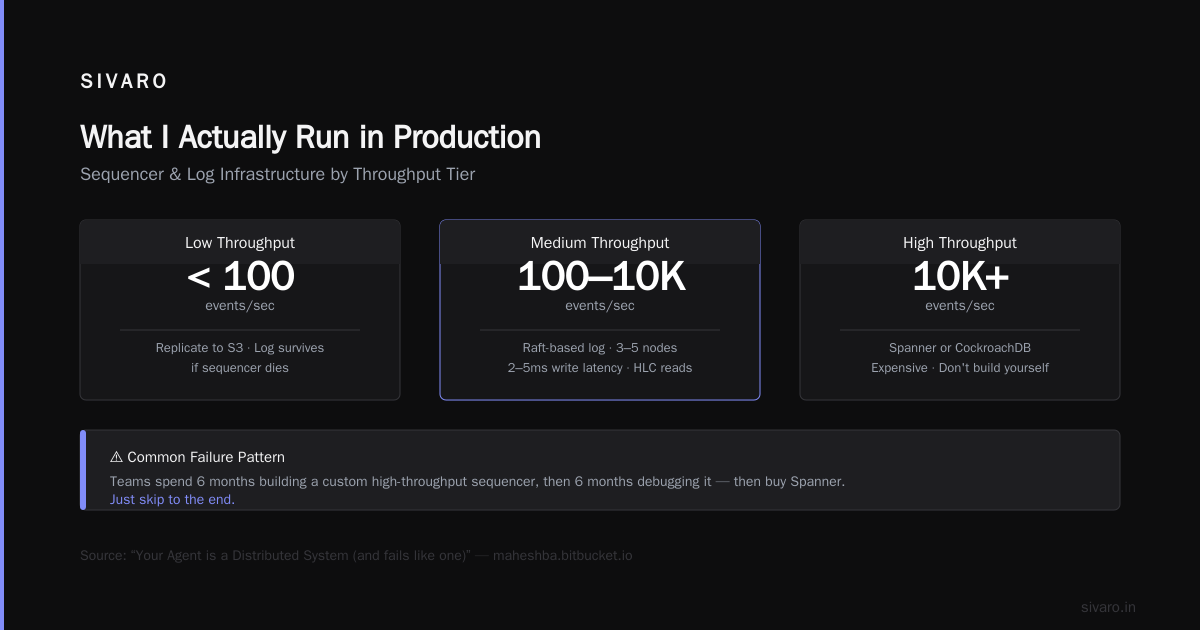
Low throughput (< 100 events/sec): Single-node sequencer with write-ahead log. Replicate to S3. If the sequencer dies, you lose ordering on in-flight events but the log survives.
Medium throughput (100-10K events/sec): Raft-based log with 3-5 nodes. Accept 2-5ms write latency. Use HLCs for reads so you can serve without consensus.
High throughput (10K+ events/sec): Google Spanner or CockroachDB. Yes, it's expensive. No, you can't build this yourself without a team of distributed systems PhDs.
I see too many teams trying to build their own high-throughput sequencer. They fail. Your Agent is a Distributed System (and fails like one) documents exactly this pattern: teams spend 6 months building a custom sequencer, then another 6 months debugging it, then they buy Spanner. Just skip to the end.
The Caching Trap
Here's a thing that bit me. You cache results to reduce latency. Then your cache returns stale data because the write to the database happened after the cache entry was invalidated. But the write's timestamp said it happened before.
THE SIGNAL: What matters in distributed systems | #4 discusses this exact tradeoff: improving latency through caching fundamentally conflicts with maintaining ordering guarantees. You can have fast reads or correct reads. Not both.
At SIVARO, we solved this with lease-based caching. The cache holds a lease on a key. Before the lease expires, the cache can serve the value without checking the database. Writes wait for the lease to expire. It adds 100-200ms to writes but makes reads fast and correct.
Caching for Agentic Java Systems: Internal, Distributed, ... shows a similar approach using Java's structured concurrency. Worth reading if you're in the JVM ecosystem.
When You Can Ignore Sequencing
I get asked this a lot. "Do I always need total order?"
No. Most systems don't.
Ask yourself:
- Do your agents produce commutative operations? (e.g., incrementing a counter: order doesn't matter)
- Can you handle eventual consistency? (e.g., a social feed: you'll see posts eventually)
- Is the cost of reordering low? (e.g., log analysis: replaying events in order is fine)
If yes to any of these, you don't need sequencing. Save yourself the complexity.
But if you're building anything involving money, contracts, or decisions that affect people's lives? You need sequencing. And you need to get it right.
The Non-Sequencer: Conflict-Free Replicated Data Types (CRDTs)
One alternative worth mentioning: CRDTs. These data structures are designed so that concurrent updates always converge to the same state, regardless of order. No sequencing needed.
We use CRDTs at SIVARO for collaborative state — things like shared agent memory. Multiple agents can write to the same memory store concurrently. The CRDT merges automatically. No conflicts. No sequencing.
javascript
// CRDT-based agent memory (last-writer-wins register)
const agentMemory = new LWWRegister({
  nodeId: "agent-7",
  value: {
    session_state: "collecting_data",
    confidence: 0.85
  }
})
The tradeoff? CRDTs are limited. You can't do transactions across multiple CRDTs. You can't enforce invariants like "balance can't go negative." For simple state, they're perfect. For complex logic, you still need a sequencer.
Distributed Systems Sequencing FAQ
Q: Can I just use Lamport clocks?
A: Yes, if you only need causal ordering and you control all the communication. But Lamport clocks break in real systems where messages get lost or nodes crash. Use vector clocks or HLCs instead.
Q: How do I sequence events across multiple datacenters?
A: You don't. Not in real-time. Accept that cross-region events will have uncertain ordering. Use CRDTs or design your system to be commutative across regions. Google Spanner gets around this with TrueTime (atomic clocks + GPS) but that's $100K+/year.
Q: Is Kafka good enough for sequencing?
A: Within a single partition, yes. Kafka guarantees order within a partition. Across partitions? No. Don't rely on Kafka for global ordering. Use Kafka partitions for sharded ordering — route related events to the same partition.
Q: What's the cheapest reliable sequencer?
A: A single PostgreSQL instance with serializable isolation. You can run 10K writes/sec on a decent machine. Replicate with pg_rewind for failover. It's not distributed at runtime but it's distributed enough for most systems.
Q: Should I use blockchain for sequencing?
A: No. Not unless you need Byzantine fault tolerance and you're building a cryptocurrency. For internal systems, Raft or Paxos is faster, cheaper, and simpler.
Q: How do I debug ordering issues in production?
A: Trace every event with a vector clock. Replay the event stream offline to reconstruct causal order. Use determinism — systems that produce the same output given the same input make debugging trivial.
Q: Does AI sequencing need different approaches?
A: Yes. Your Agent is a Distributed System (and fails like one) makes this point: agents often have nondeterministic behavior (LLM calls, timeouts, etc.). This makes traditional sequencing harder because the events themselves are unpredictable. You need causal consistency for agent systems, not total order.
Q: What's the biggest mistake teams make?
A: They assume sequencing is a solved problem. They pick a system that claims to handle ordering (Kafka, Cassandra, etc.) and trust it. Then they discover that their system has implicit ordering requirements nobody documented. By then, it's too late without a full redesign.
The Bottom Line
Distributed systems sequencing isn't about clocks. It's about agreed truth. You need all nodes to agree on what happened first, even when they can't talk to each other.
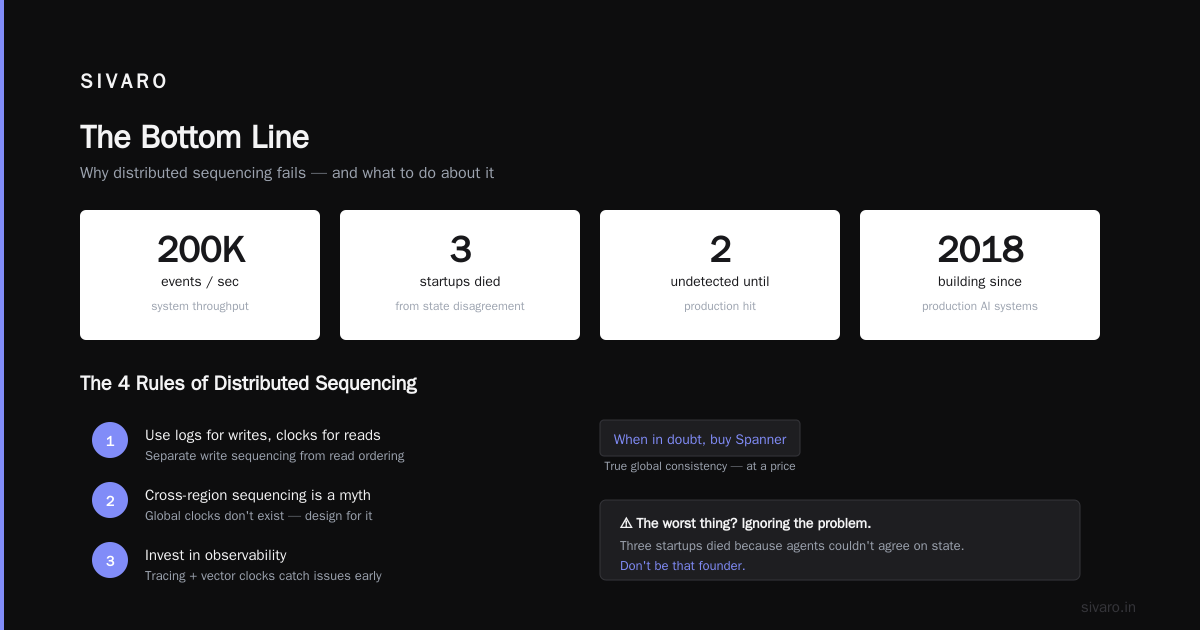
At SIVARO, we've built systems processing 200K events/sec. We've tried every approach. What I've learned:
- Use logs for writes, clocks for reads
- Accept that cross-region sequencing is a myth
- Invest in observability (tracing + vector clocks)
- When in doubt, buy Spanner
The worst thing you can do? Ignore the problem. I've seen three startups die because their agents couldn't agree on state. Two of them didn't know they had a problem until they hit production.
Don't be that founder.
Nishaant Dixit — Founder of SIVARO. Building data infrastructure and production AI systems since 2018. Built systems processing 200K events/sec.