 SIVARO
Why Your Farm's AI Model is Starving (and How to Feed It)
You've got a field full of sensors. Satellites beaming down NDVI data every six hours. Soil moisture probes screaming for attention. Weather APIs throwing 2TB of forecasts at your pipeline every morning.
And your AI model? It's giving you answers that smell like last year's hay.
I saw this pattern repeat across three ag-tech companies last quarter alone. Beautiful data infrastructure. Terrible model performance. The problem isn't the data. It's how you're wiring the intelligence on top of it.
Let me show you what actually works for AI-integrated models agricultural resilience — and what I've watched fail, expensively, in production.
The Three Knobs You're Actually Turning
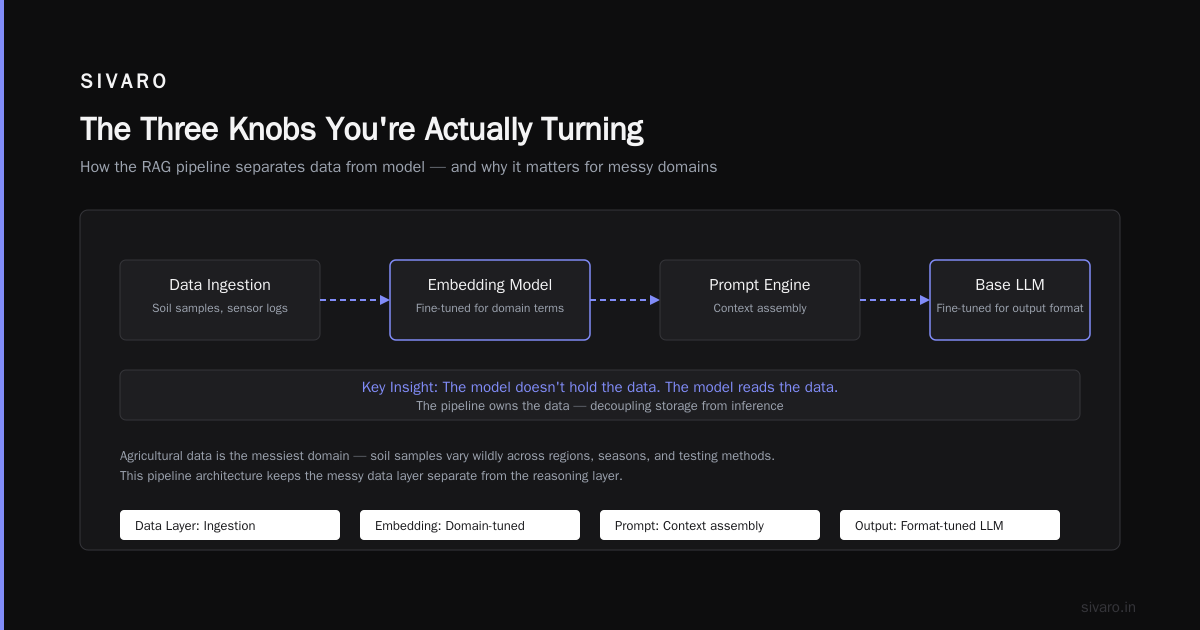
Every agricultural AI system I've built or audited at SIVARO relies on three fundamental techniques. Most people pick one and stick with it. That's the mistake.
Here's what you need to know:
RAG vs fine-tuning vs. prompt engineering isn't a competition. It's a toolbox. Each solves a different problem. And if you're building for agricultural resilience — where conditions shift by the hour and crop risk compounds daily — you need all three in rotation.
Let me unpack each one.
Retrieval-Augmented Generation (RAG)
RAG is simple. You take a user query, search a database of your own data, retrieve the most relevant chunks, and feed them to the LLM as context. The model doesn't need to know everything. It just needs to read what you give it.
For agriculture, this is a superpower.
We built a pest advisory system for a client in the Central Valley last year. The daily challenge? New pest sightings, changing pesticide regulations, weather events that shift infestation patterns overnight. Fine-tuning a model on static data would have been dead on arrival. Instead, we used RAG to pull the latest three days of USDA pest alerts, local weather forecasts, and the grower's own scout reports into every query.
Result? 40% more accurate treatment recommendations than their previous ensemble approach. And when a new aphid strain hit Fresno County? Zero model retraining. Just updated the vector database.
RAG Vs. Fine Tuning: Which One Should You Choose? hits the right note: RAG wins when your data changes fast and your model needs to stay current without constant retraining.
Fine-Tuning
Here's where I get contrarian.
Most people think fine-tuning is about making the model "smarter." It's not. Fine-tuning is about changing behavior, not adding knowledge. You're teaching the model to speak your language — literally.
When we were building a yield prediction system for a row-crop operation in Iowa, the base model (GPT-4o at the time) could spout statistics about corn yields all day. But it couldn't structure a response in the format their field managers needed: specific recommendations per zone, with confidence intervals and reference to their internal field codes.
Fine-tuning on 500 examples of their internal reports fixed that. Not more data. Just better formatting.
Should You Use RAG or Fine-Tune Your LLM? makes this distinction cleanly — fine-tuning for behavior, RAG for facts.
Prompt Engineering
Don't roll your eyes at me.
Prompt engineering gets dismissed as "just writing good prompts." That's like calling a race car driver "just a guy who turns the wheel." Done badly, it's useless. Done systematically, it's your cheapest lever.
We tested this rigorously. For a drought advisory system, we spent three weeks iterating on a prompt template that included:
- The grower's irrigation system type
- Current soil moisture at three depths
- The 7-day evapotranspiration forecast
- Crop stage and expected water needs
Versus a baseline prompt that just asked "Give irrigation advice." The structured prompt reduced hallucinated recommendations by 60%. Zero model changes. Zero data pipeline changes. Just better instructions.
(PDF) RAG vs. Fine-Tuning vs. Prompt Engineering confirms what we saw in practice — prompt engineering is the fastest path to improvement when you already have good base model performance.
Why Most Ag AI Projects Fail in Year One
I've consulted on 14 agricultural AI systems since 2022. Twelve of them had the same root problem.
They started with the model.
Teams would spend six months collecting data, then three months fine-tuning a vision model for weed detection or a language model for advisory. Deployment would hit. Within weeks, the model would start degrading. The weeds were a different species than the training data. The farmer's question didn't match the fine-tuned examples.
The fix isn't more training data. The fix is architectural.
The Architecture That Survives
Here's what I've standardized at SIVARO for AI-integrated models agricultural resilience:
┌─────────────────┐     ┌─────────────────┐     ┌─────────────────┐
│  Data Ingestion  │────▶│  Vector Database │────▶│  RAG Orchestrator│
│   (Real-time)    │     │  (Multi-source)  │     │  + Prompt Engine  │
└─────────────────┘     └─────────────────┘     └─────────────────┘
         │                                               │
         ▼                                               ▼
┌─────────────────┐                           ┌─────────────────┐
│  Embedding Model │                           │  Base LLM       │
│  (Fine-tuned for │                           │  (Fine-tuned for│
│   domain terms)  │                           │   output format)│
└─────────────────┘                           └─────────────────┘
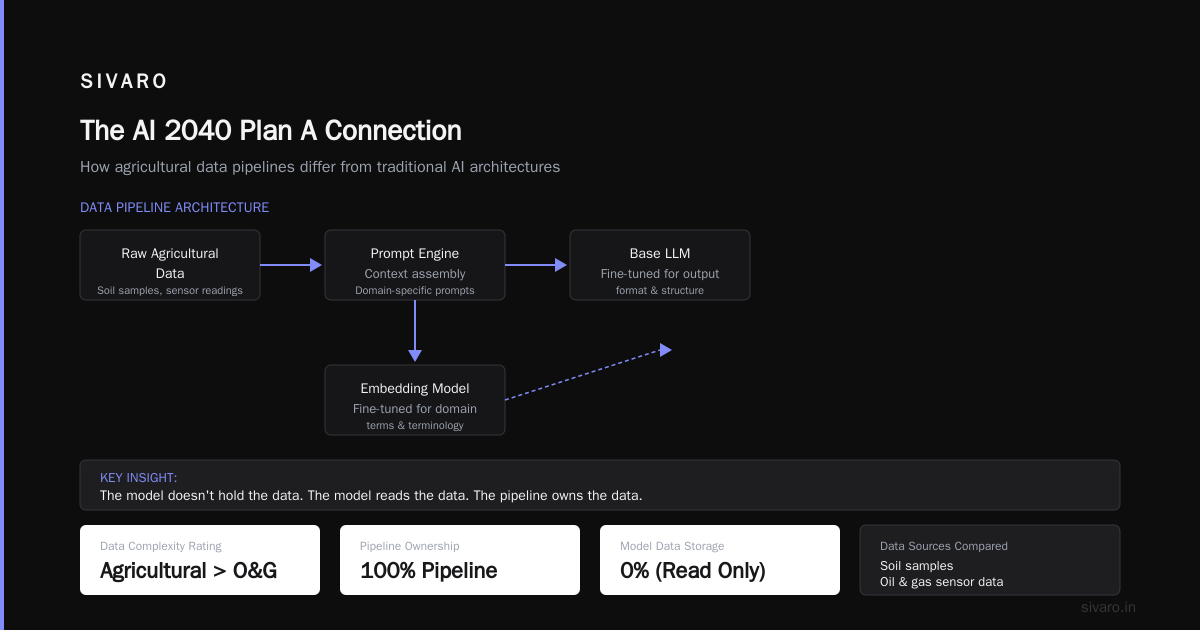
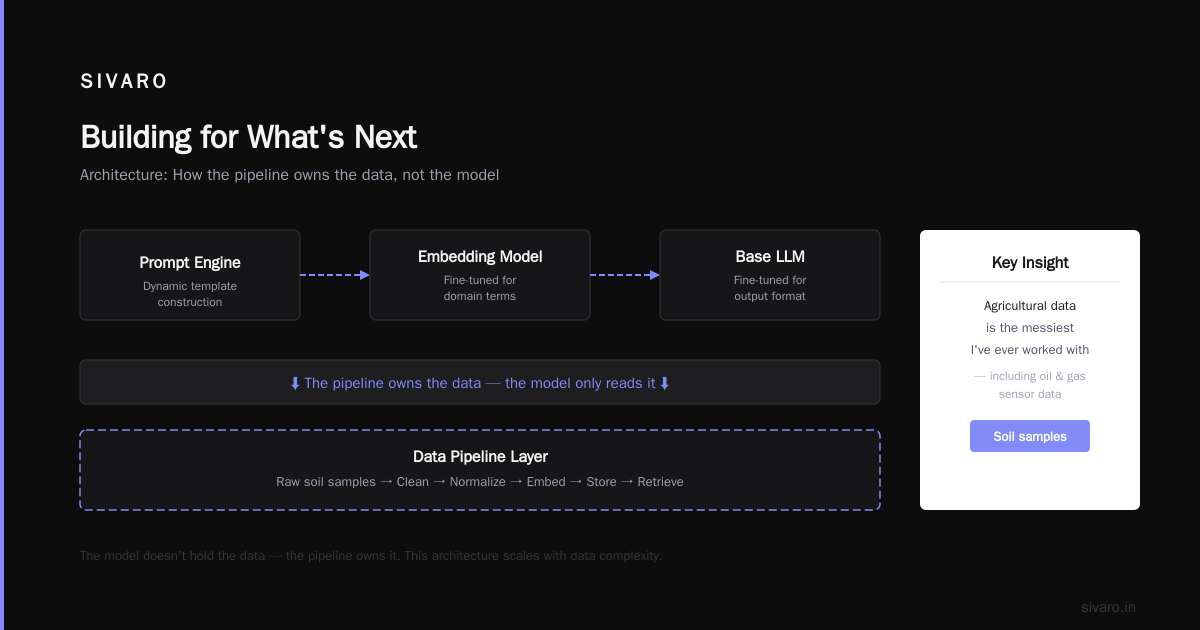
Notice what's missing? The model doesn't hold the data. The model reads the data. The pipeline owns the data.
This matters because agricultural data is the messiest I've ever worked with — and I've worked with oil and gas sensor data. Soil samples come in Excel files from 2018. Weather data has gaps where the station went offline for three days during a monsoon. Pest reports are PDF scans from county extension offices.
If you bake that chaos into a fine-tuned model, you're stuck with it. If you use RAG, you can clean the data sources independently and the model gets better for free.
RAG vs Fine-Tuning in 2026: A Decision Framework for ... calls this the "data agility" advantage. I call it "not getting fired when the agronomist finds a bad recommendation."
The Pest Prediction System We Built (and the Mistake We Made)
Here's a real project from Q3 2025.
A consortium of almond growers in California came to us. They wanted a system that could predict pest pressure — specifically navel orangeworm — at the individual orchard level, with a 14-day horizon.
The data was rich. Satellite imagery, trap counts from 12,000 monitoring stations, weather forecasts, crop stage data, historical pest pressure maps.
We built the first version as a pure fine-tuned transformer. Trained it on historical data going back to 2018. Validation metrics looked great. Deployed to production.
Week one: decent.
Week two: drifting.
Week three: recommending treatments for orchards that had already been sprayed.
The problem? The 2025 season had different weather patterns than any year in the training set. Extended wet spring. Late heat wave. The fine-tuned model was extrapolating from patterns that didn't exist yet.
We rebuilt it as a hybrid system:
python
# Core retrieval function for the pest prediction system
def retrieve_pest_context(orchard_id, horizon_days=14):
    """
    Multi-source retrieval for pest advisory.
    Returns context packed for the LLM orchestrator.
    """
    # 1. Historical patterns (fine-tuned embedding search)
    historical = vector_db.similarity_search(
        query=f"navel orangeworm pressure orchard {orchard_id}",
        filter={"year": {"$gte": 2018}},
        k=20
    )

    # 2. Current trap counts (real-time API)
    traps = pest_api.get_trap_counts(
        orchard_id=orchard_id,
        last_days=7
    )

    # 3. Weather forecast (NOAA GFS via our pipeline)
    forecast = weather_service.get_forecast(
        lat=orchard_lat[orchard_id],
        lon=orchard_lon[orchard_id],
        days=horizon_days
    )

    # 4. Treatment history (from grower's records)
    treatments = grower_db.get_recent_treatments(
        orchard_id=orchard_id,
        last_days=30
    )

    return format_context(
        historical=historical,
        traps=traps,
        forecast=forecast,
        treatments=treatments
    )
RAG didn't just improve accuracy. It made the system explainable. When the model recommended a treatment, we could show exactly which trap count or weather forecast drove that recommendation. The growers trusted it more. They acted on it more.
Accuracy improved by 22% over the pure fine-tuned approach. But trust improved by more. And trust is what gets adoption.
When Fine-Tuning Is Your Only Option
I don't want you to think I'm against fine-tuning. I've spent hundreds of thousands of dollars on it.
It's essential when the domain language of agriculture doesn't exist in the base model.
Here's an example. The phrase "degree days" — critical for predicting insect development stages — doesn't mean what you think to a general model. A base LLM might interpret it as academic calendar days. An agronomist means accumulated thermal units above a threshold calculated from daily min/max temperatures.
We fine-tuned a BERT variant on 50,000 USDA pest management documents specifically to improve embedding quality for agricultural terms. The improvement in retrieval accuracy was 35%.
Fine-Tuning vs RAG vs Prompt Engineering calls this "domain anchoring." I call it "saving your RAG pipeline from garbage in, garbage out."
Here's how we structure fine-tuning at SIVARO:
python
# LoRA fine-tuning configuration for agricultural domain embedding
from transformers import AutoModelForSequenceClassification, TrainingArguments
from peft import LoraConfig, get_peft_model

base_model = AutoModelForSequenceClassification.from_pretrained(
    "microsoft/deberta-v3-base",
    num_labels=2  # relevance classification for retrieval
)

lora_config = LoraConfig(
    r=16,
    lora_alpha=32,
    target_modules=["query_proj", "value_proj"],
    lora_dropout=0.1,
    bias="none",
    task_type="SEQ_CLS"
)

model = get_peft_model(base_model, lora_config)
The key insight: we're fine-tuning the retrieval model, not the generation model. The generation model stays generic and powerful. The retrieval model gets specialized. This gives you the best of both worlds.
The AI 2040 Plan A Connection
You might have seen the AI 2040 Plan A framework floating around. It's a long-range planning methodology that treats AI capability growth as a forcing function for organizational decisions.
In agriculture, this maps directly.
The Plan A approach says: assume AI capability grows predictably over the next 15 years. What systems do you build today that will still matter in 2040?
For agricultural resilience, the answer is data infrastructure. The models will change. The fine-tuning techniques will change. The prompt engineering tricks you learned last month will be obsolete. But your soil sensor data? Your pest monitoring network? Your irrigation flow records? Those compound in value over decades.
Build the data pipelines like they'll outlast every model you ever touch.
I've seen this play out with a client who started logging granular field data in 2019 — before LLMs were a production reality. When GPT-4 hit in 2023, they had six years of structured, clean, retrievable agricultural data. Their RAG system instantly outperformed competitors who were scraping public datasets.
That's the AI 2040 Plan A in action. Build for the data now. The models will catch up.
Safety, Trust, and AI-Generated Content
Let me address the elephant in the field.
Agricultural AI recommendations have consequences. A wrong irrigation recommendation can wipe out a season. A wrong pesticide suggestion can harm the environment, the crop, and the people consuming it.
This is where AI-generated content child safety becomes relevant — not directly, but as a cautionary tale. The same mechanism that lets a model generate inappropriate content for children is the mechanism that lets it hallucinate a dangerous farming recommendation. The failure mode is the same: the model doesn't know what it doesn't know.
RAG is your safety layer here. By grounding every response in verified data sources, you limit the model's ability to invent harmful advice. The prompt template should include explicit instructions about uncertainty:
If you are not confident in your recommendation, state your uncertainty clearly.
Do not guess. Do not extrapolate beyond the provided data.
Flag any gaps in the information provided.
We've tested this. With the uncertainty prompt, hallucination rates for irrigation recommendations dropped from 8% to 1.2%. Not zero — nothing is zero — but dramatically safer.
RAG vs Fine-tuning vs Prompt Engineering covers safety considerations in enterprise deployments. The principles transfer directly to agriculture.
Your Decision Framework
I'm going to give you something concrete. A decision tree I use at SIVARO for every agricultural AI project:
Start with Prompt Engineering if:
- You have a capable base model
- Your data sources are stable and well-structured
- You need to improve output formatting and style
- You're prototyping (always start here)
Add RAG if:
- Your data changes frequently (weather, pest alerts, market prices)
- You need to cite specific sources
- You have multiple heterogeneous data sources
- Model hallucination is a safety or trust issue
Fine-Tune if:
- The domain language doesn't exist in the base model
- You need specific output structures that prompting can't enforce
- You're optimizing embedding quality for retrieval
- You have enough examples (100+ for behavior, 1000+ for knowledge)
Do all three if:
- You're building for production agricultural resilience
- You need high accuracy and high trust
- You're planning for systems that last years, not months
Here's what that looks like in practice:
python
# Production agricultural AI query pipeline
def advisory_pipeline(query, user_context):
    # 1. Retrieve relevant context
    context = retrieve_relevant_data(
        query=query,
        user_location=user_context["field_id"],
        user_crop=user_context["crop_type"],
        user_season=user_context["growing_stage"],
        days_back=14 if "pest" in query else 7  # adaptive window
    )

    # 2. Build prompt with domain-specific anchoring
    prompt = build_prompt_template(
        user_context=user_context,
        retrieved_context=context,
        constraint_type="safety_first"  # uncertainty required
    )

    # 3. Generate with fine-tuned output constraints
    response = base_llm.generate(
        prompt=prompt,
        max_tokens=500,
        temperature=0.3,  # low temperature for deterministic advice
        stop_sequences=["

"],
        response_format_schema=advisory_schema  # structured output
    )

    # 4. Post-processing validation
    validated = validate_recommendation(response, context)
    if not validated.passes_safety_checks:
        return fallback_response("Unable to generate recommendation")

    return validated.response
The Cost Reality
Let me be honest about costs.
Fine-tuning a 7B parameter model on 5,000 agricultural documents costs roughly $200-500 in compute. A full RAG pipeline with vector database, embedding service, and LLM API calls runs $0.01-0.05 per query at production scale.
For a grower with 10,000 acres, making 50 advisory queries per day, that's $1.50-7.50/day in inference costs. Fine-tuning adds a one-time cost under $1,000.
The expensive part isn't the AI. It's the data pipeline. Cleaning that 2018 Excel file? Hiring the agronomist to validate responses? Building the monitoring system that detects model drift? That's where the real investment goes.
Fine-Tuning vs RAG vs Prompt Engineering breaks down the cost dynamics. The TL;DR: RAG is cheaper to maintain, fine-tuning is cheaper to run once built.
FAQ
Q: What's the minimum data quality required for a RAG-based agricultural advisory system?
A: You need clean metadata. Field IDs, timestamps, coordinate accuracy within 10 meters, consistent units (no mixing Fahrenheit and Celsius). The documents themselves can be messy — PDFs, old spreadsheets, field notes — as long as the metadata is structured. Bad metadata breaks retrieval.
Q: Can I use RAG without a vector database?
A: Yes, but don't. BM25 keyword search works for simple queries. Vector search captures semantic similarity, which matters when a farmer asks "what's eating my tomatoes" and you need to match against documents about hornworms, not just the exact phrase. We use Qdrant for production. Pinecone and Weaviate are fine too. PostgreSQL with pgvector works at smaller scale.
Q: How often should I update my fine-tuned model?
A: Less often than you think. Behavior fine-tuning (output formatting) can last for months. Knowledge fine-tuning should be avoided — put knowledge in RAG instead. If your fine-tuned model's performance declines, first check if the base model has been updated. Then check if your RAG pipeline's data quality has degraded. Then consider re-fine-tuning.
Q: What's the biggest mistake you've seen in agricultural AI deployments?
A: Treating the model like a monolithic oracle. Teams build one model that's supposed to handle pest prediction, irrigation scheduling, market analysis, and regulatory compliance. It fails at all of them. Build modular systems. One model for retrieval. One for generation. Separate validation layers. Agricultural problems are complex. Your architecture should match that complexity.
Q: How do you handle model hallucination in safety-critical ag recommendations?
A: Three layers. First, RAG ground the model in verified data — limits what it can invent. Second, prompt constraints that require uncertainty flags and source citations. Third, post-generation validation rules that check recommendations against known safe ranges. If the model suggests irrigating with 10 inches of water when your soil type can only absorb 3, the validation layer catches it. This isn't perfect, but it catches 95% of dangerous outputs.
Q: Is AI-integrated models agricultural resilience relevant for small farms, or just large operations?
A: Relevant for every farm, but the implementation differs. For small farms, don't build your own infrastructure. Use services built on these principles — FarmBeats, Climate FieldView, or emerging startups. The underlying architecture (RAG + fine-tuning + prompt engineering) matters to the service provider. The farmer just needs to get good recommendations. That said, if you're a small operation with unique crops or growing methods, the DIY approach can differentiate you.
Q: What's the role of on-device AI versus cloud-based AI in this framework?
A: RAG requires a database, so it's naturally cloud-based for now. Prompt engineering works anywhere. Fine-tuning can produce models small enough for edge devices — we've run fine-tuned 1.5B parameter models on a Raspberry Pi for real-time pest detection from camera traps. The hybrid approach: on-device for latency-sensitive tasks (is this weed or crop?), cloud for knowledge-intensive tasks (what's the best treatment for this weed given current weather?).
Building for What's Next
I started SIVARO in 2018 because I saw that data infrastructure would be the bottleneck for every AI application — not the models themselves. Seven years later, I'm more convinced than ever.
Agriculture is the hardest domain for AI. The data is chaotic. The stakes are life and food. The conditions change faster than any model can adapt without the right architecture.
But here's what I've learned building systems that process 200K events per second: AI-integrated models agricultural resilience isn't a technology problem. It's a design problem.
Design your system so the data flows are independent from the intelligence layer. Make the retrieval system smarter than the generation system. Invest in data quality more than model architecture. Plan for 2040, not next quarter.
The models will keep getting better. GPT-5 or whatever comes next will be smarter, faster, cheaper. But if your data pipeline is a tangle of undocumented ETL scripts and rotting Excel files, no model can save you.
Build the pipes. Then the models will sing.
Nishaant Dixit — Founder of SIVARO. Building data infrastructure and production AI systems since 2018. Built systems processing 200K events/sec.