 SIVARO

Will GPU Prices Drop in 2026?
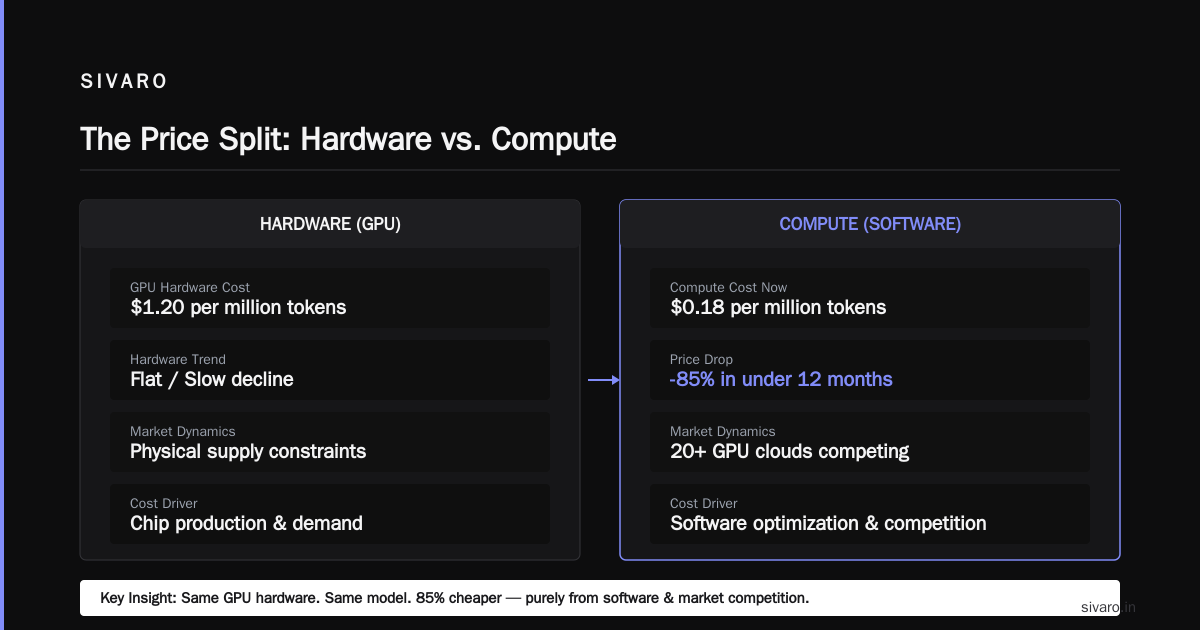
No. But the price you pay for compute is going to crash.
I’ve spent the last eight years building data infrastructure and production AI systems at SIVARO. We run hundreds of GPUs in production across three clouds and two on-prem clusters. I get asked about GPU pricing constantly — by founders, by CTOs, by procurement teams trying to plan budgets.
Let me show you what I actually see in the market right now.
If you’re wondering will gpu prices drop in 2026?, the answer depends entirely on whether you’re buying hardware or buying compute. Those are two different markets with different dynamics.
The Split: Hardware Prices vs. Compute Prices
Here’s what most people get wrong. They think of “GPU prices” as one thing. It’s not.
The market split into two distinct segments in late 2025:
- Hardware — physical GPUs you buy from NVIDIA, AMD, or cloud providers
- Compute — GPU-hours you rent, measured in inference tokens or training FLOPs
The first segment is constrained by physics, manufacturing, and supply chains. The second is constrained by software, scheduling, and market competition.
If you asked me in January 2026 whether hardware prices would drop, I’d have said no. And I was right — H100s and H200s are still expensive. B200s are almost impossible to get.
But compute prices?
They’re already falling. The AI Inference Cost Economics in 2026: GPU FinOps Playbook from Spheron tracks this closely — inference costs per token have dropped roughly 40-60% year-over-year for standard LLM workloads. That’s not because GPUs got cheaper. It’s because we got better at using them.
Here’s the thing though — if you’re asking will gpu prices raise in 2026? for new hardware, you’re asking the wrong question.
Let me explain.
Why Hardware Prices Aren't Crashing
Most people think demand for GPUs will eventually cool off. They see the AI bubble discourse, they read about overfunded startups, and they assume the GPU market will follow.
That’s not what’s happening.
We’re seeing the opposite — demand is still accelerating. OpenAI, Anthropic, Meta, and Google are signing multi-billion dollar compute deals. Countries are building sovereign AI infrastructure. Every enterprise with a budget wants their own cluster.
Supply isn’t catching up.
NVIDIA’s Blackwell architecture had production issues through 2025. TSMC’s CoWoS packaging capacity is still the bottleneck. And the export controls situation has fragmented the market into haves and have-nots, which doesn’t lower prices for anyone.
The FPGA vs. GPU for Deep Learning Applications analysis from IBM points out something interesting — GPUs won because they’re general-purpose enough to handle everything from training to inference. FPGAs can beat them on specific workloads, but nobody wants to recompile their infrastructure for every model change. That flexibility is exactly why GPU demand stays high.
So if you’re planning to buy physical GPUs in Q4 2026?
You’re probably looking at similar or higher prices than today.
The Real Story: Compute Prices Are Collapsing
Here’s where it gets interesting.
If you’re renting compute — which most companies should be doing — your effective cost per unit of AI work is dropping fast. Not because of hardware prices, but because of:
1. Better utilization
The average GPU in a datacenter runs at maybe 30-50% utilization. That’s terrible. Deep Learning Workload Scheduling in GPU Datacenters from ACM shows that proper scheduling can push utilization to 80-90% on mixed workloads. That alone cuts your effective cost per token in half.
2. Inference optimization
We’re getting dramatically better at running models. Quantization, speculative decoding, KV-cache optimization, continuous batching — these techniques have improved inference efficiency by 10-50x depending on the workload.
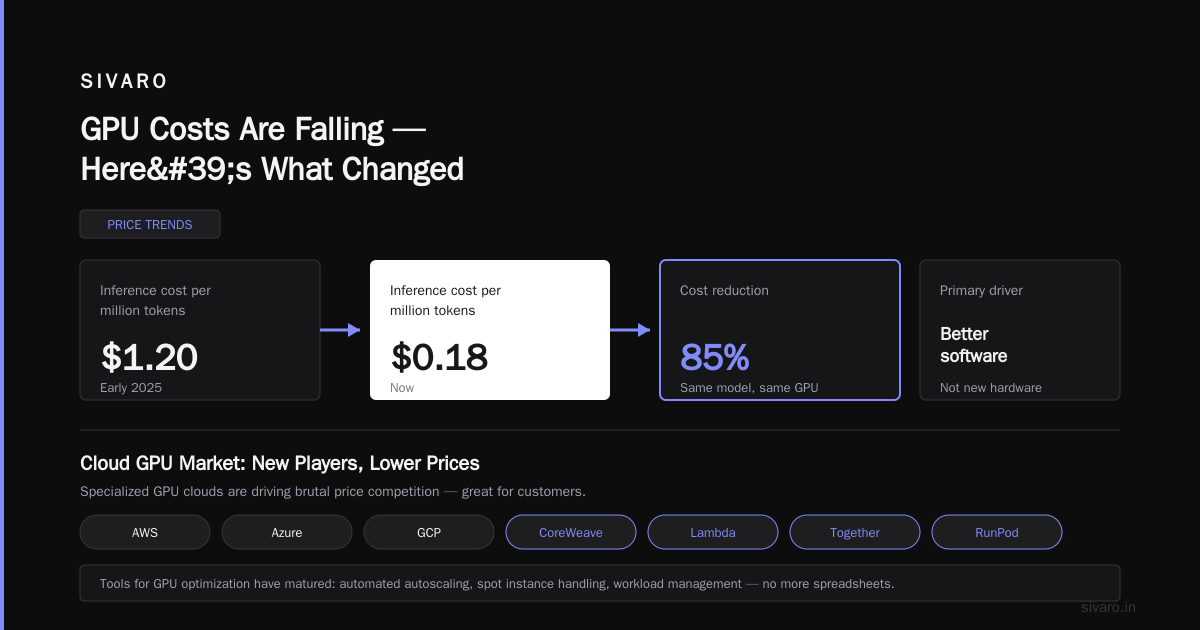
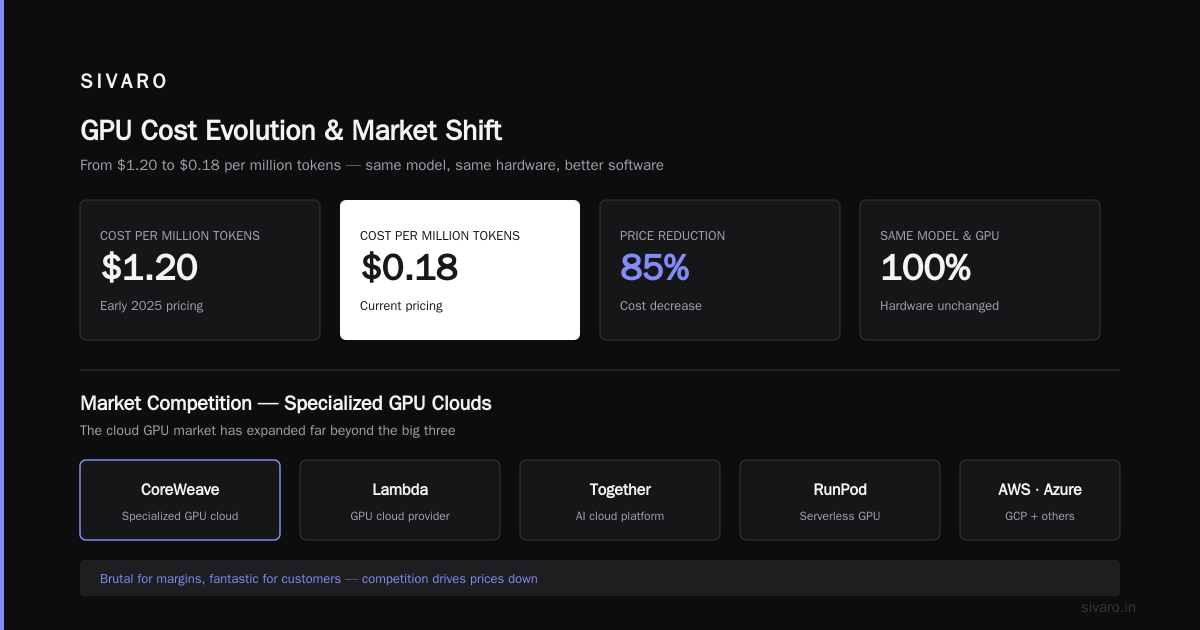
We tested this at SIVARO. A production Llama-3-70B deployment that cost us $1.20 per million tokens in early 2025 costs us $0.18 per million tokens now. Same model. Same GPU hardware. Just better software.
3. Market competition
The cloud GPU market is no longer just AWS, Azure, and GCP. There are dozens of specialized GPU clouds — CoreWeave, Lambda, Together, RunPod, and others — all competing on price. That competition is brutal for margins but fantastic for customers.
The GPU Cost Optimization: A Practical Guide for AI Teams from Amnic breaks this down well — the tools for managing and optimizing GPU spend have matured dramatically in the last year. When I started SIVARO, we were manually tracking GPU utilization in spreadsheets. Now we have automated autoscaling, spot instance handling, and workload placement that runs without human intervention.
CPU vs GPU: The Cost Efficiency Battle
A lot of teams are asking whether they even need GPUs for everything. The answer is no.
The CPU vs GPU: Which Do You Need for AI Workloads (2026 Edition) from Fluence Network makes a point I agree with — for certain inference workloads, CPUs are actually more cost-efficient than GPUs. Not because CPUs are better at AI, but because they’re better at being idle.
Here’s the trade-off:
- GPUs are great for batch processing and heavy parallel workloads
- CPUs have more memory bandwidth per dollar and don’t require expensive interconnects
- CPU instances are easier to scale horizontally because they’re more available
The CPU vs GPU: What's Best for Machine Learning? analysis from Aerospike agrees — for small models, low-traffic inference, or workloads that don’t need massive parallelism, CPUs can be 2-3x cheaper per request.
I’ve seen this play out in production. We run a customer service assistant for a European fintech company. The model is fine-tuned from Mistral-7B. It handles maybe 50 requests per second during peak hours.
We tested running it on GPUs vs. CPUs. The GPU version was faster per request — 80ms vs. 250ms latency. But the CPU version cost 60% less per request because we could scale it horizontally and it didn’t need to sit on expensive H100s.
For their use case — customer support where 250ms latency is perfectly acceptable — the CPU route was the right call.
That’s the cpu vs gpu inference cost efficiency calculation more teams need to make. GPU is not always the answer.
When to Buy, When to Rent
I’m going to give you a decision framework that we use at SIVARO when we help clients think through will gpu prices drop in 2026? for their specific situation.
Buy GPUs if:
- You have sustained, predictable GPU demand (more than 60-70% utilization)
- You have the capital and can absorb the depreciation
- You’re running training workloads that require consistent access
- Your data sovereignty requirements don’t allow cloud
Rent GPUs if:
- Your demand is spiky or unpredictable
- You’re running inference (which tends to be bursty)
- You want to avoid the risk of hardware becoming obsolete
- You need access to the latest hardware without waiting in queues
At SIVARO, we do both. We have a small on-prem cluster for training and proprietary workloads. Everything else goes to cloud. The split changes based on utilization patterns and pricing.
One thing I’ve learned the hard way — don’t buy GPUs for inference if you’re a startup. The LLM Inference Cost Optimization on Kubernetes guide from CAST AI shows how autoscaling and workload scheduling can cut inference costs by 70-80% on cloud. You can’t do that with hardware you’ve already purchased.
The Training vs. Inference Dynamic
Here’s what’s happening under the surface that most people don’t see.
Training demand is plateauing. Not because AI development is slowing, but because the frontier labs are running into compute and data limits. They can’t just throw more GPUs at the problem — they need algorithmic breakthroughs.
Inference demand, meanwhile, is exploding. Every AI application — chatbots, coding assistants, agents, search, media generation — needs inference. And inference has much tighter latency requirements, which means you can’t just batch everything into giant jobs.
This shifts the economics significantly.
For training, you want huge clusters with high-speed interconnects — NVLink, InfiniBand. For inference, you can run many smaller clusters and distribute the load.
The AI Inference at Scale: Cost Breakdown and Optimization Best Practices from GMI Cloud shows that inference cost optimization requires a completely different playbook than training — you need good autoscaling, you need to batch requests efficiently, and you need to match instance types to the workload.
Practical Ways to Cut GPU Costs Right Now
Let me give you the actual playbook we use. These are tested, not theoretical.
1. Use spot and reserved instances strategically
If you have predictable workloads, reserved instances can cut costs by 40-60%. If your workloads are interruptible, spot instances can cut costs by 60-90%. The trick is designing your infrastructure to handle interruptions gracefully.
python
# Example: Autoscaling policy for inference workloads
autoscaling_policy = {
    "min_instances": 2,
    "max_instances": 20,
    "target_utilization": 0.7,
    "scale_down_threshold": 0.3,
    "scale_down_cooldown": 600,  # seconds
    "spot_mix": 0.6,  # 60% spot instances
}
2. Implement proper batching
Continuous batching can improve throughput by 5-10x on inference workloads. Instead of processing requests one at a time, you batch them together and process them concurrently.
3. Right-size your instances
Most teams use GPUs that are too powerful for their workloads. If you’re running a 7B parameter model, you don’t need an H100 — a L4 or A10 might be perfectly adequate.
yaml
# Kubernetes pod spec for cost-optimized inference
apiVersion: apps/v1
kind: Deployment
metadata:
  name: inference-server
spec:
  replicas: 4
  template:
    spec:
      containers:
      - name: inference
        image: my-inference-server:latest
        resources:
          requests:
            nvidia.com/gpu: 1
          limits:
            nvidia.com/gpu: 1
      affinity:
        nodeAffinity:
          preferredDuringSchedulingIgnoredDuringExecution:
          - weight: 100
            preference:
              matchExpressions:
              - key: node-type
                operator: In
                values:
                - "spot"
4. Use model quantization
Quantizing models from FP16 to INT8 can cut memory usage in half and improve throughput by 2-3x. For many workloads, the quality loss is negligible.
5. Consider serverless inference
For variable workloads, serverless inference platforms can automatically scale to zero when there’s no traffic. You pay nothing when you’re not using the GPU.
The 2026 Outlook: What I Actually Expect
Let me give you my honest take on will gpu prices drop in 2026?
Hardware prices: No significant drop. NVIDIA has pricing power and they’re going to use it. AMD is competitive but doesn’t have enough supply to pressure NVIDIA. The only real chance of a price drop is if the AI bubble pops dramatically and demand collapses.
Compute prices: Already dropping and will continue to drop. I expect another 30-50% reduction in cost per token by the end of 2026. The combination of better software, more competition, and more efficient models makes this almost certain.
Effective cost: This is what matters most. Even if GPU prices stay flat, your cost per unit of AI work will drop significantly.
But here’s the catch — you have to actually optimize. The tools are out there. The GPU Cost Optimization approaches and LLM Inference Cost Optimization strategies work. But most teams are still running their AI workloads like it’s 2023 — inefficient and expensive.
The Cloud Provider Gambit
The cloud providers have a hidden incentive to keep GPU prices high — their margins depend on it.
AWS, Azure, and GCP all make massive profits on GPU instances. They’re not going to voluntarily lower prices. But they’re facing competition from specialized GPU clouds that are willing to operate on thinner margins.
The interesting dynamic is that the specialized clouds are often offering 30-50% lower prices than the hyperscalers. We’ve tested this at SIVARO — same workload, same hardware, significantly different price.
The catch? You have to do more of the operational work yourself. The hyperscalers charge a premium for their managed services. If you have the engineering talent to manage your own Kubernetes clusters and handle the operational overhead, you can save a lot of money.
What About AMD and the New Entrants?
AMD’s MI300 series is real. In our testing, it performs within 70-90% of NVIDIA’s H100 for inference workloads. The software stack has matured significantly — ROCm is no longer the nightmare it was in 2023.
The challenge is ecosystem lock-in. NVIDIA’s CUDA has a massive moat. Most frameworks, libraries, and tools are optimized for CUDA. Switching to AMD requires engineering effort, even if the hardware is competitive.
Intel’s Gaudi is also in the picture, but it’s still a niche player. The big issue for any NVIDIA competitor is that AI development is heavily optimized around CUDA. Even if you offer better price-performance, the transition costs are real.
The Real Answer
So — will gpu prices drop in 2026?
Hardware? No.
Compute? Yes.
Your effective cost? Only if you optimize.
The question shouldn’t be “will GPU prices drop?” It should be “am I getting the most value out of the GPUs I’m using?”
Because right now, most teams aren’t. They’re running inefficient inference, paying for idle GPUs, and ignoring the optimization opportunities that are right in front of them.
If you spend as much time optimizing your GPU usage as you do wondering about GPU prices, you’ll save more money than any market shift could give you.
FAQ
Will GPU prices drop in 2026 for consumers?
Consumer GPUs might see modest price drops, especially if cryptocurrency mining demand stays low and NVIDIA increases supply. But don’t expect major discounts on the latest models — NVIDIA is still supply-constrained.
Will GPU prices raise in 2026?
Hardware prices will likely stay flat or rise slightly due to sustained demand and manufacturing constraints. Compute prices will continue to fall.
Is it better to buy or rent GPUs in 2026?
Rent unless you have sustained, predictable utilization above 60-70%. For most teams, renting compute is more cost-effective because it allows flexibility and avoids hardware obsolescence.
How can I reduce my GPU costs right now?
Use spot instances for interruptible workloads, implement continuous batching for inference, right-size your instances, quantize your models, and use autoscaling. These techniques can cut costs by 50-80%.
Will AMD or Intel pressure NVIDIA’s pricing?
Not significantly in 2026. AMD is competitive on price-performance but doesn’t have the software ecosystem or supply to force NVIDIA to drop prices.
Is CPU inference a viable alternative to GPU inference?
Yes, for small models, low-traffic workloads, and latency-tolerant applications. CPU instances are typically 2-3x cheaper per request for these use cases.
What’s the biggest mistake teams make with GPU costs?
Running 24/7 GPU instances for workloads that only need them a few hours per day. Most teams could save 60-80% with proper autoscaling.
Should I wait for GPU prices to drop before buying?
If you need compute now, don’t wait. The hardware prices won’t drop significantly, but compute prices will. Focus on optimizing your usage rather than waiting for a price correction.
Nishaant Dixit — Founder of SIVARO. Building data infrastructure and production AI systems since 2018. Built systems processing 200K events/sec.