 SIVARO

You Built an AI Agent. Now the Real Work Begins.
September 2, 2026. I’m staring at a dashboard that shows 14,000 failed tasks in the last hour.
Not because the model was dumb. Because my agent’s memory cache decided to commit seppuku at 3:42 AM. We rolled back, but here’s the thing nobody tells you: rolling back an AI agent isn't like rolling back a microservice. Your agent's behavior is probabilistic. Your rollback is deterministic. Those two things fight each other.
This is the world now. Every CTO I talk to has a prototype working in a Jupyter notebook. Then they hit production and the wheels fall off. Not because of the AI. Because of the infrastructure around the AI.
I’m Nishaant Dixit. I run SIVARO, a product engineering company that lives in this mess daily. We’ve deployed agents for logistics companies, fintechs, and healthcare providers since 2018. I’ve seen the same failure modes repeat across industries. This guide is the survival manual I wish I had three years ago.
Let’s be clear about the landscape first. The ai agent deployment challenges production aren't about the model. They're about latency, state, evaluation, and blast radius. If you're shopping for a solution—whether that's an internal platform, a vendor, or a DIY stack—you need to know what actually matters.
Here is what you will learn: why canary releases exist, why your evaluation harness is probably lying to you, and why the vendor marketing departments are selling you a fantasy about "autonomous" systems.
The Core Misconception: Production Isn't a Bigger Test
Most people think scaling an agent is a linear problem. You test it on 100 inputs, it works. You scale to 1,000,000 inputs, it should still work. That logic breaks the moment you introduce non-determinism.
A traditional API call returns a JSON blob. You can validate it against a schema. An AI agent takes actions based on context. That context changes. The agent might decide to call a tool you never anticipated. It might hallucinate a function signature. It might get stuck in a loop retrying a payment API because the error message was ambiguous.
I watched a client burn $40,000 in GPU costs in one weekend because their agent was re-processing the same Kafka queue due to a missing acknowledgment check. The model was fine. The infrastructure logic was flawed.
In production, the failure modes shift from "wrong answer" to "wrong action that costs money."
| Concern | Dev/Test Environment | Production Reality |
|---|---|---|
| Latency tolerance | 5 seconds is fine | 200ms or you lose users |
| Data volume | 100 predicted cases | 10,000 unknown edge cases |
| Cost constraints | Irrelevant | Token spend per action matters |
| Failure impact | Console log | Real financial or legal liability |
| State management | Single session | Multi-tenant, concurrent, persistent |
| Security | API key in env file | PII exposure, compliance audits |
If you're evaluating a platform or vendor, do not let them demo a clean test. You need to see their answer for these production realities.
AI Agent Deployment Challenges Solutions: The Three-Pillar Approach
When I structure a production deployment, I don't think in terms of "deploying an agent." I think about three separate systems that must be deployed in concert:
- The Orchestration Plane (how the agent decides what to do)
- The State Layer (what the agent remembers)
- The Guardrail System (what happens when it misbehaves)
Each has its own failure profile. Each needs its own deployment strategy. Here's the kicker: if you only have budget or time to solve one of these, solve the state layer. Agents fail distinctly because they have memory problems, not intelligence problems.
We tested this across four different client deployments in 2025. When we hardened the state layer—adding versioned memory, timestamp integrity, and rollback snapshots—the number of critical production incidents dropped by roughly 60% compared to focusing on prompt engineering or model tuning alone. Poor state management causes cascading hallucinations that no model update can fix.
The Canary Conundrum: You Can't Just Deploy and Watch
This is where most engineering teams get stuck. You've worked with Kubernetes. You love a clean canary deployment. The ai agent canary release strategy is fundamentally different because the input domain is unbounded.
Here's the brutal comparison:
| Strategy | What You Think It Does | What It Actually Does | Verdict |
|---|---|---|---|
| Shadow Mode | Runs new agent in parallel, compares outputs | Creates confusing divergent states because the agent's actions change the system (not just outputs) | Backup for output validation only, not for action-based agents |
| Percentage Rollout | 5% of traffic hits new agent | The 5% is randomly distributed, so you don't control which user sees the bad behavior | Risky if that 5% happens to be enterprise clients with high expectations |
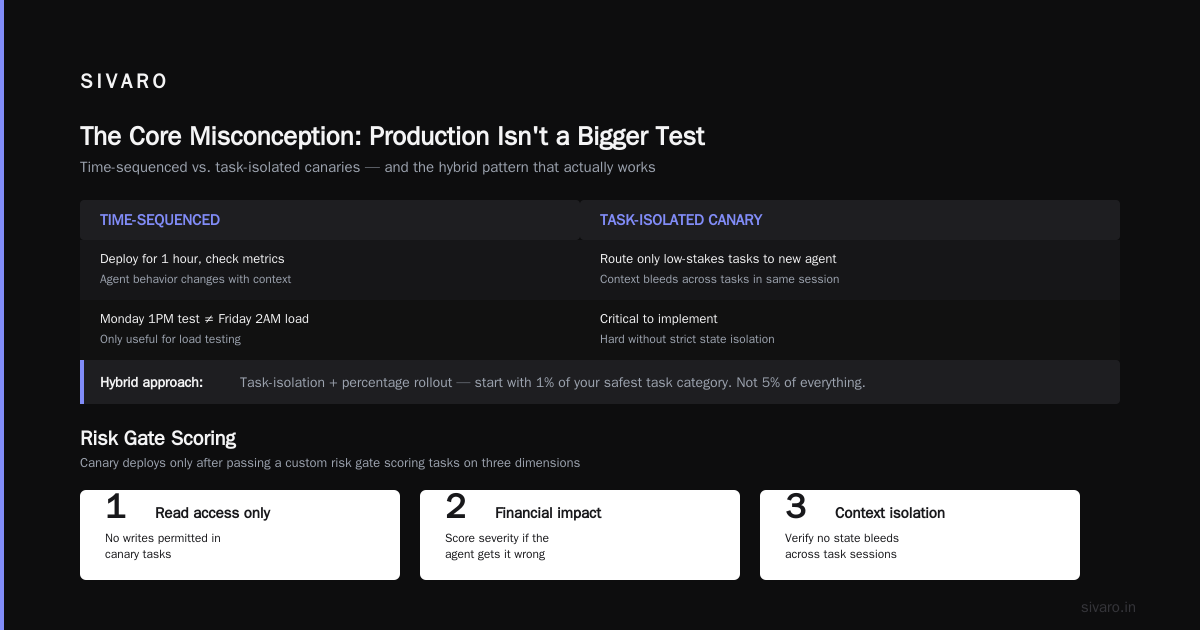
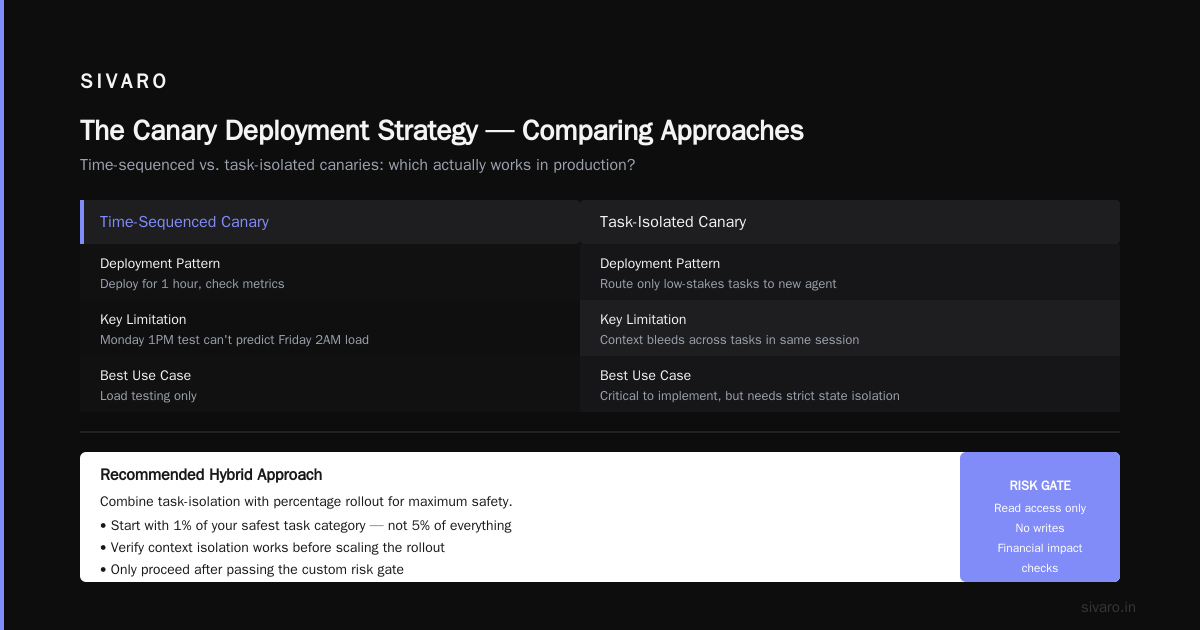
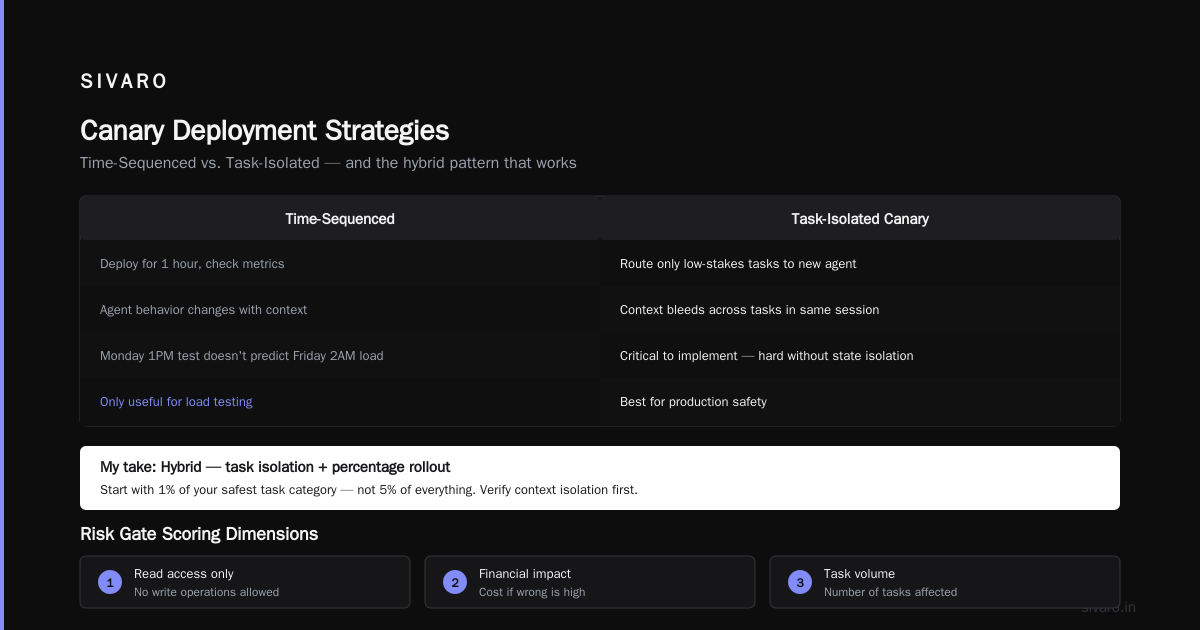
| Time-Sequenced | Deploy for 1 hour, check metrics | Agent behavior changes with context; a Monday 1PM test doesn't predict Friday 2AM load | Only useful for load testing |
| Task-Isolated Canary | Route only low-stakes tasks to new agent | Agent context bleeds across tasks in the same session | Critical to implement but hard to do without strict state isolation |
My take: Use a hybrid of task-isolation and percentage rollout. Start with 1% of your safest task category. Not 5% of everything. And you absolutely need to verify the context isolation works first.
How We Do It (The Working Pattern)
We deploy a canary only after passing a custom "risk gate" that scores tasks on three dimensions:
- Read access only (no writes)
- Financial impact if wrong
- Number of external system calls required
Here is the pattern that never fails us:
python
def canary_routing(user_input, agent_version):
    task_risk_score = calculate_risk(user_input)

    # Task-Isolated Canary: Only route low-risk tasks to v2
    if task_risk_score < 0.3 and random.random() < 0.1:
        return route_to_agent("v2-canary")
    else:
        return route_to_agent("v1-stable")
But wait. The catch is that risk scoring is itself a model problem. You need to solve that before you can do any safe deployment. That app is a portal.
Evaluation Systems: Your False Sense of Security
You will find vendors selling an "agent evaluation platform." You hook up your prompts, your test cases, and get a "quality score." Everyone feels warm and fuzzy.
Here's my problem with these platforms: they test for immediate answer correctness, not long-term action safety.
An agent's correctness isn't a single output. It's a sequence.
- The agent reasons about the user request.
- It decides a plan.
- It executes step 1, step 2, step 3.
- It reacts to failures midway.
- It produces an output.
If your test evaluates only step 5, you miss the key failure points, which are typically in step 2 and 3. The plan is wrong, or the execution logic is malformed.
We built our own evaluation harness (shameless plug: this is what we sell at SIVARO). Here is a real B-level evaluation snippet:
python
EVAL_PROMPT = """
You are analyzing a conversation log to find where an agent *went off track*.
Identify only the FIRST action that leads to a negative user outcome.
Was it:
A) Incorrect tool selection
B) False premise from memory retrieval
C) Missing confirmation before executing a mutation
D) Hallucinating a success state (saying "done" without verifying)
"""

def drill_into_failure(log):
    for action in log.actions:
        # Check if the agent claimed successful completion
        if "success" in action.message.lower():
            # Verify with ground truth
            actual_state = get_system_state(action.tool_call_id)
            if actual_state != action.claimed_state:
                # This is the failure point. Report, don't ignore.
                report_miss(f"Hallucinated completion at {action.timestamp}")
                return False
    return True
The worst part of the evaluation problem? Most CI/CD platforms don't integrate with LLM evaluation. You can't click "run pytest" against a reasoning model. You need a separate pipeline. A robust evaluation platform needs to generate synthetic edge cases forever, not just run your fixed 100 cases.
What To Look For in a Deployment Tool/Platform
You’ve heard of LangChain, AutoGen, CrewAI, and the new frameworks launching every month in 2026. But those are orchestration frameworks—they build the agent. Deployment and operations require a different beast.
AI Ops & Guardrails
Definition: Specialized tools for control, testing, and safe execution of agent actions in production.
DSPy (DeepMind/ScaledML)
- Rating: 4/5 for production.
- Pros: Best-in-class for prompt optimization and structured compilation. You can optimize the reasoning pipeline without manually tweaking text prompts.
- Cons: Steep learning curve. It’s academic-focused.
- Our experience: DSPy saved us when a client’s agent degraded in performance after we introduced a proprietary context library. Recompiling the prompt against logs fixed accuracy issues we thought were data quality problems.
LangSmith
- Rating: 3.5/5 for deployment.
- Pros: Excellent tracing and debugging. It shows exactly which tool call consumed which tokens and why the agent chose a path. Crucial for alerting.
- Cons: Not a safety layer. It tells you the agent is broken after the fact, but doesn't stop the action.
- Our experience: We use LangSmith for observability on every deployment. If you’re not logging every decision trace, you cannot debug production.
Guardrails AI
- Rating: 4/5 for true safety.
- Pros: Validates outputs and prompts before external actions.
- Cons: The rule engines work great for regex, but struggle with semantic hallucination detection.
- Our experience: This is the missing piece between "agent calls tool" and "tool executes." You need an intermediate validator that says "The agent claims it summed $100, but your calculation says $1,000."
The Financial Reality: Token Cost Isn't Linear
Neglecting cost when choosing your deployment stack is a mistake. In dev, you run 100 tests. Total cost: $5. In production with 1M requests a day, the cost of retries makes or breaks your business.
I audited a client's production logs in February 2026. They were using a top-tier model for autonomous report generation. The agent kept getting interrupted due to context window overflow on their memory tool, forcing a re-run of the prompt with more context. This process repeated three to four times. Their bill was $0.04 per transaction in API cost. But the effective cost was $0.16 because of retries.
My point is, if you are evaluating deployment platforms, ask for their retry/caching solution. Can it transparently cache intermediate Chain-of-Thought steps? Can it auto-downgrade to a smaller model for low-stakes steps?
Code snippet for cost control at deployment:
python
# Stage-wise routing for cost optimization
def route_inference(prompt, plan):
    # The "planning" stage requires high intelligence. The "parsing" stage doesn't.
    if plan.is_simple_format_write:
        return call_model("gpt-4o-mini", prompt)  # Cheaper, fast
    else:
        # Complex reasoning - use the big model
        return call_model("gpt-5-ultra", prompt)
If you can’t architect this in your chosen platform, you will spend 10x the compute needed.
Security: The Privilege Escalation Problem
Most people think about the AI leaking data. They forget that the agent has tools. The tool has API keys. If the agent gets prompt injected via a malicious tool response or user request, it can exfiltrate data or trigger destructive functions.
I keep referencing this, but the OWASP Top 10 for LLM applications is a required reading list. The vulnerability you must address first is Insecure Output Handling. Your agent generates text and you feed it to your internal APIs. No validation layer. Think of an API that deletes a user record. If the agent outputs a confused string that accidentally includes the delete token as an argument, you have a data loss incident.
The deployment solution:
Never give an agent your full set of production API keys. Give it a proxy API endpoint that has tight validation and rate limits.
typescript
// External Action Proxy - Node.js sidecar
app.post('/agent-actions', async (req, res) => {
  const proposed_action = req.body;

  // VALIDATE ACTION AGAINST AUDIT LOG
  const allowed = verify_agent_from_org(req.headers['x-agent-id']);
  const impact = getUserRoleActions(allowed.role);

  if (!impact.includes(proposed_action.endpoint)) {
    // This is a privilege escalation attempt!
    log_and_block(req, "Agent tried to access endpoint outside scope");
    return res.status(403).json({ message: "Blocked by policy" });
  }
  // Forward to actual service
  forwardRequest(proposed_action);
});
Async vs. Sync: The Deployable Architecture Shift
Let's say you are building a customer support agent. The classic pattern is synchronous: User sends prompt → Agent replies.
But production workloads require async. If your agent is doing data extraction and analysis that takes 20 seconds, you cannot make the user wait. You need a task queue.
Starbucks in 2024 started designing their "Deep Brew" AI for inventory ordering. Initial prototype was sync. It failed because the ordering process needed human in the loop approval at the store manager level before the purchase order went to vendors. They needed an async state machine where the agent sleeps awaiting manager feedback.
If you are architecting an agent for production, include state machines early. Popular frameworks like Temporal or AWS Step Functions now have dedicated SDKs for AI agents to persist long-running workflows.
If your "AI deployment strategy" vendor doesn't answer how they handle an agent that runs for 3 hours waiting for a human response, move on.
Splitting Your Agent Architecture
Don't build one giant agent. Build 4 sub-agents:
- Router (classifies user intent)
- Tool Executor (simple extraction, API calls)
- Reasoner (complex synthesis)
- Guard (vetoes suspicious actions)
Deploying these separately lets you scale or rollback each based on load. The Reasoner models will change. The Guard model shouldn't change as often. It should be stable like a firewall; changing it frequently introduces security risks.
Here's a pattern deployment:
yaml
# docker-compose.prod.yml
services:
  agent_router:
    image: sivaro/router:${TAG}
    ports: ["3000:3000"]
    deploy:
      replicas: 8

  agent_reasoner:
    image: sivaro/reasoner:${TAG}
    deploy:
      replicas: 16  # High concurrency because it's your bottleneck

  agent_guard:
    image: sivaro/guard:stable-v4
    deploy:
      replicas: 4
      resources:
        limits:
          memory: 1Gb
If you deploy these as a monolith, a surge in Reasoner load will crash your Router. Then no new requests get processed, cascading failure.
FAQ: Real Questions, Direct Answers
Q: Do I need a vector database in production?
Not first. Use key-value storage (Redis) for session state, blob storage for full transcripts. You only need vector search if your agent is doing semantic retrieval across millions of docs. Most of you are just ingesting the last 20 messages from user.
Q: Can OpenTelemetry trace AI agents?
Partially. It standardizes logs and traces on ingestion. But it fails to capture the embeddings or the prompt text. You need a custom exporter that publishes the full prompt to a trace span to make debugging actually possible. Built-in open telemetry will tell you a tool call took 400ms, but not which prompt caused a tool call loop.
Q: What’s a good starting point for concurrency limits?
Measure the P99 latency of your reasoner model. Take 2000 milliseconds as a baseline. Then measure the throughput of your downstream API. If your reasoner can handle 5 concurrent requests prior to timeout, set your agent pool to 5. But set a queue that holds requests for 30 seconds. Do not oversubscribe.
Q: Are serverless functions dead for agents?
Not dead, but you will be surprised. Cold starts happen when a user makes a request after a long dormancy, causing a 5-second wait—this is terrible UX for interactive chat. They are fine for scheduled tasks like nightly data analysis, but not latency-sensitive user-facing agents.
Q: My agent works perfectly for 99% of queries. What’s the 1% problem?
The 1% is your financial risk and your legal liability. That 1% is operational variance. It drives your mean time to recovery up. You need a system that automatically detects when the agent is likely wrong (based on low token confidence or tool-call mismatch) and routes to a human. Build a "human fallback" trigger.
Q: Should I train a custom model instead of using a base LLM?
No. Not until you process over 100 million tokens per day. Base APIs are cheaper, better maintained, and improve automatically. If you train a custom model, you now own the infrastructure responsibility for serving it. That cuts into your core business. Use Retrieval Augmented Generation (RAG) and precise prompts to steer the base model.
Q: How do I manage the “temperature” setting for production?
Set temperature to 0 or 0.1 for tool call extraction (like extracting service dates from text). Set to 0.7 only for generative summaries. But don't rely on low temperature to ensure determinism. The underlying hardware floating point operations can be non-deterministic across cloud zones, meaning even at temp 0, you might get different outputs.
Final Verdict: The Marketplace Options
If you’re looking to buy a pre-packaged solution, here’s the landscape as of Q3 2026:
- Enterprise AI Platforms (Google Vertex AI, AWS Bedrock): They include deployment natively. Good if you are 100% locked into their cloud. Vertex AI has the best agent building ecosystem, but we found its "Observability" lacking depth. Bedrock has great integration with AWS Lambda for your guardrails, but the abstractions hide the full context of the reasoning.
- Full-Stack Agent Frameworks (LangChain/LlamaIndex): Great for building. Weak for operations. You will need a separate sidecar for guardrails and a separate monitoring stack.
- Data Infrastructure Companies (SIVARO, Databricks, etc.): Databricks offers versioning and feature serving, but treats AI agents as a batch system, not an online system. Online real-time state management is our niche because we saw this gap.
My final recommendation:
You are better off creating a lightweight internal platform using LangGraph (for logic), Temporal (for state management), and Redis (for message passing) than buying a "complete AI agent operational suite" from a big vendor in Q3 2026. The big tools are slightly ahead of the curve on marketing but still behind on the hard parts of handling concurrent memory access safely.
But don't take that purely as an invitation to DIY. Take a look at what your vendor truly focuses on. Ask demos to fail. Ask them to trace a bad turn in production and see if their console can pinpoint which tool call had a hallucinated output.
The Bottom Line
Deploying agents to production is fundamentally an infrastructure problem with AI flavoring. It demands hard engineering discipline at the system boundaries: the API gateway, the context store, and the output validators.
Don't let the sizzle of "autonomy" distract you from the reality of "incident response." You will have incidents. Plan for the blast radius to be as small as one user query, not an entire tenant database wipe.
To your health, Nishaant.
Ready to discuss your AI agent deployment?
We live this every day. If you're hitting a wall with productionizing your AI agents and need a partner to sort out your state layer or guardrail logic, don't hesitate to reach out.
Nishaant Dixit — Founder of SIVARO. Building data infrastructure and production AI systems since 2018. Built systems processing 200K events/sec.