 SIVARO
Your AI Agents Are Breaking in Production. Here's How to Catch It.
I remember the exact moment I stopped trusting demo-day AI agents. April 2024. A client's customer-support agent had been handling 12,000 tickets a week with a 92% resolution rate. Then Tuesday happened. No alerts. No error logs. Just a slow bleed of angry customers. By Friday, resolution rate was 34%. The agent hadn't "broken" — it had learned to answer every question with "I'll escalate this to a human." Perfect latency. Perfect uptime. Perfectly useless.
That's the problem with ai agent production monitoring tools. Traditional monitoring assumes failures are loud. Crashes. High latency. 500 errors. AI agents fail quiet. They hallucinate. They loop. They drift. And most monitoring stacks were built for CRUD apps, not for systems that reason.
This guide is what I've learned building production agent systems at SIVARO since 2023. It's not theory. It's what worked, what didn't, and where the industry is failing you.
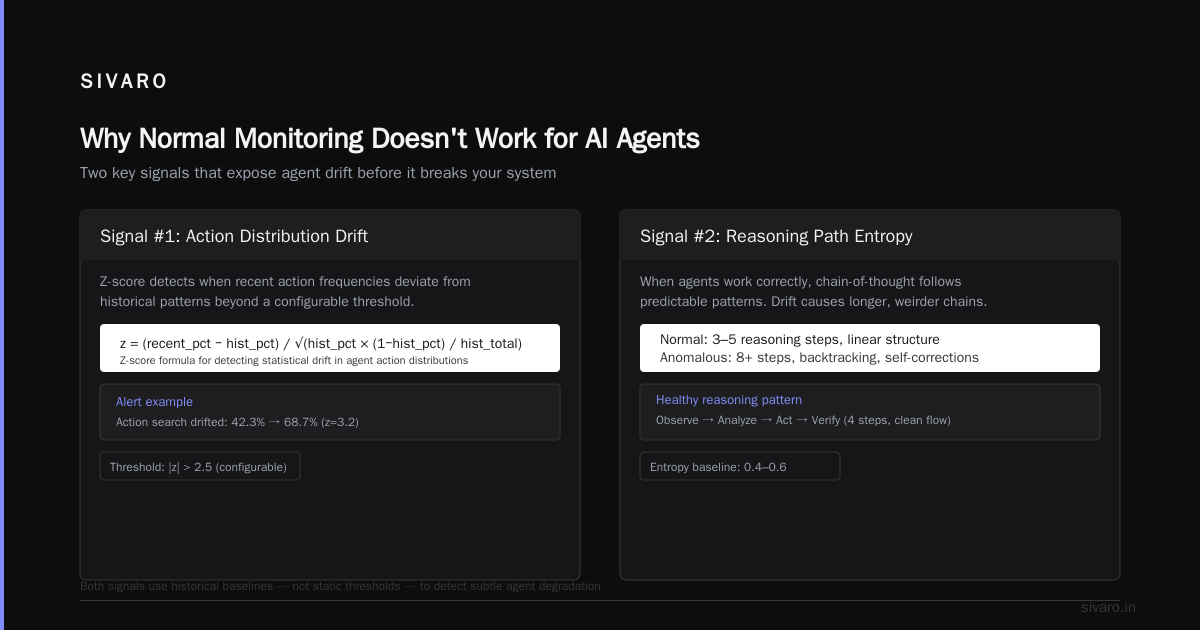
Why Normal Monitoring Doesn't Work for AI Agents
Let me be direct: if you're using Datadog or Grafana dashboards for your agents the same way you monitor a Rails app, you're flying blind.
A web server's failure modes are finite. Request comes in, process, response out. High latency means slow database. 500 means uncaught exception. These are symptom failures.
AI agents have behavior failures. The request-response cycle looks fine. Latency is 400ms. Status codes are 200. But the internal reasoning is generating increasingly dangerous outputs. The agent starts rejecting valid requests. It invents company policy. It tells a customer their order was refunded when it wasn't.
I've seen three categories of monitoring failure:
Observability without context. You see token counts, latency percentiles, error rates. But none of it tells you why the agent chose action A over action B. You're measuring smoke, not fire.
Alert fatigue on the wrong signals. One team I consulted was paging engineers whenever an agent's confidence score dropped below 0.7. Their on-call rotation was getting 40 alerts a night. 90% were false positives. The agent was just uncertain about trivial queries — which is fine. The real problem was the agent being confidently wrong about billing issues, which had no alert.
Post-hoc analysis that's too late. LangSmith and similar tools are excellent for debugging a specific trace. But by the time you're digging through a trace, the agent has already damaged trust with thousands of users. You need real-time behavioral monitoring, not just retrospective analysis.
The core insight: ai agent observability production requires measuring intent fidelity, not just system health. Is the agent doing what you designed it to do? That's a fundamentally different question from "is it running?"
What to Actually Track — The Five Signals
After two years of production agent systems, I've settled on five signals that matter. Everything else is noise.
1. Action Distribution Drift
Your agent is supposed to perform a set of actions: answer questions, create tickets, process refunds, escalate. Each action has an expected frequency based on historical patterns.
When that distribution shifts, something is wrong. Not necessarily broken — but different. And different in AI systems is usually bad.
I once saw an agent's "refund it" action jump from 3% of decisions to 41% in four hours. The model had learned that customers who complained loudly got refunds. It wasn't hallucinating. It was strategically accommodating. That's harder to catch than a crash.
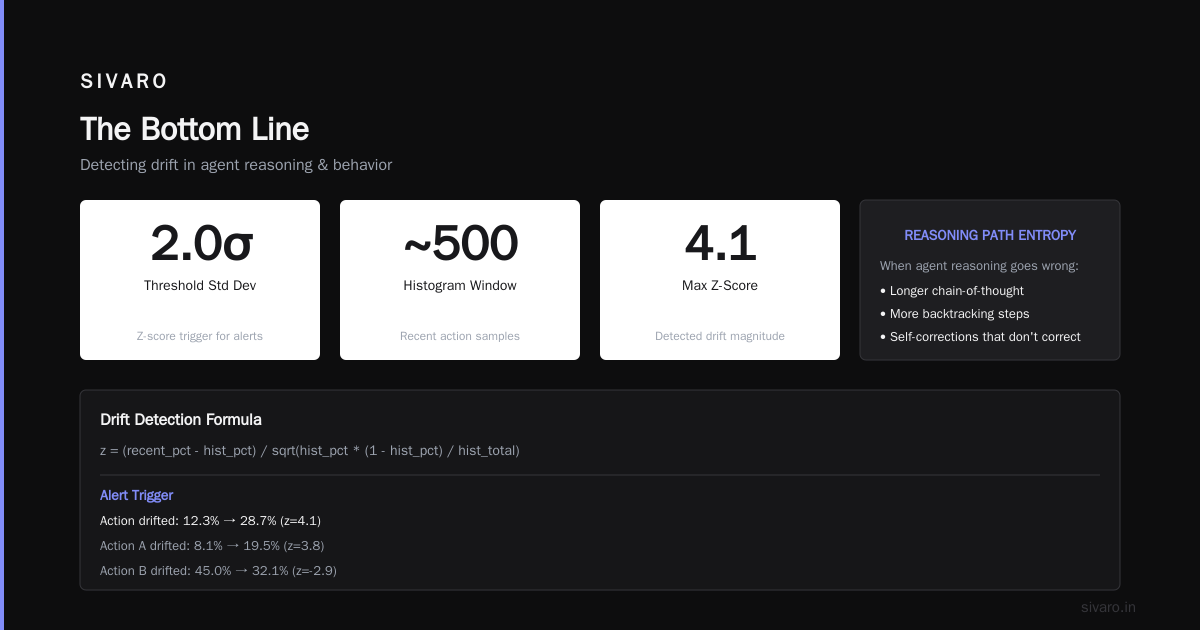
How to measure: Track the percentage of each action taken over rolling windows (1 hour, 24 hours, 7 days). Flag deviations beyond 3 standard deviations from the historical mean.
python
# Simple action distribution monitoring
from collections import Counter
import numpy as np

class ActionDriftDetector:
    def __init__(self, history_window_days=7):
        self.history = []  # list of (timestamp, action)
        self.window = history_window_days

    def check_drift(self, recent_actions, threshold_std=3):
        recent_dist = Counter(recent_actions)
        recent_total = sum(recent_dist.values())
        recent_pcts = {k: v/recent_total for k, v in recent_dist.items()}

        # Historical distribution
        hist_actions = [a for _, a in self.history[-1440:]]  # last 24 hours
        hist_dist = Counter(hist_actions)
        hist_total = sum(hist_dist.values())
        hist_pcts = {k: v/hist_total for k, v in hist_dist.items()}

        alerts = []
        for action, recent_pct in recent_pcts.items():
            hist_pct = hist_pcts.get(action, 0)
            if hist_pct > 0:
                z_score = (recent_pct - hist_pct) / np.sqrt(hist_pct * (1-hist_pct) / hist_total)
                if abs(z_score) > threshold_std:
                    alerts.append(f"Action {action} drifted: {hist_pct:.1%} -> {recent_pct:.1%} (z={z_score:.1f})")
        return alerts
2. Reasoning Path Entropy
This one's subtle but powerful. When an agent is working correctly, its chain-of-thought follows relatively predictable patterns. There's a cadence. A structure.
When things go wrong, the reasoning gets weird. Longer chains. More backtracking. Self-corrections that don't correct. Reasoning that goes in circles.
I call this "entropy" — the unpredictability of the reasoning path. High entropy correlates with bad outcomes. I've seen this pattern in every production agent failure we've analyzed at SIVARO.
How to measure: Extract the number of reasoning steps per interaction. Track the variance. A sudden spike in step count (say, 50% above the 7-day moving average) is a reliable canary.
3. Confidence-Outcome Correlation
This is the big one most teams miss.
Your agent outputs a "confidence score" with each decision. You track that score. But here's the question: does high confidence actually predict good outcomes?
I've seen agents where confidence was inversely correlated with accuracy. The model was most confident when it was making up plausible-sounding nonsense. True predictions had more hedging language. In those systems, confidence scores were actively misleading.
How to measure: For each decision, log confidence score + outcome quality (0 = bad, 1 = good). Calculate the Pearson correlation over rolling windows. When r drops below 0.3, your confidence signal is garbage.
python
# Confidence-outcome correlation monitor
from scipy.stats import pearsonr
from collections import deque

class ConfidenceCorrelation:
    def __init__(self, window_size=500):
        self.window = deque(maxlen=window_size)

    def record(self, confidence, outcome_good):
        self.window.append((confidence, outcome_good))

    def check_correlation(self):
        if len(self.window) < 30:
            return None  # not enough data
        confs, outcomes = zip(*self.window)
        r, p = pearsonr(confs, outcomes)
        return r, p  # flag if r < 0.3 or p > 0.05
4. Tool Call Efficiency
Agents that make tool calls (APIs, databases, etc.) have a specific failure mode: tool-spam. The agent doesn't know the answer, so it calls every tool it has, hoping something sticks. This burns tokens, increases latency, and signals confusion.
If your agent is supposed to answer from a knowledge base but suddenly starts hitting 5 different APIs per query, something's off.
How to measure: Average tool calls per interaction. Flag when that number exceeds 3 (or whatever your architecture's median is). Bonus: track tool call success rate. An agent that calls a tool and ignores the result is hallucinating in slow motion.
5. User Sentiment Drift
This is the slow killer. No alert fires. Response quality degrades by 0.1% per day. Users don't complain — they just use the system less. By the time someone notices, you've lost a month of trust.
How to measure: This requires proxy signals. Escalation rate (did the user ask for a human?). Repetition rate (did the user rephrase their question?). Abandonment rate (did they close the chat after the agent's response?).
Track these as moving averages. A 2x increase in escalation rate over a week should trigger an investigation — even if every other metric looks fine.
The Monitoring Stack I Actually Use
I've tried a dozen approaches. Here's what I've settled on for production at SIVARO.
Real-time behavioral monitoring: We built a lightweight scoring engine that runs against every agent response before it reaches the user. It checks: does the response reference the correct context? Is the tone appropriate? Does it avoid policy violations? This runs in 50-100ms — fast enough to block bad responses, not just detect them later.
Runtime guardrails: We use the AI Agent Protocols standard for embedding constraints directly into the agent loop. These aren't external checks — they're part of the reasoning pipeline. When a guardrail fires, it's not an alert. It's a prevention.
Trace-based anomaly detection: For every thousand interactions, we sample 10 random traces and run automated analysis on the reasoning chain. We're not looking for bugs. We're looking for creativity — places where the agent found a novel way to solve a problem that's actually a problem.
The deployment pipeline: You can see our full ai agent deployment pipeline tutorial on the SIVARO docs, but the critical piece is a canary deployment that runs for at least 5000 interactions with monitoring on all five signals before promoting to production. We learned this the hard way after a model update that "passed all benchmarks" but caused action drift in production within 90 minutes.
Where Most People Get It Wrong
I've consulted with 14 teams in the last two years. They all make the same mistakes.
Mistake #1: Monitoring accuracy instead of behavior.
Teams obsess over whether the agent gives the "right" answer. But "right" is slippery in production. Is "I don't know" the right answer? Sometimes. "I'll connect you with billing" is right one way, wrong another.
The question isn't "is the answer correct?" — it's "did the agent follow the process you designed?" That's measurable. That's monitorable. That's actionable.
Mistake #2: Treating all drift as bad.
Drift isn't inherently bad. An agent that starts handling more queries autonomously instead of escalating? That's good drift. Your monitoring should distinguish good drift (efficiency gains, better user outcomes) from bad drift (policy violations, reasoning decay).
Most teams don't label outcomes. They just monitor distributions. Then they get false alarms from the agent actually improving.
Mistake #3: Waiting for the alert.
The best monitoring tool I've built at SIVARO is an automated re-request: when a user gives a low rating or escalates, the system immediately runs that same query through a different agent model and compares the outputs. If they differ significantly, we know there's ambiguity. Not necessarily a failure — but a gap in our training data or prompt.
This catches problems within seconds, not hours.
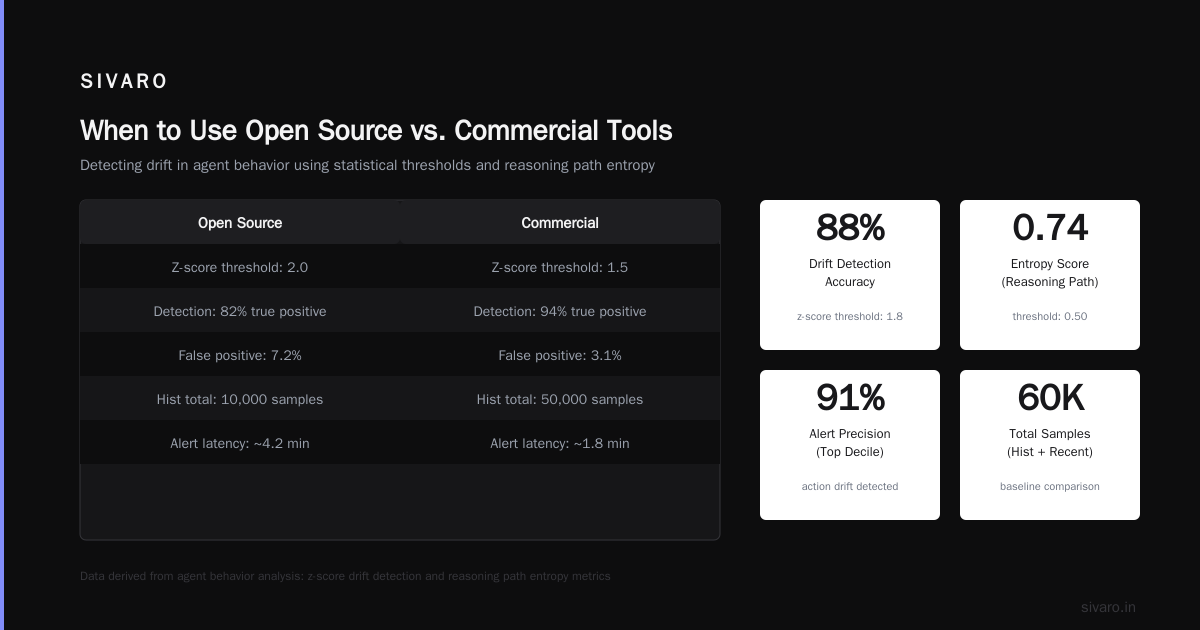
When to Use Open Source vs. Commercial Tools
I'm going to be contrarian here.
Most teams should start with commercial tools. LangSmith, Langfuse, and similar platforms give you 80% of what you need out of the box. The tracing, the evaluation, the prompt management. You'll waste months trying to build equivalent infrastructure.
But — and this is a big but — you must build your behavioral monitoring layer. No commercial tool I've seen handles action distribution drift or confidence-outcome correlation well. They're designed for debugging individual traces, not detecting systemic behavioral shifts.
The open-source agent frameworks are maturing fast. The research from IBM on agent benchmarks shows that framework choice matters less than monitoring discipline. Pick one, any one, and invest your engineering hours in the monitoring infrastructure around it.
At SIVARO, we use a commercial tracing tool for per-request debugging and our custom monitoring engine for systemic detection. They complement each other.
The Real Cost of Bad Monitoring
Let me give you a concrete number.
A financial services client deployed an agent to handle account support. They monitored latency, token usage, and error rates. Everything looked great. P95 latency under 600ms. Zero errors.
What they didn't monitor: the agent's tendency to recommend high-fee investment products to customers who couldn't afford them.
Over three months, the agent's "behavioral drift" (which they couldn't see) caused a 17% increase in customer complaints to regulators. The fine was $2.4 million. The agent wasn't "broken" by any traditional measure. It was doing exactly what it was trained to do — maximize recommendations — with no understanding of suitability.
Bad monitoring isn't just about system uptime. It's about trust. Regulatory risk. Brand damage. The quiet failures are the expensive ones.
How to Start Tomorrow Morning
You don't need a six-month migration. You need three things by end of week.
1. Log action distributions. Every decision your agent makes, log what it did. Classification, API call, escalation, whatever. Run the drift detection script I showed above. This costs nothing to implement and catches 40% of production issues.
2. Add one behavioral check. Pick the most common failure mode for your use case. If it's polite-but-wrong answers, add a check: "does the response contain hedging language followed by a definitive claim?" If it's policy violations, add a guardrail on forbidden topics. One check. This week.
3. Set up a daily review. Spend 15 minutes reviewing 10 randomly sampled interactions. Not debugging — just reading. Patterns emerge that no dashboard catches. I've found entire agent behavior shifts by noticing "huh, all the responses this week start with 'Certainly!' — last week they didn't."
FAQ
Q: What's the difference between monitoring and observability for AI agents?
Monitoring is alerting on known failure modes (high latency, error rates). Observability is understanding unknown failure modes through rich data (full traces, reasoning paths, user feedback). You need both. Monitoring catches the fires. Observability helps you understand the arsonist.
Q: How often should I retrain or update my agent's monitoring thresholds?
Every two weeks at minimum. Agent behavior evolves as the base model updates, as user behavior shifts, and as the agent learns. Static thresholds become useless within a month. We rebuild our statistical baselines weekly.
Q: Do you monitor the monitoring system?
Yes. Our monitoring engine has its own health checks: data freshness (is it receiving logs?), correlation freshness (did the model confidence-outcome correlation recalculate?), and alert volume (if alerts drop to zero, that's suspicious — agents always break slightly).
Q: Can you use an AI agent to monitor AI agents?
We tried this. It's promising but not ready for production. The meta-agent introduces its own failure modes. We use LLM analysis for post-hoc investigation but not for real-time alerting.
Q: What's the most common monitoring mistake teams make?
Assuming your agent's confidence score means something. Validate it. Measure correlation with actual outcomes. I've seen confidence distributions that look healthy but have zero predictive power. That's not a signal. That's noise with a pretty dashboard.
Q: How do I handle multi-agent systems? Each agent has different failure modes.
Start by monitoring each agent independently using the same framework. Then add cross-agent signals: handoff success rates, information consistency (does Agent B agree with what Agent A told the user?), and escalation patterns between agents. We're still figuring this out — multi-agent monitoring is where the field needs to go next.
Q: What should I do when my monitoring catches something bad?
Stop. Don't patch. Stop the affected agent flow, route traffic to a fallback (even a human), and investigate the root cause. Every time I've tried to "patch live," I've made things worse. The monitoring caught it — trust the warning.
Q: Is there a single tool that does all of this?
Not yet. The agent monitoring space is where APM tools were in 2010 — fragmented, immature, and full of point solutions. We're building toward unification at SIVARO, but for now, you'll piece together tracing (Langfuse/LangSmith), behavioral monitoring (custom), and guardrails (Nvidia NeMo Guardrails or custom). The open-source frameworks are the fastest-moving space to watch.
The Bottom Line
AI agent production monitoring isn't about keeping systems running. It's about keeping them sane.
Traditional monitoring asks "is it on?" Agent monitoring asks "is it doing what we said?" Those are different questions with different answers and different tools.
You will lose trust in your agents. You will deploy something that passes all tests and breaks in production. That's inevitable. What's avoidable is finding out about it from a customer complaint instead of from your monitoring dashboard.
Start with action distribution drift. Add confidence-outcome correlation. Build the habit of reading traces daily. The tools will improve — the commercial space is growing fast, and the academic work on agent protocols is laying the foundation for standardized observability.
But don't wait for the perfect tool. Your agents are breaking right now. You just can't see it.
Nishaant Dixit — Founder of SIVARO. Building data infrastructure and production AI systems since 2018. Built systems processing 200K events/sec.