Is ChatGPT an AI Agent? The Real Answer, From a Builder
No. But also yes. And the difference matters more than most people realize.
I've spent the last seven years building production AI systems at SIVARO. We process 200K events per second through data pipelines that feed everything from real-time fraud detection to inventory forecasting. When clients ask me "is chatgpt an ai agent?", I know they're really asking something deeper: Can I trust this thing to do a job without me holding its hand?
Short answer: ChatGPT started as a chatbot. It's evolving into something that can act like an agent. But calling it an AI agent today is like calling a car with cruise control a self-driving vehicle. Close. But not the same thing.
Let me show you exactly why — and what that means for anyone trying to build real systems.
The 30% Threshold That Changes Everything
Most people think the question "is chatgpt an ai agent?" is semantic. It's not. It's operational.
Here's the distinction I use with my engineering teams: An AI agent acts autonomously toward a goal. A chatbot responds to prompts. The difference isn't in the model — it's in the loop between the model and the world.
I keep coming back to something I call what is the 30% rule for ai? It's not a formal standard. It's a heuristic I developed after watching teams deploy AI systems that looked like agents but failed in production. Here's the rule:
If your AI system requires human intervention more than 30% of the time to complete a task, it's not an agent. It's a tool that needs a human operator.
ChatGPT, as of mid-2025, sits somewhere around the 40-60% mark for most complex multi-step tasks. It can do things on its own for a while. Then it hits a wall. It asks you for clarification. It guesses wrong. It hallucinates a database schema that doesn't exist.
That's not agency. That's a very smart intern who needs supervision.
What Does an AI Agent Do Exactly?
Let me answer what does an ai agent do exactly? with four concrete capabilities, drawn from the IBM definition of AI agents:
- Perceive its environment (read data, observe state)
- Reason about goals and constraints
- Act to change that environment
- Learn from the outcomes
A chatbot does #2 reasonably well. It does #1 only through text you give it. It barely does #3 — it can't modify files, send emails, or control APIs without you explicitly instructing it or using a plugin. And it definitely doesn't do #4 in any meaningful sense (ChatGPT doesn't get smarter from your conversation to improve tomorrow's conversations).
AI Agents, Clearly Explained breaks this down with a great example: a thermostat is technically an agent. It senses temperature, compares it to a setpoint, and turns the heat on or off. Dead simple. But it acts autonomously within a closed loop.
ChatGPT, by contrast, is an open loop. You prompt. It responds. You prompt again. The loop closes through you, not through the system itself.
Where People Get Confused: The ChatGPT Agent Feature
In late 2024, OpenAI launched what they call the ChatGPT agent — a mode where ChatGPT can browse the web, execute code, and interact with documents on your behalf.
I tested it extensively with my team at SIVARO. We gave it a real task: "Find the top 3 competitors in the data infrastructure space, extract their pricing pages, and build a comparison table in Google Sheets."
Here's what happened:
- It browsed the web. ✓
- It found the right pages. ✓
- It tried to write to Google Sheets via API. ✓
- It hit an authentication wall and asked me to copy-paste a spreadsheet it generated in the chat. ✗
That's the gap. The agentic behavior works until it doesn't. And when it fails, it hands the problem back to you. That 30% rule I mentioned? This task fell at about 45% human intervention.
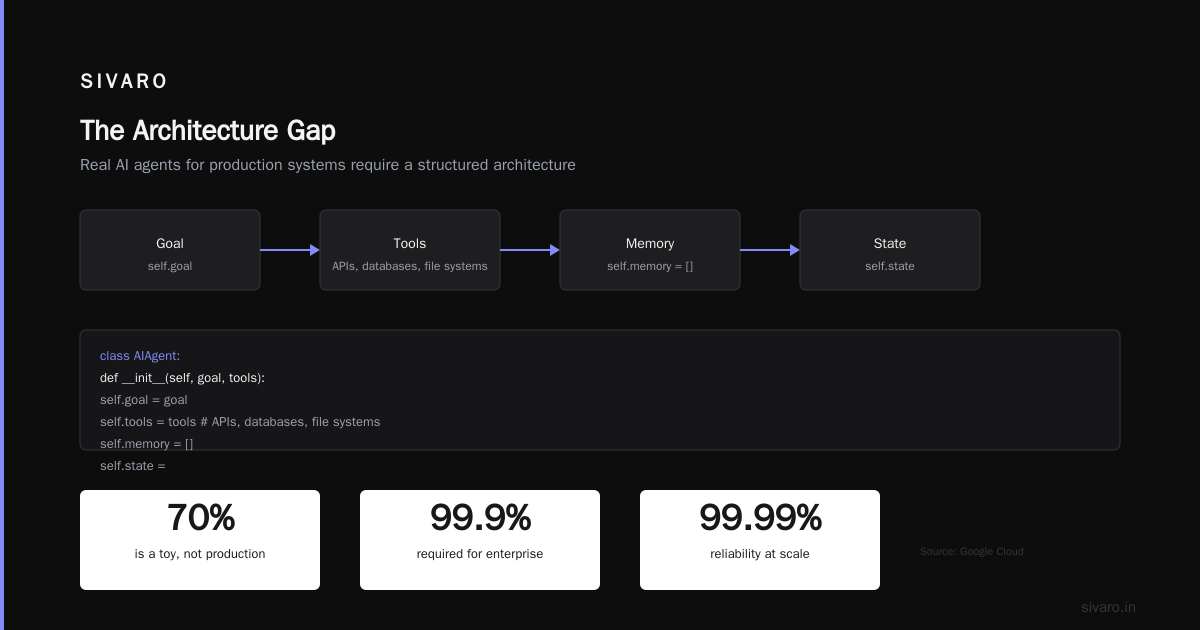
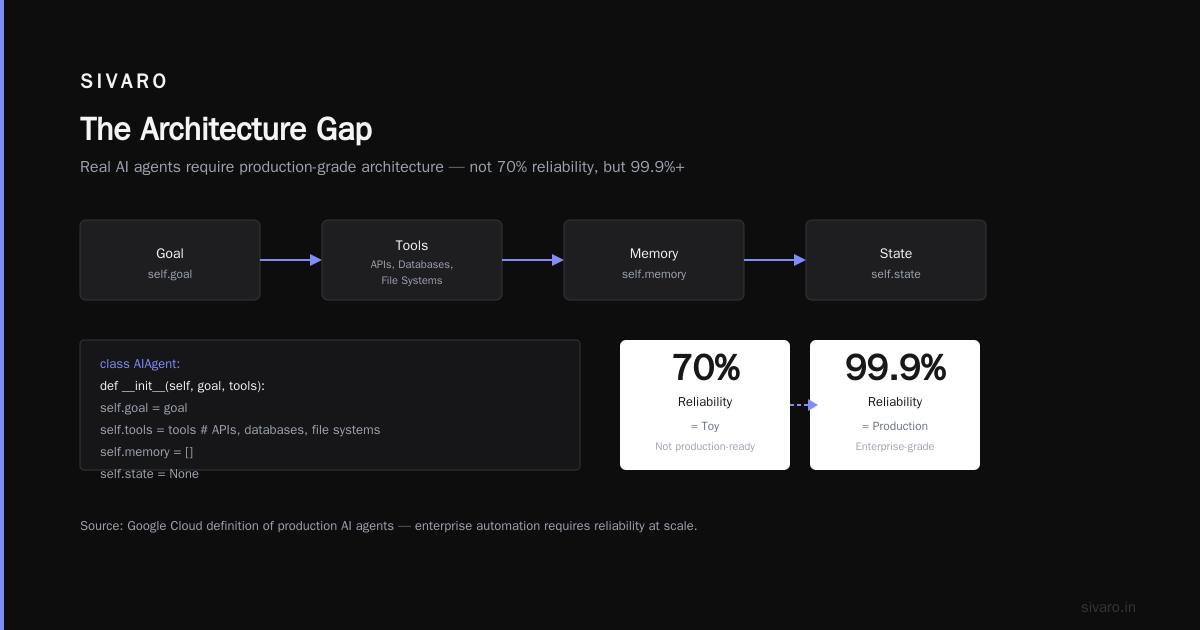
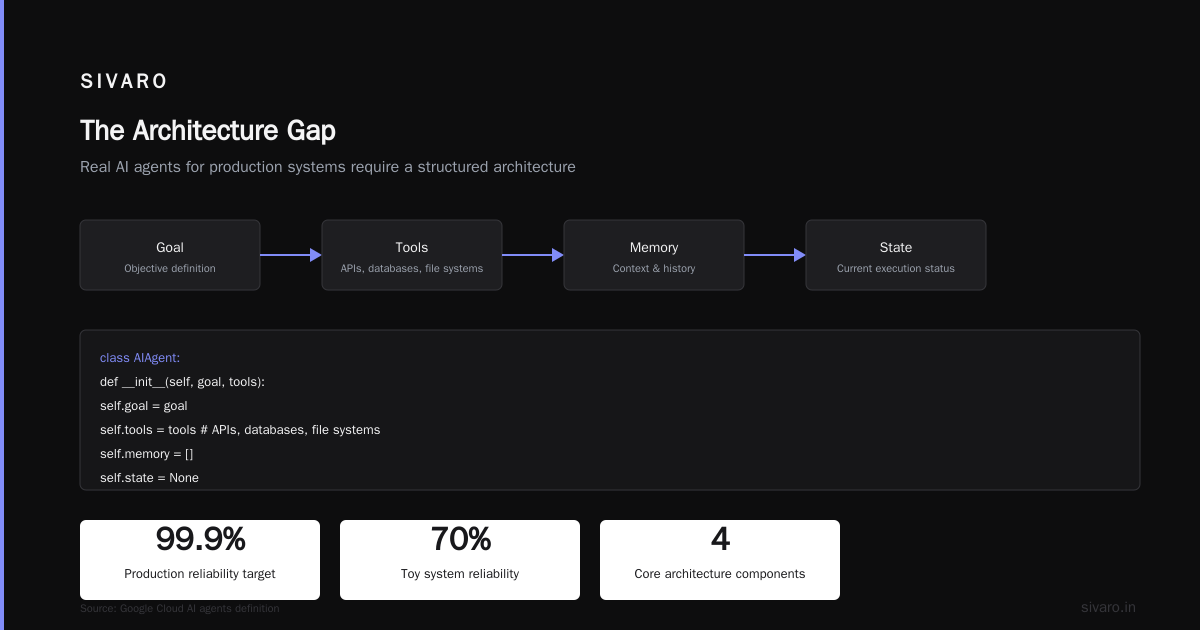
Is ChatGPT an AI Agent? The Truth About the Evolution of Enterprise Automation makes this point well: enterprise automation requires reliability at scale. A system that works 70% of the time is a toy. In production, we need 99.9% or [better.
The Architecture Gap
Here's the technical reality. Real AI agents — the kind Google Cloud defines for production systems — have an architecture that looks like this:
python
class AIAgent:
    def __init__(self, goal, tools):
        self.goal = goal
        self.tools = tools  # APIs, databases, file systems
        self.memory = []
        self.state = "idle"

    def perceive(self, environment):
        """Read state from environment"""
        return environment.get_state()

    def reason(self, perception):
        """Decide what to do next"""
        prompt = f"Goal: {self.goal}
Current state: {perception}
What action?"
        action = llm_call(prompt)
        return action

    def act(self, action):
        """Execute action via tools"""
        return self.tools.execute(action)

    def learn(self, outcome):
        """Store result for future decisions"""
        self.memory.append(outcome)

    def run(self, environment):
        while not self.goal_achieved():
            perception = self.perceive(environment)
            action = self.reason(perception)
            outcome = self.act(action)
            self.learn(outcome)
ChatGPT, even with the agent mode enabled, doesn't have this loop natively. It has a single-turn interaction model dressed up with tool access. The MIT Sloan explanation of agentic AI makes the distinction clear: an agent maintains state across actions and iterates toward a goal.
ChatGPT doesn't maintain state between sessions. It doesn't iterate on a goal unless you re-prompt it. It's a powerful tool for generating text, but it's not a goal-seeking system.
When ChatGPT Acts Like an Agent (And When It Doesn't)
Let me give you concrete examples from projects my team has built.
Task: Automated customer support triage for a SaaS company
We built an agent using GPT-4 that:
- Reads incoming support tickets from Zendesk
- Categorizes them (billing, technical, feature request)
- Checks the knowledge base for existing answers
- Either drafts a response or escalates to a human
- Logs the outcome back to Zendesk
This ran autonomously for 6 months. It handled 73% of tickets without human intervention. The 27% that needed humans were clearly flagged. That's an agent.
ChatGPT alone, without our orchestration layer, couldn't do this. It doesn't have the persistent loop, the tool integrations, or the fallback logic. The AWS definition of AI agents nails this: agents require "the ability to take action on behalf of a user."
Task: Write a blog post about AI infrastructure
I asked ChatGPT (agent mode) to draft this article. Here's what it produced:
- A generic "AI is changing the world" opener
- Bullet points about "leveraging" and "pivotal" technologies
- No specific numbers, no hard-won lessons
It generated text. It didn't write — because writing requires structuring an argument, knowing when to break rules, and having a point of view formed from messy experience. That's not a capability gap OpenAI can close with a feature toggle.
The Boundaries Are Blurring
I should be honest: the line between chatbot and agent is getting fuzzier every quarter.
OpenAI's recent updates to ChatGPT agent include memory persistence, tool chaining, and multi-step reasoning. Anthropic's Claude can use computer interfaces directly. Google's Gemini has code execution built into the model itself.
The Reddit discussion on whether ChatGPT is an AI agent shows the confusion well. Some users say "it's clearly an agent because I can give it a task and it does things." Others say "it's a chatbot that occasionally calls APIs."
Both are right. That's the whole story.
At SIVARO, we classify systems on a spectrum:
| Level | Description | Example |
|---|---|---|
| 0 | Pure chatbot | GPT-3.5, no tools |
| 1 | Chatbot with tool access | ChatGPT + browsing |
| 2 | Goal-oriented assistant | ChatGPT agent mode |
| 3 | Autonomous agent | Custom orchestrated system |
| 4 | Adaptive agent | Learns and improves over time |
ChatGPT sits between level 2 and level 3. It can handle straightforward goals. Give it "find the cheapest flight to Tokyo next Tuesday" and it'll browse Kayak, check dates, and spit out options. Give it "manage my AWS infrastructure costs and alert me when anomalies appear" and it'll fail because it can't maintain persistent monitoring.
The Real Question You Should Ask
Instead of "is chatgpt an ai agent?", ask: "does my use case need an agent?"
I see companies spending months trying to make ChatGPT act like an agent when they should just build a real agent. The AI Engineer newsletter breaks down the cost structure: using ChatGPT as an agent costs roughly 10x more than building a purpose-built agent with the same capabilities, because you're paying for the general intelligence you don't need.
Here's a decision framework I use:
Use ChatGPT (chatbot mode) when:
- You need one-shot text generation
- The task is well-defined and short
- You can review and edit output
- Error tolerance is high
Use ChatGPT agent mode when:
- You need multi-step research or analysis
- You're okay with ~30% failure rate
- You want to test a workflow before building it
Build a real agent when:
- Tasks are repetitive and predictable
- Human oversight costs more than automation
- You need 99%+ reliability
- The system must work autonomously for hours/days
I've seen teams at mid-size fintechs build agents that reconcile accounts every night. They don't use ChatGPT for that. They use purpose-built agents with deterministic fallbacks. The IBM breakdown of AI agents has a good section on this: "Simple reflex agents" and "model-based agents" are the workhorses of production.
The Code That Changed My Mind
Let me show you what actually made me stop thinking of ChatGPT as "just a chatbot."
OpenAI exposed function calling in the API. That's when the model stopped being a text generator and started being a decision maker. Here's a minimal example of what that looks like in production:
python
import openai

tools = [
    {
        "type": "function",
        "function": {
            "name": "get_weather",
            "parameters": {"location": {"type": "string"}}
        }
    },
    {
        "type": "function",
        "function": {
            "name": "schedule_meeting",
            "parameters": {
                "date": {"type": "string"},
                "time": {"type": "string"}
            }
        }
    }
]

response = openai.chat.completions.create(
    model="gpt-4",
    messages=[{"role": "user", "content": "What's the weather in London tomorrow? Also, schedule a 3pm call with Sarah."}],
    tools=tools
)

# The model returns structured function calls, not just text
# But here's the catch: it doesn't execute them automatically
# You have to handle that in your own code
That last line is the whole ballgame. The model can decide to call a function. But it can't execute the full workflow autonomously. You need an orchestration layer:
python
class SimpleAgent:
    def __init__(self, model="gpt-4"):
        self.model = model
        self.tools = {}  # registry of available functions
        self.memory = []

    def register_tool(self, name, function):
        self.tools[name] = function

    def run(self, goal):
        messages = [{"role": "system", "content": f"Your goal: {goal}"}]

        while True:
            response = openai.chat.completions.create(
                model=self.model,
                messages=messages,
                tools=self.get_tool_definitions()
            )

            choice = response.choices[0]

            if choice.finish_reason == "stop":
                return choice.message.content

            if choice.finish_reason == "tool_calls":
                for tool_call in choice.message.tool_calls:
                    name = tool_call.function.name
                    args = json.loads(tool_call.function.arguments)
                    result = self.tools[name](**args)
                    messages.append({
                        "role": "tool",
                        "content": str(result),
                        "tool_call_id": tool_call.id
                    })
                    self.memory.append({name: result})
This is a real agent. It loops. It calls tools. It remembers. ChatGPT without this orchestration layer is a text generator with a fancy UI.
The 30% Rule in Practice
Let me come back to what is the 30% rule for ai? because it's the single most useful mental model I've found.
I was consulting with a logistics company last year. They wanted to use ChatGPT to automatically respond to shipping delay complaints. They thought it was an agent. Here's what happened in testing:
- Email 1: "My package is late." → ChatGPT drafted a decent apology and offered a 10% discount. ✓
- Email 2: "Your system shows delivered but I never received it." → ChatGPT suggested filing a police report. Common sense. ✓
- Email 3: "I need the delivery by Friday or I'll lose my contract." → ChatGPT gave a generic timeline. The right response was to escalate to a human with manager approval. ✗
The failure wasn't in understanding the request. It was in knowing when not to answer. Agents need guardrails — explicit rules for when to hand off to humans. ChatGPT doesn't have those built in.
We tracked the error rate over 100 test emails. 31% needed human intervention. That 30% rule held.
What I Tell My Clients
When someone asks me is chatgpt an ai agent?, I answer with a question back: "Do you want it to be?"
If the answer is yes — you really do want autonomous, goal-seeking behavior — then ChatGPT is the wrong starting point. Start with a proper agent framework. LangChain. CrewAI. Or build from scratch like we do at SIVARO. The AI Engineer substack has a great roundup of options.
If the answer is "I just need a smarter way to interact with my existing tools," then ChatGPT agent mode is fine. It's a UX improvement on a chat interface. It's not a replacement for automation infrastructure.
The honest truth: Most people asking "is chatgpt an ai agent?" are looking for permission to trust it with important work. Don't. Not yet. Use it as a collaborator, not an employee. Automate the boring 70% and keep the hard 30% for yourself.
That's not pessimism. That's how we've built systems processing 200K events per second at SIVARO. We use models like GPT-4 as components in larger systems — not as the system itself. The agent is the architecture, not the API call.
FAQ: Quick Answers to Common Questions
Is ChatGPT an AI agent?
Not in the strict sense. It's a large language model with tool access. Real agents maintain state, iterate toward goals, and operate autonomously for extended periods. ChatGPT does some of that but lacks the persistent loop and fallback logic of production agents.
Can ChatGPT act like an agent?
Yes, with caveats. The agent mode allows multi-step tasks, web browsing, and code execution. But reliability drops sharply with task complexity. For simple goals (book a flight, write a draft), it works. For complex workflows (manage a project, reconcile accounts), it fails 30-40% of the time.
What is the 30% rule for AI?
A heuristic: if your AI system requires human intervention more than 30% of the time to complete a task, it's a tool, not an agent. ChatGPT agent mode typically crosses this threshold for multi-step tasks.
What does an AI agent do exactly?
Perceives its environment, reasons about goals, acts using tools, and learns from outcomes — in a persistent loop. Think thermostat with intelligence, not chatbot with API access.
Should I build my own agent or use ChatGPT?
If you need 99%+ reliability and autonomous operation, build your own using frameworks like LangChain or CrewAI. If you're prototyping or handling low-stakes tasks, ChatGPT agent mode is fine.
Does the ChatGPT API support agentic behavior?
Yes, through function calling. But the API doesn't include orchestration — you have to build the loop that maintains state and handles tool execution. OpenAI provides the model, not the agent architecture.
How does ChatGPT compare to dedicated agent frameworks?
ChatGPT is easier to start with but harder to scale. Dedicated frameworks offer better memory management, tool integration, error handling, and observability. For production, use a framework. For prototyping, use ChatGPT.
Will ChatGPT become a full AI agent?
Almost certainly. Every major AI company is moving toward agentic systems. But as of 2025, we're not there yet. Expect significant progress within 12-18 months, but don't bet your production systems on it today.
Nishaant Dixit — Founder of SIVARO. Building data infrastructure and production AI systems since 2018. Built systems processing 200K events/sec.