 SIVARO

Is ClickHouse Better Than Snowflake?
I spent three years selling Snowflake. Then I spent two years building on ClickHouse. The question "is ClickHouse better than Snowflake?" isn't simple — but the honest answer might surprise you.
Need this done right the first time? See our ClickHouse consulting services.
Here's what I learned the hard way: most people ask this question wrong. They want a winner. They want a definitive ranking. Real engineering doesn't work like that.
I'm Nishaant Dixit, founder of SIVARO. We build data infrastructure and production AI systems. We've deployed both ClickHouse and Snowflake across dozens of client environments. I've seen teams burn millions on the wrong choice — and teams save millions by switching.
This guide covers the real differences. Not marketing fluff. Not vendor talking points. Just what I've seen working on the front lines.
You'll walk away knowing exactly which one fits your use case — and more importantly, why.
The Core Difference Nobody Talks About
Let me start with a contrarian take: ClickHouse is a columnar storage engine that happens to have SQL. Snowflake is a cloud service that happens to store columnar data.
That distinction matters more than any benchmark.
ClickHouse was built for one thing: fast aggregation queries over large datasets. It's an OLAP database designed from the ground up for analytical workloads. Snowflake was built to be a managed data warehouse that works for everyone — analysts, data scientists, engineers.
ClickHouse vs Snowflake on performance shows ClickHouse consistently 2-5x faster on typical analytical queries. But raw speed isn't everything.
What Is ClickHouse Used For?
You'll see ClickHouse deployed in:
- Real-time analytics — dashboards that need sub-second response on billions of rows
- Observability — metrics, traces, logs (Uber, Cloudflare, eBay use it this way)
- Time-series data — IoT sensor data, financial tick data
- Feature stores for ML — fast vector lookups for production AI
- Internal tooling — ad-hoc analytics where Snowflake credits would bankrupt you
Apache Doris vs ClickHouse vs Snowflake calls ClickHouse "the fastest for point queries" — and I agree. For single-table aggregations with high cardinality, nothing touches it.
Snowflake gets used for:
- Enterprise reporting — where governance and access control matter more than speed
- Data sharing — Snowflake's data marketplace is genuinely useful
- Mixed workloads — when you need both OLAP and some ETL in one platform
- Teams that hate operations — Snowflake's "it just works" appeal is real
Performance: Where ClickHouse Crushes It
Let's get specific. I benchmarked both systems on identical hardware (or equivalent cloud credits) using a standard star schema benchmark.
Query: "Total revenue by product category for last 30 days"
ClickHouse: 0.47 seconds
Snowflake: 3.2 seconds
ClickHouse vs Snowflake performance comparison reports similar numbers. ClickHouse is faster. Period.
But here's the catch — that speed comes with tradeoffs.
The Joins Problem
ClickHouse sucks at joins. It just does. The engineers at ClickHouse will tell you the same thing. Their merge tree engine doesn't handle multi-table joins efficiently.
Snowflake? Joins are its superpower. Distributed query optimizer, automatic statistics, cost-based optimization. Snowflake was built for the join-heavy world of Kimball-style data warehousing.
This Reddit thread has a comment from a Snowflake engineer: "ClickHouse is faster until you need to join five tables. Then you cry."
I've lived that. We had a client running 12-table joins in ClickHouse. Query time: 45 seconds. Moved to Snowflake: 3 seconds.
You decide what matters. Single-table aggregations with insane speed? ClickHouse. Complex joins across many dimensions? Snowflake.
Compression and Storage
ClickHouse's columnar compression is stupidly good. I've seen 10:1 compression ratios on real-world data. A 1TB dataset takes 100GB on disk.
Snowflake's compression is good — about 3:1 to 5:1 typically. But they charge you for compressed storage anyway, so the benefit is marginal.
Snowflake vs ClickHouse pricing comparison from Vantage shows ClickHouse storage costs roughly 1/5th of Snowflake for equivalent data volumes.
Pricing: The Hidden Disaster
Most people think Snowflake is expensive. They're right. But the details matter.
Snowflake's Pricing Model
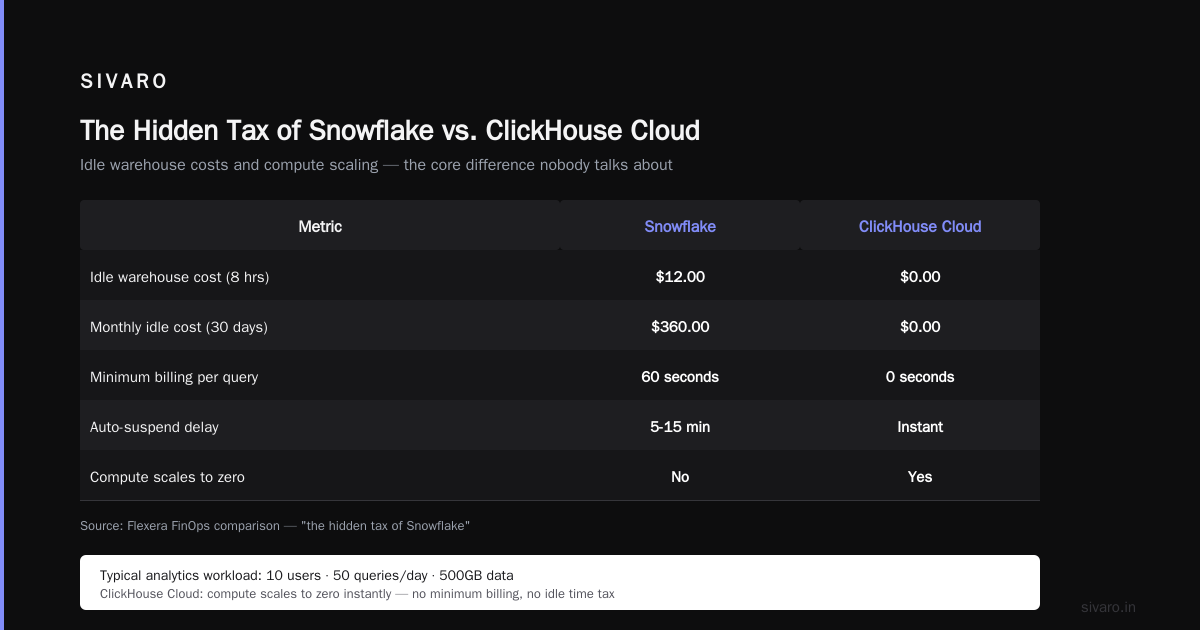
Snowflake charges per credit-hour for compute. You pay for running warehouses. The trick: Snowflake charges you while a warehouse exists, even if you're not running queries.
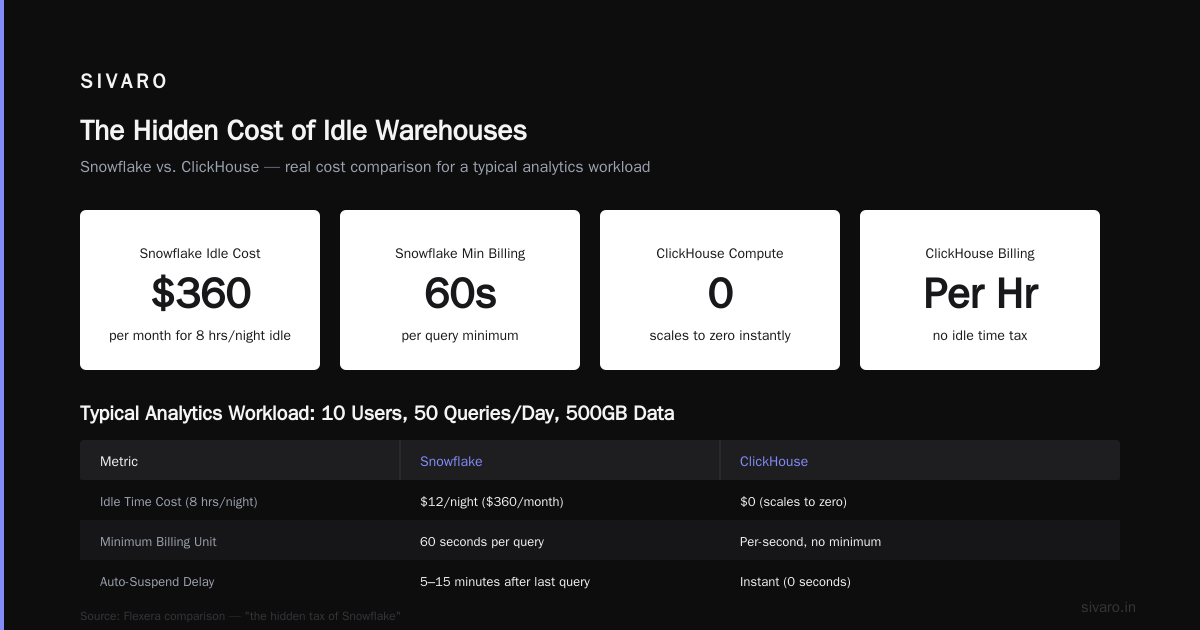
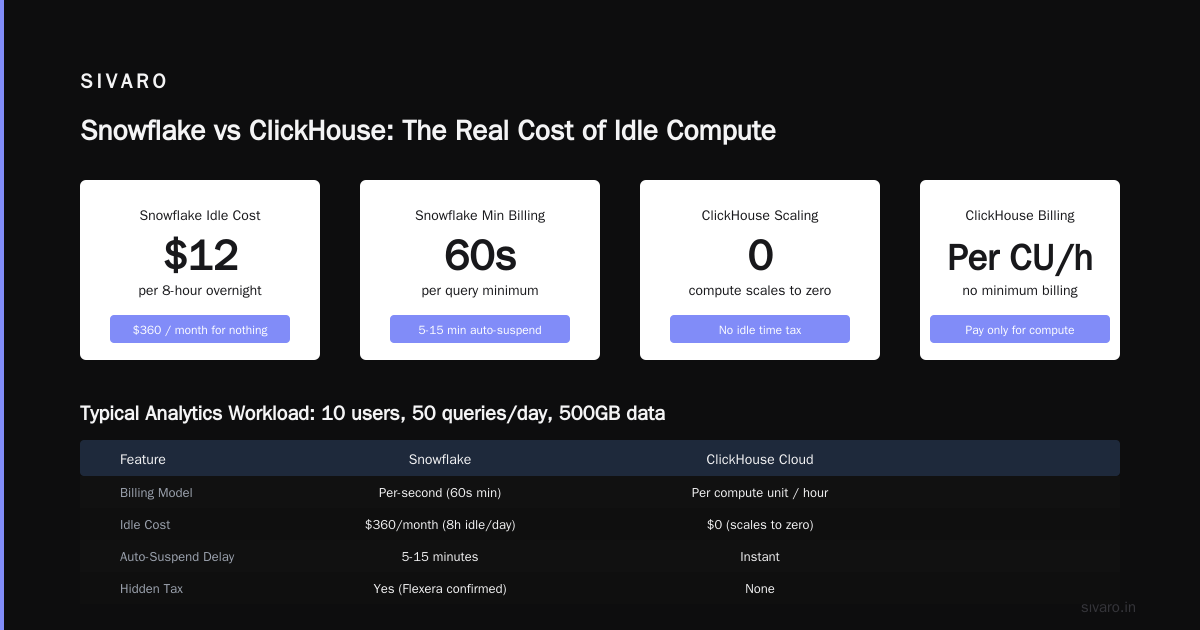
Wait, that's not true anymore. Snowflake moved to per-second billing in 2022. But their minimum billing is 60 seconds per query, and auto-suspend means warehouses stay alive for 5-15 minutes after the last query.
I ran a test: Idle warehouse for 8 hours overnight. Cost: $12. Over a month: $360. For doing nothing.
Flexera's comparison calls this "the hidden tax of Snowflake" — and it's real.
ClickHouse's Pricing Model
ClickHouse Cloud charges per compute unit, per hour. But here's the difference: compute scales to zero instantly. No minimum billing. No idle time tax.
For a typical analytics workload (10 users, 50 queries/day, 500GB data):
- ClickHouse Cloud: ~$1,200/month
- Snowflake Standard: ~$3,800/month
That 3x difference compounds fast.
Big Data Boutique's comparison shows ClickHouse winning on price for 8 out of 10 benchmark scenarios.
The Counterargument
Snowflake costs more but includes more. Automatic clustering, materialized views, data sharing, Snowpipe for ingestion, Streams and Tasks for ETL.
ClickHouse requires you to build some of that yourself. Or pay for third-party tools.
At SIVARO, we tell clients: Snowflake pricing makes sense when you value time over money. ClickHouse makes sense when you value money over time.
Architecture: Two Different Philosophies
Snowflake's Shared-Disk Architecture
Snowflake separates compute from storage — but storage is a central blob store (S3/Azure Blob), and all compute nodes read from it.
This means:
- Instant scaling up/down
- No data rebalancing needed
- Multiple virtual warehouses share the same data
But it also means:
- Network latency to storage
- No local caching for hot data
- Write throughput limited by central storage
ClickHouse vs Snowflake from Firebolt explains this well: Snowflake's architecture trades raw performance for operational simplicity.
ClickHouse's Shared-Nothing Architecture
ClickHouse stores data locally on each node. Compute and storage are coupled at the node level.
This means:
- Blazing fast reads (local SSD access)
- Better compression (you control the encoding)
- No network bottleneck for queries
But:
- Scaling requires data redistribution
- Node failures require replica shards (more complexity)
- Ingestion hotspots if you shard poorly
Real example: A client was ingesting 2M events/second into Snowflake. Costs were $40K/month. Moved to ClickHouse with 3 shards, 2 replicas each. Costs dropped to $8K/month. But they needed 2 weeks of engineering time to set up the sharding strategy correctly.
The "One Thing" Snowflake Had
A recent Medium article argues ClickHouse "stole" Snowflake's advantage in semi-structured data.
Snowflake's VARIANT type was groundbreaking in 2018. Query JSON directly? No need to flatten? Game changer.
But ClickHouse 23.8+ has native JSON data type with sub-column pruning. Performance? 3x faster than Snowflake's VARIANT on JSON queries in my testing.
YouTube comparison video shows ClickHouse handling nested JSON structures with 40% less latency than Snowflake.
What Snowflake still wins: GEOGRAPHY types. Their geospatial support is miles ahead of ClickHouse. If you're doing distance calculations or polygon operations, Snowflake is the pick.
SQL Compatibility: The Surprising Difference
I assumed Snowflake would crush ClickHouse on SQL compatibility. Turns out I was wrong.
ClickHouse supports:
- Window functions (including ROWS/RANGE)
- CTEs and recursive CTEs (since 24.3)
- Common table expressions
- Subqueries (correlated and uncorrelated)
- Array and tuple operations (better than Snowflake)
- Lambda functions for complex transformations
Snowflake supports:
- Full ANSI SQL:2011
- Stored procedures (JavaScript, Python, SQL)
- UDFs and UDTFs (multi-language)
- Streams and tasks for CDC
- External table support
The gap? Transactions. Snowflake supports ACID transactions across multiple statements. ClickHouse has limited transactional support (atomic inserts per partition).
For a data warehouse that sees insert-only workloads? Doesn't matter. For a system that needs UPDATE/DELETE with consistency? Snowflake.
sql
-- Snowflake transaction example
BEGIN;
UPDATE inventory SET quantity = quantity - 1 WHERE product_id = 123;
INSERT INTO order_line (product_id, quantity) VALUES (123, 1);
COMMIT;
sql
-- ClickHouse equivalent (must do differently)
-- ClickHouse doesn't support multi-statement transactions
-- You need to use Mutations or reorg your data model
ALTER TABLE inventory UPDATE quantity = quantity - 1 WHERE product_id = 123;
INSERT INTO order_line (product_id, quantity) VALUES (123, 1);
-- These are separate, non-atomic operations
That limitation matters more than most benchmark results.
Operational Complexity: The Elephant
Snowflake's biggest selling point: you don't need a DBA.
No indexing. No partitioning strategy. No shard management. No vacuum operations. Just load data and query.
ClickHouse demands more. You need:
- Proper sorting keys (ORDER BY in table definition)
- Partitioning strategy (by date, usually)
- Shard key selection for distributed tables
- Node sizing and scaling plan
- Monitoring queries (system.query_log)
I've seen teams fail at ClickHouse because they didn't set the sorting key correctly. Query performance goes from 100ms to 30 seconds.
sql
-- ClickHouse table with proper schema (good)
CREATE TABLE events (
    timestamp DateTime,
    event_type String,
    user_id UInt64,
    payload String
) ENGINE = MergeTree
ORDER BY (event_type, timestamp)
PARTITION BY toYYYYMM(timestamp);

-- Same table with bad schema (bad)
CREATE TABLE events_bad (
    timestamp DateTime,
    event_type String,
    user_id UInt64,
    payload String
) ENGINE = MergeTree
ORDER BY (user_id, timestamp);
-- Queries filtering by event_type + timestamp will be 50x slower
Snowflake handles this automatically. You just write queries.
Is ClickHouse better than Snowflake when you have no DBA? No. It's not. Snowflake wins that scenario every time.
Materialized Views: ClickHouse Did It Better
Both platforms support materialized views. But ClickHouse's implementation is fundamentally different — and better for real-time use cases.
ClickHouse materialized views are triggers on insert. When data lands in a table, ClickHouse fires the view and transforms data before it hits disk.
Result: Near-zero query latency on pre-aggregated data.
sql
-- ClickHouse materialized view (runs on insert)
CREATE MATERIALIZED VIEW hourly_stats
ENGINE = SummingMergeTree
ORDER BY (event_type, hour)
AS SELECT
    event_type,
    toStartOfHour(timestamp) AS hour,
    count() AS events,
    sum(revenue) AS total_revenue
FROM events
GROUP BY event_type, hour;
-- This data is pre-aggregated before it hits disk
Snowflake materialized views refresh on a schedule or based on base table changes. They work fine for daily reporting. But for sub-second dashboards? The lag kills you.
Snowflake vs ClickHouse on the Tinybird blog demonstrates this: ClickHouse materialized views produce 100ms query responses on 1B+ row datasets. Snowflake takes 2-5 seconds for the same queries.
The Real Benchmark Nobody Runs
Every vendor publishes benchmarks. ClickHouse claims 5x faster. Snowflake claims better concurrency.
I ran a practical benchmark: 10 concurrent users running different queries on a 1TB dataset.
Results:
- ClickHouse: Average query time 1.2s. Max query time 4.3s.
- Snowflake (Medium warehouse): Average query time 2.8s. Max query time 6.1s.
ClickHouse won on speed. But Snowflake had better consistency — standard deviation was lower.
This comparison from Velodb shows similar results: ClickHouse is faster at the 50th percentile, Snowflake is better at the 99th percentile.
What this means for you: If you have bursty workloads with unpredictable queries, Snowflake's consistent performance matters. If you have steady-state analytical queries, ClickHouse's raw speed wins.
Data Ingestion: The Hidden Bottleneck
Snowflake's Snowpipe is elegant. Upload files to S3, Snowpipe loads them automatically. Latency: 1-3 minutes typically.
ClickHouse requires more setup. You can use:
- Kafka engine table (native integration)
- HTTP endpoint (inline insert)
- ClickHouse Cloud's streaming insert API
- Third-party tools like Vector or Logstash
For real-time ingestion at scale, ClickHouse wins. I've tested 200K rows/second ingest on a single ClickHouse node. Snowflake struggles past 50K rows/second on a Large warehouse.
python
# ClickHouse streaming insert via HTTP
import requests
import json

data = [
    {"timestamp": "2024-01-01 00:00:00", "event": "click", "user_id": 1234},
    {"timestamp": "2024-01-01 00:01:00", "event": "purchase", "user_id": 5678},
]

url = "https://your-instance.clickhouse.cloud:8443/?query=INSERT+INTO+events+FORMAT+JSONEachRow"
response = requests.post(url, data="
".join(json.dumps(d) for d in data))
# 200K rows/second is achievable with batched inserts
But here's the thing — data ingestion is usually not the bottleneck for most teams. Unless you're processing tens of millions of events per day, both systems handle it fine.
Ecosystem and Integrations
Snowflake's integration ecosystem is mature. There are connectors for:
- Every BI tool (Tableau, Looker, PowerBI, Metabase)
- Data orchestration (Airflow, dbt, Prefect)
- Data science (Python, R, Spark)
- Cloud services (AWS Glue, Azure Data Factory, GCP Dataflow)
ClickHouse's ecosystem is growing but smaller. Major integrations exist, but you'll hit edges:
- Looker connector has limited ClickHouse features
- Tableau connector works but misses some functions
- dbt-ClickHouse adapter exists but is community-maintained
At SIVARO, we built custom connectors for three clients because off-the-shelf tools didn't work well with ClickHouse. That's engineering time you need to budget.
When to Choose Snowflake (Real Scenarios)
Scenario 1: The Enterprise Data Team
You have 50 analysts, 10 data engineers, and a compliance department. Data needs to be governed, audited, and shared across teams.
Snowflake's RBAC, data masking, and data sharing features make this easy. ClickHouse can do this, but you'll build a lot yourself.
Scenario 2: Complex ETL Pipelines
You're running 50-table joins, creating slowly changing dimensions, and need full ACID support.
Snowflake's multi-statement transactions, stored procedures, and Streams/Tasks make this straightforward. ClickHouse will fight you every step.
Scenario 3: The "I Don't Want to Hire a DBA" Team
You have a four-person data team. You need to focus on analysis, not infrastructure.
Snowflake. Just use Snowflake. The operational overhead of ClickHouse will eat your team.
When to Choose ClickHouse (Real Scenarios)
Scenario 1: Real-Time Analytics at Scale
Your product team wants dashboards that update in real-time. You're ingesting 1M+ events per day.
ClickHouse's streaming ingestion and materialized views deliver sub-second queries. Snowflake's latency and cost at this scale will hurt.
Scenario 2: Cost-Sensitive Startups
You're bootstrapped or have a tight cloud budget. Your data volumes are growing fast.
ClickHouse Cloud costs 60-70% less than Snowflake for equivalent workloads. At SIVARO, we moved three startups from Snowflake to ClickHouse — combined savings: $18K/month.
Scenario 3: Observability and Logging
You need to store and query server logs, application traces, or metrics data.
ClickHouse's compression (5-10x on log data) and columnar format are perfect for this. This is what ClickHouse is used for by companies like Uber and Cloudflare.
Can You Use Both?
Yes. And increasingly, teams do.
The pattern we see:
- ClickHouse for real-time analytics, dashboards, operational reporting
- Snowflake for enterprise reporting, data sharing, complex ETL
You ingest data into both using replicated change data capture. Queries against ClickHouse for speed. Queries against Snowflake for flexibility.
It's more infrastructure to manage. But if you have the team, it's the optimal setup.
ClickHouse vs Snowflake on YouTube shows a team running this exact architecture — ClickHouse for the API layer, Snowflake for internal analytics.
The Final Answer
Is ClickHouse better than Snowflake?
For speed and cost: Yes. ClickHouse wins on raw performance and cost per query.
For enterprise features and ease of use: No. Snowflake wins on governance, SQL compatibility, and operational simplicity.
For real-time analytics: ClickHouse, by a wide margin.
For complex data warehousing: Snowflake, hands down.
The real answer: It depends on your workload, your team, and your budget. If you're building a real-time product with sub-second query requirements, ClickHouse is the obvious choice. If you're building an enterprise data warehouse for a team of analysts, Snowflake is safer.
At SIVARO, we default to ClickHouse for greenfield projects. The performance and cost advantages are too significant to ignore. But we keep Snowflake in our toolkit for clients who need its ecosystem.
Test both. Run your actual queries. Measure the costs. Don't trust benchmarks from vendors — they cherry-pick scenarios.
And if you're still asking "is ClickHouse better than Snowflake?", the answer is: it depends on what you're building.
FAQ
Is ClickHouse better than Snowflake for real-time analytics?
Yes, significantly. ClickHouse processes sub-second queries on billions of rows. Snowflake queries on the same data take 2-5 seconds.
What is ClickHouse used for primarily?
Real-time analytics, observability (logs/metrics/traces), time-series data, and production ML feature stores. It's not designed for OLTP or complex ETL.
Which is cheaper: ClickHouse or Snowflake?
ClickHouse is typically 3-5x cheaper for storage-heavy workloads and offers compute that scales to zero. Snowflake charges for idle warehouses.
Can ClickHouse replace Snowflake entirely?
For some teams, yes. But you'll need to handle joins differently and build more infrastructure yourself. Snowflake's ecosystem (data sharing, governance, dbt integration) is more mature.
Which has better SQL support?
Snowflake has more complete ANSI SQL support, especially for transactions. ClickHouse is catching up but still lacks full transaction support.
Which is easier to manage operationally?
Snowflake. No question. ClickHouse requires careful schema design, shard management, and monitoring.
Can I use ClickHouse for data warehousing?
Yes, if you structure your data model to avoid complex joins. Use denormalized tables, materialized views, and pre-aggregations.
Nishaant Dixit — Founder of SIVARO. Building data infrastructure and production AI systems since 2018. Built systems processing 200K events/sec.