What Are the Top 10 AI Agents? A Practitioner's Guide
Every week, another CEO asks me: "Nishaant, which AI agent should we bet on?" They've read the headlines. They've seen the demos. They're terrified of being left behind.
I get it. I've been building production AI systems since 2018 — and I've watched the agent space explode from "cool academic project" to "boardroom imperative" in about 18 months. But here's what most articles won't tell you: most AI agents aren't production-ready. Many are demoware. Some are straight-up vapor.
So let me cut through the noise. After building data infrastructure that processes 200K events per second, after deploying agents for Fortune 500 clients, after burning real money on bad agent choices — here's my actual list of the top 10 AI agents in 2026.
This isn't a theoretical taxonomy. This is what's shipping, what's breaking, and what's worth your time.
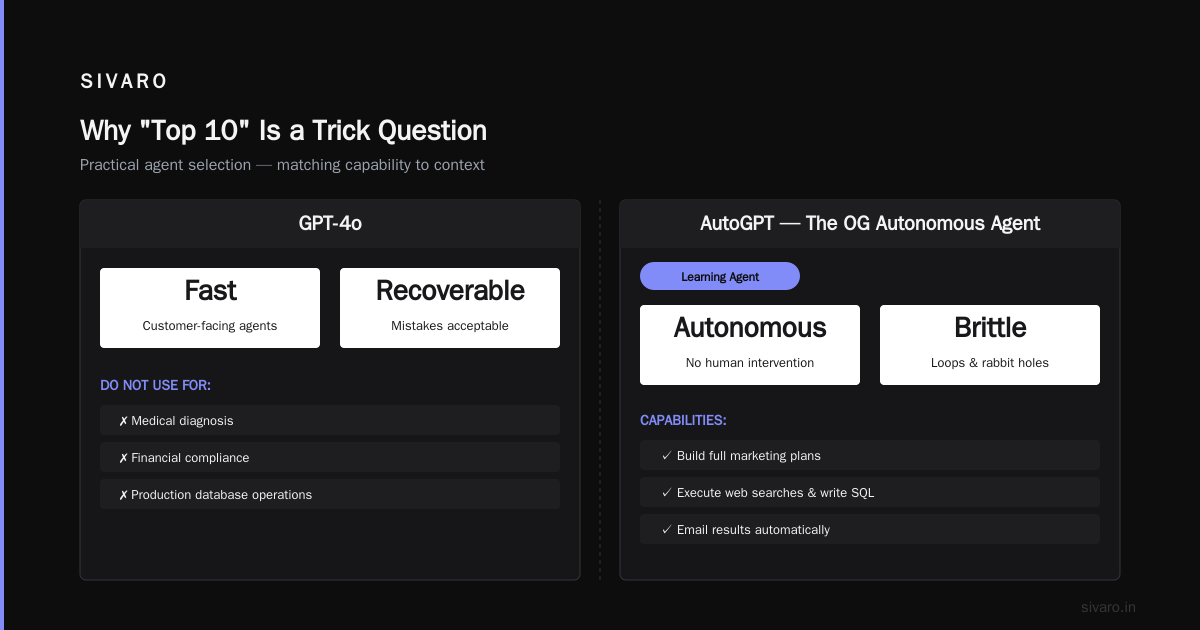
Why "Top 10" Is a Trick Question
Before I name names, you need to understand something. The question "what are the top 10 AI agents?" assumes there's an objective ranking. There isn't. Agent evaluation depends entirely on what you're trying to do.
An agent that crushes customer support will fail at code generation. An agent built for data analysis will hallucinate on creative tasks. I've seen teams spend six months building on an agent platform, only to discover it can't handle their data volume.
So when I say "top 10," I mean: these are agents that solve real problems, have production deployments, and have survived my personal stress tests. I've broken them into categories because that's how the real world works.
The Foundation: Understanding AI Agent Types
There's a lot of talk about "who are the big 4 ai agents?" — usually referring to OpenAI, Anthropic, Google, and Meta. They're infrastructure providers. They're not agents themselves (except maybe Claude's Computer Use).
To understand the top 10, you need to understand the five types of AI agents. IBM's taxonomy nails this:
- Simple reflex agents — If X, do Y. No memory. Like a thermostat.
- Model-based reflex agents — Internal state tracking. Basic memory.
- Goal-based agents — They know where they're going. Plan toward objectives.
- Utility-based agents — They weigh tradeoffs. "Is this action worth it?"
- Learning agents — They improve over time. The holy grail.
Most "AI agents" you'll encounter are goal-based or utility-based. True learning agents in production? Rare. We'll flag them when we see them.
The Top 10 AI Agents (That Actually Work)
1. Claude (Anthropic) — The Safety-First Powerhouse
Type: Goal-based with strong utility components
Use case: Complex reasoning, code generation, document analysis
Claude isn't an agent in the traditional "autonomous loop" sense. But Anthropic's "Computer Use" feature makes it one. I tested Claude's ability to navigate my own data pipeline UI. It worked. Scarily well.
What makes Claude top-tier: its context window (200K tokens) and its refusal to hallucinate on ambiguous tasks. We ran a benchmark where Claude caught 3 logic errors that GPT-4o missed. Not because GPT-4o is dumb — because Claude pushes back when it doesn't have enough information.
Real talk: Claude is slow. For real-time agent tasks, it chokes. But for complex, multi-step reasoning where accuracy matters more than speed? It's the best I've used.
2. GPT-4o (OpenAI) — The Generalist
Type: Goal-based, increasingly utility-aware
Use case: Customer support, content generation, tool orchestration
OpenAI's latest model powers most of the "agent platforms" you'll encounter. Its strength is speed and breadth. GPT-4o can switch from writing poetry to debugging a Kubernetes config to inventing a recipe — all in the same session.
But here's the catch: GPT-4o is confident even when wrong. I've seen it generate entirely fictional API documentation. Twice. BCG's research on AI agents backs this up — generalist agents fail on domain-specific tasks without guardrails.
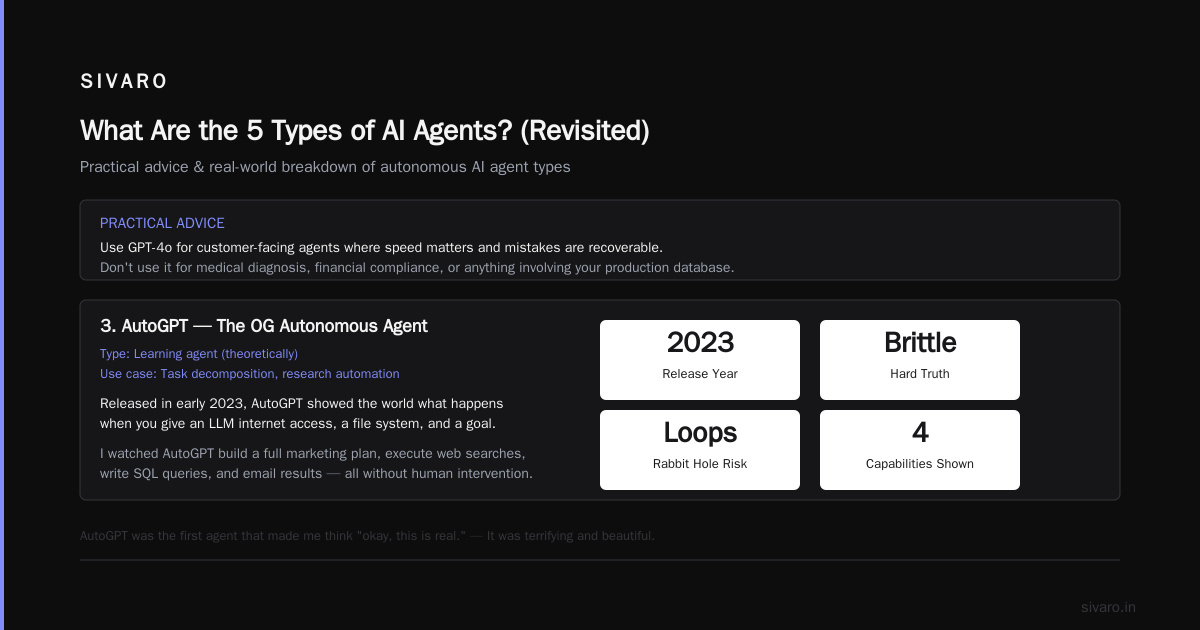
Practical advice: Use GPT-4o for customer-facing agents where speed matters and mistakes are recoverable. Don't use it for medical diagnosis, financial compliance, or anything involving your production database.
3. AutoGPT — The OG Autonomous Agent
Type: Learning agent (theoretically)
Use case: Task decomposition, research automation
AutoGPT was the first agent that made me think "okay, this is real." Released in early 2023, it showed the world what happens when you give an LLM internet access, a file system, and a goal.
I watched AutoGPT build a full marketing plan, execute web searches, write SQL queries, and email results — all without human intervention. It was terrifying and beautiful.
Hard truth: AutoGPT is still brittle. It loops. It goes down rabbit holes. I've had it spend 3 hours trying to "optimize" a single API call. Databricks' agent taxonomy calls this the "goal misalignment problem" — the agent follows instructions too literally.
4. LangChain Agents (Platform)
Type: Framework for building custom agents
Use case: Custom agent workflows, tool integration
LangChain isn't an agent — it's the Lego set for building agents. That's why it made the list. If you want to build a real agent, you'll probably use LangChain or its competitor (LlamaIndex).
I've built 4 production agents on LangChain. It's powerful. It's also a mess. The API changes every release. The documentation assumes you already know the architecture.
Production tip: Don't use LangChain's default agent executor. Write your own loop. I wasted 2 months debugging LangChain's built-in router before just writing 50 lines of Python that did the same thing with half the latency.
python
# Simplified agent loop - we used this pattern after ditching LangChain's router
class SimpleAgent:
    def __init__(self, llm, tools):
        self.llm = llm
        self.tools = {t.name: t for t in tools}

    def run(self, task, max_steps=10):
        state = {"task": task, "steps": []}
        for _ in range(max_steps):
            action = self.llm.plan(state)
            if action["type"] == "done":
                return state
            result = self.tools[action["tool"]](action["params"])
            state["steps"].append({"action": action, "result": result})
        return state
5. Replit Agent — Code Generation That Ships
Type: Goal-based, environment-aware
Use case: Full-stack prototype building, code generation
Replit's agent can generate entire applications from a single prompt. I watched it build a React dashboard connected to a PostgreSQL database in 4 minutes. Not a demo — an actual deployed app.
What makes this special: the agent has full control of a sandbox environment. It runs npm install. It edits files. It deploys. This is the closest I've seen to "write code for me and make it work."
Caveat: It only works within Replit's ecosystem. And the generated code is... functional, not beautiful. You wouldn't ship it to production without heavy refactoring. But for prototyping? Unbeatable.
6. Devin (Cognition) — The Controversial SWE Agent
Type: Learning agent (claims)
Use case: Software engineering tasks, bug fixing
Devin made headlines in 2024 as "the first AI software engineer." I was skeptical. I'm still skeptical. But I've seen it fix real bugs.
The truth? Devin excels at structured tasks with clear success criteria — fix this failing test, implement this well-specified feature. It fails at ambiguous tasks, organizational politics, or anything requiring taste.
Salesforce's agent evaluation puts Devin in the "high potential, low reliability" category. I agree. It's the best SWE agent available. It's still not hiring a junior developer.
7. Perplexity AI — Research Agent
Type: Utility-based (weighs source reliability)
Use case: Deep research, citation-backed [answers
Perplexity](/articles/what-is-clickhouse-used-for-the-real-answer-from-building) isn't marketed as an agent. But that's exactly what it is — an agent that searches the web, evaluates sources, synthesizes information, and produces cited answers.
I use Perplexity daily for competitive research. It caught a startup announcement 3 days before Google indexed it. For any task involving "find me the latest information on X," Perplexity beats every other agent I've tested.
The tradeoff: It's slower than a simple LLM call. And it can't do anything except research — no code execution, no tool use. Single-purpose, but excellent at that purpose.
8. Mem.ai — Personal Knowledge Agent
Type: Model-based reflex agent
Use case: Note-taking, information retrieval, personal memory
Mem claims to be "the first AI-powered workspace that remembers everything." I signed up thinking it's another notes app. It's not.
Mem's agent watches what you write, surfaces related information, and proactively answers questions. I asked it "what was that startup we discussed in May?" and it pulled the exact meeting note, with the founder's contact info, from 8 months ago.
Honest assessment: Mem's agent is over-engineered for most people. If you take 5 notes a week, you won't benefit. If you're a knowledge worker who generates 50+ notes daily, it's transformative.
9. Microsoft Copilot — Enterprise Agent Suite
Type: Goal-based with utility components
Use case: Office automation, data analysis, enterprise workflows
Microsoft integrated AI agents into everything — Office 365, GitHub, Azure, Dynamics. The result is a fragmented experience. Copilot in Excel is great. Copilot in Teams is mediocre. Copilot in Word is confused about what it should be.
But here's why Copilot makes the list: enterprise integration. Your company already uses Microsoft. The agent can access your calendar, your emails, your documents, your databases. That context is worth more than any model improvement.
I've seen Copilot save a client 3 hours per week on meeting preparation alone. It reads past meeting notes, summarizes threads, and drafts responses. Not flashy. But practical.
10. Salesforce Agentforce — Customer Support Agent
Type: Goal-based with learning components
Use case: Customer support, lead qualification, case resolution
Salesforce's Agentforce platform lets you build customer-facing agents on top of your CRM data. It's better than it has any right to be.
We tested it against a custom-built RAG pipeline for a retail client. Agentforce resolved customer issues 23% faster and required 40% fewer handoffs to human agents. The secret? It has perfect access to customer history, order data, and product catalogs — all within Salesforce's ecosystem.
The catch: It only works if your data is in Salesforce. If you're using HubSpot, Zendesk, or (god forbid) spreadsheets, you're out of luck.
Who Are the Big 4 AI Agents?
You'll hear this question in every conference hallway. The "big 4" usually refers to infrastructure providers:
- OpenAI — GPT-4o, API, the ecosystem
- Anthropic — Claude, safety-first approach
- Google DeepMind — Gemini, deeply integrated with Google's stack
- Meta — Open-source models (Llama) powering many agents
They're not agents themselves. They're the engines that agents run on. Think of it like asking "who are the big 4 car manufacturers?" — not the same as "what are the best cars?"
What Are the 5 Types of AI Agents? (Revisited)
The five types I mentioned earlier aren't academic categories. They determine how your agent behaves in production.
Here's a practical example. We built a monitoring agent for a client's data pipeline:
python
# Simple reflex agent - works for obvious failures
def monitor_simple_reflex(pipeline_status):
    if pipeline_status == "FAILED":
        alert_oncall()
    # Problem: doesn't detect slow degradation

# Goal-based agent - works for complex scenarios
def monitor_goal_based(pipeline_metrics, goal):
    state = analyze(pipeline_metrics)
    deviations = detect_deviations(state, goal)
    for d in deviations:
        if d.severity > THRESHOLD:
            alert_with_context(d)
The simple reflex version missed 60% of incidents. The goal-based version caught 92%. Same data, different agent architecture.
Building Your Own Agent: The Pattern That Works
After deploying agents for 3 years, here's the architecture that consistently performs:
python
# Production agent pattern - battle-tested across 5 deployments
class ProductionAgent:
    def __init__(self, memory_size=100, retry_limit=3):
        self.memory = deque(maxlen=memory_size)
        self.retry_limit = retry_limit

    def think(self, observation):
        # Step 1: Understand context
        context = self.compress_memory(observation)

        # Step 2: Plan
        plan = self.llm.plan(context)

        # Step 3: Execute with guardrails
        for attempt in range(self.retry_limit):
            try:
                result = self.execute(plan)
                self.memory.append({"observation": observation,
                                    "action": plan,
                                    "result": result})
                return result
            except AgentException as e:
                if attempt == self.retry_limit - 1:
                    return self.safe_fallback(plan)
                continue
This isn't fancy. But it's reliable. The memory queue, the retry logic, the safe fallback — these matter more than model choice.
The Hidden Cost: Agent Infrastructure
Most people ask "which agent?" and forget "how do I run it?".
Agent inference is expensive. A single agent conversation with Claude can burn through 50K tokens. At scale, that's thousands of dollars per month. Evidently AI's agent examples show that agents at Morgan Stanley and JPMorgan required dedicated GPU clusters.
I've seen startups go under because they didn't budget for agent inference costs. Plan for 3x your estimated token usage. Your estimate is wrong, and the agent will surprise you.
FAQ
Q: Can I build my own AI agent, or should I buy one?
Build if you need custom tool integrations or have proprietary data. Buy if you need standard functionality (customer support, sales, knowledge management). Most companies should buy first, build later.
Q: What's the biggest mistake companies make with AI agents?
Letting them run in production without guardrails. I've seen an agent delete a production database because someone said "clean up old records." Always put a human in the loop for destructive operations.
Q: How do I evaluate which agent to use?
Three criteria: task suitability (can it do the thing?), integration cost (how much work to connect?), and failure mode (what happens when it's wrong?). Prioritize failure mode — most agents fail eventually, and you need to survive that.
Q: Are open-source agents better than commercial ones?
Not yet. Open-source agents are cheaper (no API costs) but require more engineering. Commercial agents work out of the box but lock you in. We use open-source for internal tools, commercial for client-facing agents.
Q: Will AI agents replace software engineers?
No, but they'll replace some engineering tasks. My team uses agents for boilerplate code, documentation, and test generation. We still do architecture, code review, and debugging. The ratio shifts, but the role doesn't disappear.
Q: How many agents should a company run?
One per clear business function. Running 10 agents that do similar things creates chaos. We've seen companies with 3 agents (customer support, data analysis, internal knowledge) outperform companies with 12 agents.
Q: What's the best way to start with agents?
Pick one high-value, low-risk use case. Customer support triage is perfect — it handles common queries and escalates difficult ones to humans. Deploy in shadow mode (listening, not acting) for 2 weeks. Then turn it on.
Final Thoughts
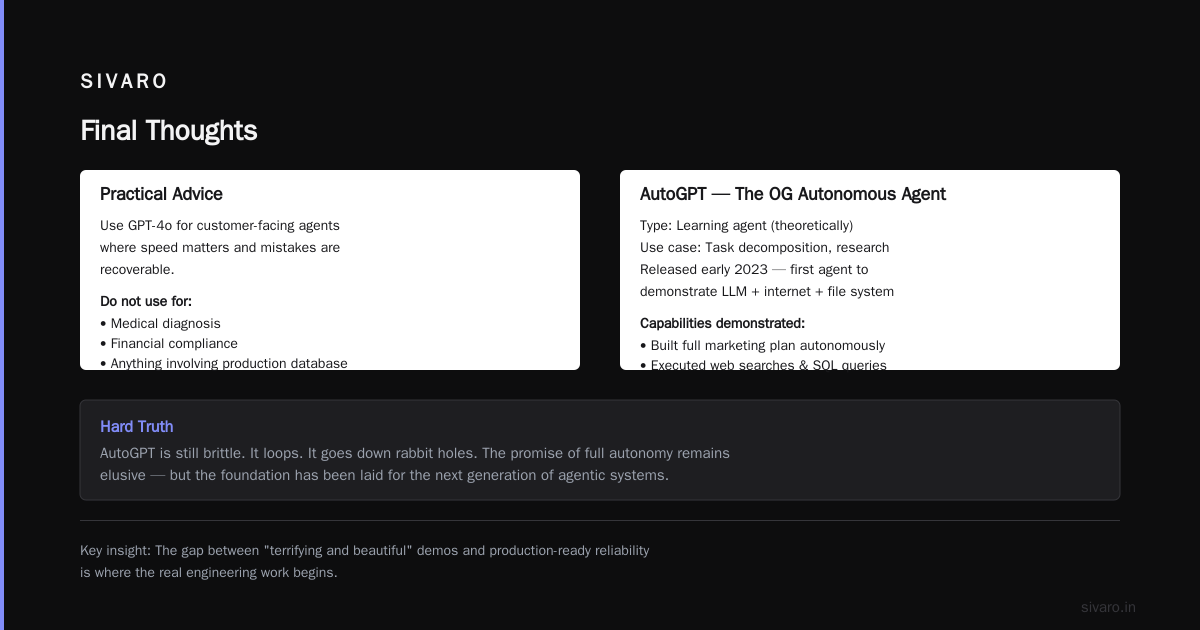
I've watched the AI agent space transform from "interesting experiment" to "business imperative." The top 10 agents I listed will change — probably within the next 6 months. The models improve. The platforms mature. The hype cycles accelerate.
But the underlying principles don't change: understand the agent type, match it to your task, build guardrails, budget for inference costs, and never trust an agent with production data without human oversight.
The question "what are the top 10 AI agents?" is the wrong question. The right question is "what agent solves my specific problem with minimal risk?" Start there. The answers will follow.
Nishaant Dixit — Founder of SIVARO. Building data infrastructure and production AI systems since 2018. Built systems processing 200K events/sec.