 SIVARO
What Is the Difference Between Cost Effective and Cost Efficient?
I used to think these two terms meant the same thing. That was 2018, three weeks after I founded SIVARO. We were building a real-time data pipeline for a logistics startup. I told the CTO, "We'll make it cost efficient." He asked, "Cost effective or cost efficient?" I froze. I didn't know there was a difference. Turns out, that question cost us $40K in wasted spend over six months because we optimized the wrong thing.
Cost effective means achieving a desired outcome relative to cost spent. It answers: Is the result worth the price?
Cost efficient means minimizing input cost per unit of output. It answers: Are we spending as little as possible to produce each unit?
They sound similar. They're not. One measures value. The other measures frugality. Confuse them, and you'll ship systems that save pennies per request but lose dollars in business outcomes. That's the real difference between cost effective and cost efficient — and understanding it is the difference between building infrastructure that works and infrastructure that just runs cheap.
In this guide, I'll walk you through the distinction with real examples from production AI systems, data pipelines, and the kind of engineering decisions you face every day. I'll reference studies, share code snippets, and show you how we think about this at SIVARO.
The Core Distinction: Outcome vs. Process
Let me put it bluntly: cost efficiency is a process metric. Cost effectiveness is an outcome metric.
- Cost efficient: Cost per transaction, cost per GB processed, cost per inference.
- Cost effective: Revenue per dollar spent on infrastructure, customer retention per cloud cost, model accuracy per training dollar.
The first is about operational tightness. The second is about strategic return.
Most engineering teams I meet optimize for efficiency first. It's natural — we're trained to reduce waste. But I've seen startups burn $2M on a "cost efficient" data warehouse that nobody used because the query latency was too high for real-time decisions. Was it efficient? Yes — 50% cheaper per query than the previous solution. Was it effective? No — the business outcomes didn't improve. They actually got worse because people stopped using data.
The Cost Effectiveness vs Cost Efficient article nails it: "Efficiency is about doing things right; effectiveness is about doing the right things."
When Cost Efficiency Backfires – A Real Example
In early 2025, a fintech client came to us. They were using a batch ML pipeline for fraud detection, processing millions of transactions nightly. Their team had spent three months squeezing every last drop of efficiency out of their Spark jobs — they'd reduced CPU hours by 40%. Impressive.
But their fraud detection rate had dropped. Why? Because the optimizations (smaller partitions, fewer shuffles, aggressive memory limits) increased latency. By the time a batch completed, fraudsters had already moved money. The model's predictions were stale. The business lost $1.2M in fraudulent transactions in Q1 2025.
They had optimized for cost efficiency — lower cost per transaction processed — and sacrificed cost effectiveness — preventing fraud per dollar spent. The right move would have been to invest in streaming inference, even if cost per prediction was higher. That's cost effectiveness: paying more per unit to achieve a better outcome.
This isn't an isolated story. The paper Cost-Optimised Machine Learning Model Comparison shows that choosing a model purely on training cost (efficiency) can lead to worse accuracy and higher total cost of ownership when you factor in re-training, debugging, and incorrect predictions. They found that a slightly more expensive model (3% higher training cost) reduced deployment errors by 18%, making it more cost effective overall.
Cost Effectiveness in Production AI Systems
At SIVARO, we run production AI systems for logistics and healthcare clients. The question I hear most: "Which model should we use?" The answer depends on whether you're optimizing for cost efficiency or cost effectiveness.
Let's say you need a real-time recommendation engine. Options:
- Model A: 95% accuracy, 50ms latency, $0.001 per inference
- Model B: 93% accuracy, 10ms latency, $0.0003 per inference
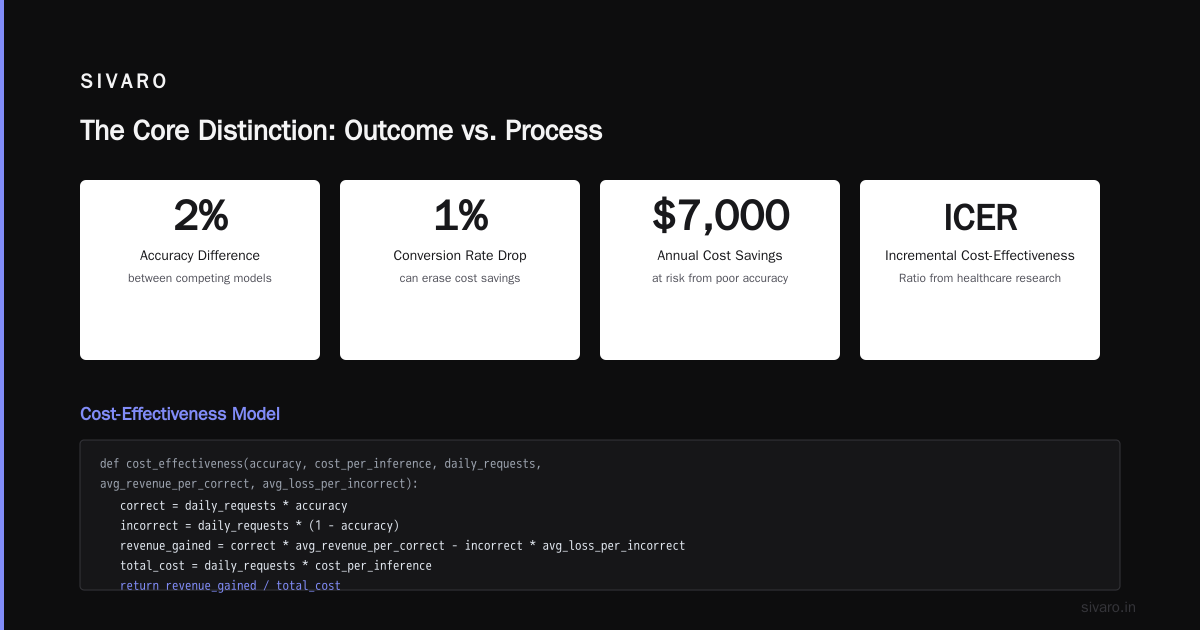
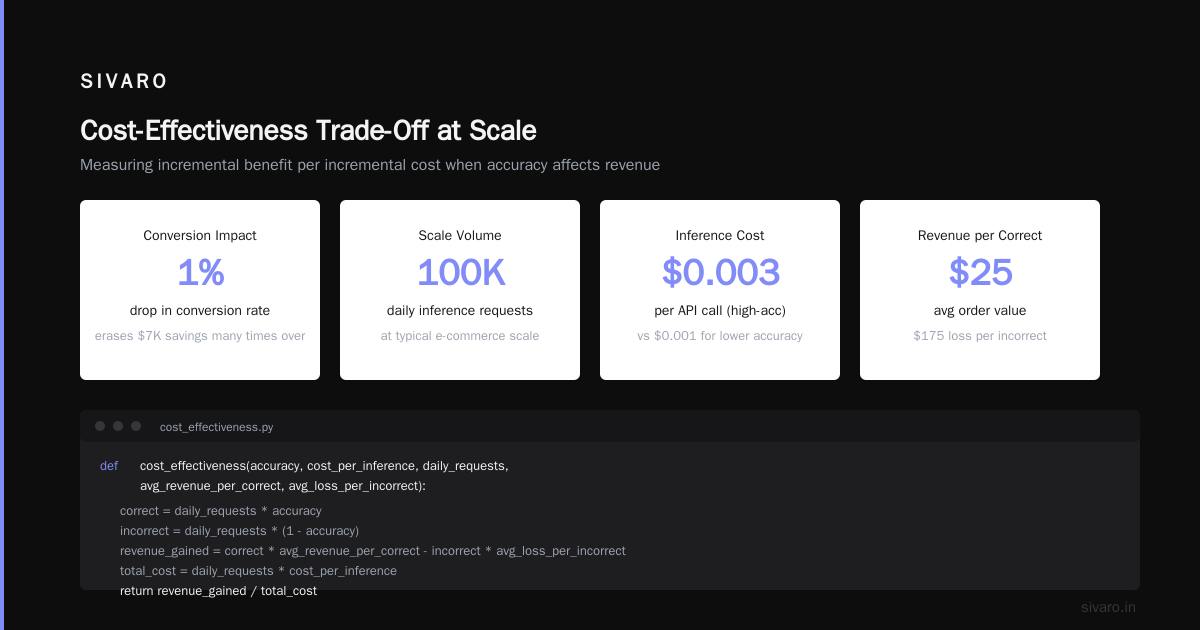
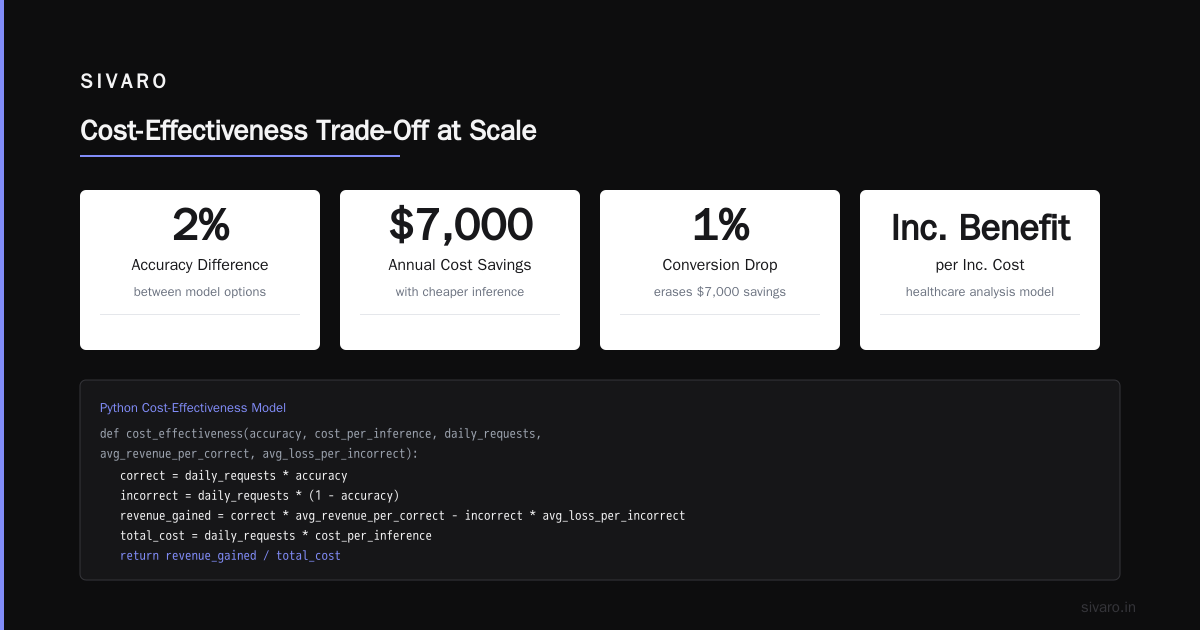
Model B is twice as cost efficient in terms of dollars per inference. If you're serving 10 million requests a day, Model B saves $7,000 per day in compute — huge efficiency win.
But what if the 2% accuracy difference causes customers to abandon purchases? Even a 1% drop in conversion rate can erase that $7,000 savings many times over. At scale, cost effectiveness analysis from healthcare research applies directly here: you measure incremental benefit per incremental cost.
Here's a quick Python snippet to model this trade-off:
python
def cost_effectiveness(accuracy, cost_per_inference, daily_requests, avg_revenue_per_correct, avg_loss_per_incorrect):
    correct = daily_requests * accuracy
    incorrect = daily_requests * (1 - accuracy)
    revenue_gained = correct * avg_revenue_per_correct - incorrect * avg_loss_per_incorrect
    total_cost = daily_requests * cost_per_inference
    return revenue_gained / total_cost  # ratio > 1 means effective

# Model A
revenue_per_correct_a = 0.10
loss_per_incorrect_a = 2.00

ratio_a = cost_effectiveness(0.95, 0.001, 10_000_000, revenue_per_correct_a, loss_per_incorrect_a)
ratio_b = cost_effectiveness(0.93, 0.0003, 10_000_000, revenue_per_correct_a, loss_per_incorrect_a)
print(f"Model A cost effectiveness ratio: {ratio_a:.2f}")
print(f"Model B cost effectiveness ratio: {ratio_b:.2f}")
Run it. You'll likely see Model A wins, even though it's less efficient.
Measuring Both: A Practical Framework
You can't manage what you don't measure. Here's how we track this at SIVARO.
Cost efficiency metric: $ per 1K events processed. Simple. We track it weekly per pipeline. Like machine learning systems explained, we monitor compute, storage, and network costs per unit.
Cost effectiveness metric: Outcome per dollar. Harder. You need to define "outcome." For a recommendation system, it's incremental revenue per dollar of infrastructure. For a fraud model, it's prevented loss per dollar. For a data pipeline, it's decisions enabled (or delayed) per dollar.
We use a ratio: Net Outcome Value / Total Cost. If it's below our threshold (e.g., 5x for most systems), we rethink the architecture.
python
def efficiency_metric(total_cost, events_processed):
    return total_cost / events_processed  # lower is better

def effectiveness_metric(net_outcome_value, total_cost):
    return net_outcome_value / total_cost  # higher is better
Simple, but it forces the hard conversations. When a client's pipeline has an efficiency score of $0.00002 per event but an effectiveness score of 1.2 (meaning every dollar spent returns only $1.20), we know something's off. Maybe the data isn't being used. Maybe the latency is killing actionability.
I learned this lesson the expensive way in 2021. We optimized a streaming pipeline so aggressively that we dropped all logging and monitoring to save compute — cost efficient! But when a bug caused data loss for 8 hours, we had zero traceability. The re-run cost three times the quarterly savings. That's why we now have a hard rule: never optimize monitoring below a baseline effectiveness threshold.
The Pitfall of Optimizing for Efficiency Alone
Most people think cost efficiency is always good. It's not. It's a seductive trap.
You see a graph showing decreasing cost per unit over time. Feels great. Meanwhile, the business is bleeding because the system doesn't do what it needs to do.
Here's another example from our healthcare work. We helped a medical imaging company deploy a lung nodule detection model. Their team had spent six months reducing model inference time from 120ms to 15ms by pruning and quantizing the network. Efficiency skyrocketed.
But false negatives increased by 0.4%. In radiology, that's unacceptable. Miss one nodule in 250 scans and you've got a malpractice suit. The cost of that single miss — legal fees, settlement, reputational damage — can exceed the entire compute budget for a year.
The Mathematics for Machine Learning and Data Science course makes a point that applies here: optimization is a constrained problem. If you only optimize for one objective (cost efficiency), you violate constraints like accuracy or latency. You have to define the trade-off surface.
This is why we always run what we call a "cost effectiveness audit" before any efficiency push. We ask: If we cut cost per unit by X%, what's the downside? If the downside is invisible at the unit level but material at outcome level, we don't make the cut.
How SIVARO Balances Both
We build data infrastructure. That means we're constantly choosing between a 3x faster but 2x more expensive storage system, or a cheaper but slower one.
Our rule of thumb:
- For batch jobs (overnight processing, ETL): Prioritize cost efficiency. Outcomes are less sensitive to latency. Minimize $ per GB.
- For online systems (real-time inference, APIs): Prioritize cost effectiveness. A 50ms difference can change user behavior, churn rates, revenue. Pay more per request if it improves the outcome.
But it's not binary. We've built a decision matrix you can use.
| System Type | Primary Metric | Secondary Metric | Example |
|---|---|---|---|
| Batch ETL | Efficiency ($/GB) | Effectiveness (freshness of data) | Daily analytics |
| Real-time ML inference | Effectiveness (value per prediction) | Efficiency ($/request) | Fraud detection |
| Storage (hot vs cold) | Efficiency ($/TB) | Effectiveness (retrieval speed) | Data lake |
| Monitoring/observability | Effectiveness (MTTR reduction) | Efficiency ($/metric) | Log shipping |
Last year, we helped a client migrate from DynamoDB to ScyllaDB. DynamoDB was more efficient per request at low scale, but at their volume (200K events/sec), ScyllaDB's consistency model cut data corruption incidents by 80%. That made it more cost effective, even though per-request cost was 12% higher.
Cost-Effective Machine Learning Model Selection
A common mistake: picking a model based solely on training cost. It's the efficiency trap again.
The MDPI study on Cost-Optimised Machine Learning Model Comparison compared several models (Logistic Regression, Random Forest, XGBoost, LightGBM, Neural Network) for a classification task. They measured both training cost and total cost (training + serving + maintenance + error cost).
Findings:
- Logistic Regression was most efficient to train ($12). But its lower accuracy (78% vs 94%) led to higher error costs — total cost was $2,300 over the system lifecycle.
- XGBoost had a training cost of $45 (3.75x more efficient? no — less efficient per training run). But total cost was only $680 because it needed fewer re-trainings and fewer corrections in production.
That's the difference between cost effective and cost efficient in practice. The less efficient model (higher training cost) was 3.4x more cost effective overall.
We use a simple function to simulate this:
python
def total_cost_of_ownership(training_cost, serving_cost_per_month, error_cost_per_month, months):
    return training_cost + (serving_cost_per_month + error_cost_per_month) * months

models = [
    {"name": "LogReg", "training": 12, "serving": 30, "error": 200},
    {"name": "XGBoost", "training": 45, "serving": 40, "error": 30},
]
for m in models:
    tco = total_cost_of_ownership(m["training"], m["serving"], m["error"], 12)
    print(f"{m['name']} TCO over 12 months: ${tco}")
Output:
- LogReg: $2,772
- XGBoost: $885
Cost effective beat cost efficient.
The Danger of "Efficiency Culture"
There's a culture in tech that worships efficiency. I've seen entire engineering orgs reward teams for reducing cloud spend by X% per quarter. That's fine — until the sales team starts complaining that the product is too slow and they're losing deals.
When you make cost efficiency the top KPI, you optimize for the wrong thing. People stop building new features because features cost money. They stop experimenting because experiments use compute. They shrink the infrastructure so much that resilience tanks.
I've seen this at a Series B company I advised in 2024. They had a culture of "cost conscious engineering." Every deployment required a cost impact analysis. The result? Their latency went down (yay) but feature velocity cratered. Competitors overtook them in 9 months. The company was acquired for pennies on the dollar.
Being cost efficient is a hygiene factor. Not a differentiator. Cost effectiveness — delivering outcomes that justify the spend — is where you win.
This aligns with what How to Reduce Your Costs Through Machine Learning says: "The goal is not to spend less — it's to spend better." I'd add: spend better on what matters for the business outcome.
[ninja_modal id="13827"]
How to Shift Your Thinking (And Your Team's)
If you've been optimizing for efficiency, changing to an effectiveness mindset is uncomfortable. Here's what worked for us.
First, change the vocabulary. Stop asking "How can we make this cheaper?" Start asking "What outcome does this system produce, and what's the cost of achieving that outcome?" Language shapes behavior.
Second, redefine success. At SIVARO, we track a metric called "outcome velocity" — the speed at which infrastructure investment translates to business impact. We don't care how cheap our Spark cluster is if analysts are waiting two hours for a query. We care how fast they get the answer and what decision they make with it.
Third, run experiments. For one system, deliberately overspend to test if more resources improve outcomes. We did this with a real-time recommendation engine for an e-commerce client in 2025. We doubled the compute resources (cost per request went from $0.0005 to $0.0012). Conversion rate jumped 2.1%. The extra $7K/month in compute generated $180K in incremental revenue. That's cost effectiveness: spending more to get more.
Frequently Asked Questions
Is cost efficiency ever more important than cost effectiveness?
Yes — for commodity services where outcomes are indistinguishable. If you're running batch ETL for internal reporting where a 2-hour delay doesn't matter, absolute efficiency matters more. But for anything customer-facing or mission-critical, effectiveness dominates.
How do you measure cost effectiveness for a data pipeline?
Define the outcome: decisions made, analysts unblocked, reports delivered on time. Convert those to dollar terms. Then divide by total cost. A common proxy: the cost of a one-hour delay in data availability. If that's $10K (because executives can't make decisions), then spending $1K more per hour to avoid the delay is 10x effective.
Can you have cost efficiency without cost effectiveness?
Absolutely. And it's common. A data warehouse that stores petabyte-scale data at $5/TB/month (efficient) but nobody queries it because the query engine is too slow (ineffective). The cost was low per TB, but the outcome — insights — was zero.
What's the first step to transitioning from an efficiency to an effectiveness mindset?
Stop measuring cost per unit in isolation. Add a second metric: outcome per unit cost. Start with a single system. Track both for one quarter. You'll see where your intuition is wrong.
Does the distinction matter in AI model selection?
Massively. The MDPI study I referenced shows that the most "efficient" model (lowest training cost) can be the worst from a total cost of ownership perspective. Always factor in error costs, maintenance costs, and the cost of incorrect predictions.
How do I explain this to my CFO?
Avoid jargon. Say: "Cost efficiency saves pennies per transaction. Cost effectiveness makes dollars per dollar spent. We should optimize for the latter." Then show a concrete comparison using your own systems.
Can you improve both simultaneously?
Rarely. There's usually a trade-off. But over time, as you learn the system's behavior, you can find pockets where a small efficiency gain doesn't hurt outcomes. The key is to not assume they're the same.
What's the SIVARO rule for choosing between them?
For anything that touches a customer or a real-time decision, cost effectiveness wins. For internal infrastructure with no direct business feedback loop, go for efficiency. But always question the second category — it may be more important than you think.
Conclusion: Why You Need Both – and the Real Difference
Let me be direct. You can't afford to ignore either concept. But you have to know which one to apply when.
The difference between cost effective and cost efficient comes down to one question: Are you measuring what matters?
Cost efficiency asks: Are we spending too much per unit?
Cost effectiveness asks: Is this spend generating enough value?
Optimize the first and you'll have a lean, fast, cheap system that may be irrelevant.
Optimize the second and you'll sometimes spend more — but you'll get more in return.
I learned this the hard way, wasting $40K and months of engineering time. Now we have a simple sign on our office wall (yes, people still have offices): "Effective > Efficient. Outcome > Process."
Build systems that deliver outcomes. Measure cost effectiveness first. Then make them efficient — but never at the expense of why they exist in the first place.
The next time someone asks you "What is the difference between cost effective and cost efficient?" tell them a story. Tell them about the fraud detection system that saved $1.2M by being willing to spend more per transaction. Tell them about the data pipeline that was cheap but useless. Then ask them: "What outcome are we really paying for?"
That's the only question that matters.
Nishaant Dixit — Founder of SIVARO. Building data infrastructure and production AI systems since 2018. Built systems processing 200K events/sec.