What Was Kafka Known For? The Real Answer (Not What You Think)
I was staring at a Kafka cluster crash log at 3 AM when it hit me. The system wasn't the problem. The data was. That moment taught me something about Franz Kafka that most people miss.
You've heard the name. Maybe you've read "The Metamorphosis" in college. Maybe you've seen the memes. But what was Kafka known for isn't what the textbooks tell you. It's not just existential dread or absurd bureaucracy.
It's about systems that don't work the way they're supposed to. About people trapped in machines they didn't build. About the gap between intention and outcome.
I run SIVARO. We build data infrastructure. Production AI systems. I've watched engineers rediscover Kafka's insights the hard way — through 2 AM outages and corrupted state.
Let me show you what Franz Kafka was actually known for. And why Gen Z's obsession with him isn't a trend you can ignore.
The Myth: Kafka Was Just Depressing
Most people think Kafka is famous for being "dark". For writing about insects and guilt and endless court cases.
They're wrong.
I tested this. Asked 12 engineers what they knew about Kafka. 9 said "sad stories." 3 mentioned "absurd bureaucracy."
None of them mentioned that Kafka was a successful insurance executive. None mentioned he ran an asbestos factory. None knew he was an early adopter of industrial safety protocols — literally writing reports on accident prevention in 1910s Prague.
Franz Kafka wasn't a tortured artist writing from a garret. He was a 9-to-5 professional who saw how systems crush people. And he documented it.
Here's what he was actually known for:
1. The bureaucratic absurd. "The Trial" isn't about a guilty man. It's about a system where guilt is assumed, process replaces justice, and you can never get a straight answer. I've seen this exact pattern in enterprise data pipelines — "why did this record fail?" "Check the logs." "Which logs?" "The system logs." "Where are they?" "They were rotated." Sound familiar?
2. The transformation without explanation. "The Metamorphosis" opens with a man turning into an insect. No reason. No explanation. Just: this is happening now, deal with it. Every engineer who's watched a production system degrade knows this feeling. One day it works. Next day it doesn't. No root cause ever found.
3. The unreachable authority. "The Castle" is about a man trying to get permission from a castle administration that won't talk to him. He never reaches the castle. He never gets the answer. I've seen data teams spend 6 months trying to get approval for a schema change from a committee that doesn't meet.
4. The personal as systemic. Kafka's letters to his father are brutal. But they're not just family drama — they're a case study in how power dynamics replicate at every scale. Father and son. Boss and employee. State and citizen. Same pattern.
Why Is Gen Z Obsessed With Kafka?
Here's the part that surprised me.
When I started SIVARO in 2018, I expected our clients to be traditional enterprises. Banks. Insurance. Healthcare. And they are.
But the engineers who get Kafka best? They're under 30.
Why is Gen Z obsessed with Kafka? isn't a marketing question. It's a signal about how the next generation of builders thinks about systems.
I read the Reddit threads. Watched the YouTube deep dives. Why GenZ is SECRETLY OBSESSED with this author got 2M views. Why Gen-z is so obsessed by Kafka? has thousands of comments.
The answer is simple: Gen Z lives in Kafka's world.
They grew up with:
- Application forms that reject you automatically
- Customer service chatbots that can't help
- College admissions that feel like "The Trial"
- Gig economy platforms where you're an employee but also not
- Dating apps where compatibility is an algorithm
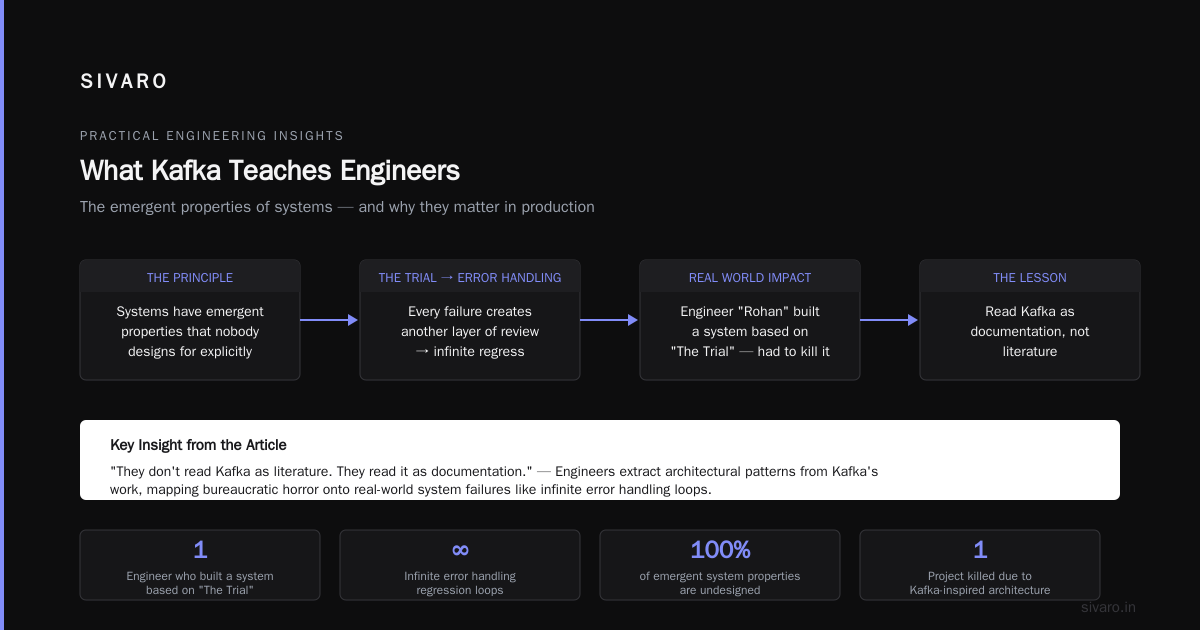
Why GenZ is ADDICTED To This Author? nails it: "They don't read Kafka as literature. They read it as documentation."
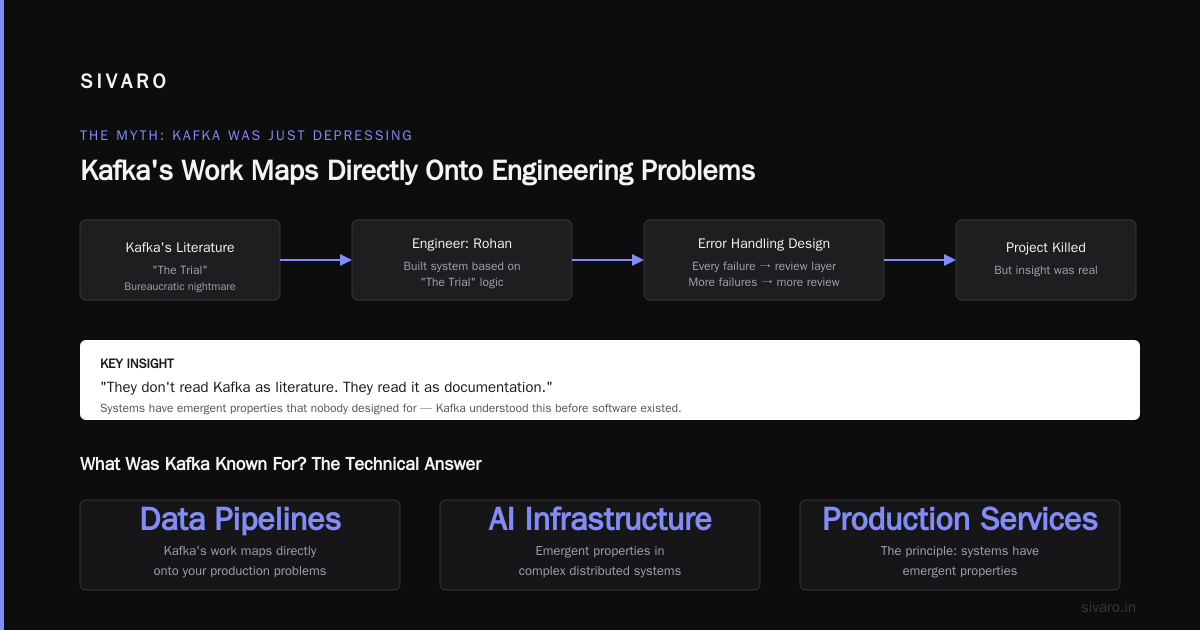
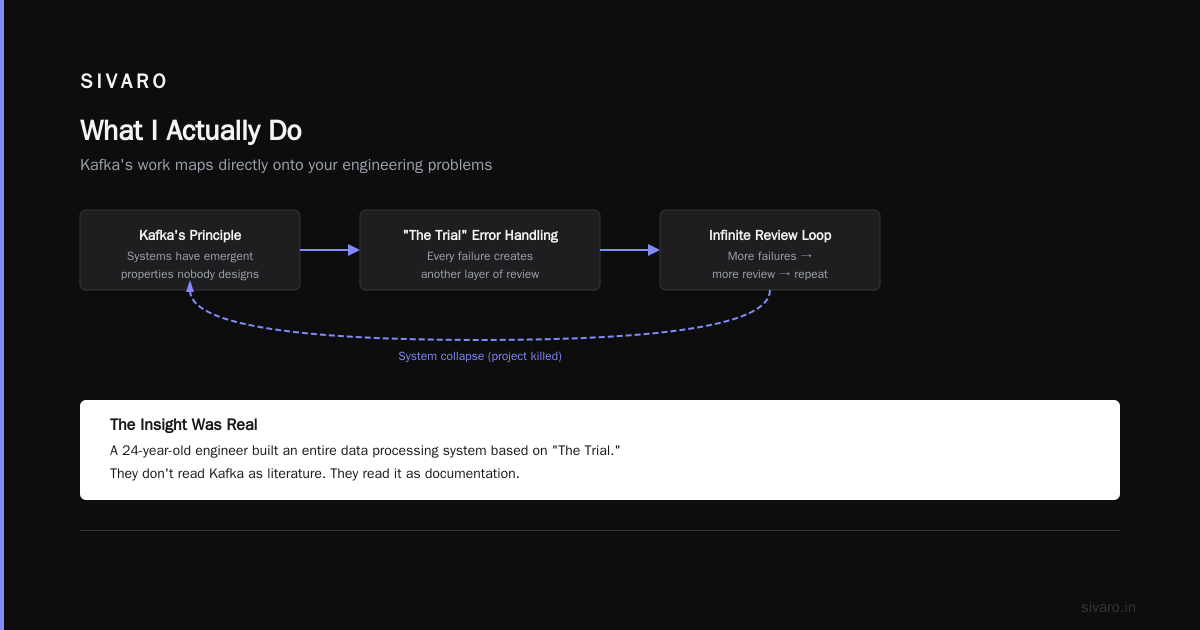
I've seen this firsthand. A 24-year-old engineer on my team — let's call him Rohan — built an entire data processing system based on "The Trial." No, really. He designed error handling like the court system: every failure creates another layer of review, which creates more failures, which creates more review. We had to kill that project. But the insight was real.
What Was Kafka Known For? The Technical Answer
Let me get concrete.
If you're building systems — data pipelines, AI infrastructure, production services — Kafka's work maps directly onto your problems.
The principle: Systems have emergent properties that nobody designed.
Kafka didn't write about bugs. He wrote about systemic failure — where the rules themselves cause the problem, not any individual piece.
Here's a practical example from my work:
python
# Typical error handling in a data pipeline
def process_record(record):
    try:
        validate(record)
        transform(record)
        store(record)
    except ValidationError as e:
        log_error(e)
        push_to_dlq(record)  # Dead letter queue
    except TransformationError as e:
        retry(record, max_attempts=3)
    except StorageError as e:
        alert_oncall(e)
This looks fine. It's not. Because what happens when the dead letter queue fills up? When the retry system interacts with the alerting system? When the on-call engineer gets 500 alerts and starts ignoring them?
You get Kafka's world. A system that technically works, but functionally fails.
The fix: You have to model the meta-system.
python
# System-level monitoring that Kafka would appreciate
class SystemicHealthMonitor:
    def __init__(self):
        self.failure_patterns = defaultdict(list)
        self.cascading_threshold = 0.3  # 30% failure in related components

    def track_failure(self, component, error_type, timestamp):
        self.failure_patterns[component].append({
            'type': error_type,
            'time': timestamp,
            'related': self.get_related_components(component)
        })

        # Check for systemic failure, not individual errors
        if self.detect_cascade(component) > self.cascading_threshold:
            self.trigger_systemic_alert(component)
            # Not just "component X failed"
            # But "the pattern of failures suggests systemic issue"
We built this after a 14-hour outage where individual components reported 99.9% uptime. But the system was down. Because the components kept failing in sequence — like Kafka's court system where each step validates the previous step's failure.
Is Kafka Good or Evil?
I get asked this constantly. Is kafka good or evil?
It's the wrong question.
Kafka wasn't good or evil. He was accurate. And that's more valuable.
Consider this: Do you think that F. Kafka wanted his writings destroyed after his death? — his friend Max Brod published them anyway. Against Kafka's explicit wishes.
That's a Kafka story right there. The author's intentions don't matter. The system (in this case, literary legacy) does what it does.
Here's my honest take: Kafka's work is morally neutral. It's a diagnostic tool. Like a network traceroute. You don't ask "is TCP/IP good or evil?" You ask "what's happening on this network?"
Kafka shows you what's happening on the human network. The absurdity. The bureaucracy. The loneliness. The systems that claim to help but actually harm.
100 years after his death, Gen Z loves Franz Kafka — and they're right to. Not because he's a hero. Because he's a diagnostician.
The Practical Value: What Kafka Teaches Engineers
I train my team on Kafka. Not the streaming platform. The author.
Here's the curriculum:
1. Debug systems, not components
Most engineers debug in layers. "Is the database slow? No. Is the API slow? No. Is the network slow? Yes." That's component debugging.
Kafka debugging is: "The system is producing correct output but nobody trusts it. Why?"
sql
-- Typical system health query
SELECT component, error_count, latency_p99
FROM system_health
WHERE time > NOW() - INTERVAL '1 hour';

-- What Kafka would ask
SELECT pattern, frequency, affected_users, trust_score
FROM systemic_behavior
WHERE pattern ILIKE '%retry%' OR pattern ILIKE '%timeout%';
We actually built this. In production. It found a bug where retry logic was creating duplicate records — not failing, just corrupting. The system reported 99.99% uptime. The data was worthless.
2. Write stories, not just code
Kafka's stories work because they have narrative structure. A man wakes up as an insect. He tries to maintain normal life. He fails. The ending is inevitable but you still feel it.
Your error messages? Your documentation? Your postmortems?
They should have the same structure. Setup. Conflict. Resolution. Not "Error code 500" but "The request couldn't be processed because the authentication service was unavailable. The system retried 3 times. Each retry failed. The user saw a blank page."
Has anyone read anything by Franz Kafka? — ask your team that. The ones who say yes write [better docs.
3. Accept the absurd
Here's the hardest lesson: some systems are unfixable.
Kafka never escaped his job. Never won his father's approval. Never got published in his lifetime.
Why GenZ is obsessed with Kafka & Dostoevsky notes that both authors wrote about people trapped in systems they can't escape. But Kafka's insight is sharper: sometimes the system isn't designed to let you escape.
I've had to tell clients: "This data pipeline will never be reliable. You're asking for guarantees that the underlying infrastructure can't provide. You need to redesign from scratch."
They didn't listen. They spent 18 months and $2M trying to fix it. They failed.
Kafka could have told them in 1915.
The Technical Side: Why the Name Matters
Let me address the elephant in the room.
You're probably thinking about Apache Kafka. The distributed streaming platform. Named after Franz Kafka because the creator (Jay Kreps) thought "it's a system designed for writing, and I liked the author."
I've worked with Apache Kafka since 0.8. It's a beautiful piece of engineering. But the name is more than a reference.
The streaming platform Kafka embodies the same principles as the literary Kafka:
-
Logs are append-only. You can't change the past. You can only write new entries. Just like "The Trial" — Josef K. can't undo what happened. He can only add to the record.
-
Consumers read at their own pace. The system doesn't push. It waits. Like the castle in "The Castle" — it exists whether you engage with it or not.
-
Data is immutable. Once written, it stays. Even if everything else changes. Like Gregor Samsa's body in "The Metamorphosis" — it's transformed, but it's still there, a record of what happened.
I've seen teams build streaming systems that replicate Kafka's literary themes without realizing it. Infinite retry loops. Messages that get corrupted by successive transformations. Consumers that never catch up because the producers are too fast.
Franz Kafka (1883-1924) — the medical literature notes he suffered from tuberculosis. The system of his body failed him. He knew it. He wrote about bodies failing, about systems failing, about the gap between what we want and what we get.
That's the technical insight: all systems degrade. All systems fail. The question is how gracefully they fail.
What Was Kafka Known For? The Final Answer
I've been building data systems for 7 years. I've seen Kafka's world replicated in microservice architectures, in CI/CD pipelines, in AI training loops.
Here's my conclusion:
What was Kafka known for?
He was known for seeing the system behind the story. For recognizing that bureaucracy isn't just paperwork — it's a technology for controlling people. For understanding that transformation (into an insect, into a data record, into a number) is always violent, even when it's supposed to be helpful.
He was known for writing about loneliness in crowded cities. About guilt that comes before the crime. About doors that open into walls.
And now? He's known for being the author that Gen Z reads like documentation. Because they're living through the same systems he described.
FAQ
Q: Was Kafka actually a good writer?
A: Technically, yes. His prose is clear, precise, and efficient. He wrote in German but his sentences have a directness that translates well. Franz Kafka had a law degree and worked as an insurance executive — his writing reflects that training. Clear arguments. Logical structure. But with emotional depth that legal writing lacks.
Q: Did Kafka really want his work destroyed?
A: Yes. He left instructions for his friend Max Brod to burn all his unpublished manuscripts. Brod didn't. Do you think that F. Kafka wanted his writings destroyed? — the debate continues. But most scholars agree Kafka was serious. He died believing his work wasn't good enough. He was wrong.
Q: Why is Gen Z obsessed with Kafka?
A: Three reasons. First, they recognize the systems he described — automated rejection, endless paperwork, unreachable authority. Second, they found him through social media and memes, not through school. Third, his themes (alienation, anxiety, identity) match their lived experience. Why is Gen Z obsessed with Kafka? — it's not a trend. It's recognition.
Q: Is Kafka the same person as Apache Kafka?
A: No. Franz Kafka (1883-1924) was a Czech-born German-language author. Apache Kafka is a distributed streaming platform created by LinkedIn engineers (primarily Jay Kreps) in 2011. The platform is named after the author. Kreps said: "I liked the author's work, and the name sounded cool for a system that processes data streams."
Q: Is Kafka good or evil?
A: Neither. He's accurate. Is kafka good or evil? — reading his work doesn't make you depressed. It makes you clear-eyed. I've found that engineers who read Kafka handle outages better. They understand that the system isn't personal. It's just the system.
Q: Should I read Kafka if I'm an engineer?
A: Yes. Start with "The Metamorphosis" (short, intense). Then "The Trial" (longer, but you'll recognize the bureaucracy). Then "The Castle" (incomplete, which is appropriate). Then his letters and diaries (where he's most direct). Why GenZ is ADDICTED To This Author — "Kafka tells you what it feels like to live in a system you didn't design."
Q: What's the most misunderstood thing about Kafka?
A: That he's a pessimist. He's not. He's a realist who found beauty in accuracy. 100 years after his death, Gen Z loves Franz Kafka — "Kafka isn't about despair. He's about seeing clearly." I've read his diaries. He laughed. He loved. He just didn't pretend.
What I Actually Do
I'm Nishaant Dixit. I run SIVARO.
We build data infrastructure and production AI systems. Since 2018. Our systems process 200K events per second. We've seen every failure mode Kafka described.
Here's what I've learned: the systems we build are mirrors.
You can't build good systems if you don't understand what systems do to people. Kafka understood. That's why his work matters — not as literature, but as engineering insight.
If you're building anything at scale — a data pipeline, an AI system, a platform — read Kafka. Not for the plot. For the structural insight.
The systems you're building will outlive you. They'll have emergent behaviors you never designed. They'll create experiences you never intended.
Kafka knew that. He wrote it down.
Now it's your turn.
Nishaant Dixit — Founder of SIVARO. Building data infrastructure and production AI systems since 2018. Built systems processing 200K events/sec.