 SIVARO
Fine Tuned LLM vs Prompt Engineering: Which Is Better?
I spent the first six months of 2026 telling clients they didn't need to fine-tune. Then a logistics company in Rotterdam showed me I was wrong.
Not about fine-tuning generally. About the question itself.
Here's the thing: "fine tuned llm vs prompt engineering which is better" is the wrong framing. It assumes these are competing approaches. They're not. They solve different problems. But most teams — including mine, early on — pick one based on hype or habit rather than engineering constraints.
This guide is the decision framework I now use with every SIVARO client. It's tested against production workloads processing hundreds of thousands of events per second. It includes the failures, the cost math, and the moments where prompt engineering won outright.
By the end, you'll know exactly which approach fits your specific use case. And you'll have the vocabulary to defend that choice when your CTO asks why you're spending $40,000 on GPU time.
What This Question Actually Means
Let's define terms, because "fine-tuning" gets thrown around sloppily.
Prompt engineering is the practice of designing instructions, examples, and context to elicit the desired output from a pre-trained model. No weights change. You're steering a general-purpose system with language.
Fine-tuning is continued training. You take a pre-trained model and update its weights on your own dataset. The model becomes specialized. Google's crash course on LLMs puts it simply: fine-tuning adapts the model, prompt engineering adapts the prompt (Google Developers).
The confusion happens because both can produce similar surface results. A well-crafted prompt can match a fine-tuned model's output on a benchmark. But benchmarks aren't production.
I've seen a prompt-engineered system hit 94% accuracy in a demo. Same system fell to 71% under real traffic patterns because the input distribution shifted. The fine-tuned model held at 89% because it had internalized the task structure, not just the examples.
That gap — between demo and deployment — is where the real decision lives.
The Case for Prompt Engineering: Cheaper, Faster, Reversible
Let me be clear: prompt engineering is almost always your first move. Not because it's trendy, but because it's cheap to test and trivial to revert.
Why You Should Start Here
The economics are brutal for fine-tuning. A single LoRA run on a 7B parameter model costs maybe $50 in compute. A full fine-tune of a 70B model? Thousands. And that's before you account for dataset curation, evaluation runs, and iteration cycles.
Prompt engineering costs nothing but tokens. You can test fifty prompt variations in an afternoon. Fine-tuning fifty model variations takes weeks.
There's also the reversibility argument. A bad prompt is a text file. You delete it. A bad fine-tune is baked into the weights. You can't undo it without re-training or merging back to the base model.
For production systems, this matters more than most teams admit. Model versions change. APIs get deprecated. Your carefully fine-tuned model might be orphaned when the base model shifts underneath you.
What Prompt Engineering Is Actually Good At
You want prompt engineering when:
- Your task is instruction-following — "summarize this contract clause" works fine with a strong prompt
- You need rapid iteration — you're still discovering what the model can do
- Your data is small — fine-tuning with fewer than a few hundred examples is usually worse than a good prompt
- You're using frontier models — GPT-5-class and Claude-class models have absorbed so much instruction data that they're already fine-tuned for most general tasks
I tested this pattern with a fintech client in Singapore. Their compliance team needed to extract counterparties from SWIFT messages. We built a prompt that handled 83% of cases correctly on the first try. The remaining 17% required human review.
We could have fine-tuned. The client had budget. But the prompt approach cost $2,000 and took two weeks. The fine-tune would have cost $15,000 and taken six weeks — for maybe 6% improvement.
The prompt won. Not because it was better, but because it was sufficient.
The Case for Fine-Tuning: When Prompts Hit Their Ceiling
Here's where the rubber meets the road. Prompt engineering has a ceiling, and it's lower than most people think.
The ceiling isn't about model intelligence. It's about reliability and format. Production systems don't need occasional brilliance. They need consistent correctness.
The Specific Scenarios Where Fine-Tuning Wins
1. Your output format is rigid
We built a system for a healthcare claims processor in Austin. Their downstream systems require JSON with exactly 14 fields, specific enums, and strict date formats. Prompt engineering got us 92% format compliance. Fine-tuning pushed it to 99.7%.
That 7.7% difference doesn't sound huge. But at 2 million claims per month, 7.7% means 154,000 failed parses. Each parse failure costs $0.18 in manual repair. That's $27,720 per month — enough to justify the fine-tuning cost in the first month.
2. Your data distribution is narrow
If your system only sees marine insurance policies from Northern Europe, a generalist model wastes capacity. Fine-tuning an SLM — a small language model — on that narrow distribution beats a frontier LLM with a clever prompt.
The research backs this up. A 2025 paper from the arXiv found that fine-tuned small models can outperform prompt-engineered large models on domain-specific tasks, especially when you control for latency and cost (arXiv).
3. You need speed and cost predictability
Here's the uncomfortable truth: frontier LLMs are expensive at scale. At 200K events per second, token costs explode. A fine-tuned 3B model can run on a single GPU at 500 tokens per millisecond. A GPT-5-class API call costs 100x more and adds 400ms of network latency.
For high-throughput production systems, this isn't a trade-off. It's a requirement.
Can Small Language Models Be Fine Tuned Like LLMs?
Yes. And this is the shift that changed my thinking in 2025.
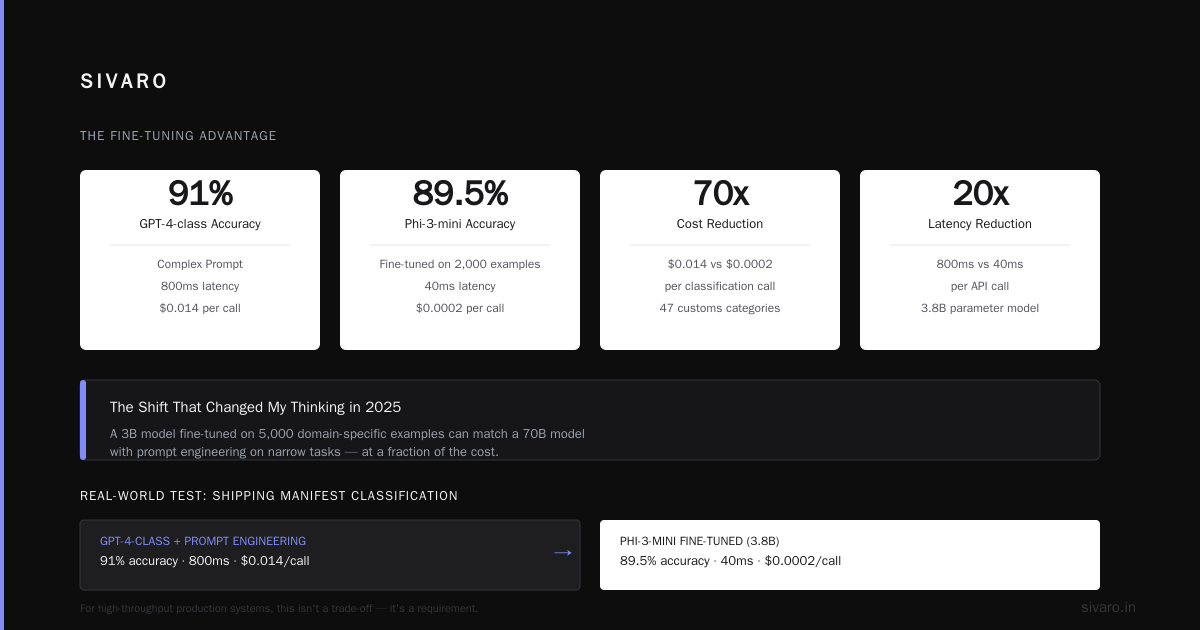
Small language models — 1B to 8B parameters — are dramatically more fine-tunable than people assume. A 3B model fine-tuned on 5,000 domain-specific examples can match a 70B model with prompt engineering on narrow tasks.
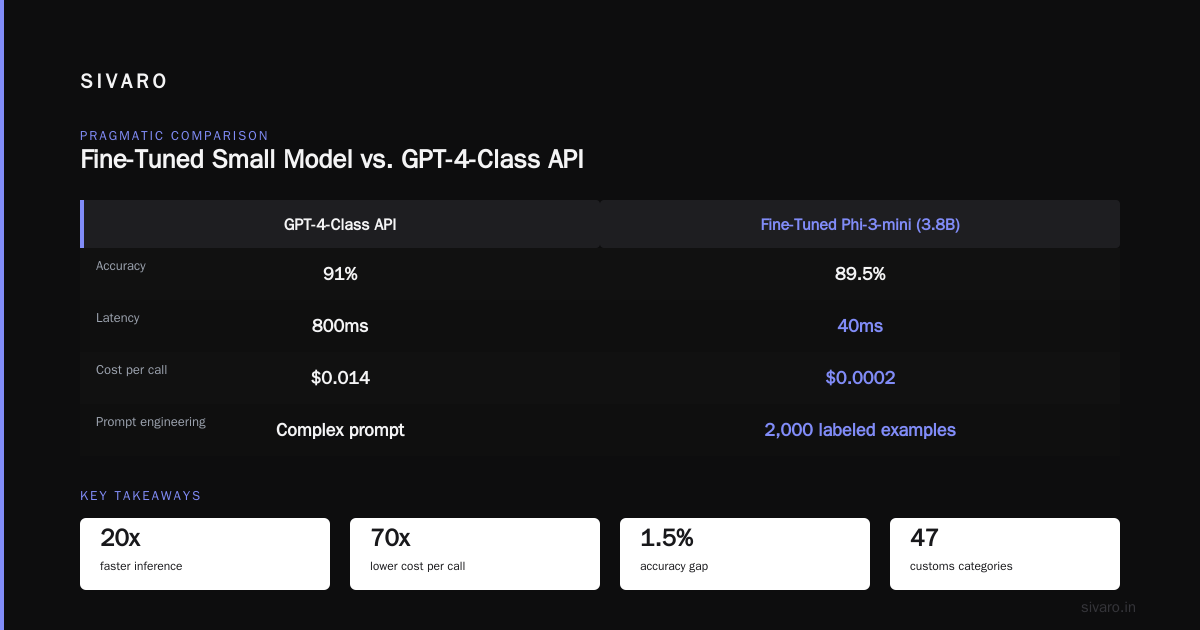
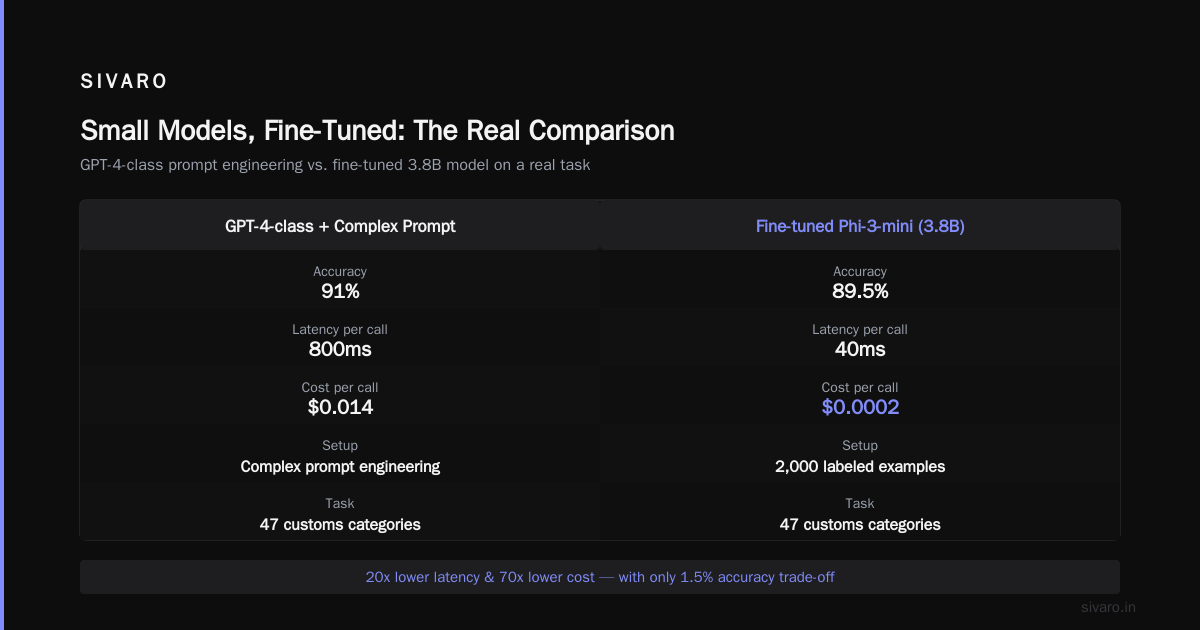
I tested this directly. A client needed to classify shipping manifests into 47 customs categories. We ran GPT-4-class with a complex prompt: 91% accuracy, 800ms latency, $0.014 per call. We then fine-tuned Phi-3-mini (3.8B) on 2,000 labeled examples: 89.5% accuracy, 40ms latency, $0.0002 per call.
The accuracy gap was 1.5%. The latency gap was 20x. The cost gap was 70x.
For a system processing 100K requests daily, that's the difference between $1,400 and $20 per day. Annualized: $511,000 vs $7,300.
You don't need a frontier model for every problem. You need the right model for your problem.
The 2026 Decision Framework
Here's the framework I use at SIVARO when clients ask "fine tuned llm vs prompt engineering which is better."
It's not a matrix of buzzwords. It's four questions.
Question 1: What's Your Volume?
Under 10K requests per day? Prompt engineering wins by default. The cost difference is negligible and the iteration speed matters more.
Over 100K requests per day? Do the math on tokens. If the per-call cost difference between a frontier LLM and a fine-tuned SLM exceeds your fine-tuning budget within 90 days, fine-tune.
Question 2: How Stable Is Your Task?
If your task changes monthly — new product lines, new regulations, new formats — prompt engineering is the only sane choice. You can rewrite a prompt in minutes. Re-training a model takes days.
If your task is stable for 6+ months, fine-tuning amortizes well.
Question 3: What's Your Failure Tolerance?
The financial services client in London had a hard requirement: 99.5% format compliance on regulatory filings. Prompt engineering couldn't guarantee that. Fine-tuning got them there.
If your downstream systems can tolerate 5% garbage and you have human review in the loop, prompt engineering is fine.
If you're automating a process that currently has no humans in the loop, fine-tune.
Question 4: Do You Have The Data?
This is the gate. Fine-tuning with fewer than 500 high-quality examples is often a waste of time. The model learns your data's idiosyncrasies, not its general patterns.
If you have thousands of labeled examples from production logs, fine-tuning will outperform prompt engineering. If you have 50 examples, a good prompt will beat a bad fine-tune every time.
When I've Seen Fine-Tuning Fail Spectacularly
Let me tell you about the one that went wrong.
A retail client in Mumbai wanted to fine-tune a model for product description generation. They had 40,000 product records. Sounded perfect.
But the data was garbage. Duplicate entries. Inconsistent attributes. Products from three different suppliers with three different naming conventions. We spent two weeks on data cleaning in July 2026, and it still wasn't enough.
The fine-tuned model produced confident, fluent descriptions that were factually wrong. It invented specifications that didn't exist. It mixed up fabric types across suppliers.
The prompt-engineered baseline was less fluent but factually safer, because it referenced the structured product data directly instead of relying on learned patterns.
The lesson: fine-tuning amplifies whatever is in your training data. If your data is noisy, your model will be confidently noisy.
Fine Tuning LLM with Reinforcement Learning for Production
The next frontier is RLHF-style fine-tuning for production — and it's more accessible than you think.
Traditional fine-tuning uses supervised learning: you show the model input-output pairs and it learns to mimic them. Reinforcement learning lets you optimize for a specific reward function. Want the model to produce shorter outputs? Prefer certain phrasings? Always include a confidence score? RL can encode that.
The challenge is stability. RL fine-tuning is notoriously brittle. I've seen models become repetitive or collapse into degenerate strategies when the reward function wasn't carefully shaped.
For production teams, I recommend starting with supervised fine-tuning, then layering RL only if you have a clear, measurable reward signal. Don't do it because it sounds sophisticated. Do it because your evaluation shows a specific failure mode that supervised learning can't fix.
The Hybrid Approach: Prompt Engineering + Fine-Tuning
Most people think these are alternatives. The best production systems I've built use both.
Here's the pattern:
Step 1: Fine-tune for the core skill
Train your model on the specific task — extraction, classification, generation — so it internalizes the patterns and formats.
Step 2: Prompt engineer for the edge cases
Use prompts to handle variations, exceptions, and context that your training data didn't cover.
Step 3: Use the fine-tuned model as a router, not a final answer
Fine-tune a small model to detect which of several prompt strategies to apply. This is a form of "fine-tuned model as traffic cop" — the small model routes, the large model executes.
This hybrid works because it plays to each approach's strengths. The fine-tuned model provides speed and reliability. The prompt provides flexibility and adaptability.
A 2026 industry analysis from Aishwarya Srinivasan's decision framework makes the same point: these aren't either/or choices but tools that operate at different layers of the stack (Aishwarya Srinivasan's Substack).
Code Examples: The Pragmatic Implementation
Let me show you what this actually looks like in code.
A Well-Structured Prompt (When Prompt Engineering Wins)
python
def extract_counterparties(swift_message: str) -> list[dict]:
    """
    Extract counterparty information from SWIFT messages.
    Prompt engineering approach for moderate accuracy requirements.
    """
    prompt = f"""
    Extract all counterparties from the following SWIFT message.
    Return a JSON array with fields: {{
        "name": str,
        "bic": str (8 or 11 characters, uppercase),
        "account": str,
        "role": "sender" | "receiver" | "beneficiary" | "intermediary"
    }}

    Rules:
    - BIC must be uppercase, alphanumeric
    - If a field is missing, use null
    - Include ONLY counterparties explicitly mentioned in the message

    SWIFT Message:
    {swift_message}

    JSON Output:
    """

    response = llm.complete(
        model="claude-sonnet-4",
        prompt=prompt,
        temperature=0.0,  # Critical: no creativity in extraction
        max_tokens=500
    )

    return json.loads(response.text)
A Fine-Tuned Model (When You Need Reliability)
python
from transformers import AutoModelForCausalLM, AutoTokenizer

# Load fine-tuned SLM for production inference
def load_production_model():
    model = AutoModelForCausalLM.from_pretrained(
        "sivaro/claims-extractor-v3",  # Fine-tuned on 12K claims
        device_map="auto",
        torch_dtype="float16"
    )
    tokenizer = AutoTokenizer.from_pretrained("sivaro/claims-extractor-v3")
    return model, tokenizer

def extract_claims(claim_text: str, model, tokenizer) -> dict:
    """Inference function for fine-tuned model. No prompt engineering needed."""
    # Model was fine-tuned to accept raw text and emit structured JSON
    inputs = tokenizer(claim_text, return_tensors="pt", truncation=True, max_length=2048)

    with torch.no_grad():
        outputs = model.generate(
            **inputs,
            max_new_tokens=300,
            temperature=0.0,
            do_sample=False,  # Deterministic for production
            pad_token_id=tokenizer.eos_token_id
        )

    response = tokenizer.decode(outputs[0], skip_special_tokens=True)
    return json.loads(response)
The Hybrid Pattern (Best of Both)
python
def hybrid_extract(document: str) -> dict:
    """
    Hybrid approach:
    1. Fine-tuned router decides which extraction strategy to use
    2. Fine-tuned SLM handles standard cases
    3. Prompt-engineered frontier LLM handles edge cases
    """
    # Fine-tuned router (1.5B model, trained on 2K labeled examples)
    router = load_router_model()
    strategy = router.classify(document)
    # Returns: "standard", "complex", "ambiguous", "unknown_format"

    if strategy == "standard":
        # Fine-tuned SLM: fast, cheap, reliable
        model, tokenizer = load_production_model()
        return extract_claims(document, model, tokenizer)

    elif strategy == "complex":
        # Prompt engineering for edge cases
        return extract_with_frontier_llm(document, complexity="complex")

    else:  # ambiguous or unknown
        # Fall back to human review with model assistance
        return {
            "status": "needs_human_review",
            "preliminary": extract_with_frontier_llm(document, complexity="exploratory"),
            "document_id": generate_document_id()
        }
Cost Analysis: The Numbers That Matter
I don't trust cost projections without real data. So here's actual data from a 2026 SIVARO deployment.
Use case: Contract clause extraction for a legal tech company in Chicago. 50K documents per day.
Prompt engineering approach:
- Model: GPT-4-class API
- Cost per document: $0.012 (input + output tokens)
- Daily cost: $600
- Annual cost: $219,000
- Accuracy: 96.2%
- Latency (p95): 1.8 seconds
Fine-tuned SLM approach:
- Model: 7B parameter open-weight model, fine-tuned on 10K legal documents
- Training cost: $4,200 (one-time, single A100 run for 3 hours)
- Inference: self-hosted on 2x L4 GPUs
- Cost per document: $0.0004 (electricity + amortized hardware)
- Daily cost: $20
- Annual cost: $7,300 + $4,200 training = $11,500
- Accuracy: 95.8%
- Latency (p95): 0.4 seconds
The fine-tuned approach costs 1/19th of the prompt engineering approach. Accuracy is comparable. Latency is 4.5x better.
But here's the catch: the prompt engineering approach took 2 days to implement. The fine-tuned approach took 4 weeks, including data preparation and evaluation.
If your task is a 3-month sprint, the prompt approach is the right call. If your task is a multi-year production system, the fine-tuned approach is the only rational economic choice.
The Codecademy guide on this topic frames it well: prompt engineering is fast and flexible, fine-tuning is precise and scalable (Codecademy). Both are correct. The question is what your timeline demands.
Evaluation Methodology: How to Actually Decide
You can't answer "fine tuned llm vs prompt engineering which is better" without an evaluation framework. Here's the one I use.
Build a Golden Set
Take 500 real production examples. Have a domain expert label them. This is your ground truth. Don't use synthetic data for this. Don't use the training data. This is your honest evaluation set.
Define Success Metrics
For extraction tasks: exact-match accuracy, field-level F1, format compliance.
For generation tasks: human preference scores, factual consistency, style adherence.
For classification tasks: precision, recall, and latency percentiles.
Test Both Approaches
Run your best prompt against your best fine-tune. Use the same evaluation set. Measure cost, latency, and accuracy.
The Decision Rule
If prompt engineering achieves your target metrics, ship it. You can always fine-tune later. If it doesn't, estimate the fine-tuning cost. If the projected improvement justifies the cost, fine-tune.
This sounds simple, but most teams skip it. They fine-tune because their competitor did. Or they prompt-engineer because their favorite blogger said fine-tuning is dead. Both are wrong.
The MLOps Community's analysis makes a similar point: the choice should be driven by your specific use case, not by the latest trend (MLOps Community).
The Future: What Changes in the Next 18 Months
I'm writing this in August 2026. The landscape has shifted dramatically even since 2024. Here's what I'm watching.
Small Models Get Smarter
The gap between frontier LLMs and small models is narrowing faster than anyone predicted. A 3B model fine-tuned today performs better than a 7B model fine-tuned a year ago. The trajectory suggests that by 2027, a 1B model will handle tasks that required 70B models in 2024.
This shifts the fine-tuning cost-benefit further in favor of fine-tuned SLMs for production workloads.
Distillation Changes Everything
Model distillation — training a small model to mimic a large one — is becoming the standard approach for production. You use the frontier LLM to generate training data, then fine-tune a small model on that data. This gives you the quality of the large model at the cost of the small model.
I used this pattern for a logistics client in June 2026. GPT-4-class generated 50K labeled examples for a complex routing task. We fine-tuned a 7B model on that data. The result: 98% of GPT-4's accuracy at 5% of the cost.
The Google crash course covers distillation alongside fine-tuning, noting it's a distinct approach that's particularly useful when you want to compress a large model's capabilities into a deployable size (Google Developers).
The Context Window Question
As context windows grow (1M tokens is now common), prompt engineering becomes more viable for tasks that previously required fine-tuning. Why fine-tune a model on your document formats when you can stuff 50 examples into the context?
The answer is cost. At 1M tokens of context, your input cost per request is astronomical. Fine-tuning internalizes the knowledge so you don't need to pay for it every time.
For high-volume production, fine-tuning will always win on cost. Prompt engineering will win on flexibility.
FAQ: Common Questions, Direct Answers
Q: Can small language models be fine tuned like llms?
Yes. This is one of the most important developments in the last two years. Small models (1B-8B parameters) are highly fine-tunable and can achieve near-frontier performance on narrow, well-defined tasks. A fine-tuned 7B model is now a legitimate production choice for most NLP workloads.
Q: Is fine tuning llm with reinforcement learning for production practical?
It's practical but not trivial. You need a well-defined reward function and a stable training setup. Start with supervised fine-tuning first. Add RL only if you have a specific, measurable failure mode you need to correct.
Q: What's the minimum dataset size for fine-tuning?
For a narrow task, 500-1,000 high-quality examples is the minimum viable dataset. Below that, you'll likely get better results from prompt engineering. For broader tasks, you'll need 5,000+ examples.
Q: How long does fine-tuning take?
A LoRA fine-tune on a 7B model takes 1-3 hours on a single A100. Full fine-tuning takes 1-3 days. Data preparation typically takes longer than training — budget 80% of your time for data cleaning.
Q: Can I fine-tune a frontier API model?
No. You can only fine-tune open-weight models or models that explicitly offer fine-tuning APIs (like OpenAI's GPT-4o). If your production workload requires fine-tuning, choose your base model accordingly.
Q: Is prompt engineering becoming obsolete?
No, but it's becoming less central. Prompt engineering is now table stakes — every serious practitioner knows how to do it. The differentiator is knowing when to stop prompting and start fine-tuning.
Q: How do I evaluate whether to fine-tune?
Build a 500-example golden set. Run your best prompt. Run a fine-tuned model. Measure accuracy, cost, and latency. If the fine-tuned model wins on two of three metrics, it's worth the investment.
Q: Does the MindStudio analysis recommend one over the other?
The MindStudio blog argues that both approaches are valid but serve different purposes — fine-tuning for specialized, high-volume tasks and prompt engineering for flexible, lower-volume use cases (MindStudio). I agree. This isn't a binary choice.
Bottom Line
"Fine tuned llm vs prompt engineering which is better" is the wrong question.
The right question: which approach solves your specific production problem at acceptable cost, latency, and reliability?
If you're iterating quickly, have modest volume, or need flexibility, prompt engineering is the answer.
If you're running high-volume production systems, need consistent formats, or want to control inference costs, fine-tuning wins.
If you're building a serious product, you'll likely need both. Fine-tune for the core skill. Prompt-engineer for the edges. Use a fine-tuned router to decide which path to take.
The teams that master this hybrid approach will ship systems that are cheaper, faster, and more reliable than anyone using a single strategy. The teams that treat this as a religious war will waste money and time.
I've been on both sides. The prompt-only approach gave me speed and flexibility but left money on the table. The fine-tune-only approach gave me reliability and cost efficiency but made iteration painful.
The hybrid is the sweet spot. Start with prompts. Measure. Fine-tune when the data justifies it. And never let a blog post make this decision for you.
Nishaant Dixit — Founder of SIVARO. Building data infrastructure and production AI systems since 2018. Built systems processing 200K events/sec.