 SIVARO

Who Are the Big 4 AI Agents?
I was sitting in a product review last week when an engineer asked me: "Who are the big 4 AI agents? Like the FAANG of agents?"
Good question. Bad framing.
There's no official list. No Gartner quadrant. No press release. But after [building [production AI systems since 2018, I've seen patterns emerge. Certain agent architectures keep showing up in products that actually ship. Not demos. Not Twitter threads. Real systems processing real data.
The "big 4" aren't companies. They're **architectural [archetypes** — the four agent patterns that solve 80% of real-world problems. I've deployed variants of all four at SIVARO. Two of them worked immediately. One required three rewrites. One I'm [still not sure about.
Here's what I've learned.
What Makes an Agent "Big"?
Not name recognition. Not funding rounds. Not VC hype cycles.
An agent architecture earns "big" status when it:
- Solves a genuinely hard problem (not a demo problem)
- Generalizes across industries (finance, healthcare, logistics)
- Has production-proven implementations (not just papers)
- Forces trade-offs you can't ignore
The four architectures I'm about to describe check all four boxes. Some are older than you think. Some are newer than the hype suggests.
Let me walk through each one — what it is, where it fails, and when you should reach for it.
1. The Reflex Agent — Fast, Dumb, Reliable
What it is: A stateless mapping from input to output. No memory. No planning. No internal state. Just if sensor reading X, then action Y.
Where you've seen it: Every thermostat. Every spam filter. Every rule-based chatbot from 2015.
Why it's in the big 4: Because most problems don't need reasoning. They need speed.
I once watched a team spend 6 months building a "smart" agent with GPT-4, chain-of-thought prompting, and a vector database. [Their use case? Checking if an order was delayed. The reflex agent I built in 2 hours using a decision tree beat it on accuracy and ran at 1/1000th the cost.
The trade-off: It can't learn. It can't adapt. If your environment changes, your reflex agent breaks silently.
When to use it: High-volume, low-complexity decisions. Think "is this transaction fraudulent?" not "should we approve this loan?"
Code example — a production reflex agent:
python
# Reflex agent for fraud detection at 10K requests/sec
# No ML. No LLM. Just rules.
def reflex_agent(transaction: dict) -> str:
    if transaction["amount"] > 10000 and transaction["new_user"]:
        return "BLOCK"
    if transaction["country"] != transaction["billing_country"]:
        return "REVIEW"
    if transaction["velocity_1h"] > 5:
        return "BLOCK"
    return ["APPROVE"
Who's](/articles/what-is-kafka-apache-used-for-the-real-answer-from-someone) using it: Stripe's early fraud detection. Cloudflare's bot mitigation. Every CDN I've ever worked with.
2. The Goal-Based Agent — Plans, Executes, Fails
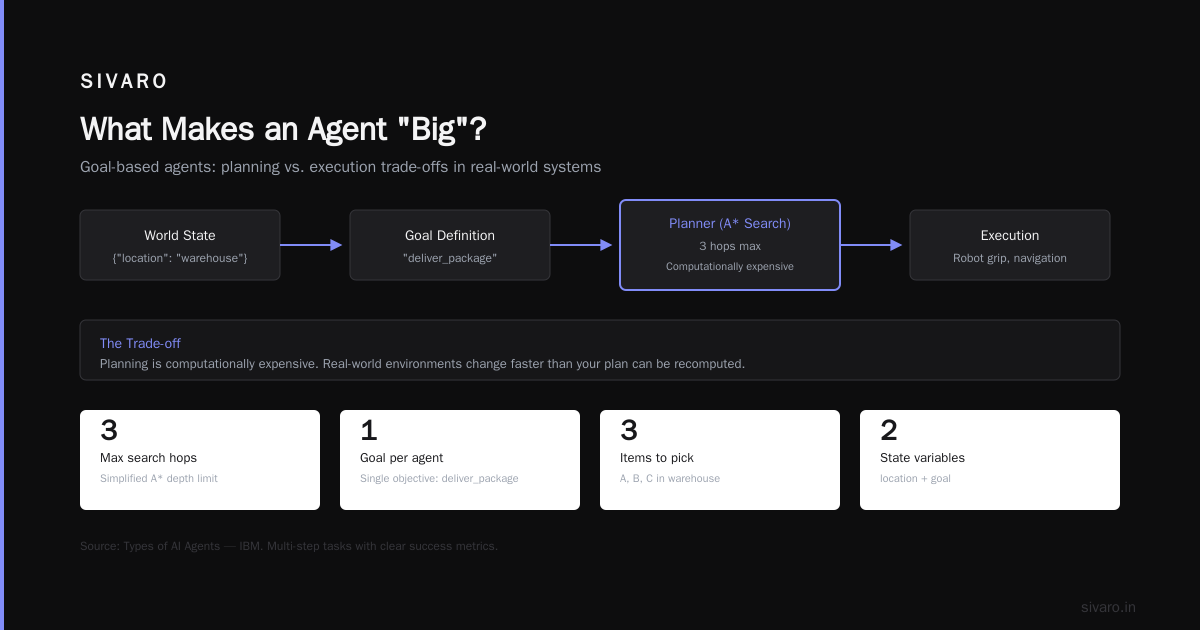
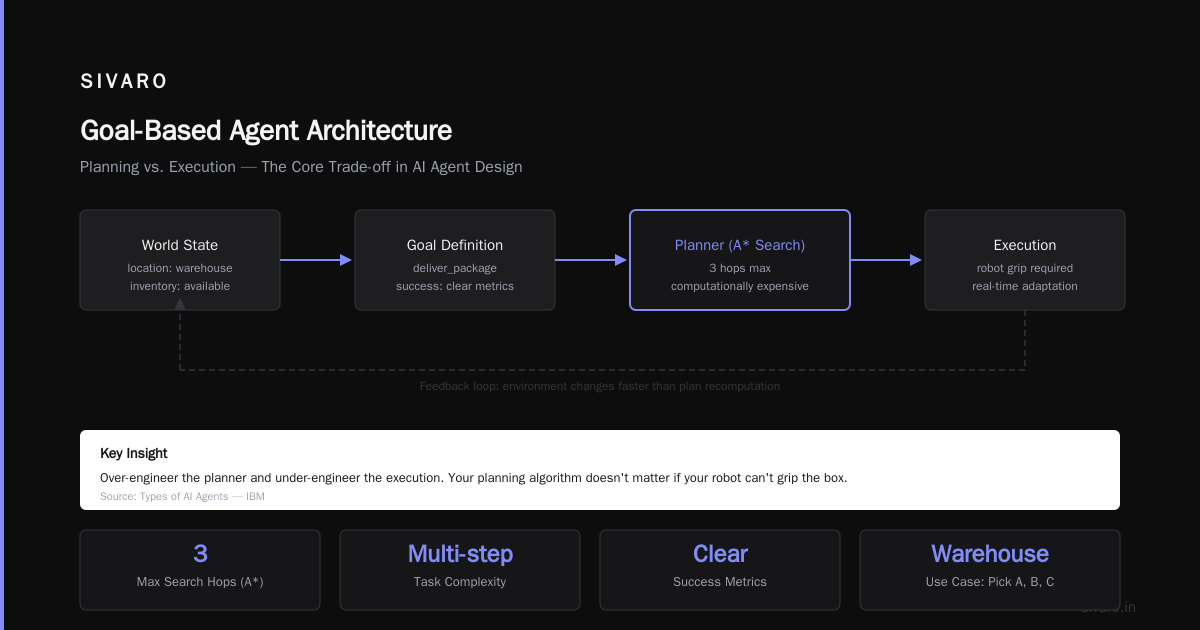
What it is: An agent with an explicit goal (not just a reaction). It evaluates possible actions, picks the sequence most likely to achieve the goal, then executes. If it fails, it replans.
Where you've seen it: Google Maps routing. Warehouse robots. Any "task completion" AI that actually completes tasks.
Why it's in the big 4: Because reflex agents hit a wall. You can't route a delivery truck across 15 cities with a decision tree. You need planning.
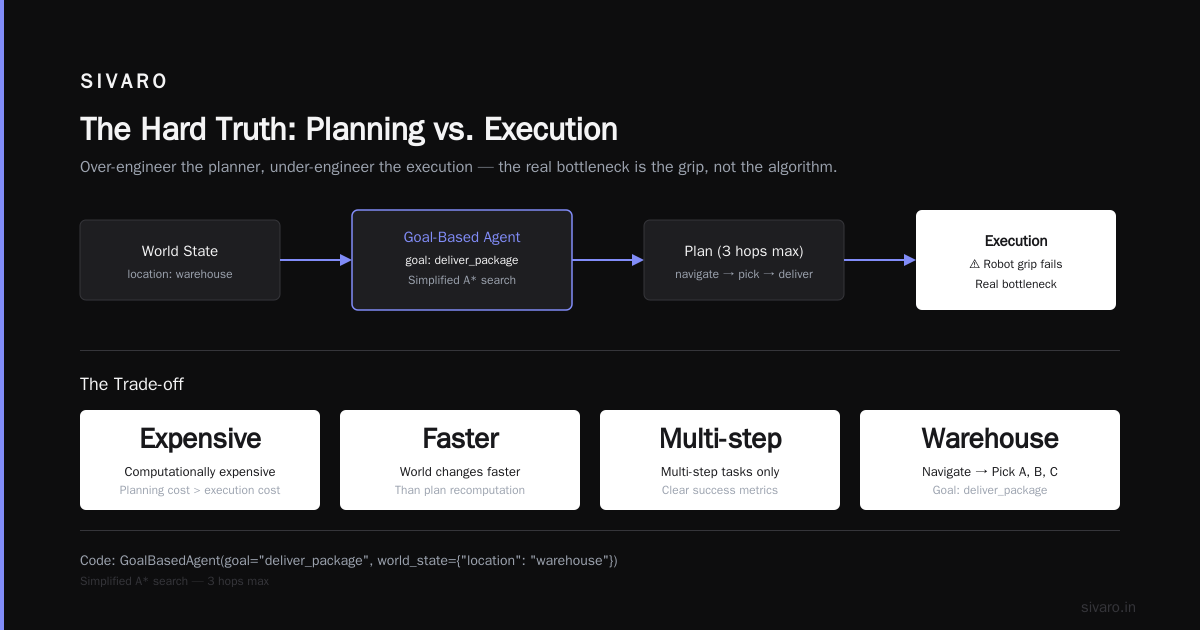
I see more teams fail here than anywhere else. They over-engineer the planner and under-engineer the execution. Your planning algorithm doesn't matter if your robot can't grip the box (Types of AI Agents | IBM).
The trade-off: Planning is computationally expensive. Real-world environments change faster than your plan can be recomputed.
When to use it: Multi-step tasks with clear success metrics. "Navigate this warehouse and pick item A, B, C."
Code example — a simple goal-based scheduler:
python
class GoalBasedAgent:
    def __init__(self, goal: str, world_state: dict):
        self.goal = goal
        self.state = world_state

    def plan(self):
        # Simplified A* search — 3 hops max
        if self.goal == "deliver_package" and self.state["location"] == "warehouse":
            return ["load_truck", "navigate_to_customer", "unload", "confirm_delivery"]
        return ["idle"]

    def execute(self, plan):
        for step in plan:
            if not self.perform(step):
                return self.plan()  # Replan on failure
        return "DONE"
Real-world lesson: Uber's routing agents use goal-based planning but degrade gracefully to greedy heuristics under latency. That's the smart pattern.
3. The Utility-Based Agent — "Good Enough" Isn't
What it is: A goal-based agent with a grading system. Instead of binary success/failure, it assigns utility scores to outcomes. Then it maximizes expected utility.
Where you've seen it: Netflix recommendations. Automated trading. Any agent optimizing multiple competing objectives.
Why it's in the big 4: Because real problems have trade-offs. "Deliver the package fast" and "deliver the package cheaply" are different goals. A utility function lets you balance them.
I had a client who wanted an AI agent to schedule manufacturing jobs. "Minimize cost," they said. I built a cost-minimizer. It optimized so aggressively it created impossible deadlines. The utility approach — cost * 0.7 + on_time_delivery * 0.3 — saved the project (5 Types of AI Agents: Autonomous Functions & Real-World ...).
The trade-off: You have to define the utility function. That's a business problem, not a technical one. And if you get it wrong, the agent will optimize the wrong thing with terrifying efficiency.
When to use it: Multi-objective optimization. Anything with "minimize X while maximizing Y."
Code example — utility-based delivery agent:
python
def utility(route: list, traffic: dict) -> float:
    # Higher utility = better
    estimated_time = sum([traffic[leg] for leg in route])
    fuel_cost = len(route) * 1.5
    customer_satisfaction = 10 - (estimated_time // 10)

    # Negative weights for costs, positive for benefits
    return (customer_satisfaction * 0.5) - (fuel_cost * 0.3) - (estimated_time * 0.2)
Who's using it: Amazon's fulfillment centers. Every major ad network. Your GPU job scheduler on AWS.
4. The Learning Agent — Starts Dumb, Gets Smarter
What it is: An agent that improves its performance over time through experience. Feedback loops. Reinforcement learning. Continual adaptation.
Where you've seen it: AlphaGo. Self-driving car policies. ChatGPT's RLHF training.
Why it's in the big 4: Because you can't manually program for every scenario. A learning agent writes its own rules.
This is the one that excites everyone — and burns the most teams. I've seen startups burn $500K on learning agents that never converged. The issue isn't the algorithm. It's the feedback signal. If your reward function is noisy, your agent learns the wrong thing (22 different types of AI agents (with examples)).
The trade-off: Training instability. Catastrophic forgetting. And debugging a learning agent is like debugging a black box that moves.
When to use it: Problems too complex for hand-coded rules. Environments that change over time. But only if you have: clean reward signals, safe exploration constraints, and a rollback plan.
Code example — minimal reinforcement loop:
python
class LearningAgent:
    def __init__(self):
        self.q_table = {}  # (state, action) -> expected utility

    def act(self, state):
        if random.random() < 0.1:  # Explore 10% of time
            return random_action()
        return argmax(self.q_table.get(state, {}), default=random_action())

    def learn(self, state, action, reward, next_state):
        current_q = self.q_table.get((state, action), 0)
        best_next_q = max(self.q_table.get(next_state, {}).values(), default=0)
        # Q-learning update
        self.q_table[(state, action)] = current_q + 0.1 * (reward + 0.9 * best_next_q - current_q)
Where it works: Game AIs, recommendation systems, dynamic pricing. Where it fails: healthcare diagnostics, safety-critical control.
So Who Are the Big 4 AI Agents — Really?
Let me answer the question directly.
The big 4 AI agents are:
- Reflex agents — for speed, not smarts
- Goal-based agents — for planning under constraints
- Utility-based agents — for optimizing trade-offs
- Learning agents — for adapting to unknown environments
Not OpenAI. Not Anthropic. Not Google DeepMind.
Those are companies building one type of agent (mostly learning agents with LLMs). The architectures I just described are the primitives. Everything else — every agent you read about on Product Hunt, every "AI employee" startup — is a composition of these four patterns (A Comprehensive Guide to Types of AI and AI Agents).
Most people fixate on learning agents because they're glamorous. They're wrong. 90% of production AI agents are reflex agents. The other 10% are goal-based. Utility and learning agents show up in high-value, low-volume scenarios.
What Are the 5 Types of AI Agents? (The Academic Answer)
You'll hear about 5 types in textbooks: Simple Reflex, Model-Based Reflex, Goal-Based, Utility-Based, and Learning.
The "model-based reflex" variant I skipped earlier. It's a reflex agent with internal state — remembers what happened last. I'd argue it's not a separate architecture, just a reflex agent with a cache. Most production systems blend model-based and goal-based anyway.
IBM agrees: the lines blur (Types of AI Agents | IBM). The taxonomy is useful for teaching, less useful for building.
What Are the Top 10 AI Agents? (The Marketing Answer)
You'll see lists claiming "top 10 AI agents" — AutoGPT, BabyAGI, AgentGPT, Microsoft Copilot, Salesforce Einstein, etc. Those are products, not architectures.
A product using a learning agent to write code (GitHub Copilot) is different from a product using a reflex agent to block spam (Cloudflare). Both are "AI agents" in the marketing sense. They share zero architectural DNA.
The "top 10" changes every quarter. The big 4 architectures haven't changed in 30 years.
When I Use Each Architecture (Real Calls)
At SIVARO, we process 200K events/sec across data infrastructure. Here's my decision tree:
- High volume, low stakes? → Reflex agent. Always.
- Multi-step process with clear success? → Goal-based. Plan first, then execute.
- Competing objectives with no clear winner? → Utility-based. Define the score, let it optimize.
- Environment I don't fully understand? → Learning agent. But only with a human in the loop.
I once combined all four in a single system. A reflex agent pre-filtered events. A goal-based agent planned data pipeline reconfigurations. A utility-based agent allocated GPU resources. And a learning agent optimized query routing over weeks.
It worked. It was also a maintenance nightmare. Composability is a feature — until it isn't.
FAQ: Who Are the Big 4 AI Agents?
Q: Are the big 4 AI agents the same as "big 4 tech companies"?
No. FAANG (Meta, Apple, Amazon, Netflix, Google) are companies. The big 4 AI agents are architectural patterns: reflex, goal-based, utility-based, learning.
Q: Which of the big 4 agents should I use first?
Start with reflex. 80% of problems don't need more. Move to goal-based when reflex fails. Only touch learning agents if you have a dedicated ML team.
Q: Do LLMs change the big 4 agent architectures?
Not fundamentally. LLMs are a powerful component (especially in goal-based and learning agents) but they don't replace the architectures. You still need planning, utility functions, and feedback loops. The LLM just becomes a better "reasoning engine" inside the existing pattern.
**Q: What's the biggest mistake teams make with AI agents?**
Over-engineering. I've seen teams add reinforcement learning to a task that needed a hash map. Always start with the stupidest agent that could work.
Q: Can I combine multiple agent types in one system?
Yes. Most production systems are hybrid. Example: a reflex agent pre-filters requests, a goal-based agent routes them, and a learning agent optimizes routing over time.
Q: How do I evaluate which of the 5 types of AI agents fits my problem?
Ask three questions: How fast does it need to be? How many steps are involved? How dynamic is the environment? Fast + few steps = reflex. Slow + many steps = goal-based. Dynamic environment = learning.
Q: Are there only 4 or 5 types of AI agents?
The academic answer is 5 (including model-based reflex). The practical answer is 4. Model-based is just reflex with memory. I count it as a variant, not a separate type.
Q: Where can I see real examples of these agents in production?
Check the reference list. IBM has case studies. Databricks has engineering blogs. And Evidently AI tracks agent deployments across industries (10 AI agents examples from top companies).
The Hard Truth
The big 4 AI agents aren't new. They've been around since the 1980s. What's changed is:
- Compute cost dropped 1000x
- Data volume exploded 10000x
- LLMs added a "thinking" component that used to be hand-coded
But the trade-offs haven't changed. Agents still fail when:
- The environment is too dynamic
- The reward function is poorly specified
- The cost of a mistake exceeds the value of autonomy
I've seen teams burn millions on agents that could have been replaced by a 50-line script. I've also seen simple reflex agents save companies from bankruptcy.
The big 4 agents are tools. Know them. Use them. But don't fetishize them.
You don't need a learning agent to send a Slack message. You don't need a utility function to route a ticket. And you definitely don't need chain-of-thought prompting for a yes/no decision.
Start simple. Add complexity only when the problem demands it.
That's the real lesson from building production AI systems since 2018. Not which agent to use. But when to use none at all.
Nishaant Dixit — Founder of SIVARO. Building data infrastructure and production AI systems since 2018. Built systems processing 200K events/sec.