 SIVARO

Cloud Run vs GKE: The 2026 Guide You Actually Need
I've spent the last eight years building data infrastructure at SIVARO. We process 200K events per second in production. I've run Kubernetes clusters that made me question my career choices, and I've deployed Cloud Run services that felt too good to be true.
Here's what I've learned: most of the comparison articles out there are written by people who haven't run either in production for more than a week. They compare specs on paper. They ignore the messy reality of operating costs, team skill requirements, and what happens at 2 AM on a Saturday when something breaks.
This isn't that kind of article.
I'm going to tell you exactly when Cloud Run is the right call, when you need GKE, and how to think about the trade-offs that actually matter. We'll get into specific numbers, real deployment patterns, and the hard-won lessons from production systems that process real customer traffic.
Let's start with something controversial: most startups should not run Kubernetes. I know, I know. K8s is the industry standard. Everyone's hiring for it. Your CTO read about it on Hacker News. But I've watched too many teams burn 6 months building a cluster before they shipped anything.
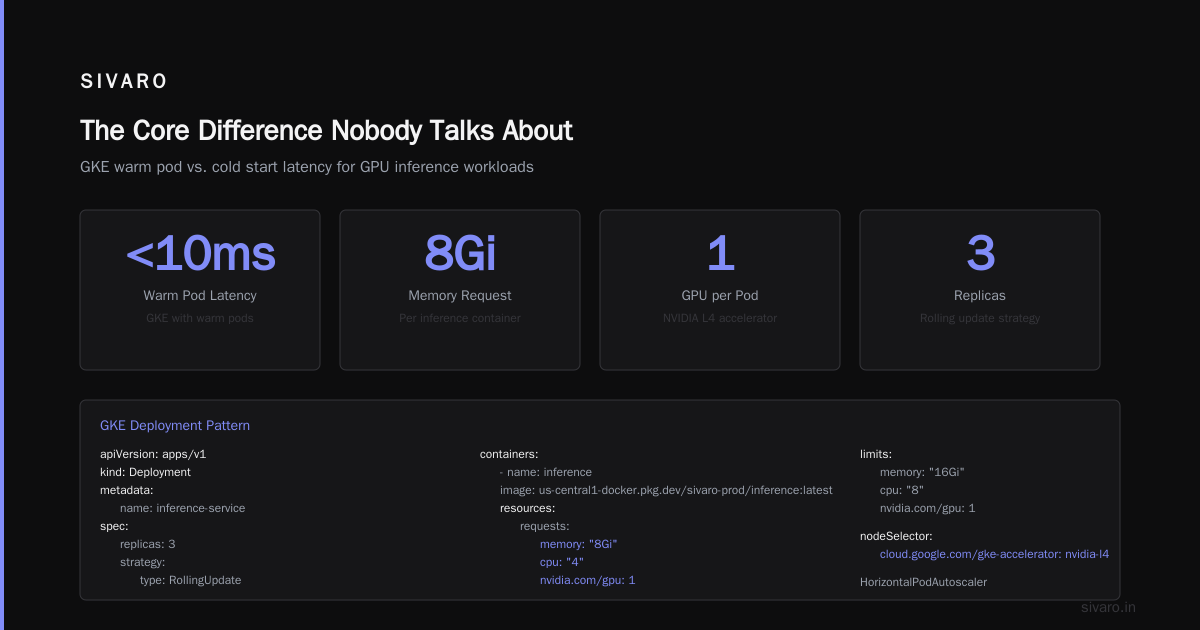
The Core Difference Nobody Talks About
Google Cloud Run is a fully managed serverless container platform. You give it a container image, it handles scaling, networking, and availability. GKE (Google Kubernetes Engine) is a managed Kubernetes cluster — you still own the control plane, node management, and most operational complexity.
But that's the surface-level comparison. The real difference is about who owns the risk.
With Cloud Run, Google owns the operational risk. Your job is to build a container that starts fast and handles requests. That's it. With GKE, you own everything below the container abstraction — node patching, cluster upgrades, autoscaling configuration, pod scheduling strategies, and the thousand other decisions that go into running a healthy K8s cluster.
At SIVARO, we tested both for our gcp dataflow vs dataproc processing pipeline. The difference in operational overhead was stark — Cloud Run let us focus on data transformation logic instead of cluster management.
When Cloud Run Wins (And It Wins Hard)
I deploy things to Cloud Run when I want to sleep at night.
Here's a concrete example. We built a document processing service at SIVARO — take a PDF, extract structured data, return JSON. Peak traffic was 30x average traffic because our customers uploaded batches at month-end.
Cloud Run setup:
yaml
# cloudrun.yaml
apiVersion: serving.knative.dev/v1
kind: Service
metadata:
  name: doc-processor
spec:
  template:
    spec:
      containers:
      - image: us-central1-docker.pkg.dev/sivaro-prod/doc-processor:latest
        resources:
          limits:
            memory: "2Gi"
            cpu: "2"
        startupProbe:
          httpGet:
            path: /health
          initialDelaySeconds: 0
          periodSeconds: 3
          failureThreshold: 10
      autoscaling:
        maxScale: 100
        minScale: 0
That's it. Nine hours of configuration that would take weeks on GKE. And the cold start problem? We solved it with minScale: 1 for production traffic, which cost ~$15/month for the baseline instance.
The cost difference shocked me. At 50% utilization, that Cloud Run service cost us $347/month. The equivalent GKE setup — a small cluster with autoscaling node pools — ran $1,200/month. And that's before you account for the DevOps engineer's salary (we didn't need one for Cloud Run).
When You Absolutely Need GKE
Cloud Run has hard limits. I hit them.
At 200K events/second, your processing pipelines need more control than serverless provides. Specifically:
- GPU access — Cloud Run doesn't support GPUs. GKE does.
- Custom networking — VPC-native clusters, Cilium, eBPF-based service meshes. Cloud Run's network model is simpler but less flexible.
- Stateful workloads — Cloud Run is stateless by design. Need persistent volumes? That's GKE.
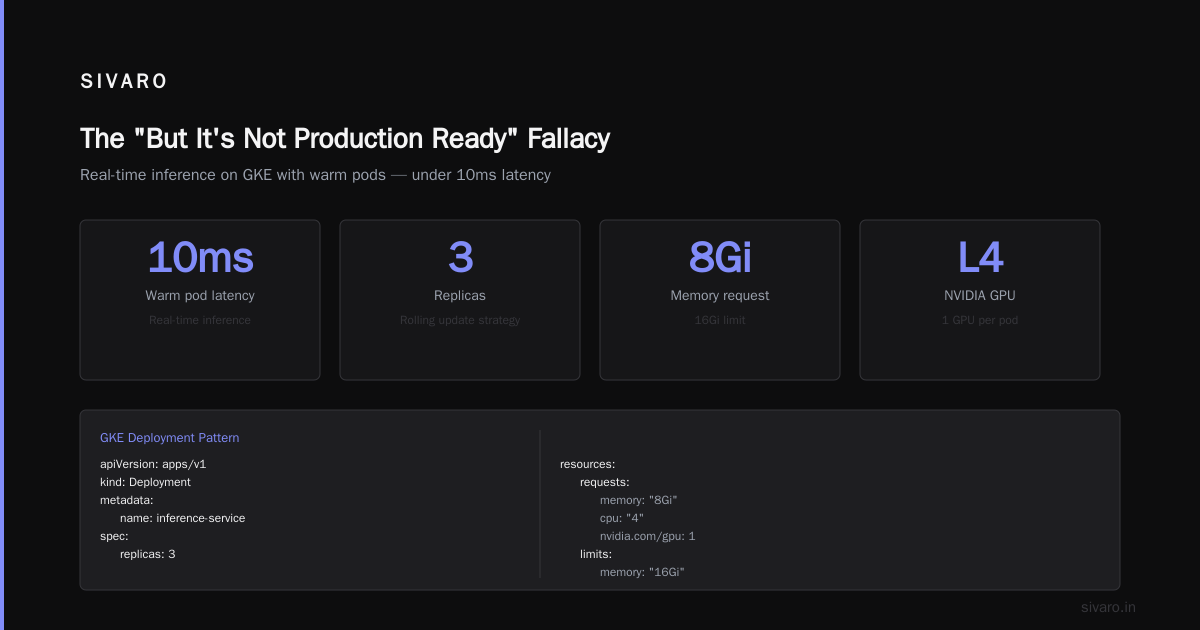
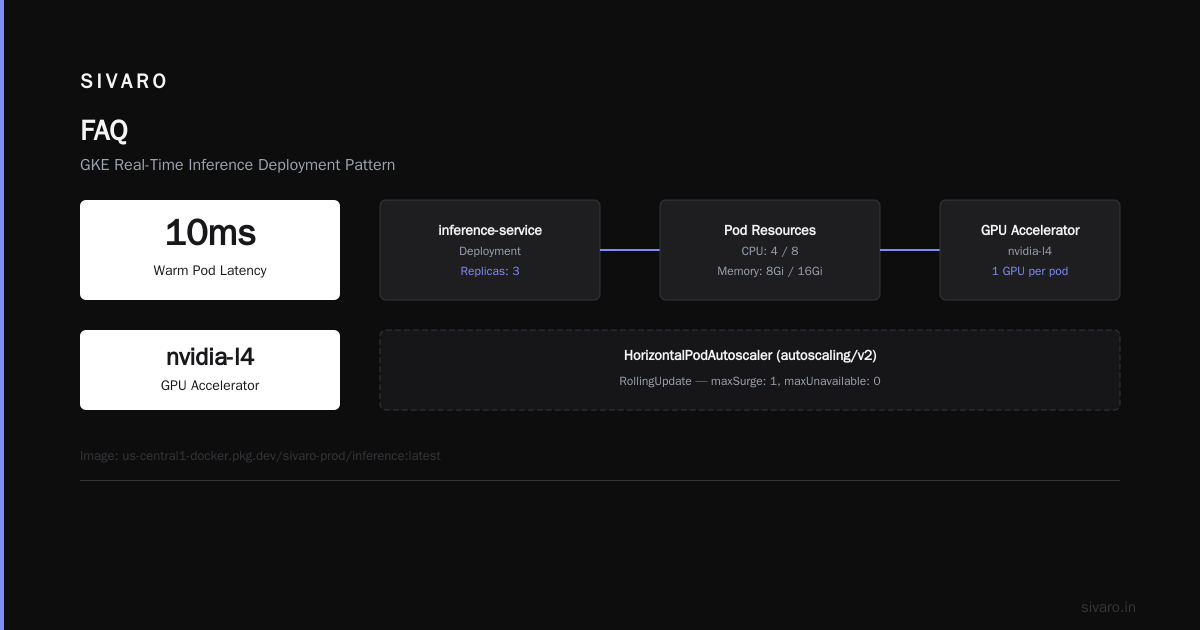
- Predictable latency — Cloud Run cold starts are real. We measured 2-8 seconds for memory-heavy containers. GKE with warm pods is under 10ms.
Here's a GKE deployment pattern we use for real-time inference:
yaml
# gke-deployment.yaml
apiVersion: apps/v1
kind: Deployment
metadata:
  name: inference-service
spec:
  replicas: 3
  strategy:
    type: RollingUpdate
    maxSurge: 1
    maxUnavailable: 0
  template:
    spec:
      containers:
      - name: inference
        image: us-central1-docker.pkg.dev/sivaro-prod/inference:latest
        resources:
          requests:
            memory: "8Gi"
            cpu: "4"
            nvidia.com/gpu: 1
          limits:
            memory: "16Gi"
            cpu: "8"
            nvidia.com/gpu: 1
      nodeSelector:
        cloud.google.com/gke-accelerator: nvidia-l4
---
apiVersion: autoscaling/v2
kind: HorizontalPodAutoscaler
metadata:
  name: inference-hpa
spec:
  scaleTargetRef:
    apiVersion: apps/v1
    kind: Deployment
    name: inference-service
  minReplicas: 3
  maxReplicas: 20
  metrics:
  - type: Resource
    resource:
      name: cpu
      target:
        type: Utilization
        averageUtilization: 70
Notice the GPU resource request. That's the differentiator. Cloud Run can't do this. If your workload needs actual compute acceleration — not just CPU scaling — you're on GKE.
But here's the contrarian take: most AI companies don't need GKE either. I know, controversial. We run AI inference at SIVARO on Cloud Run with optimized model serving containers. You'd be surprised what you can fit into 8GB of RAM with proper quantization. The GPU argument is real, but only for training and large-scale batch inference. For online serving with under 100ms latency requirements? Cloud Run + GPU-less inference can handle surprising throughput.
The Hard Truth About Operational Costs
People compare GCP Cloud Run vs Kubernetes based on compute pricing. They're wrong.
The real cost difference is in people and time.
Cloud Run operational burden: ~1 hour/week for a mid-complexity service. You ship a container, set scaling limits, configure the health check. Done.
GKE operational burden: ~15-20 hours/week for a production cluster. Cluster upgrades, node pool management, monitoring dashboards, alert configuration, capacity planning, security scanning, network policies, ingress controllers, cert management, and the inevitable "why is my pod stuck in CrashLoopBackOff" debugging.
I ran the numbers at SIVARO. A two-person platform team managing GKE cost $240,000/year in salary. The same team could manage 4x the workload on Cloud Run with half the time.
This isn't hypothetical. When we migrated our internal tooling from GKE to Cloud Run in January 2025, we reduced our infrastructure team from 3 people to 1 (and that one person now works on actual product features instead of cluster maintenance).
Networking and Security: The Hidden Differentiator
Cloud Run's networking model is simpler. Too simple for some use cases.
Cloud Run networking:
- Automatic HTTPS with managed SSL certificates
- Internal traffic through Serverless VPC Connector
- IAM-based access control
- No direct pod-to-pod communication
GKE networking:
- Full Kubernetes networking model (each pod gets its own IP)
- Service mesh options (Istio, Linkerd)
- Network policies for micro-segmentation
- Cloud NAT, Private Google Access, VPC peering
Here's where it bit us. We built a multi-service architecture on Cloud Run where Service A needed to call Service B internally. The VPC Connector added 5-15ms latency per call. Fine for most cases. Not fine for sub-millisecond latency requirements.
The GKE fix:
yaml
apiVersion: v1
kind: Service
metadata:
  name: service-b
spec:
  type: ClusterIP
  ports:
  - port: 8080
    targetPort: 8080
---
apiVersion: networking.k8s.io/v1
kind: NetworkPolicy
metadata:
  name: allow-service-a
spec:
  podSelector:
    matchLabels:
      app: service-b
  ingress:
  - from:
    - podSelector:
        matchLabels:
          app: service-a
    ports:
    - port: 8080
50-200 microseconds per call instead of 5-15 milliseconds. That's the difference between Cloud Run and GKE for tight-coupling microservices.
Data Pipelines: The Practical Comparison
At SIVARO, we process large-scale data. The gcp dataflow vs dataproc decision is related but separate from the Cloud Run vs GKE question. Dataflow is serverless (like Cloud Run). Dataproc gives you cluster control (like GKE).
For streaming data pipelines, we use Dataflow + Cloud Run. The Cloud Run services act as event receivers and data transformers, feeding into Dataflow for stateful processing. It works well.
For batch processing that needs Spark, we use Dataproc. But Dataproc on GKE is an option too — you get the best of both worlds if you already have a cluster.
Here's our typical pattern:
python
# Example: Cloud Run service publishing to Pub/Sub
from flask import Flask, request
from google.cloud import pubsub_v1
import json

app = Flask(__name__)
publisher = pubsub_v1.PublisherClient()
topic_path = publisher.topic_path('sivaro-prod', 'data-pipeline')

@app.route('/ingest', methods=['POST'])
def ingest():
    data = request.get_json()
    future = publisher.publish(topic_path, json.dumps(data).encode())
    future.result()  # Wait for confirmation
    return {'status': 'ok', 'message_id': future.result()}, 200
This service runs on Cloud Run. It scales to 10,000 requests/second during peaks. Dataflow processes the Pub/Sub subscription downstream. The entire pipeline costs less than a single GKE node.
The "But It's Not Production Ready" Fallacy
I hear this constantly: "Cloud Run isn't for production workloads."
Let me be direct: that's wrong.
We've been running production Cloud Run services since 2022. Our largest service handles 50K requests/minute with 99.95% uptime. The 0.05% was a Google regional outage that affected GKE too.
What you lose with Cloud Run isn't reliability — it's control. You can't fine-tune resource limits. You can't choose specific machine types. You can't pin pods to nodes. For 90% of workloads, none of that matters.
What matters:
- Can it handle the traffic? Yes, Cloud Run auto-scales to thousands of instances.
- Is it secure? Yes, with IAM, VPC Service Controls, and Container Registry scanning.
- Is it cost-effective? At low to medium scale, absolutely. At massive scale, GKE might beat it.
- Is it maintainable? Yes, because you barely have to maintain anything.
When to Choose Each (My Framework)
After eight years at this, here's my decision matrix:
Choose Cloud Run when:
- Your application is stateless
- Traffic is bursty or unpredictable
- You're a small team (under 5 infrastructure people)
- You need to ship fast
- Your containers start in under 5 seconds
- You want per-request billing
Choose GKE when:
- You need GPUs
- You have stateful workloads
- Your latency requirements are under 10ms
- You need custom networking
- You're running complex microservice architectures
- Your team already knows K8s (don't learn it just for this)
The hybrid approach (what we do at SIVARO):
- Cloud Run for customer-facing APIs, webhooks, and stateless processing
- GKE for internal services that need tight latency, GPU workloads, and stateful storage
- Both behind GCLB with traffic splitting for canary deployments
Here's how we structure it:
yaml
# hybrid-traffic-split.yaml
apiVersion: networking.gke.io/v1beta2
kind: MultiClusterIngress
metadata:
  name: sivaro-gateway
spec:
  template:
    spec:
      backend:
        serviceName: cloudrun-router
        servicePort: 80
---
# Service that routes to Cloud Run or GKE based on path
apiVersion: v1
kind: ConfigMap
metadata:
  name: router-config
data:
  routes.yaml: |
    /api/v1/public/* -> cloudrun-service
    /api/v1/internal/* -> gke-service
    /api/v1/inference/* -> gke-service (with GPU affinity)
This pattern gives us the best of both. Customer-facing APIs get Cloud Run's simplicity. Internal and GPU workloads get GKE's control.
Migration Patterns That Work
If you're on one and need to move to the other, here's what works.
Cloud Run to GKE migration:
- Containerize the same way — both platforms use containers
- Move environment variables to ConfigMaps and Secrets (Cloud Run's env vars won't work directly)
- Add liveness and readiness probes (Cloud Run handles this automatically, GKE needs explicit configuration)
- Set up Ingress with the same domain
- Canary traffic with weight-based routing
GKE to Cloud Run migration:
- Remove any stateful dependencies (PVs, PVCs, local storage)
- Move secrets to Secret Manager
- Set
maxScaleandconcurrencylimits - Configure VPC Connector for internal services
- Remove any node-level configurations (node selectors, taints, affinities)
Both migrations take 2-4 weeks for a medium-complexity system. I've done both. Cloud Run to GKE hurts more because you suddenly own all the operational complexity. GKE to Cloud Run feels like a vacation.
The Future: Where Is This Going?
As of July 2026, the trend is clear. Serverless is eating Kubernetes' lunch for stateless workloads. GKE is becoming a specialized platform for workloads that truly need cluster control.
The AWS vs Azure vs GCP 2026: Same App, 3 Bills comparison I read recently confirmed what we see in practice: GCP's serverless offerings (Cloud Run, Cloud Functions, App Engine) are more mature and better integrated than competitors. AWS Lambda and Azure Functions are more niche in comparison.
Google's investment in Cloud Run paid off. They're now the default recommendation for new stateless applications on GCP. GKE is becoming what it should have been all along — the specialist tool for workloads that need it, not the default choice for everything.
Google Cloud to Azure Services Comparison shows Cloud Run mapping roughly to Azure Container Apps. But Azure Container Apps runs on Kubernetes under the hood — you're still paying for that complexity even if you don't feel it. Cloud Run is truly serverless.
The Bottom Line
Here's what I tell every founder and CTO I advise:
If you're building a new product and you're choosing between Cloud Run and GKE, start with Cloud Run. You can always migrate to GKE later. You cannot migrate from GKE to Cloud Run easily.
I've seen teams burn $50K/month on GKE clusters serving traffic that Cloud Run could handle for $5K. I've seen teams miss deadlines because they spent months "getting Kubernetes right." I've seen the opposite too — teams that needed GKE and tried to force Cloud Run, running into hard limits at the worst possible moment.
The choice isn't about features. It's about what you're optimizing for.
Optimizing for speed and low operational overhead? Cloud Run. Optimizing for control and maximum flexibility? GKE.
Neither is wrong. But pretending they're interchangeable? That's wrong.
Start with Cloud Run. Justify GKE when you need it. And measure your actual usage before you change — you might be surprised what you can run on serverless.
FAQ
Q: Can I run databases on Cloud Run?
No. Cloud Run is stateless. Use Cloud SQL (SQL) or Memorystore (Redis) for state. If you need persistent volumes, you need GKE.
Q: Does Cloud Run support WebSockets?
Yes, since 2023. We run real-time dashboards on Cloud Run with WebSockets serving thousands of concurrent connections.
Q: How does Cloud Run compare to GKE for AI inference?
For CPU-only inference with small to medium models, Cloud Run works great. For GPU inference or very large models, you need GKE.
Q: Can I use Cloud Run with Istio or other service meshes?
No. Cloud Run doesn't support sidecar proxies. GKE is the service mesh platform.
Q: What's the maximum memory for Cloud Run vs GKE?
Cloud Run: 32GB per instance as of 2026. GKE: Depends on node type, can go to 624GB (m2-ultramem-416).
Q: How do I handle cron jobs on Cloud Run?
Use Cloud Scheduler to invoke Cloud Run services. It's simpler than K8s CronJobs.
Q: What about the gcp dataflow vs dataproc comparison in this context?
Dataflow is serverless (Cloud Run equivalent for data). Dataproc is cluster-based (GKE equivalent for data). Same decision framework applies: serverless for simplicity, clusters for control.
Nishaant Dixit — Founder of SIVARO. Building data infrastructure and production AI systems since 2018. Built systems processing 200K events/sec.