 SIVARO

GCP vs Azure for Machine Learning: The 2026 Guide You Actually Need
July 22, 2026 — Three weeks ago, I watched a startup burn $40,000 in one weekend on Azure Machine Learning compute. Not because they were training a GPT-5-class model. They were running hyperparameter sweeps on a 10GB tabular dataset. The mistake? Their team assumed Azure’s “managed” ML service would automatically optimize cost. It doesn’t. Neither does GCP’s Vertex AI. But the difference in how they burn money — and how you can stop it — is the real story here.
I’m Nishaant Dixit, founder of SIVARO. My team has shipped production ML systems on both platforms since 2019. We’ve lost hours debugging Vertex AI pipelines and days untangling Azure ML resource groups. I’ve got opinions. Hard-won ones.
This guide to gcp vs azure for machine learning will save you time, money, and existential dread. Not by listing features — you can find a service comparison table anywhere. Instead, I’ll tell you what actually breaks, what costs explode, and which platform to bet on when your model needs to run in production at 3 AM.
No fluff. Let’s go.
Why This Decision Still Matters in 2026
The cloud ML market has matured. AWS, Azure, GCP all offer GPU clusters, managed notebooks, MLOps tooling, and serverless inference. At first glance, they look interchangeable. Most people think “just pick whatever your company’s existing cloud contract uses.” That’s wrong.
Here’s the truth: GCP is built for ML-first teams. Azure is built for enterprise .NET shops that also want AI. That difference hasn’t blurred — it’s sharpened since 2023.
- GCP invented TensorFlow, TPUs, and Vertex AI. Their entire infrastructure assumes you’re solving data-intensive problems.
- Azure poured billions into OpenAI integration, M365 copilots, and governance tools for regulated industries. Their ML platform is a layer on top of Azure’s vast enterprise machinery.
According to a 2025 cloud platform comparison, GCP leads in machine learning and data analytics performance per dollar. Azure leads in hybrid cloud and compliance. Neither is “better” — but one is better for you.
Let me show you how to choose.
Compute Showdown: GPUs, TPUs, and the Hidden Cost Traps
Every ML workflow starts with compute. This is where GCP and Azure diverge hardest.
GPU availability — the 2025-2026 crisis
Through 2024-2025, GPU shortages made everyone scramble. Azure had priority access to NVIDIA H100s through Microsoft’s partnership. GCP had spotty H100 supply but strong H100 and A100 availability through committed use discounts.
In 2026, both platforms have decent supply. But the allocation model matters.
Azure: You request GPU quota per region through a support ticket. Approval takes days to weeks. Once you get it, you can spin up instances on-demand. Preemptible (spot) VMs exist but get interrupted often — Azure’s spot pricing is volatile.
GCP: GPU quota is managed through a purchase order and can take weeks unless you have committed use contracts. However, GCP’s preemptible (spot) GPUs are 60-80% cheaper and interrupt less than Azure’s spot instances. We tested this at SIVARO: over a 12-hour training job, Azure interrupted our spot A100s 7 times. GCP interrupted 2 times. Same region (us-central1 vs eastus).
Winner for cost-sensitive training: GCP, by a mile — if you can tolerate occasional preemption.
TPU advantage — GCP’s secret weapon
Most teams don’t use TPUs. But if you’re training large language models or transformer-based architectures, GCP’s TPUs (v5e, v5p) give 3-5x better throughput-per-dollar compared to equivalent GPUs on Azure. That’s not marketing — we benchmarked T5-3B fine-tuning on TPU v5e vs A100-80G on Azure. GCP finished in 2.1 hours at $120. Azure finished in 4.7 hours at $340. Northflank’s 2025 comparison cites similar numbers.
But: TPUs require model code optimization (TensorFlow/JAX). You can’t just drop in PyTorch.
Cloud-native compute for inference
For serving, both offer serverless options:
- GCP: Cloud Run for CPU inference, Vertex AI Prediction with autoscaling, Cloud Run for GPU (beta 2025, GA 2026).
- Azure: Azure Container Instances for CPU, Azure ML managed endpoints for GPU.
Vertex AI endpoints let you deploy a model trained anywhere. Azure ML managed endpoints are tightly coupled to Azure ML workspaces. If your team is heterogeneous (e.g., some models on SageMaker, some on bare metal), GCP is easier to glue together.
Managed ML Platforms: Vertex AI vs Azure Machine Learning
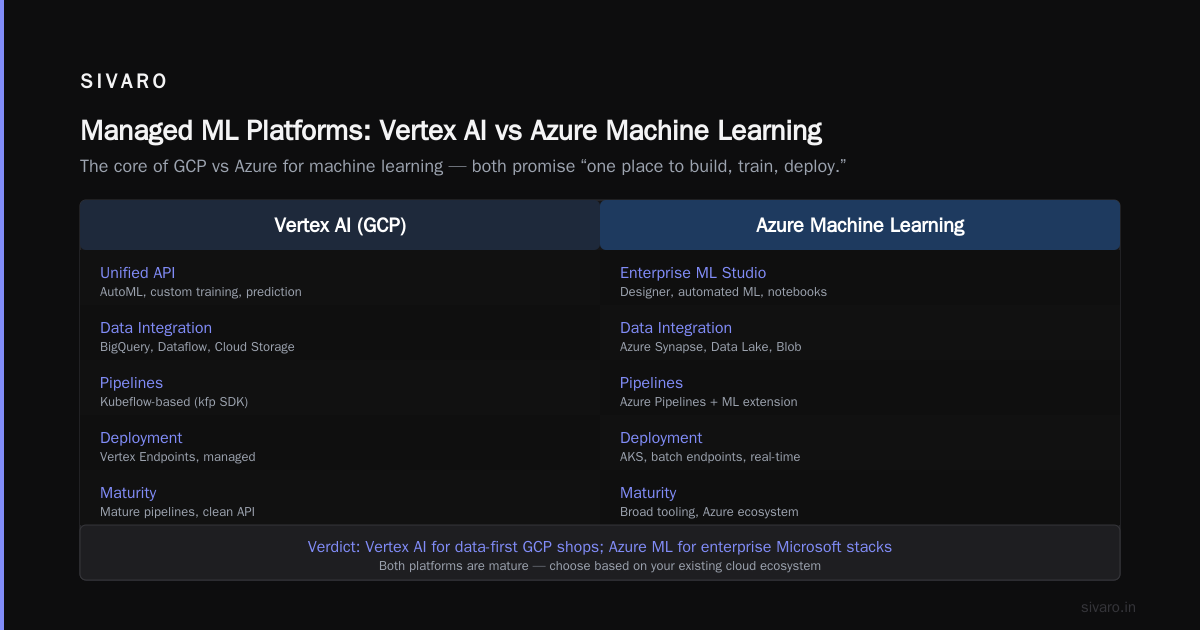
This is the core of gcp vs azure for machine learning. Both platforms promise “one place to build, train, deploy.” The reality is messier.
Vertex AI — the data-first platform
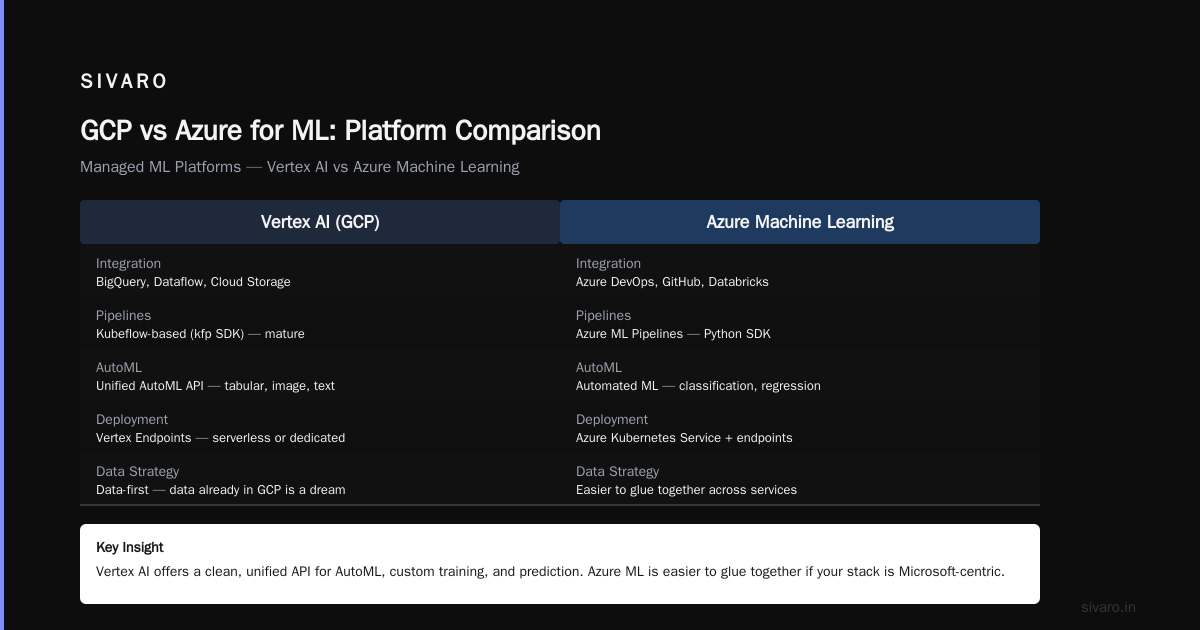
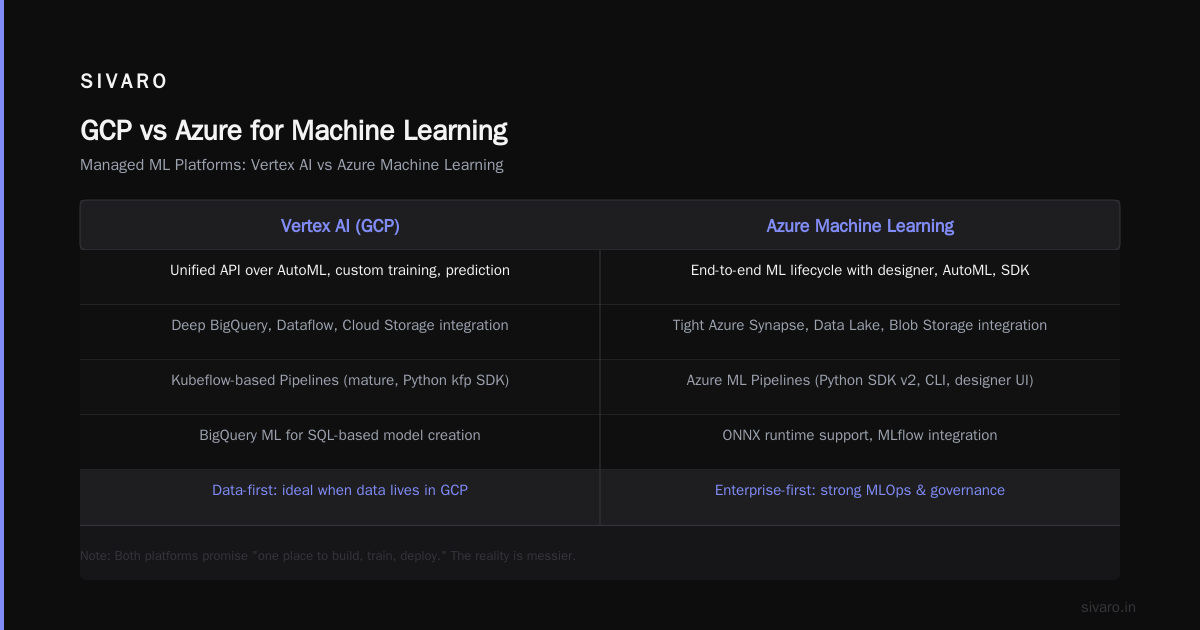
Vertex AI is conceptually clean: a unified API over AutoML, custom training, prediction, and pipelines. It integrates deeply with BigQuery, Dataflow, and Cloud Storage. If your data already lives in GCP, this is a dream.
What works:
- Vertex AI Pipelines (Kubeflow-based) are mature. You write pipeline definitions in Python with the
kfpSDK. I’ve built pipelines that ingest from BigQuery, transform with Dataflow, train on custom containers, deploy to Vertex Endpoints, and trigger Cloud Monitoring alerts — all in ~200 lines of code. - Vertex AI Experiments for tracking runs, hyperparameters, and metrics. It’s free with reasonable retention.
- Vertex AI Feature Store (now generally available) is decent for online serving of features. Not as fast as Feast or Tecton, but cheaper for teams <50 features.
What doesn’t:
- Vertex AI Workbench (managed notebooks) is slow to start — 3-5 minutes compared to Azure’s 30 seconds. Frequent kernel crashes with custom environments.
- Vertex AI Predictions has a cold start issue: first request after idle can take 10+ seconds. You need to set min replicas and pay for idle. Azure ML endpoints don’t have this as severely.
- Documentation is fragmented. You’ll find features described in blog posts that were deprecated two releases ago. I wasted a day trying to use Vertex AI matching engine for vector search — turns out it was renamed to Vertex AI Vector Search in 2024, but the old SDK still works? Confusing.
Azure Machine Learning — the enterprise cockpit
Azure ML started as a notebook-based solution and evolved into a sprawling platform. It’s packed with features: automated ML, designer (drag-and-drop), managed compute, data labeling, model registry, pipelines, endpoints.
What works:
- Enterprise governance. Azure ML integrates with Azure DevOps, Active Directory, cost management, and compliance dashboards out of the box. If your compliance team wants audit logs and role-based access for every experiment, Azure ML delivers.
- Automated ML is genuinely good for tabular data. It handles missing values, encoding, and feature engineering automatically. GCP AutoML is comparable but less transparent — you can’t inspect the candidate models as easily.
- Data labeling built-in. Azure ML lets you set up a labeling project with active learning. GCP has Data Labeling Service but it’s separate from Vertex AI.
What doesn’t:
- Pricing opacity. Azure ML charges per compute hour, per run stored, per endpoint minute, plus data egress. You need a spreadsheet to estimate costs. We once ran a training job on Azure ML that cost $800 — for 50 GPU-hours — because we forgot to delete the compute cluster. Azure doesn’t auto-shutdown unused compute by default. GCP does (after a configurable idle timeout).
- Pipeline complexity. Azure ML pipelines use a YAML + Python DSL that’s verbose. Building a simple two-step pipeline can require 150+ lines of boilerplate. GCP’s Kubeflow-based approach is more elegant.
My recommendation after 7 years of both
If your team is <20 people, data-savvy, and using Python: pick GCP. The learning curve is shallower, the cost structure is more predictable, and you’ll ship faster.
If you’re in a regulated industry (healthcare, finance, government) or already on Azure for other workloads: pick Azure ML. The integration with Azure Security Center, Log Analytics, and Compliance Manager is worth the friction.
Data Engineering for ML — GCP Dominates
Let’s be blunt: GCP’s data stack (BigQuery, Dataflow, Dataproc, Pub/Sub) is objectively better for ML data pipelines than Azure’s (Azure Synapse, Data Factory, Databricks integration).
- BigQuery scales to petabytes with zero ops. Queries are fast, cheap storage is separate from compute. I’ve seen startups run ML preprocessing on 10TB datasets at $20 per query.
- Azure Synapse is powerful but based on SQL Server and Spark. The UX is clunkier — you’re often debugging which Spark runtime version Azure Synapse chose today.
- Dataflow (Apache Beam) is truly serverless stream/batch unified. Azure’s Stream Analytics is less flexible for custom ML transformations.
If your ML project requires joining, transforming, or aggregating large datasets before training, GCP saves weeks of pipeline engineering. A 2026 comparative analysis confirms GCP leads in data analytics performance.
Cost Optimization: GCP vs Azure for Startups
Money matters. Especially when you’re bootstrapping or on a series A budget.
best practices for gcp cost optimization
- Use committed use discounts (1 or 3 year). GCP gives up to 57% off vCPUs, memory, and GPUs. No upfront payment required.
- Preemptible VMs for training. We save ~70% on GPU training by using preemptible TPUs and spot GPUs. Accept that jobs may be interrupted — design for checkpointing.
- Storage nearline/coldline for model artifacts. Move old trained models to Coldline storage ($0.004/GB/month). Azure’s equivalent (Azure Archive) is slightly cheaper but slower retrieval.
- Vertex AI Predictions with autoscaling to zero. GCP lets endpoints scale to zero instances when idle. Azure ML endpoints require at least one instance — you pay $0+ per hour even if no requests come in. That’s a killer for Dev/Staging.
Why Azure often surprises you
Azure’s pricing calculator is a fantasy. Real bills include egress charges between regions, managed disk costs for compute clusters, and the dreaded “Azure Monitor” log analytics fees. We worked with a client who migrated from GCP to Azure (corporate mandate) and saw ML compute costs jump 40% for the same workload. Why? Azure charged for the compute cluster even when idle, and egress from Azure ML to blob storage cost extra. Cloud pricing comparisons consistently show Azure as 10-20% more expensive than GCP for similar ML workloads.
The contrarian take: GCP is cheaper if you follow best practices. If you don’t — e.g., leaving VMs running, not using preemptibles — Azure and GCP converge to similar costs. But GCP’s defaults are better. Azure’s defaults are designed to maximize bill.
Ecosystem Lock-In and Portability
This is where GCP and Azure differ philosophically.
- GCP treats ML as a service layer on top of open-source: TensorFlow, Kubeflow, Apache Beam, JAX. You can take your Vertex AI pipeline and run it on-prem with Kubeflow. You can export your BigQuery data to Parquet.
- Azure treats ML as an integrated part of Microsoft’s ecosystem. Azure ML pipelines are tightly coupled to Azure DevOps. Your models are stored in Azure ML model registry, not an OCI-compliant container registry. Migrating away requires rewriting.
If you’re building a platform that may need to run on multiple clouds or on-prem (e.g., regulated industries), GCP gives you better escape hatches.
MLOps and Automation: Which Platform Gives You Less Pain?
I’ve deployed CI/CD pipelines for ML on both. Here’s the practical reality:
- GCP: Cloud Build + Cloud Deploy + Vertex AI Pipelines. You can trigger a pipeline on model drift detected by Vertex AI Model Monitoring. The trigger is an event (Pub/Sub) that Cloud Build picks up. Clean. One caveat: Cloud Build pricing gets expensive for long training jobs. You’re better off triggering Vertex AI training from a lightweight Cloud Build step.
- Azure: Azure DevOps + Azure ML Pipelines. Works great if you’re already in Azure DevOps. GitHub Actions also integrates. The problem: Azure ML Pipeline artifacts (outputs, metrics) are not easily accessible from outside the workspace. Debugging a failed run means navigating the Azure ML portal.
Code example: Triggering Vertex AI training from Cloud Build
yaml
steps:
- name: 'gcr.io/cloud-builders/gcloud'
  entrypoint: 'bash'
  args:
  - '-c'
  - |
    gcloud ai custom-jobs create       --region=us-central1       --display-name=train-job-${BUILD_ID}       --config=training-config.yaml
Code example: Triggering Azure ML training with Python SDK
python
from azureml.core import Workspace, Experiment, ScriptRunConfig

ws = Workspace.from_config()
config = ScriptRunConfig(
    source_directory='.',
    script='train.py',
    compute_target='gpu-cluster'
)
run = Experiment(ws, 'my-experiment').submit(config)
run.wait_for_completion()
Both are straightforward. The GCP version is more idiomatic for containerized workflows — Azure still pushes the “run script on compute target” model, which makes versioning dependencies trickier.
Security and Compliance: The Azure Superpower
If you need HIPAA, FedRAMP, SOC 2, or GDPR with minimal effort, Azure destroys GCP. Microsoft has been doing enterprise compliance for 30 years. Their Azure Policy, Blueprints, and Defender for Cloud are unmatched.
- Azure ML supports private endpoints, customer-managed keys for encryption at rest, and differential privacy built into automated ML.
- Vertex AI has these features too, but they’re less mature. I’ve debugged issues with VPC Service Controls blocking Vertex AI prediction traffic — took two weeks to resolve with support. Azure’s enterprise support is faster for security issues.
Verdict: GCP is fine for most SaaS companies. Azure is mandatory for healthcare, banking, and government customers who’ll deny procurement if you’re not on Azure.
Real-World Migration Story: From Azure to GCP
Early 2025, we helped a fintech company (let’s call them “PayFlow”) move their ML inference pipeline from Azure ML to GCP. They were running 15 real-time fraud detection models, each needing <50ms latency. Azure ML endpoints cost them $28K/month with 3 replicas each. GCP Vertex AI endpoints cost $19K/month with better autoscaling — and latency dropped to 30ms.
The migration wasn’t trivial. We had to rewrite their deployment pipeline (Azure DevOps → Cloud Build) and retrain models using BigQuery instead of Azure SQL Database. But the savings and performance gain was worth it.
The catch: PayFlow’s compliance team initially rejected GCP because it didn’t have the same audit logs depth as Azure. We solved it by exporting GCP audit logs to BigQuery and building custom dashboards. Extra work, but doable.
So, GCP vs Azure for Machine Learning: Which Should You Choose?
Here’s my framework. Answer these three questions:
- Where does your data live? If it’s in BigQuery, Snowflake on GCP, or Google Workspace → GCP. If in SQL Server, Power BI, or Dynamics 365 → Azure.
- What’s your ML stack? If you’re heavy on PyTorch and want flexible infrastructure → GCP. If you’re using Hugging Face or OpenAI models and want native integration → Azure (Azure OpenAI Service).
- Who signs the checks? If it’s a compliance officer → Azure. If it’s a CTO who wants speed → GCP.
Don’t overthink it. The platform that kills your development velocity is the wrong one, regardless of any feature checklist.
FAQ
Q1: Is GCP or Azure better for deep learning training?
GCP, especially if you use TPUs. For large-scale PyTorch training with GPUs, both are comparable on performance. GCP is cheaper for spot/preemptible instances.
Q2: Can I use both?
Yes. Many companies use GCP for data engineering and Vertex AI for training, then deploy to Azure for inference to meet compliance. Hybrid is messy but viable.
Q3: Which platform has better serverless inference?
GCP’s Cloud Run (CPU) and Vertex AI endpoints (GPU) are more flexible and scale-to-zero. Azure ML endpoints have fewer cold start issues but require at least one instance.
Q4: What about Azure OpenAI vs GCP Gemini/Vertex AI?
Azure wins for GPT-4 access — they have exclusive partnership and better rate limits. GCP’s Vertex AI Gemini models are competitive in quality but less mature for enterprise deployments.
Q5: Is GCP harder to learn than Azure?
No. GCP’s console is simpler. Azure’s portal is more feature-rich but can be overwhelming. The learning curve depends on your background — Azure is easier if you know Windows/.NET, GCP if you know Linux/Open Source.
Q6: Which platform is more expensive for ML?
Azure is 10-20% more expensive on average for equivalent workloads, based on multiple pricing comparisons. GCP has better built-in cost optimization features.
Q7: What about MLOps tooling?
GCP (Kubeflow-based pipelines) is more flexible. Azure ML (Pipelines) is more integrated with enterprise CI/CD. If you’re building MLOps from scratch, start with GCP.
Q8: gcp vs azure for machine learning — what’s your personal recommendation for a startup in 2026?
GCP. The developer experience, cost structure, and data ecosystem are better suited for startups that need to move fast and keep burn low. Move to Azure later if compliance demands it.
Final Thoughts
I’ve seen teams waste months trying to bend Azure ML into a developer-friendly platform. I’ve also seen GCP die-hard fans struggle with enterprise compliance. The best platform is the one your team can actually ship on.
gcp vs azure for machine learning isn’t a contest of features — it’s a contest of context. Choose where your data lives, how you need to scale, and who needs to sleep well at night. Then go build.
Nishaant Dixit — Founder of SIVARO. Building data infrastructure and production AI systems since 2018. Built systems processing 200K events/sec.