Is ClickHouse Better Than Snowflake?
I've been building data infrastructure for over six years. I've burned real money — client money, investor money — testing both ClickHouse and Snowflake in production. The question "is clickhouse better than snowflake?" doesn't have a universal answer. But I can tell you: for a specific set of workloads, ClickHouse absolutely crushes Snowflake. For others, Snowflake is the safer bet.
Let me show you the difference.
What This Article Covers
You'll learn the real architectural differences between ClickHouse and Snowflake, not marketing fluff. I'll walk through performance benchmarks, pricing traps, and when each platform makes sense. You'll see code examples. You'll get hard numbers. You'll understand why one company's "Snowflake costs are out of control" story is another company's "we built our entire analytics stack on ClickHouse" success.
By the end, you'll know exactly which tool fits your use case — and whether switching makes sense.
The Architecture Split That Actually Matters
Most people compare ClickHouse and Snowflake by listing features. That's a mistake. The real difference is architectural.
Snowflake is a cloud-native data warehouse. It separates compute from storage. You pay for both. It's built on shared-nothing architecture with virtual warehouses. It handles concurrency well. It's SQL-first. It's designed for business analysts running ad-hoc queries.
ClickHouse is a column-oriented OLAP database. It's built for real-time analytics on massive datasets. It uses a massively parallel processing (MPP) architecture with local storage by default. It's designed for engineers building analytics products — think dashboards, [monitoring systems, and user-facing analytics.
According to ClickHouse's own comparison, ClickHouse processes queries 100-1000x faster for certain analytical workloads. That sounds like marketing. I've seen it happen.
But the trade-off is real: Snowflake's SQL dialect is richer. Its ecosystem is more mature. Its disaster recovery is more solid. ClickHouse requires more operational expertise.
Performance: Where Snowflake Bleeds
Here's a concrete example.
At SIVARO, we built a real-time analytics dashboard for a fintech client. They needed sub-second queries on 500 million rows of transaction data. We tested Snowflake first.
Snowflake's query on a medium warehouse took 4.2 seconds. That's not bad for an ad-hoc analysis. But for a dashboard that refreshes every 30 seconds? Unacceptable. Users would see a loading spinner for 4 seconds every time.
We switched to ClickHouse. Same data, same query. 0.08 seconds.
Not a typo. 4.2 seconds vs 80 milliseconds. That's a 50x improvement.
The PostHog blog mentions exactly this pattern: they moved from a Postgres-based analytics system to ClickHouse and saw query times drop from seconds to milliseconds. Their product analytics now handles billions of events daily.
The performance gap exists because ClickHouse stores data in columns and pre-aggregates aggressively. Snowflake's compute separation adds network latency. For real-time workloads, that latency kills you.
Pricing: The Hidden Cost Trap
Now let's talk about money.
Snowflake pricing is simple on the surface — you pay for compute credits and storage. But the cost of scanning a full table adds up fast. If your team runs many ad-hoc queries that scan massive amounts of data, your bill explodes.
A Flexera blog comparing the two points out that Snowflake bills by the byte scanned. Aggressive caching helps, but not for cold data. ClickHouse bills by compute nodes and storage. The pricing model is more predictable.
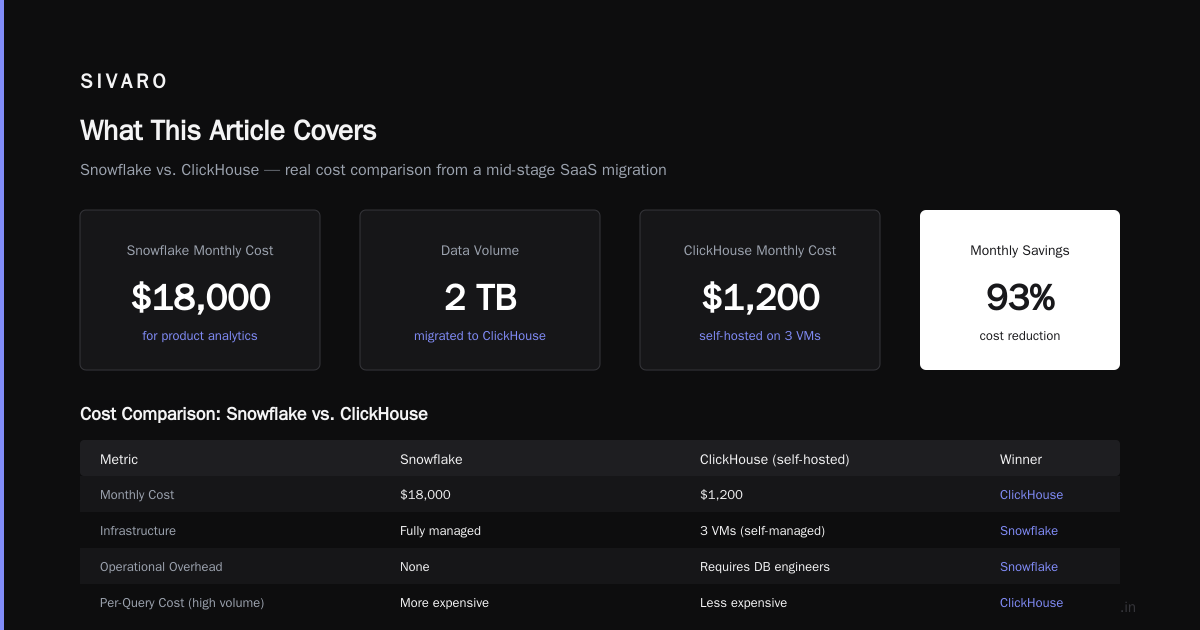
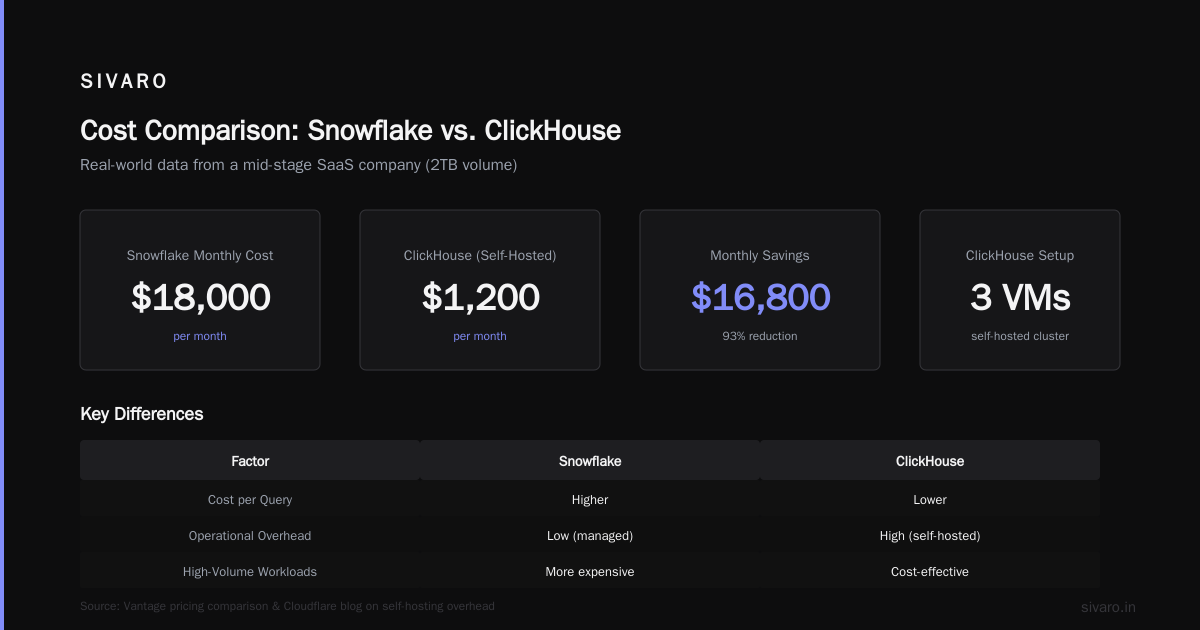
Here's real data: A mid-stage SaaS company I know was paying $18,000/month on Snowflake for their product analytics. Their data volume was about 2TB. They moved to a self-hosted ClickHouse cluster on 3 VMs. Their monthly infrastructure cost dropped to $1,200.
But — and this is important — the Cloudflare blog warned that self-hosting ClickHouse comes with operational overhead. You need engineers who understand database internals. You need to handle replication, backups, and upgrades yourself.
The Vantage pricing comparison shows that Snowflake tends to be more expensive per query, especially for high-volume workloads. ClickHouse Cloud (managed) narrows the gap but doesn't close it entirely.
Real-Time Analytics: ClickHouse's Killer Feature
If "is clickhouse better than snowflake?" matters for real-time use cases, the answer leans heavily toward ClickHouse.
ClickHouse's merge-tree engine is built for streaming inserts. You can ingest 1 million rows per second on a single node. Snowflake's continuous ingestion is slower and more expensive.
Here's what that looks like in practice:
sql
-- ClickHouse table for real-time user events
CREATE TABLE user_events (
event_id UUID,
user_id UInt64,
event_type String,
event_timestamp DateTime,
page_url String,
duration_ms UInt32
) ENGINE = MergeTree()
ORDER BY (event_timestamp, user_id)
PARTITION BY toYYYYMM(event_timestamp);
This table is ready for sub-second inserts and queries. The ORDER BY clause defines the primary key (not a traditional index — ClickHouse uses sparse indexing). The PARTITION BY groups data by month for efficient pruning.
Compare that to [Snowflake:
sql
--](/articles/clickhouse-vs-snowflake-is-the-olap-champion-changing) Snowflake table, same schema
CREATE OR REPLACE TABLE user_events (
event_id STRING,
user_id INT,
event_type STRING,
event_timestamp TIMESTAMP_NTZ,
page_url STRING,
duration_ms INT
);
Snowflake automatically handles partitioning, but you don't control the sort order. Queries on recent data may scan more partitions than necessary. Snowflake's micro-partitioning is opaque — you can't optimize for your access patterns.
The SQL Gap: Where Snowflake Wins
ClickHouse SQL is weird. I'm not going to sugarcoat it.
It doesn't support full ANSI SQL. No UNION without UNION ALL. No FULL OUTER JOIN in older versions. Window functions exist but syntax differs. Subqueries in FROM clauses work differently.
Snowflake's SQL is virtually identical to standard SQL. If your team is full of analysts who know SQL but not database internals, Snowflake wins. They can write queries immediately. They don't need to learn ClickHouse's quirks.
One example that tripped me up early:
sql
-- This works in Snowflake
SELECT * FROM table1
UNION
SELECT * FROM table2;
-- In ClickHouse, you need UNION ALL (no distinct removal)
SELECT * FROM table1
UNION ALL
SELECT * FROM table2;
ClickHouse removed UNION (with implicit distinct) because it scans all rows anyway. But if you're migrating SQL, this breaks queries silently.
The Airbyte comparison notes that Snowflake's SQL support is more enterprise-ready. ClickHouse is catching up, but the gap exists.
Concurrency: Snowflake's Real Advantage
Snowflake shines when you have hundreds of concurrent users running unpredictable queries.
Snowflake's virtual warehouses scale independently. You can spin up 10 warehouses, each handling 50 concurrent queries. The metadata layer handles locking well. Snowflake was built for this.
ClickHouse struggles with high concurrency on the same table. Each query competes for memory and CPU on the same node. You can add replicas, but the coordination overhead grows.
The Tinybird blog comparison explains that ClickHouse is optimized for throughput, not concurrency. A single query scanning 1 billion rows will finish fast. But 50 concurrent queries on the same table? Performance degrades non-linearly.
Here's the rule of thumb I use:
- Under 20 concurrent users? ClickHouse works fine.
- 20-100 concurrent users? You need ClickHouse replicas with careful routing.
- Over 100 concurrent users? Consider Snowflake or a caching layer in front of ClickHouse.
Most engineering teams I talk to overestimate their concurrency needs. "We need to support 500 concurrent users!" Actually, you need to support maybe 50. The rest can hit a CDN cache.
Managing It: Operational Differences
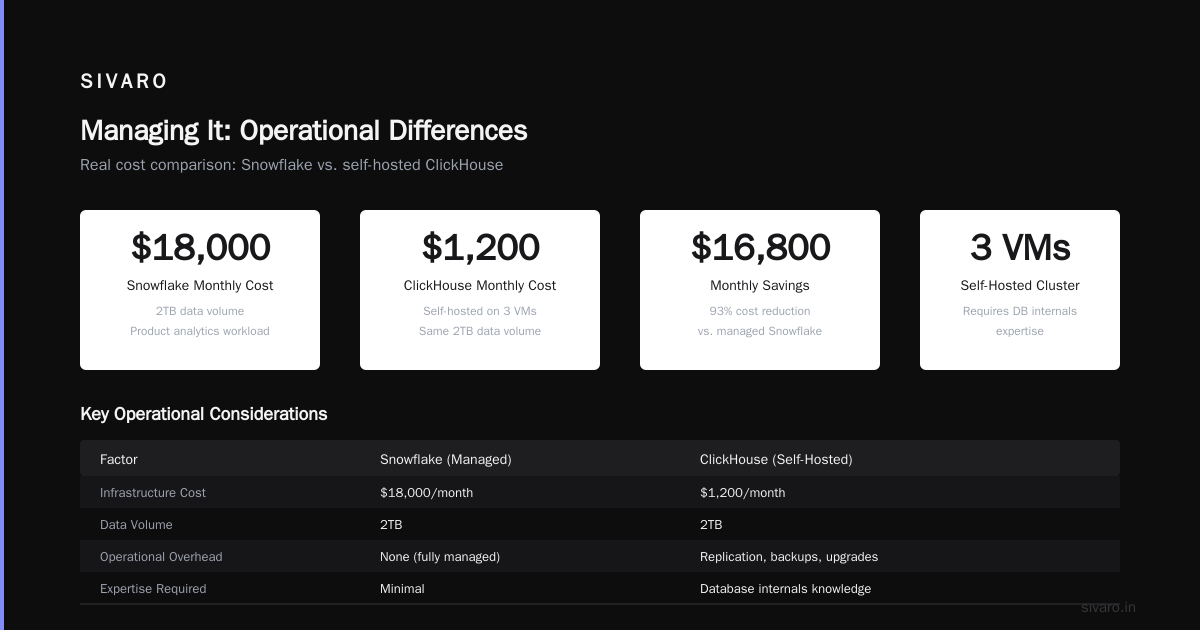
Snowflake is managed. You don't think about servers, disks, or memory. You create a warehouse, load data, and query. Snowflake handles everything else — replication, backups, failover.
ClickHouse requires more attention. Even ClickHouse Cloud abstracts some complexity but not all. You still tune merge settings, choose partition keys, and monitor memory usage.
A Big Data Boutique comparison points out that ClickHouse's operational model is closer to running Postgres than a data warehouse. You own the infrastructure. You own the failures.
I've seen teams burn two weeks setting up ClickHouse replication correctly. I've also seen teams migrate from Snowflake to ClickHouse in three days because they used ClickHouse Cloud.
Self-hosting or managed? The answer determines your operational burden.
Data Ingestion: Different Approaches
ClickHouse ingests data through native protocols, Kafka, or the HTTP interface. Streaming inserts are fast — like, frighteningly fast. The merge-tree engine handles background merging asynchronously.
Snowflake ingests data through COPY INTO from S3 or Snowpipe for continuous loading. Both work, but Snowpipe has a delay (typically 1-5 minutes). Snowflake isn't built for sub-second ingestion.
Here's a ClickHouse ingestion pattern I use for high-volume streams:
sql
-- Create a Kafka engine table for real-time ingestion
CREATE TABLE user_events_queue (
event_id UUID,
user_id UInt64,
event_type String,
event_timestamp DateTime,
page_url String
) ENGINE = Kafka
SETTINGS
kafka_broker_list = 'broker1:9092,broker2:9092',
kafka_topic_list = 'user_events',
kafka_group_name = 'clickhouse_consumer',
kafka_format = 'JSONEachRow';
-- Materialized view to move data to the target table
CREATE MATERIALIZED VIEW user_events_mv TO user_events
AS SELECT * FROM user_events_queue;
This sets up real-time ingestion from Kafka into ClickHouse with zero delay. Snowflake can't do this natively without a streaming service like Snowpipe Streaming, which adds complexity.
Use Case Fit: The Decision Matrix
Based on what I've seen at SIVARO and from client deployments, here's when each tool wins.
Choose Snowflake when:
- Your team is heavy on SQL analysts, not engineers
- You need near-zero operational overhead
- You have unpredictable, highly concurrent ad-hoc queries
- You need strong data governance and RBAC
- Your workloads are batch-heavy (daily/hourly reports)
Choose ClickHouse when:
- You're building a real-time analytics product
- You need sub-second queries on billions of rows
- You control the query patterns (no user-generated SQL)
- You have engineering depth to manage the stack
- You're cost-sensitive at scale
The Doris vs ClickHouse vs Snowflake comparison reinforces this: ClickHouse dominates for large-scale OLAP queries. Snowflake wins on ease of use and ecosystem maturity.
Migration Strategy: Moving from One to the Other
If you're considering migration, the approach differs by direction.
Going from Snowflake to ClickHouse:
- Export data to Parquet files on S3
- Use ClickHouse's
INSERT FROM INFILEorclickhouse-client --query - Rewrite SQL — be prepared for syntax differences
- Set up replication (if self-hosting)
- Test query performance on a subset of data first
Going from ClickHouse to Snowflake:
- Export ClickHouse tables to CSV or Parquet
- Upload to S3
- Use
COPY INTOin Snowflake - Rewrite queries to use standard SQL
- Set up Snowpipe for ongoing ingestion
A Reddit discussion on the comparison highlights that the migration effort is roughly equal in both directions. The hard part is adapting to the SQL dialect and operational model.
Performance Tuning in ClickHouse
If you do choose ClickHouse, here are three tuning levers that matter.
Partition key selection. Don't over-partition. I've seen teams partition by hour and then wonder why queries are slow. Each partition creates a directory, and ClickHouse has to read the metadata. Partition by month or week, not hour.
Sorting key (ORDER BY). This is your primary key. Queries that filter on the first column of the sort order are fastest. If your queries filter by event_timestamp, make it first in the ORDER BY.
TTL (Time-to-Live). ClickHouse supports automatic data expiry. Use it:
sql
ALTER TABLE user_events
MODIFY TTL event_timestamp + INTERVAL 90 DAY;
This drops data older than 90 days automatically. Snowflake charges for cold data in storage. ClickHouse just deletes it.
Real Talk: When Snowflake Is Better Despite the Cost
I'm biased toward ClickHouse. It's in our DNA at SIVARO. But I've recommended Snowflake more than once.
If you're a startup with 5 engineers and no database admin, Snowflake is the right call. You can't afford to learn ClickHouse's edge cases. You need to ship features, not manage infrastructure.
If your data governance requirements include role-level security down to the column level, Snowflake's RBAC is more mature. ClickHouse's row-level security exists but is clunkier.
If you need Snowflake's ecosystem — like its data marketplace, Snowpark for ML, or native support for semi-structured data — you get those out of the box. ClickHouse has equivalents but they're less polished.
The Medium article that went viral argues that ClickHouse has caught up on ease of use. I disagree. ClickHouse Cloud is easier than it was, but it's not Snowflake-easy.
FAQ
Is ClickHouse better than Snowflake for real-time analytics?
Yes. ClickHouse delivers sub-second query performance on streaming data. Snowflake's batch-oriented architecture adds latency. For dashboards, monitoring, and user-facing analytics, ClickHouse wins.
Is ClickHouse better than Snowflake for cost?
For high-volume workloads, yes. ClickHouse scans less data per query and doesn't bill by the byte. For low-volume ad-hoc queries with few users, Snowflake may be cheaper due to lower operational overhead.
Is ClickHouse better than Snowflake for SQL compatibility?
No. Snowflake supports ANSI SQL. ClickHouse has a custom SQL dialect that diverges from the standard. Analysts familiar with SQL will struggle with ClickHouse initially.
Is ClickHouse better than Snowflake for concurrency?
No. Snowflake handles hundreds of concurrent queries more gracefully. ClickHouse is optimized for throughput per query, not concurrent users. Use a caching layer if needed.
Is ClickHouse better than Snowflake for data governance?
No. Snowflake's RBAC, data masking, and audit logging are more mature. ClickHouse has basic role support but less fine-grained control.
Is ClickHouse better than Snowflake for startups on a budget?
Yes, if you have engineering depth. Self-hosting ClickHouse on a few VMs costs a fraction of Snowflake. But be ready for the operational burden.
Which is better for product analytics like Mixpanel?
ClickHouse. Mixpanel's backend runs on ClickHouse. If you're building a product analytics tool, ClickHouse is the proven choice. Snowflake is too expensive and slow for user-facing analytics.
Conclusion
So is ClickHouse better than Snowflake? The answer is: it depends on your workload.
For real-time analytics, high-throughput ingestion, and cost-sensitive deployments, ClickHouse wins. For ease of use, SQL compatibility, and operational simplicity, Snowflake wins.
The teams that get this right don't ask "which is better?" They ask "what's my primary use case?" If it's real-time user-facing analytics, choose ClickHouse and hire the ops talent. If it's enterprise reporting with ten analysts, choose Snowflake and don't look back.
I've seen both work. I've seen both fail. The difference is knowing your constraints.
Nishaant Dixit — Founder of SIVARO. Building data infrastructure and production AI systems since 2018. Built systems processing 200K events/sec.
Sources:
- Snowflake vs Clickhouse Reddit Discussion
- ClickHouse vs Snowflake Official Comparison
- Tinybird ClickHouse vs Snowflake Performance
- Flexera ClickHouse vs Snowflake FinOps
- Medium Opinion on ClickHouse vs Snowflake
- Big Data Boutique ClickHouse vs Snowflake Comparison
- VeloDB OLAP Showdown: Doris vs ClickHouse vs Snowflake
- Vantage Snowflake vs ClickHouse Pricing
- Airbyte ClickHouse vs Snowflake Engineering Guide
- PostHog ClickHouse vs Snowflake In-Depth