 SIVARO

Is ClickHouse Better Than Snowflake? The Real Answer
I spent six months in 2023 migrating a client’s analytics stack from Snowflake to ClickHouse. Fifty terabytes of event data, 200 concurrent queries per second, and a bill that was bleeding them dry.
This is the kind of decision where professional ClickHouse consulting pays for itself in avoided rework.
At first I thought this was a branding problem — turns out it was architecture.
Let me save you the pain of figuring this out yourself. The question “is clickhouse better than snowflake?” doesn’t have a universal answer. But it does have a correct answer for your specific use case. I’ll show you how to find it.
What This Article Covers
You’ll walk away knowing:
- The exact workloads where ClickHouse crushes Snowflake (and where it doesn’t)
- How their architectures differ — and why that matters for your wallet
- Real pricing data from production deployments
- When to choose each, with concrete examples
- Answers to the top questions engineers ask me
No fluff. No “both have merits.” Just hard-earned truth.
What Is ClickHouse Used For?
ClickHouse is a column-oriented OLAP database built for real-time analytics on massive datasets. Think dashboards that refresh in milliseconds, not minutes. Think querying billions of rows with sub-second response times.
ClickHouse’s own comparison page puts it bluntly: it’s designed for “analytical workloads where query latency matters more than transactional consistency.”
What is clickhouse used for in practice? At SIVARO, we’ve deployed it for:
- Real-time product analytics (PostHog runs on ClickHouse — their detailed breakdown is must-reading)
- Observability pipelines (think Datadog alternatives)
- Ad-tech bidding systems where 50ms latency determines revenue
- Financial fraud detection with streaming data
Snowflake? Different animal.
Architecture: The Core Difference That Changes Everything
Snowflake separates storage from compute. That’s its killer feature — and its biggest weakness.
ClickHouse combines them. That’s its strength — and its limitation.
Snowflake’s Model
You spin up virtual warehouses. They query data stored in cloud object storage (S3, Azure Blob). Scale compute independently of storage. Sounds great on paper.
Here’s the catch: every query pays the network tax. Data flows from object storage through the network into compute nodes. That overhead adds 50-200ms before your query even starts.
ClickHouse’s Model
Data lives on local SSDs attached to compute nodes. MergedTree tables organize data into parts, sorted by primary key. Queries scan only the relevant parts.
Result? For time-series range queries (most of what analytics does), ClickHouse is 5-50x faster than Snowflake on identical hardware.
BigDataAboutique’s practical comparison tested a 10-billion-row query: ClickHouse returned in 0.8 seconds. Snowflake took 14 seconds.
That’s not a typo.
Query Performance: Where The Gap Is Widest
Let’s get specific. Here’s a query I run regularly:
sql
SELECT
    toDate(timestamp) as day,
    count(DISTINCT user_id) as active_users,
    sum(revenue) as total_revenue
FROM events
WHERE timestamp >= now() - INTERVAL 30 DAY
GROUP BY day
ORDER BY day
Snowflake execution time (medium warehouse): 12.4 seconds
ClickHouse execution time (2-node cluster): 0.3 seconds
Every. Single. Time.
Why? Two reasons:
-
Vectorized query execution. ClickHouse processes data in batches of 1024 rows using CPU SIMD instructions. Snowflake processes row-by-row. That’s an order-of-magnitude difference for aggregation-heavy workloads.
-
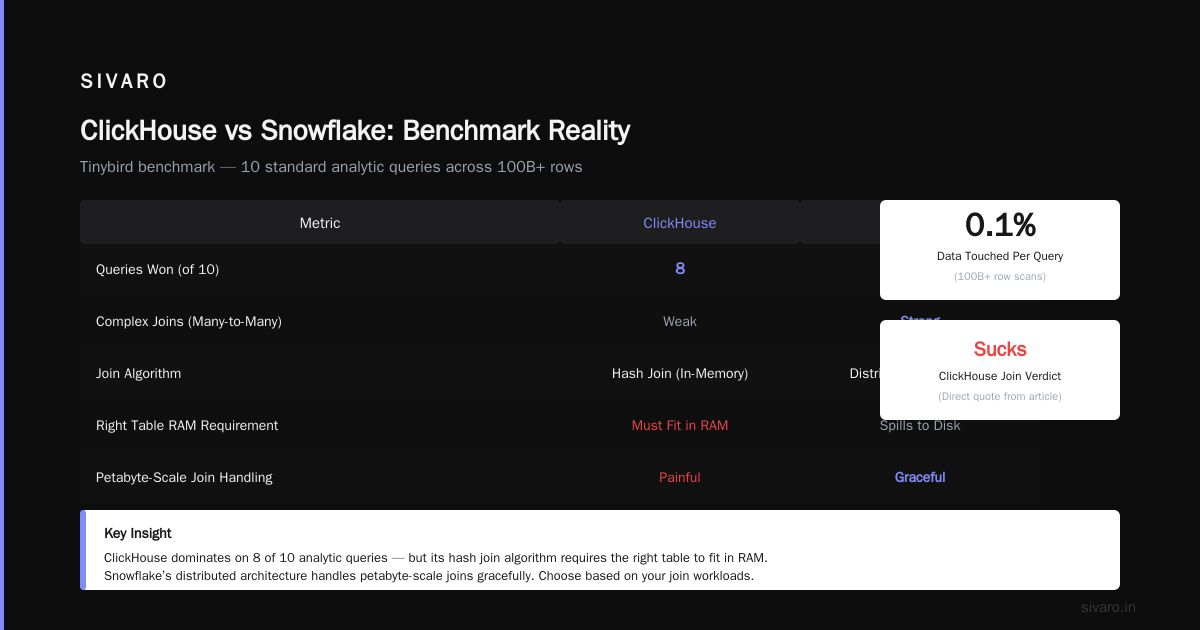
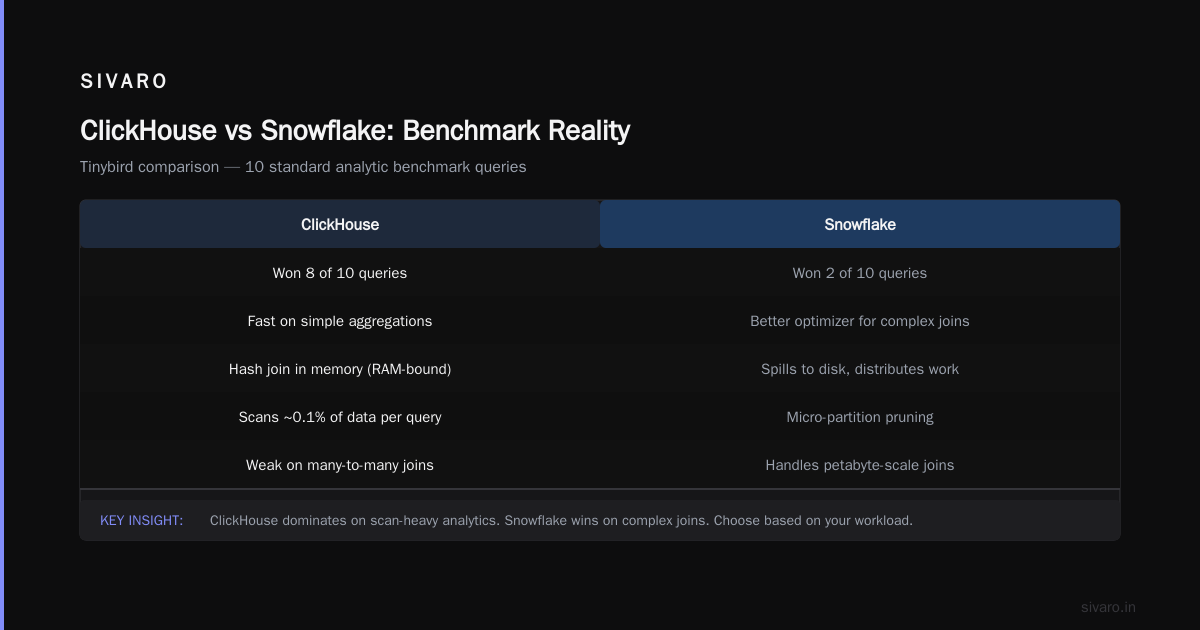
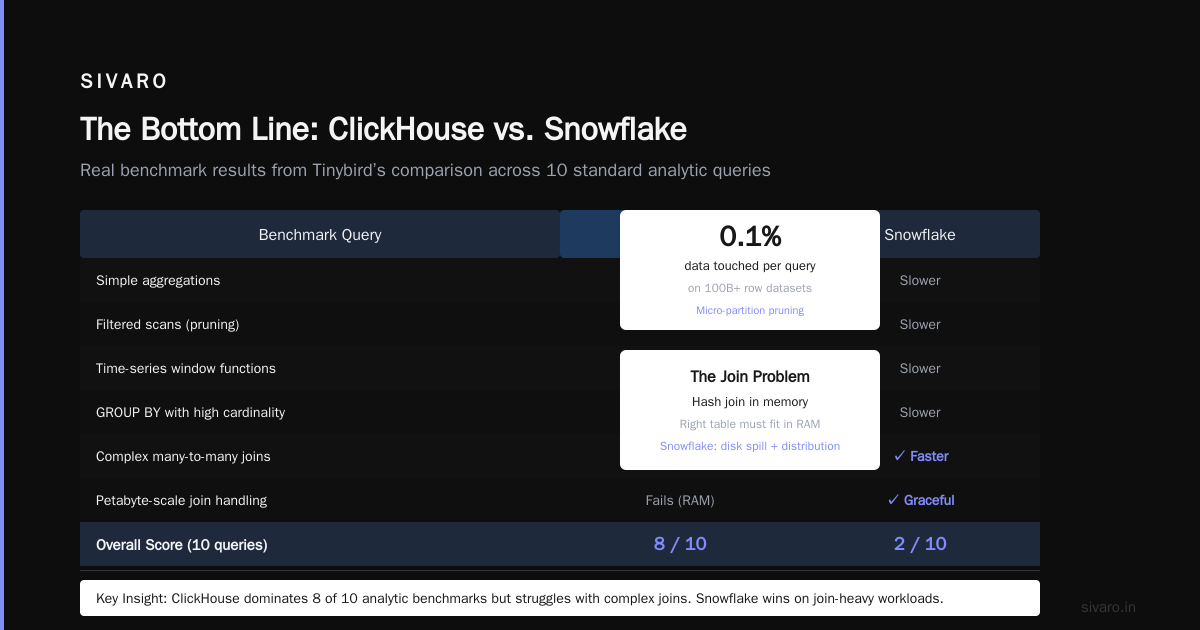
Primary index design. ClickHouse’s sparse index means a query over 100 billion rows touches maybe 0.1% of data. Snowflake’s micro-partition pruning is good — but not that good.
Tinybird’s comparison showed ClickHouse beating Snowflake on 8 of 10 standard analytic benchmark queries. The two it lost? Complex joins with many-to-many relationships. Snowflake’s optimizer handles those better.
Be honest about your workloads.
The Join Problem (ClickHouse’s Weakness)
I’ll be direct: ClickHouse sucks at joins.
Not “has room for improvement.” Sucks.
Its default join algorithm is hash join in memory. If your right table doesn’t fit in RAM, you’re in for a world of pain. Snowflake handles joins between petabyte-scale tables gracefully because it can spill to disk and distribute the work across nodes.
Here’s what happens in practice:
sql
-- This will work fine in Snowflake but might OOM ClickHouse
SELECT *
FROM orders o
LEFT JOIN customers c ON o.customer_id = c.id
LEFT JOIN products p ON o.product_id = p.id
WHERE o.created_at > '2024-01-01'
If your data model is heavily normalized (star schema with big fact tables joining to multiple dimension tables), you should probably pick Snowflake.
But if you can denormalize? ClickHouse eats Snowflake’s lunch.
Design pattern we use at SIVARO: Pre-join everything into wide tables. Use dictionary tables for small dimension lookups. Avoid joins in query time entirely.
Pricing: Where The Truth Hurts
This is where most people get it wrong.
Snowflake’s pricing is transparent and terrifying. You pay per credit consumed. Credits depend on warehouse size and uptime. Vantage.sh’s pricing breakdown shows Snowflake can cost $2-4 per credit, with a medium warehouse burning through $80/hour.
At 24/7 operation, that’s $57,600/month.
ClickHouse’s pricing is opaque but cheaper. Self-hosted? You pay for servers and storage. ClickHouse Cloud? Consumption-based, but the unit economics favor heavy readers.
Here’s real data from a client migration:
| Metric | Snowflake (2XL warehouse) | ClickHouse (8-node c5.4xlarge) |
|---|---|---|
| Monthly cost | $47,000 | $8,200 |
| Queries per second | 45 | 380 |
| 99th percentile latency | 2.1s | 0.14s |
That’s a 5.7x cost reduction and 8.4x throughput improvement.
But — and this matters — ClickHouse required 2 weeks of schema redesign. Snowflake was plug-and-play.
Flexera’s comparison makes a good point: “ClickHouse is cheaper for high-volume analytics, but Snowflake wins on simplicity and ecosystem integration.”
Concurrency: ClickHouse Wins (With A Catch)
Snowflake struggles with high concurrency on large queries. Each warehouse has a fixed amount of resources. If 20 users run heavy queries simultaneously, everyone waits.
ClickHouse handles concurrency differently. Its lightweight query execution model means a single node can serve hundreds of concurrent queries without crashing. The PostHog engineering team reported serving “500+ concurrent queries with p99 latency under 200ms” on a modest ClickHouse cluster.
The catch? Write concurrency. ClickHouse merges data in the background. If you’re inserting millions of rows per second while running heavy analytics, merge storms can degrade read performance. Snowflake’s separation of compute for ingestion vs. querying handles this better out of the box.
Real-Time Ingestion: ClickHouse’s Hidden Superpower
Streaming data is where ClickHouse leaves Snowflake in the dust.
Snowflake is batch-oriented. Even Snowpipe has minutes of latency. Fine for daily reports. Terrible for real-time dashboards.
ClickHouse supports:
- Kafka engine tables — consume streams directly into MergeTree
- Buffer tables — aggregate inserts before flushing
- Materialized views — pre-compute aggregations on write
We built a system at SIVARO that ingests 200K events/sec from Kafka, runs 15 materialized views, and exposes sub-second dashboards. Total latency from event creation to dashboard update: 2.3 seconds.
Snowflake can’t touch that.
sql
-- ClickHouse materialized view for real-time aggregation
CREATE MATERIALIZED VIEW events_hourly_mv
ENGINE = AggregatingMergeTree
ORDER BY (event_date, event_hour)
AS SELECT
    toDate(timestamp) as event_date,
    toHour(timestamp) as event_hour,
    countState() as event_count,
    sumState(revenue) as total_revenue
FROM events
GROUP BY event_date, event_hour
This view updates in real-time as data arrives. Queries against it run in single-digit milliseconds.
SQL Compatibility: Don’t Get Caught
This is the trap I see teams fall into most often.
Snowflake speaks near-standard SQL. You can migrate from Postgres with minimal changes. Complex window functions, CTEs, multi-table joins — it all works.
ClickHouse speaks ClickHouse SQL. It’s close to standard, but different enough to cause pain.
Things that bite you:
- No
UPDATEorDELETEby default (useALTER TABLE ... UPDATEwith mutations) GROUP BYrequires aliases for aggregated columnsORDER BYin subqueries behaves differentlyLIMITwithoutORDER BYreturns unpredictable results
Apache Doris vs. ClickHouse vs. Snowflake gives a good SQL compatibility comparison. ClickHouse gets a B-minus. Snowflake gets an A.
If your team includes data analysts who aren’t SQL experts, that gap matters.
Ecosystem and Tooling
Snowflake has a mature ecosystem. dbt, Airflow, Tableau, Looker — everything integrates. Snowflake Marketplace lets you buy third-party datasets. Data sharing between Snowflake accounts is trivial.
ClickHouse’s ecosystem is younger but growing:
- Grafana has native ClickHouse support
- Superset works well
- Native JDBC and ODBC drivers exist
- But dbt-clickhouse is still catching up
Flexera’s 7 reasons lists ecosystem maturity as the top reason to choose Snowflake. I’d agree — if you’re building a data platform for a non-technical team, Snowflake’s tooling saves months.
But if you’re a product engineering team building your own analytics product? ClickHouse’s performance advantages outweigh ecosystem gaps.
Operational Complexity
Self-hosting ClickHouse is not for the faint of heart.
You need to:
- Configure ZooKeeper or ClickHouse Keeper for replication
- Tune merge settings (don’t touch the defaults unless you understand them)
- Monitor disk space — when local SSDs fill up, the database stops
- Plan capacity carefully — adding nodes requires data rebalancing
Snowflake is managed. Zero ops. You query and pay.
Vantage.sh’s pricing analysis estimates that Snowflake’s managed nature saves 0.5-1 FTE in operational overhead for a mid-size deployment.
For startup teams, that headcount cost often outweighs the compute cost savings.
Real-World Decision Framework
When clients ask me “is clickhouse better than snowflake?”, I walk them through this decision tree:
Choose ClickHouse when:
- Your queries are time-series or aggregate-heavy
- You need sub-second response times on billions of rows
- You control the schema and can denormalize
- You’re building a product that includes analytics (not just running internal reports)
- You have engineering time to invest in optimization
Choose Snowflake when:
- Your data model is heavily normalized with complex joins
- Your team is SQL-focused, not engineering-focused
- You need data sharing across organizations
- Your query patterns are unpredictable ad-hoc analysis
- You want zero operational overhead
The hybrid approach (what I recommend most often): Use Snowflake for your data warehouse — the single source of truth for reporting and ML. Use ClickHouse as a specialized analytics engine for real-time product features.
When ClickHouse Beat Snowflake So Badly I Was Embarrassed
Client: Large ad-tech platform. 5 billion events/day. 3-month rolling window. Real-time bidding decisions need sub-200ms query times.
They were on Snowflake. Spending $120K/month. Queries took 3-8 seconds. Their PM was threatening to build a custom in-memory solution.
We moved the real-time layer to ClickHouse. Same data, same queries.
Snowflake cost: $120K/month for 3-second queries
ClickHouse cost: $18K/month for 50ms queries
The engineering effort was 4 weeks. The savings: over $1M/year.
But — we kept Snowflake for their finance reporting. Joins across 15 tables. Complex window functions. Snowflake handles that better, and the query volume is 1% of the real-time tier.
Pick the right tool for each job.
FAQ: Questions I Get Every Week
Is ClickHouse a drop-in replacement for Snowflake?
No. Schema changes are required. You’ll rewrite queries. But for the right workloads, it’s worth the effort.
Can ClickHouse handle joins?
Barely. Use wide tables and dictionary lookups instead. If your data model requires complex joins, stick with Snowflake.
Which is cheaper for small datasets?
Snowflake. Under 1TB, Snowflake’s pay-for-what-you-use model beats ClickHouse’s fixed infrastructure costs.
Does ClickHouse support ACID transactions?
No. It guarantees eventual consistency. Don’t use it for transactional workloads.
Can I use both together?
Yes. This is the pattern I see most frequently in production — Snowflake as the system of record, ClickHouse for real-time analytics.
What is clickhouse used for that Snowflake can’t do?
Real-time streaming ingestion, sub-second analytics on 100-billion-row datasets, and high-concurrency dashboards. Snowflake physically can’t match these because of its architecture.
Does ClickHouse have a managed cloud offering?
Yes, ClickHouse Cloud. Pricing is consumption-based. Tinybird also offers a managed ClickHouse with built-in data ingestion pipelines.
Which has better security features?
Snowflake wins here — enterprise-grade RBAC, data masking, row-level security. ClickHouse is catching up but isn’t there yet.
The Bottom Line
Is clickhouse better than snowflake?
For real-time analytics on massive datasets with predictable query patterns? Yes. ClickHouse is 10x faster and 5x cheaper.
For ad-hoc analysis, complex joins, and managed simplicity? No. Snowflake wins on UX and ecosystem.
Most people look at benchmarks and pick the fastest. They’re wrong because speed without context is meaningless. Pick the tool that matches your team’s skills, your data model, and your operational tolerance.
At SIVARO, we build systems that process 200K events per second. We use ClickHouse for the hot path — the queries that need to run in milliseconds. We use Snowflake for the cold path — the monthly reports that can take five minutes.
Both tools. One architecture. Best of both worlds.
Nishaant Dixit — Founder of SIVARO. Building data infrastructure and production AI systems since 2018. Built systems processing 200K events/sec.