What Are the 5 Types of AI Agents? A Practitioner's Guide
I started SIVARO in 2018 thinking the hardest part of AI would be the models. I was wrong. The hardest part is the agents — the systems that actually do something with those models. We've built data pipelines processing 200K events per second, and along the way, I've watched teams burn months trying to figure out which agent architecture actually works.
So when someone asks "what are the 5 types of ai agents?", they're usually asking the wrong question. They want a taxonomy. What they need is a decision framework.
Here's what I've learned from shipping production AI systems, not just reading papers.
What Makes Something an AI Agent?
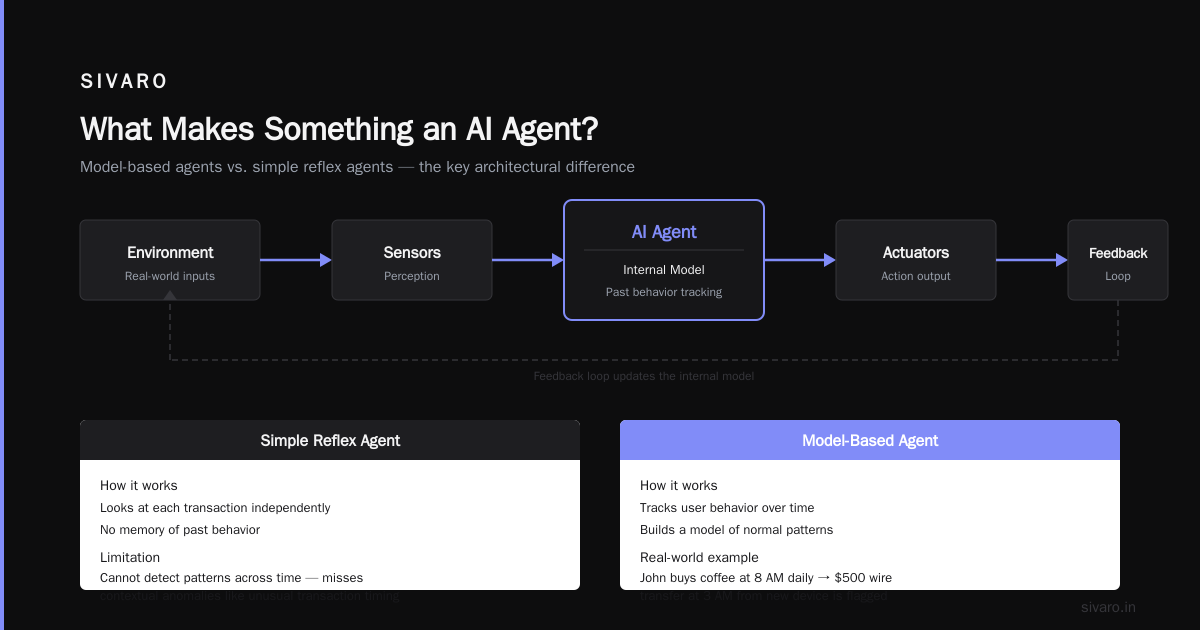
Before we talk types, let's get definitions straight. An AI agent isn't just a model. It's an autonomous system that perceives its environment, makes decisions, and takes actions to achieve goals. Think of it as the difference between a calculator (tool) and a trading bot (agent). The calculator doesn't decide when to calculate. The trading bot decides when to buy.
Every agent has four components according to the standard AI textbook model (GeeksforGeeks):
- Sensor: Perceives the environment
- Actuator: Takes action
- Decision mechanism: Maps perception to action
- Goal structure: Defines what "good" looks like
The 5 types of AI agents differ in how sophisticated that decision mechanism is. You don't need a PhD to choose. You need to match complexity to your problem.
Type 1: Simple Reflex Agents — The Light Switch
What it is: The simplest agent. Maps current perception directly to action. No memory. No state. No planning.
How it works:
python
class SimpleReflexAgent:
    def __init__(self, rules):
        self.rules = rules  # condition -> action mapping

    def act(self, percept):
        for condition, action in self.rules:
            if condition(percept):
                return action
        return self.default_action
Where it shines: Thermostats. Spam filters. Production line sensors. Anywhere the environment is fully observable and the right action depends only on the current input.
Where it breaks: The moment you need context. A thermostat that only reads current temperature can't anticipate that the room will get hot in 10 minutes because the sun is rising.
Real example: We built a simple reflex agent for monitoring server logs at a client in 2020. If CPU > 90%, alert. That worked for 3 months. Then we had a cascading failure where 3 servers spiked simultaneously. The agent couldn't distinguish "one bad server" from "distributed attack." We had to upgrade.
Takeaway: Use this for 10% of your agents. They're cheap, fast, and reliable for narrow tasks. But they're brittle.
Type 2: Model-Based Reflex Agents — Adding Memory
What it is: Same as Type 1, but with internal state. The agent maintains a model of the world it can't currently see.
How it works:
python
class ModelBasedAgent:
    def __init__(self, rules, initial_state):
        self.rules = rules
        self.state = initial_state  # internal model

    def act(self, percept):
        self.state = self.update_state(self.state, percept)
        return self.match_rule(self.state)
The key insight: The agent doesn't need to see everything. It can infer missing information from past observations.
Where it matters: Self-driving cars are the textbook example. A car can't see around a building, but it can model that a pedestrian might step out based on past behavior at similar intersections.
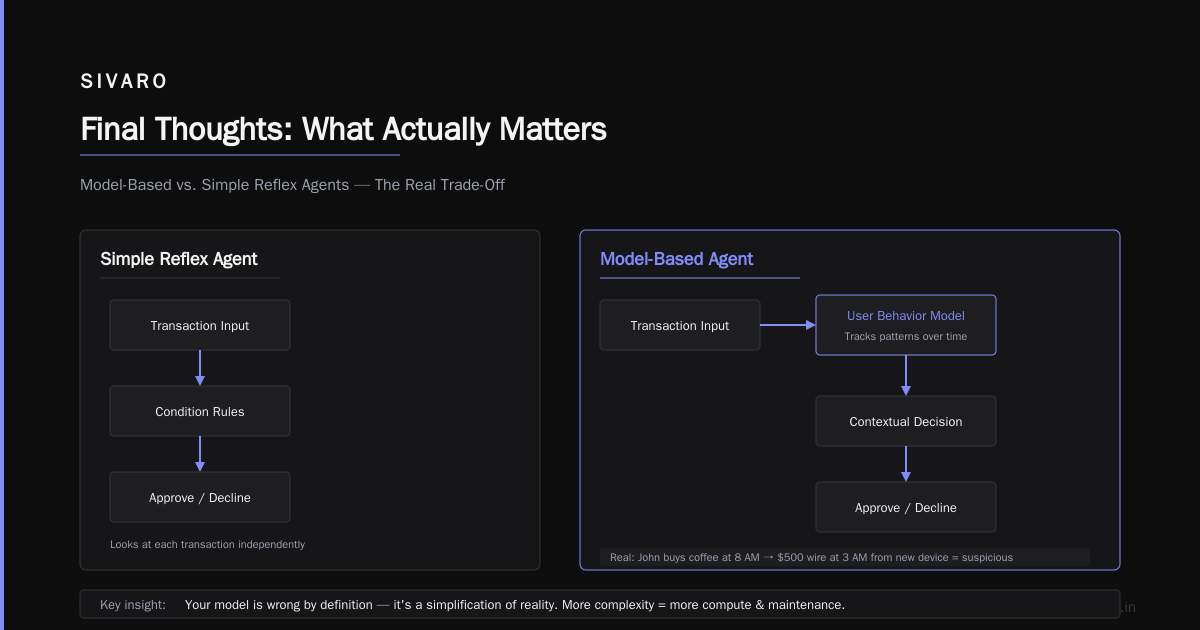
Real example: We used this for a fraud detection system. The simple reflex agent looked at each transaction independently. The model-based agent tracked user behavior over time — knew that John buys coffee at 8 AM, so a $500 wire transfer at 3 AM from a new device was suspicious even though the individual transaction looked clean.
The trade-off: Your model is wrong by definition. It's a simplification of reality. The more complex the model, the more compute and maintenance it needs. We've seen teams spend 6 months building a perfect world model that still misses edge cases.
Who does this well: Tesla's Autopilot uses model-based reasoning extensively (IBM). They model other cars' probable paths, not just current positions.
Type 3: Goal-Based Agents — Planning Ahead
What it is: Instead of a fixed rule book, the agent has a goal and figures out the sequence of actions to achieve it.
How it works:
python
class GoalBasedAgent:
    def __init__(self, goal, planner):
        self.goal = goal
        self.planner = planner

    def act(self, state):
        plan = self.planner.search(state, self.goal)
        if plan:
            return plan[0]  # first action in plan
        return self.fallback()
The leap: These agents don't just react. They search. They simulate. They consider "what if I do A, then B, then C?"
Where it matters: Game-playing AI (chess engines, AlphaGo). Route planning for logistics. Anywhere there's a clear goal and time to plan.
Real example: We built a supply chain optimizer for a manufacturer. Goal: minimize shipping costs while meeting delivery deadlines. The agent would simulate thousands of possible routes and warehouse assignments before picking one. This isn't a reflex — it's reasoning.
The problem: Search is expensive. For complex problems, the space of possible actions explodes. AlphaGo used Monte Carlo tree search with neural network guidance to prune the search space (DigitalOcean). Without pruning, you're dead.
When not to use: Real-time systems. A goal-based agent driving a car would be too slow for emergency braking. That's why modern self-driving systems mix types — reflex for urgent actions, goal-based for route planning.
Type 4: Utility-Based Agents — The Trade-Off Machines
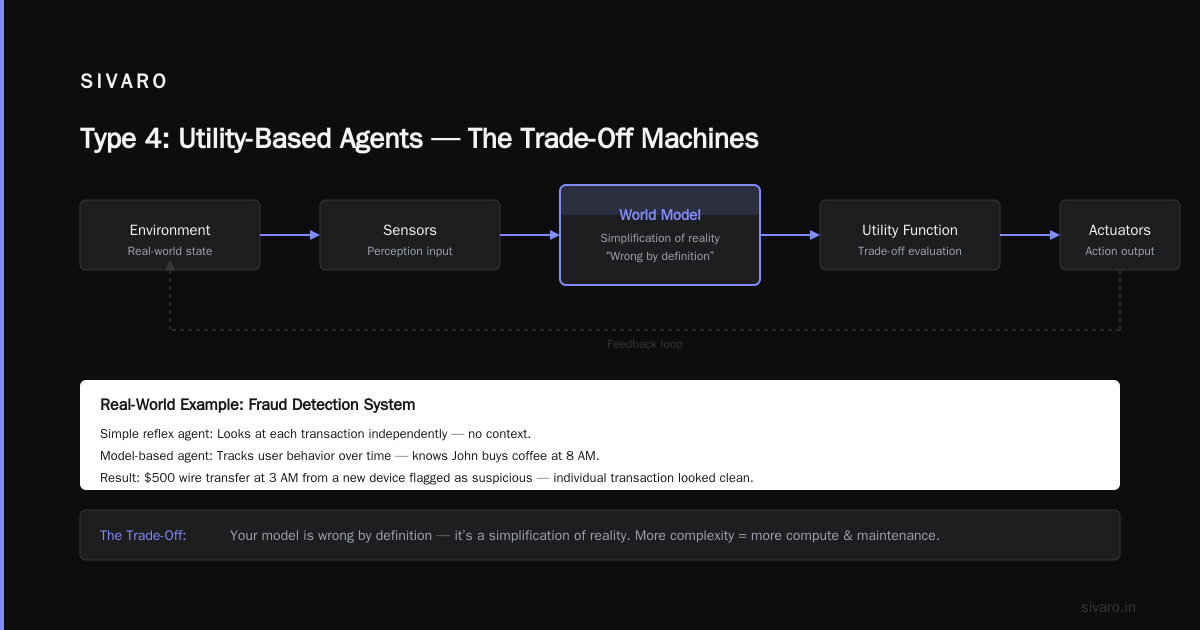
What it is: Goal-based agents know if they achieved the goal. Utility agents know how well. They assign a numeric score to each possible state and choose the action that maximizes expected utility.
How it works:
python
class UtilityAgent:
    def __init__(self, utility_function, planner):
        self.utility = utility_function  # assigns score to states
        self.planner = planner

    def choose_action(self, state):
        possible_actions = self.get_actions(state)
        best_action = None
        best_score = -float('inf')

        for action in possible_actions:
            outcome = self.predict_outcome(state, action)
            score = self.utility(outcome)
            if score > best_score:
                best_score = score
                best_action = action
        return best_action
Why it's different: Sometimes there's no single "goal" state. Multiple paths succeed — but some are [better. A goal-based chess agent wants to checkmate. A utility agent wants to checkmate with material advantage. It'll sacrifice a queen if it leads to checkmate faster, but prefers the safe win.
Where it matters: Resource allocation. Pricing systems. Ad placement. Anything with competing objectives.
Real example: Ad bidding systems use utility agents. The goal isn't just "show an ad" — it's "maximize revenue subject to budget constraints." Google's ad auction optimizes for multiple utility dimensions: user engagement, advertiser ROI, frequency capping (Nexos).
The hard part: Defining the utility function. In the ad system, you need to weigh short-term revenue against long-term user retention. Get that wrong and you maximize this quarter's profit while destroying the platform.
Watch out: Utility functions are optimization targets. What you optimize, you get. We've seen companies accidentally optimize for click-through rate and end up with clickbait garbage. The agent did exactly what you asked. It's your fault, not its.
Type 5: Learning Agents — The Ones That Get Better
What it is: All previous types assume fixed behavior. Learning agents improve over time based on experience. They have a "learning element" that updates their knowledge.
How it works:
python
class LearningAgent:
    def __init__(self, base_agent, learner, performance_critic):
        self.agent = base_agent
        self.learner = learner
        self.critic = performance_critic  # provides feedback

    def act(self, percept):
        action = self.agent.act(percept)
        feedback = self.critic(percept, action)
        self.learner.update(feedback)
        return action
This is where it gets real: Most production AI agents today are learning agents — at least partially. They use reinforcement learning, supervised fine-tuning, or online adaptation.
Real example: Recommendation systems at Netflix and Spotify. The agent learns your preferences over time. It starts generic, becomes personalized. This is why you don't hard-code recommendations — you build a learning loop.
The meta-problem: Learning agents have a fundamental tension between exploration (trying new things) and exploitation (doing what works). Get the balance wrong and you either never learn (too conservative) or never perform (too experimental) (Evidently AI).
What most people get wrong: They think "learning" means "set it and forget it." No. Learning agents require ongoing data pipelines, monitoring, and retraining. We've had clients complain their agent "stopped working" — it didn't. The world changed, and the agent learned the wrong thing because the feedback signal was noisy.
The Big Picture: What Are the 5 Types of AI Agents in Practice?
Here's a pragmatic view. These aren't rigid categories. Production systems mix them.
The stack we use at SIVARO:
- Simple reflex for urgent safety checks (circuit breakers, rate limiters)
- Model-based for anomaly detection (fraud, drift)
- Goal-based for scheduling and planning
- Utility-based for resource allocation
- Learning for personalization and adaptation
A single production agent might be all five at different levels. Your self-driving car uses reflex for emergency braking, model-based for understanding traffic, goal-based for route planning, utility-based for lane choice (speed vs safety trade-off), and learning for improving over time.
FAQ: The Questions I Actually Get Asked
Q: Who are the big 4 AI agents?
The "big 4" is a term people use loosely. Usually they mean: OpenAI's GPT-based agents, Google's Gemini/DeepMind agents, Anthropic's Claude agents, and Meta's LLaMA-based agents. But that's a vendor classification, not a functional one. The big 4 types are utility, goal, model-based, and learning — reflex is too simple for most "agent" conversations today.
Q: What are the 5 types of AI agents?
We just covered them: Simple reflex, model-based reflex, goal-based, utility-based, and learning agents. Each adds a layer of capability and complexity.
Q: What are the top 10 AI agents?
In terms of real-world impact (2024-2025): Google's Gemini agents, OpenAI's ChatGPT with plugins, Anthropic's Claude with tool use, AutoGPT (open-source), Microsoft's Copilot, Salesforce's Einstein, NVIDIA's AI agents for robotics, DeepMind's AlphaFold, Tesla's FSD, and various supply chain agents from Blue Yonder. (Wrike has a good list with examples)
Q: How do I choose which type to build?
Start with environment complexity:
| Environment | Best Type |
|---|---|
| Fully observable, static | Simple reflex |
| Partially observable | Model-based |
| Clear goal, time to plan | Goal-based |
| Multiple competing objectives | Utility-based |
| Changing environment | Learning |
Q: Can you combine types?
Yes. And you should. Most production systems are hybrid. A trading agent might use utility for portfolio allocation, learning for market prediction, and reflex for stop-loss orders.
Q: What's the biggest mistake teams make?
Over-engineering. I see teams building learning agents for problems that need a simple reflex. The reflex would work 95% as well for 5% of the cost. The "AI" label makes people want fancy solutions. Resist that.
Q: How do you handle the learning agent's exploration problem?
We use decaying epsilon-greedy. Start with 20% exploration, drop to 1% over time. And we separate online learning (quick adaptation) from offline learning (thorough retraining). This isn't theoretical — it's how we keep agents stable in production.
Final Thoughts: What Actually Matters
After building 50+ agent systems, here's what I tell my team:
The 5 types of AI agents are a useful mental model, not a prescription. The real skill is matching agent complexity to problem difficulty. Most problems need simple solutions. The ones that don't will eat your budget and time.
Every agent we've built has failed. Not because the theory was wrong — because the world is messier than any model. The reflex agent missed context. The learning agent overfit. The utility agent optimized for the wrong thing.
You don't avoid those failures. You build monitoring. You add fallbacks. You test aggressively.
If you're building your first agent, start with Type 2 (model-based). It's complex enough to be useful, simple enough to debug. By the time you outgrow it, you'll know which direction to go.
Nishaant Dixit — Founder of SIVARO. Building data infrastructure and production AI systems since 2018. Built systems processing 200K events/sec.