What Is the Best AI Orchestration Tool? (A Practitioner's Guide)
I spent six months trying to answer this question for a production system at a fintech client. We tested eight tools. Burned through three architectures. Lost a weekend to a bug that turned out to be a config file I'd read wrong.
Here's what I learned: the best AI orchestration tool doesn't exist.
But the best tool for your specific constraints? That exists. And finding it means understanding what orchestration actually does when real money is on the line.
Let me walk you through what I've seen work — and fail — in production.
What Is AI Orchestration, Actually?
Most articles define orchestration as "coordinating multiple AI components." That's technically true and practically useless.
Here's what it means when you're building something that needs to work at 2 AM on a Tuesday:
Orchestration is the layer that decides what happens, when it happens, and what to do when it breaks. It's the difference between a demo that works on your laptop and a system that survives a traffic spike on Black Friday.
Think about a customer service AI pipeline. You get a support ticket. The orchestrator decides: "First, run this through sentiment analysis. If negative, route to escalation model. If positive, generate a response using the knowledge base. Check response quality. If confidence under 85%, have a human review." That's orchestration (IBM).
Without it? You're wiring components together with scripts that fail silently at 3 AM. I know because I've done it.
The Landscape: What's Out There Right Now
Q3 2025 is a weird moment for orchestration tools. We're past the hype, not yet stable. The market split into three camps:
Workflow-as-code tools (Prefect, Dagster, Temporal). These grew from data engineering. They handle dependencies, retries, state management. Good for deterministic pipelines.
Agent frameworks (LangChain, CrewAI, AutoGen). These handle LLM calls, tool selection, memory. Good for systems that need to "think" before acting.
Platform providers (Vertex AI Pipelines, AWS Step Functions, Snowflake). These lock you into an ecosystem but offer managed infrastructure.
The debate isn't which is "best" — it's which you can actually operate over a year Digital Project Manager.
I've seen teams choose LangChain because "everyone uses it," then hit production where observability was nonexistent. I've seen teams pick Temporal because it's battle-tested, then drown in boilerplate for simple LLM calls.
What Is an AI Orchestration Example? Let Me Show You
Let's make this concrete. Here's a pipeline I built for a legal tech startup. They process contracts — 50,000 pages daily. Here's what the orchestrator handles:
1. Document upload triggers webhook
2. OCR extraction (Tesseract)
3. Chunk text (500 tokens with 50 overlap)
4. Entity extraction (GPT-4, 3 retries)
5. Clause classification (fine-tuned BERT)
6. Risk scoring (heuristic model + LLM vote)
7. If high risk → human review queue
8. If low risk → auto-approve + database insert
That's six distinct steps, three different models, a human-in-the-loop decision, and error handling at every stage.
Without orchestration? You'd have a Lambda calling a container calling another Lambda. One fails → whole chain dies → no one knows for six hours.
The Criteria That Actually Matter
I've evaluated tools for eight production systems. Here's what I've found separates survivors from toys:
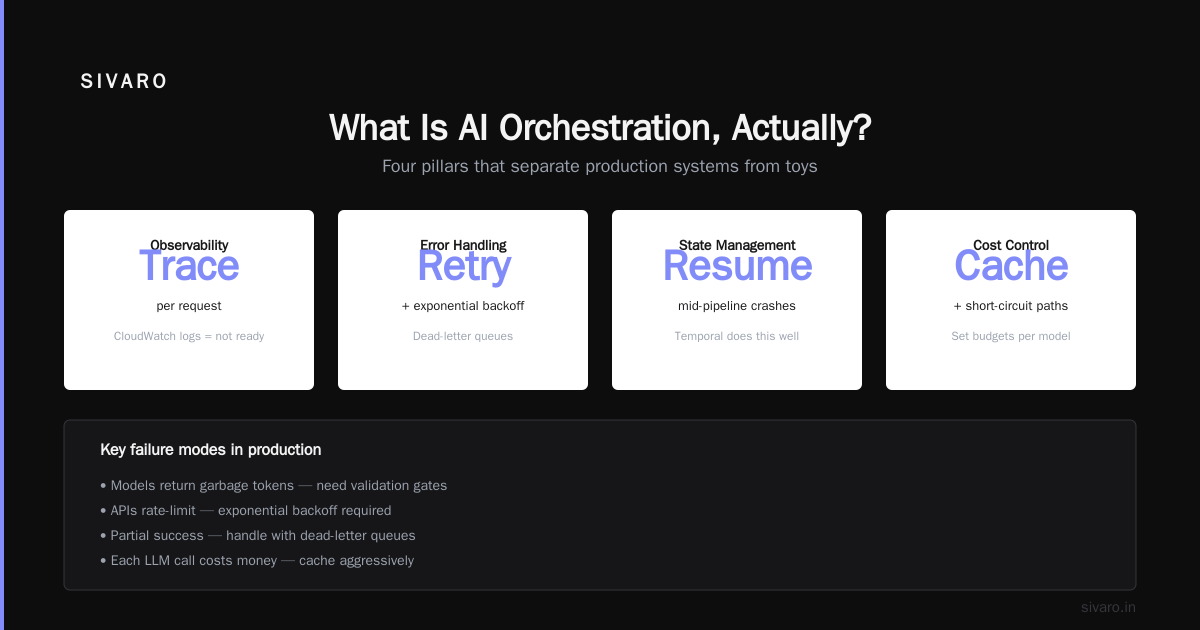
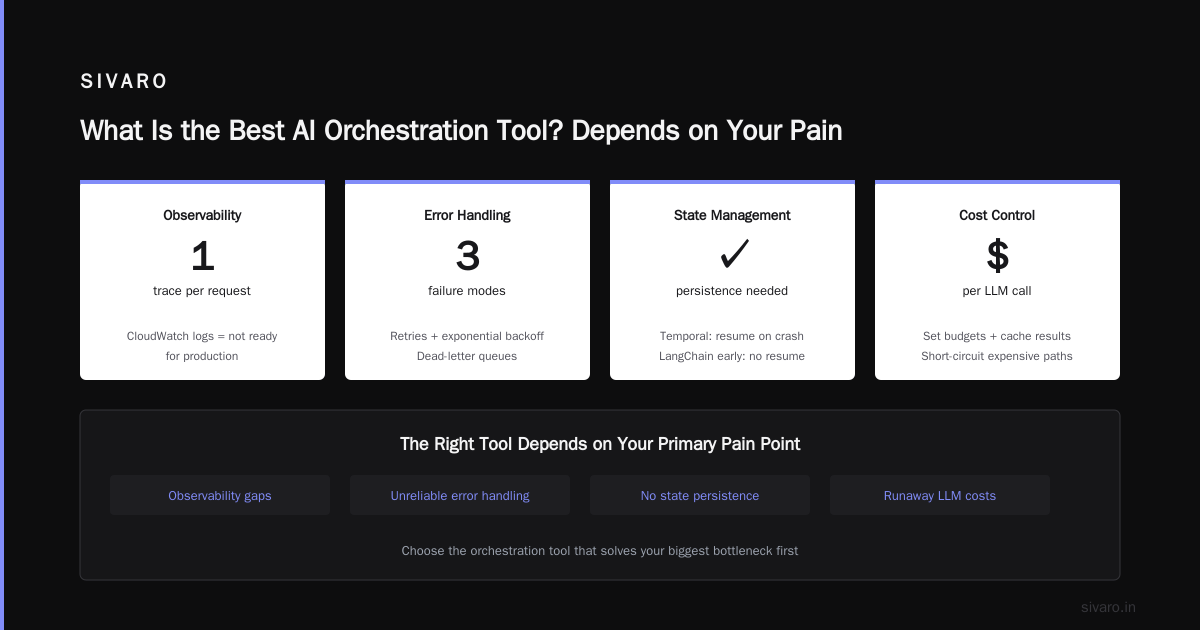
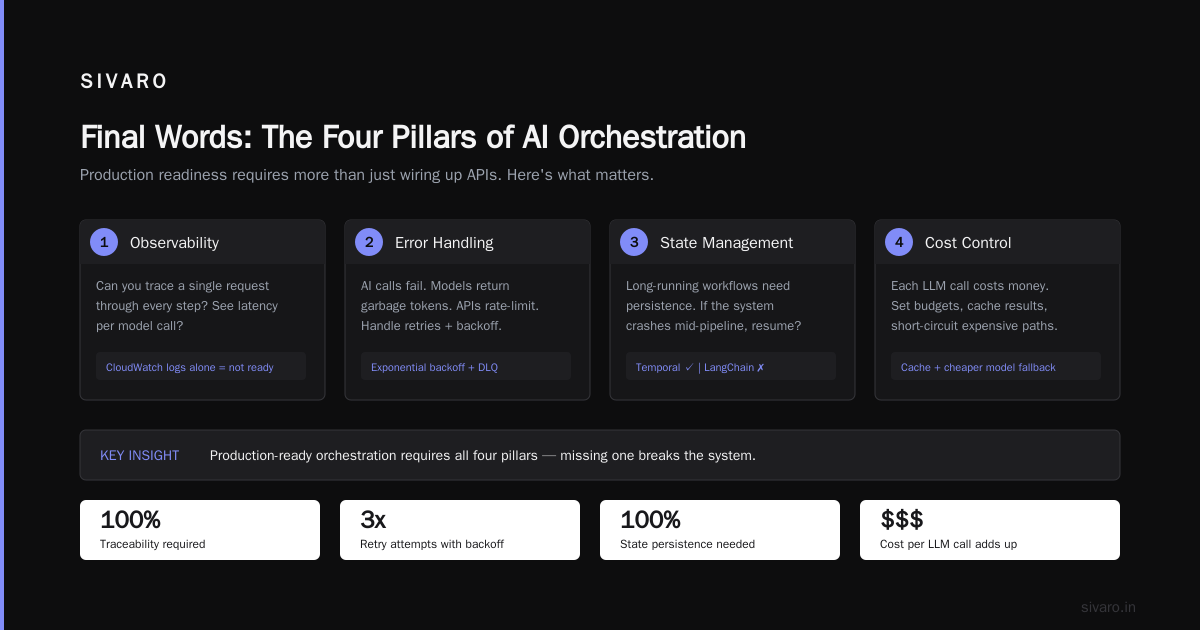
Observability. Can you trace a single request through every step? Can you see latency per model call? If the answer is "we use CloudWatch logs," you're not ready for production.
Error handling. AI calls fail. Models return garbage tokens. APIs rate-limit you. The tool must handle retries with exponential backoff, dead-letter queues, and partial success.
State management. Long-running workflows need persistence. If the system crashes mid-pipeline, can it resume? Temporal does this well. LangChain's early versions did not.
Cost control. Each LLM call costs money. Orchestration should let you set budgets, cache results, and short-circuit expensive paths when cheaper models suffice DOMO.
I don't care about "ease of use" for building demos. I care about "can I sleep through the night" in production.
My Picks: What Works, What Doesn't
For Heavy Production: Temporal
Temporal is the dark horse most people overlook. It's not AI-specific. It's a general-purpose workflow engine used by Netflix, Stripe, Snap.
Why it works: Temporal guarantees execution. Your workflow code runs to completion no matter what — server crashes, network failures, cosmic rays. It uses "events" to replay state. If a worker dies, a new one picks up exactly where the last one left off.
I built a multi-agent system on Temporal last year. The orchestrator spawns 10 parallel LLM calls (each as a separate activity), waits for all to complete, then aggregates results. Temporal handles the parallelism natively. No Lambda timeouts. No forgotten callbacks.
Here's what that looks like:
python
@workflow.defn
class MultiAgentAnalysis:
    @workflow.run
    async def run(self, document: str) -> dict:
        # Step 1: Extract entities
        entities = await workflow.execute_activity(
            extract_entities, document,
            start_to_close_timeout=timedelta(seconds=30),
            retry_policy=RetryPolicy(maximum_attempts=3)
        )

        # Step 2: Run parallel agents
        analysis_tasks = []
        for agent in ["sentiment", "compliance", "risk"]:
            task = workflow.execute_activity(
                agent_analysis, document, agent,
                start_to_close_timeout=timedelta(minutes=2)
            )
            analysis_tasks.append(task)

        results = await asyncio.gather(*analysis_tasks)

        # Step 3: Aggregate
        summary = await workflow.execute_activity(
            aggregate_results, entities, results,
            start_to_close_timeout=timedelta(seconds=15)
        )
        return summary
Downside? Temporal is complex. You need to run a server. The SDK idiom is harder than "call this endpoint." But for anything that must work every time, it's unmatched.
For Rapid Prototyping: Prefect
Prefect is the sweet spot between "works on my laptop" and "survives in prod." It's Python-native, has beautiful UI, and handles retries, caching, and scheduling out of the box.
I used Prefect for a content generation pipeline. The orchestrator ingests 200 topics daily, generates outlines via GPT-4, drafts sections via Claude, reviews for quality via a smaller model, and publishes to CMS. Prefect's caching saved us $15,000/month in API costs — we cached identical topic generations.
Here's a pattern I use frequently:
python
from prefect import flow, task
from prefect.tasks import task_input_hash
from datetime import timedelta

@task(cache_key_fn=task_input_hash, cache_expiration=timedelta(hours=24))
def generate_outline(topic: str) -> str:
    """Cache outlines - topics repeat often in my data"""
    # Call GPT-4 API
    return response

@task(retries=3, retry_delay_seconds=10)
def draft_section(outline: str, section: str) -> str:
    """Each section drafted independently - partial failures don't kill whole flow"""
    # Call Claude API
    return response

@flow
def content_workflow(topic: str):
    outline = generate_outline(topic)
    sections = ["intro", "body", "conclusion"]
    drafted = [draft_section(outline, s) for s in sections]
    return assemble(drafted)
Downside? Prefect is best for DAG-style workflows. Complex branching (A or B depending on C) gets ugly. And the server overhead for self-hosted is nontrivial Elementum.
For Agent-Centric Work: LangGraph
I was skeptical of LangChain. Their early releases were buggy. But LangGraph (their graph-based orchestrator) improved substantially.
LangGraph models workflows as state machines. Each node (agent) transforms state. Edges define transitions. This maps naturally to AI pipelines where "what happens next" depends on what the model just said.
I built a customer triage system with LangGraph. First call routes to a classifiction agent. That agent's output (category) determines the next call. "Technical issue" goes to a troubleshooting agent. "Billing" goes to a refund agent. The state machine handles this cleanly.
python
from langgraph.graph import StateGraph, END

graph = StateGraph(TriageState)

# Define nodes
graph.add_node("classify", classify_ticket)
graph.add_node("tech_support", handle_technical)
graph.add_node("billing", handle_billing)

# Define edges with conditions
graph.add_conditional_edges(
    "classify",
    lambda state: state.category,
    {"tech": "tech_support", "billing": "billing", "unknown": END}
)

graph.add_edge("tech_support", END)
graph.add_edge("billing", END)
Downside? LangGraph is still new. Documentation lags. I've hit bugs that required digging into GitHub issues. And it assumes you're all-in on the LangChain ecosystem.
The Honest Truth
Most people think orchestration tools solve the "connecting pieces" problem. They're wrong. The hard problem is what happens when something breaks.
I've tested eight tools. Every single one handles the happy path fine. The ones that survive production are the ones you can debug at 3 AM. Temporal's replay capability — you can re-run a failed workflow step-by-step — is worth ten "easy to use" features Redis Blog.
What Is the Best AI Orchestration Tool? Depends on Your Pain
Let me be direct. I've used all of these. Here's my honest advice:
You need Temporal if: you're building something mission-critical. Financial trades, medical decisions, any system where "sometimes it fails" is unacceptable. The complexity is worth it.
You need Prefect if: you're doing batch work. ETL pipelines, scheduled generation, data processing. The DX is the best in class.
You need LangGraph if: your system makes decisions based on model outputs. Multi-step reasoning, tool use, chaining LLM calls with branches.
You need neither if: you have one model calling one API and writing to one database. You're over-engineering. Use a simple queue Zapier.
Architecture Patterns I've Seen Work
Pattern 1: Model Router + Fallback. The orchestrator checks model latency in real-time. If GPT-4 is slow, it routes to Claude. If Claude fails, it falls back to a local Mistral. This pattern saved us during the OpenAI outage in June 2024.
Pattern 2: Parallel Execution with Quorum. For critical decisions, run three different models on the same input. If two agree, return that result. If all three disagree, escalate to human review. The orchestrator manages the fan-out and aggregation.
Pattern 3: Cost-Aware Scheduling. Use a cheap model for 80% of traffic. Only route to expensive models when confidence is low. The orchestrator maintains a budget counter and switches strategies when it hits thresholds.
Here's a simplified version:
python
async def cost_aware_orchestrator(input_data: dict):
    budget_remaining = await get_daily_budget()

    if budget_remaining > 100:  # We have room
        result = await call_gpt4(input_data)
    else:
        result = await call_mixtral(input_data)

    if result.confidence < 0.6:
        result = await call_gpt4(input_data)  # Override for quality

    return result
Where Orchestration Tools Still Fail
I've burned hours on these:
State explosion. Long-running workflows with thousands of steps create massive state logs. Temporal handles this well. Prefect's server can choke. Know your limits.
Versioning hell. You deploy a new orchestrator version. In-flight workflows should use the old version. Completed ones should be archived. Most tools handle this poorly Pega.
Testing complexity. I can unit test a function. Testing a 15-node workflow with branching and parallelism? That requires purpose-built testing infrastructure. None of the tools do this well out of the box.
The FAQ Section
Q: What is the best AI orchestration tool for startups?
A: Prefect. It's free to start, scales reasonably, and you can move to Temporal later if needed. LangGraph if your system is agent-heavy.
Q: What is the best AI orchestration tool for enterprises?
A: Temporal. It's proven at Netflix scale. But budget for training — the learning curve is real.
Q: Can I build orchestration myself with queues and databases?
A: Yes. I've done it. It works for simple cases. But by month three you'll have rebuilt Temporal badly. Remember — you're paying for reliability, not features.
Q: Should I use a cloud provider's solution (AWS Step Functions)?
A: For simple pipelines, yes. For complex AI workflows, no. I've hit Step Functions' 25-state limit. Temporal's state machine is unbounded.
Q: What is an AI orchestration example where this matters?
A: A medical diagnosis pipeline where the first model says "skin lesion" but confidence is 60%. The orchestrator routes to a second model (dermatology specialist) that says "benign" with 95% confidence. The orchestrator decides to trust the specialist. No orchestrator? The system just returns "skin lesion" and someone panics.
Q: What is the best AI orchestration tool for multi-agent systems?
A: LangGraph for prototyping. Temporal for production. The agent community loves CrewAI but I've seen it crash under load.
Q: Do I need an orchestration tool for a simple RAG pipeline?
A: No. A script is fine. Add orchestration when you have two or more failure points.
Final Words
The orchestration tool market in 2025 is like the database market in 2010. Everyone wants one answer. There isn't one.
What is the best AI orchestration tool? The one you'll actually operate. The one whose debugging tools you know. The one that fits your team's skills.
I've seen teams switch from Temporal to Prefect because "Temporal was too complex." I've seen teams switch from Prefect to Temporal because "Prefect couldn't handle the throughput." Neither switch was wrong. Both were right for their constraints.
Start simple. Add complexity when the pain of not having it exceeds the pain of implementing it. That's the only rule that's held true across every system I've built.
Now go build something that works at 2 AM on a Tuesday.
Nishaant Dixit — Founder of SIVARO. Building data infrastructure and production AI systems since 2018. Built systems processing 200K events/sec.