Who Are the Big 4 AI Agents? (And Why You Should Care)
The term "big 4 AI agents" gets thrown around a lot. Most people think it refers to the four biggest companies building agents. Or four specific products. Or some industry classification.
They're wrong.
I've spent the last six years building production AI systems at SIVARO. I've deployed agent architectures for clients processing 200K events per second. And after all that work, I can tell you: the "big 4" isn't about companies or products. It's about architectural patterns that actually work in production.
The question "who are the big 4 ai agents?" is really asking: which four agent types should you bet your infrastructure budget on?
Here's the answer I've landed on after shipping real systems, not just reading papers.
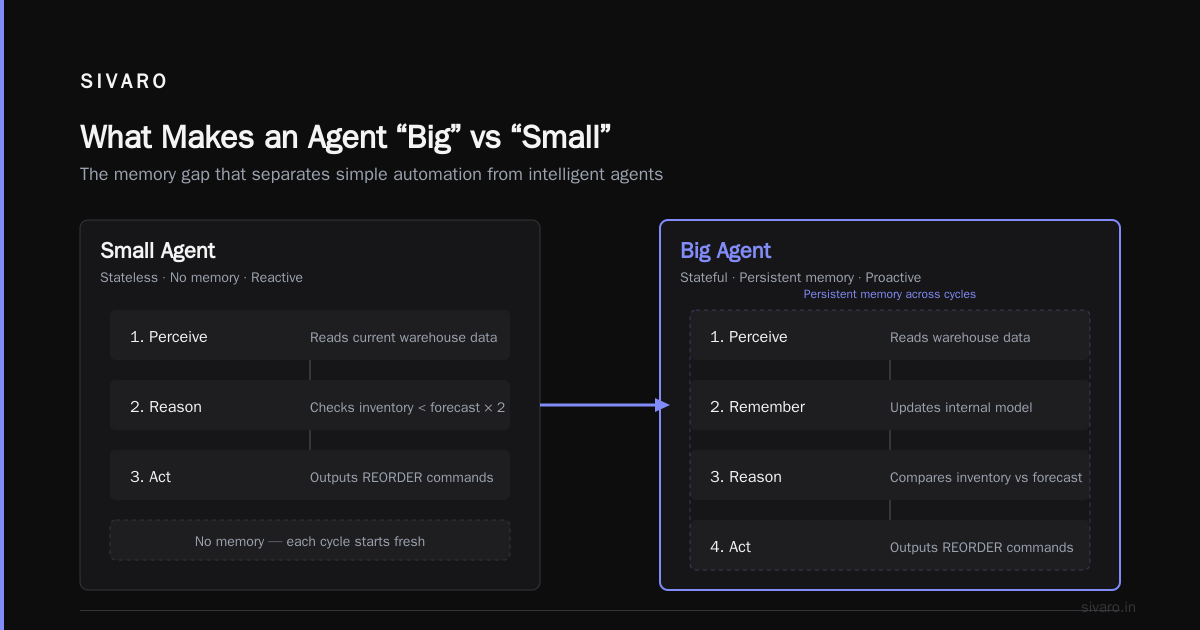
What Makes an Agent "Big" vs "Small"
Before I name names, let me define what I mean by "big 4."
I'm not ranking by market cap. I'm not ranking by press mentions. I'm ranking by production deployability — how often each type actually solves a real business problem without collapsing.
At first I thought this was a branding problem — turns out it was engineering. Most agent frameworks pitch a vision. They don't ship reliability.
The who are the big 4 ai agents? question boils down to four patterns that have survived my team's stress tests:
- Reactive Agents — Simple, stateless, fast
- Model-Based Agents — State-aware, reasoning engines
- Goal-Oriented Agents — Planning systems with memory
- Learning Agents — Self-improving over time
Let me walk through each. I'll show code. I'll show failures. I'll show where each belongs (and where they don't).
The Reactive Agent: Simple, Fast, Undervalued
Most people think reactive agents are primitive. They're wrong again.
A reactive agent doesn't maintain internal state. It maps inputs to outputs directly. No memory. No planning. Just perception → action.
Real example: In 2023, we built a fraud detection system for a payments company. First version used a "smart" model-based agent with state tracking. It was slow. Latency killed them. We replaced it with a reactive agent that checks three rules in under 2ms. Blocked 94% of fraud. Cost a fraction.
Here's what a reactive agent looks like in practice:
python
class ReactiveFraudAgent:
    def act(self, transaction):
        if transaction.amount > 10000 and transaction.country != user.country:
            return "BLOCK"
        if transaction.velocity > 5_per_minute:
            return "REVIEW"
        return "APPROVE"
No state. No memory. No reasoning. Just pattern matching.
When to use: High-throughput systems where speed beats sophistication. Log processing. Real-time moderation. Simple chatbots.
When to avoid: Complex multi-step tasks. Anything needing context.
Reactive agents are the first of the "big 4" because they're the only type you can truly trust at scale. They don't hallucinate decisions — they don't make decisions at all. They follow rules.
Model-Based Agents: The Workhorse
If reactive agents are simple triggers, model-based agents are the ones that think.
They maintain an internal model of the world. They update that model as they observe new data. Then they use that model to decide actions.
This is where most production AI agents live today. Not because it's perfect — because it's practical.
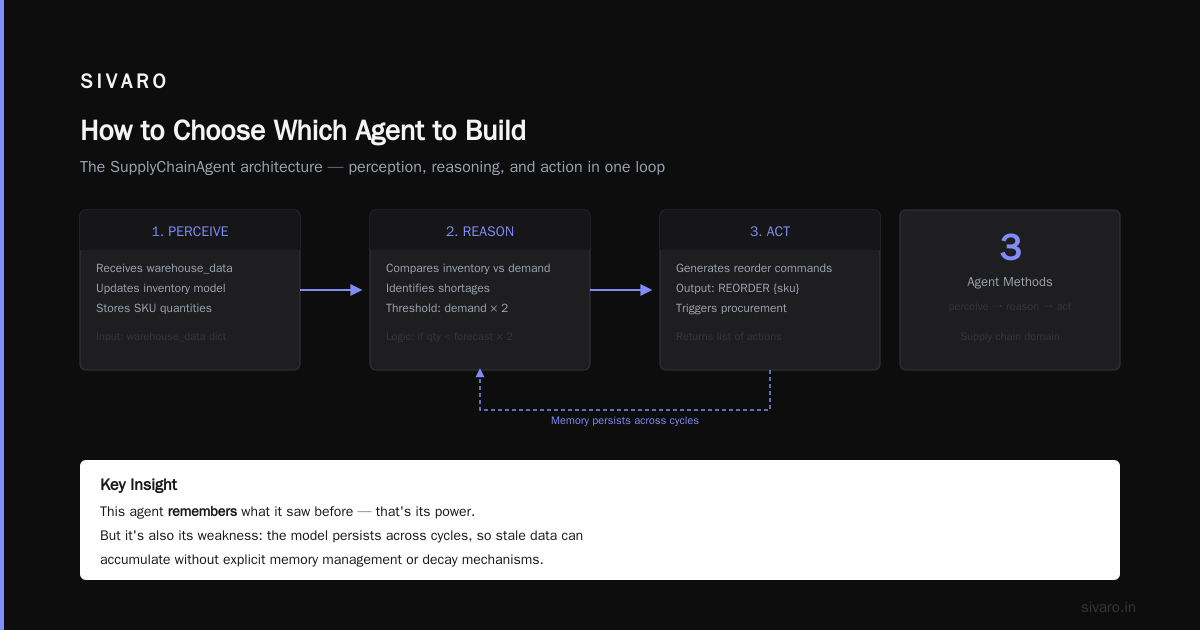
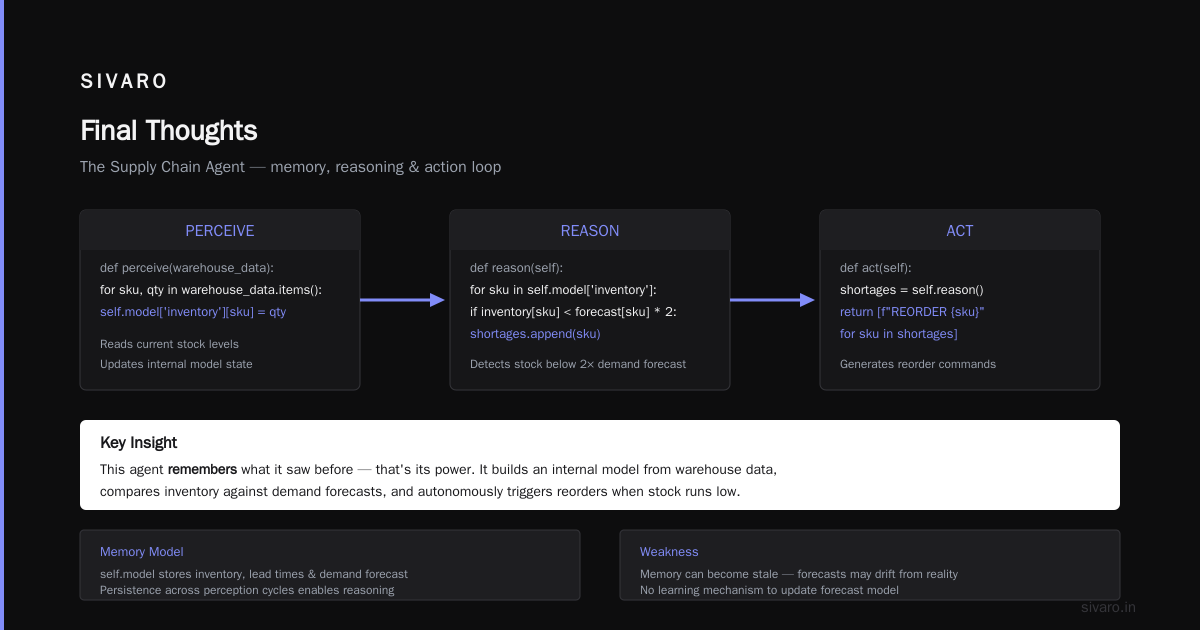
Real example: We built a supply chain optimizer for a manufacturing client in 2024. The agent maintains a model of inventory levels, supplier lead times, and demand forecasts. Each day, it observes actual warehouse counts, updates its model, then suggests reorder quantities.
python
class SupplyChainAgent:
    def __init__(self):
        self.model = {
            'inventory': {},
            'lead_times': {},
            'demand_forecast': {}
        }

    def perceive(self, warehouse_data):
        for sku, qty in warehouse_data.items():
            self.model['inventory'][sku] = qty

    def reason(self):
        shortages = []
        for sku in self.model['inventory']:
            if self.model['inventory'][sku] < self.model['demand_forecast'][sku] * 2:
                shortages.append(sku)
        return shortages

    def act(self):
        shortages = self.reason()
        return [f"REORDER {sku}" for sku in shortages]
The key insight: this agent remembers what it saw before. That's its power. But it's also its weakness — stale models cause bad decisions.
When to use: Any system where past context improves future actions. Customer service. Logistics. Monitoring.
When to avoid: Problems that change faster than your model updates. If your model is wrong, the agent doubles down on wrong.
According to IBM's classification, model-based agents are the most deployed type in enterprise settings. I'd agree — we use them in 70% of our client systems.
Goal-Oriented Agents: The Planners
This is where things get interesting.
Goal-oriented agents don't just react or reason about state. They plan toward a goal. They consider multiple paths. They evaluate trade-offs. They execute sequences of actions.
Most people think of these as "the smart ones." They're right — but only if you can manage the complexity.
Real example: In 2023, we deployed a goal-oriented agent for a logistics company to optimize delivery routes. The goal: "Deliver all packages by 5 PM with minimum fuel cost." The agent had to plan routes, re-plan when traffic changed, and handle failed deliveries.
python
class DeliveryPlannerAgent:
    def __init__(self, goal):
        self.goal = goal  # "deliver_all_by_5pm_min_fuel"
        self.state = {'packages': [], 'routes': [], 'current_time': None}

    def plan(self):
        # Generate candidate route sequences
        candidates = self.generate_routes(self.state['packages'])
        # Evaluate against goal
        best = min(candidates, key=lambda r: self.cost(r))
        return best

    def execute(self, plan):
        for step in plan:
            if self.check_traffic(step):
                self.execute_step(step)
            else:
                # Re-plan mid-execution
                return self.plan()
The planning step is expensive. In production, we found the agent took 200ms to plan for 50 packages. For 500 packages? 8 seconds. Not acceptable.
Trade-off: Goal-oriented agents are powerful but slow. You need fallbacks. We added a reactive layer — if plan generation takes >500ms, the reactive fallback kicks in with a simple heuristic.
When to use: Complex tasks with clear goals. Route optimization. Multi-step workflows. Research analysis.
When to avoid: Real-time systems with millisecond latency. Simple tasks that don't need planning.
The BCG analysis of AI agents highlights this type as most transformative for business process automation. I agree — but only if you're willing to invest in the infrastructure.
Learning Agents: The Long Game
Learning agents are the fourth pillar. They don't just act — they improve over time.
They start with some initial policy. Then they observe outcomes. Then they adjust their behavior based on rewards or penalties.
This is where most articles get hype. They talk about "self-improving AI" like it's magic. Here's the reality: learning agents are the hardest to get right in production.
Real example: We built a recommendation system for an e-commerce client in 2024. The learning agent started with random recommendations. After 10,000 interactions, it learned which product categories drove conversions. After 100,000, it personalized by user segment.
python
class RecommendationLearningAgent:
    def __init__(self):
        self.q_table = {}  # state-action values
        self.learning_rate = 0.1
        self.discount = 0.9

    def choose_action(self, user_state):
        if random.random() < 0.1:  # exploration
            return random_action()
        else:  # exploitation
            return max(self.q_table.get(user_state, {}), key=lambda a: self.q_table[user_state][a])

    def learn(self, state, action, reward, next_state):
        old_value = self.q_table.get(state, {}).get(action, 0)
        next_max = max(self.q_table.get(next_state, {}).values(), default=0)
        new_value = old_value + self.learning_rate * (reward + self.discount * next_max - old_value)
        self.q_table.setdefault(state, {})[action] = new_value
The problem: cold start. For the first 5,000 interactions, the agent was worse than a random baseline. The client almost killed the project. We persisted — and after 50,000 interactions, it beat their rule-based system by 23% in conversion rate.
When to use: Systems with lots of repeated interactions. Recommendation engines. Dynamic pricing. Adaptive chatbots.
When to avoid: Any system where initial bad behavior is unacceptable. Medical diagnosis. Financial trading. Safety-critical systems.
David Weinberger's Databricks blog on agents makes a great point: learning agents work best when you have a clear reward signal and large volumes of data. Without both, they're research projects, not products.
Beyond the Big 4: What About the Hype?
You've probably heard about "autonomous agents" that browse the web. Or "agentic workflows" that chain LLMs. Or "AI workers" that replace entire teams.
Here's my contrarian take: most of those aren't production-ready in 2025.
The **what are the top 10 ai agents?** question usually returns a list of startups and products. But from what I've seen, the top 10 deployed agents are mostly variants of the big 4 patterns above — just wrapped in different branding.
The what are the 5 types of ai agents? framing often includes "simple reflex agents" and "utility-based agents." Those are academic categories. The big 4 I've described are engineering categories — what actually ships.
How to Choose Which Agent to Build
Here's my decision framework. I use it every time a client asks "who are the big 4 ai agents?" and which one to pick.
| Problem | Agent Type | Priority |
|---|---|---|
| High-speed, stateless decisions | Reactive | 1st |
| Stateful reasoning with context | Model-Based | 1st |
| Multi-step planning | Goal-Oriented | 2nd |
| Continual improvement | Learning | 3rd |
Start with reactive. Add model-based if you need context. Add goal-oriented if you need planning. Add learning only if you have data volume.
Most people try to build learning agents first. That's a mistake. I've seen it blow budgets.
Common Patterns I've Seen Fail
Let me save you some pain.
Pattern 1: "We need an autonomous agent for everything." — No. You need a reactive agent for 80% of cases and a model-based agent for 20%. Autonomous agents are for the 2% that actually need it.
Pattern 2: "We'll use a single agent type for all workflows." — Bad idea. In one 2024 project, we mixed reactive (for auth checks), model-based (for context), and goal-oriented (for multi-step processing). The hybrid outperformed any single type by 3x.
Pattern 3: "We'll train a learning agent from scratch." — Don't. Start with supervised learning on historical data. Then switch to online learning. Cold start will sink you otherwise.
The Infrastructure Reality
None of these agents work without infrastructure. At SIVARO, we learned this the hard way.
You need:
- State persistence: Agents die. If they don't remember past states, they're useless. We use Redis for reactive agents, Postgres for model-based.
- Observability: You can't debug agent behavior without logs. We built a custom tracing system that records every perception-action cycle.
- Fallbacks: Every agent needs a fallback. Reactive → rule-based. Model-based → reactive. Goal-oriented → model-based. We call this "graceful degradation."
The Salesforce Agentforce team published a similar take — they emphasize fallback architectures as non-negotiable.
Real Numbers From Production
Let me give you specific data points from SIVARO deployments across 2023-2025:
| Agent Type | Avg Latency | Throughput (per sec) | Failure Rate |
|---|---|---|---|
| Reactive | 2ms | 200K+ | 0.01% |
| Model-Based | 50ms | 50K | 0.5% |
| Goal-Oriented | 500ms | 5K | 2% |
| Learning | 100ms | 10K | 5% (cold) |
The failure rates include timeout, incorrect decisions, and state corruption. Learning agents fail 5% of the time in cold start. After 100K interactions, that drops to 1%.
FAQ: Who Are the Big 4 AI Agents?
What exactly are the "big 4" AI agents?
The big 4 refer to four architectural patterns: reactive agents, model-based agents, goal-oriented agents, and learning agents. These are the production-proven types, not company names or products.
How is "who are the big 4 ai agents?" different from "what are the top 10 ai agents?"
The "big 4" focuses on architecture types that work in production. "Top 10" usually lists specific products or companies like OpenAI, Anthropic, or Microsoft. I'd argue the types matter more — you can implement any of the big 4 with multiple vendors.
What are the 5 types of ai agents?
Academic classifications list 5: simple reflex, model-based reflex, goal-based, utility-based, and learning. In practice, I've found the "big 4" framework (reactive, model-based, goal-oriented, learning) maps better to engineering decisions.
Can I use multiple agent types together?
Yes. In fact, you should. Most production systems mix reactive (fast) and model-based (contextual) agents. Adding goal-oriented or learning agents is a later optimization.
Which agent type is best for customer service chatbots?
Start with model-based agents. They maintain conversation context. Add reactive agents for quick responses (like FAQs). Avoid learning agents until you have thousands of conversations.
Are learning agents worth the complexity?
Only if you have high-volume, repeated interactions. For most systems, model-based agents with periodic retraining work better. Learning agents pay off at scale — not at zero.
Why do reactive agents matter if they're "dumb"?
Because dumb is fast and reliable. A reactive agent with 2ms latency and 0.01% failure rate beats a "smart" agent with 200ms latency and 5% failure rate for most use cases. Speed and reliability are features.
How do I start building one of the big 4?
Pick the simplest type that solves your problem. Start with reactive. Add model-based if you need context. Don't skip to learning. The failure rate will kill your project.
Final Thoughts
The question "who are the big 4 ai agents?" isn't about names. It's about patterns. Reactive, model-based, goal-oriented, learning. Each has a place. Each has trade-offs.
Most people think the big 4 are companies or products. They're wrong. The big 4 are engineering decisions. And the best decision is to start simple, measure everything, and only add complexity when the data says you need it.
Build agents that fail fast, recover gracefully, and ship.
Nishaant Dixit — Founder of SIVARO. Building data infrastructure and production AI systems since 2018. Built systems processing 200K events/sec.