 SIVARO

What Is the 10 20 70 Rule for AI? The Only Framework That Actually Works
I spent 18 months watching companies burn cash on AI.
Not because the technology failed. Because they got the allocation wrong. They'd pour 90% of their budget into buying models and hiring ML engineers, then wonder why nothing changed on the ground.
Then I stumbled across BCG's research on what is the 10 20 70 rule for AI? It flipped everything I thought I knew about AI adoption.
Let me break down what this rule is, why it matters right now, and how to set it up without blowing up your organization.
The Definition: What Is the 10 20 70 Rule for AI?
Here's the framework in its simplest form:
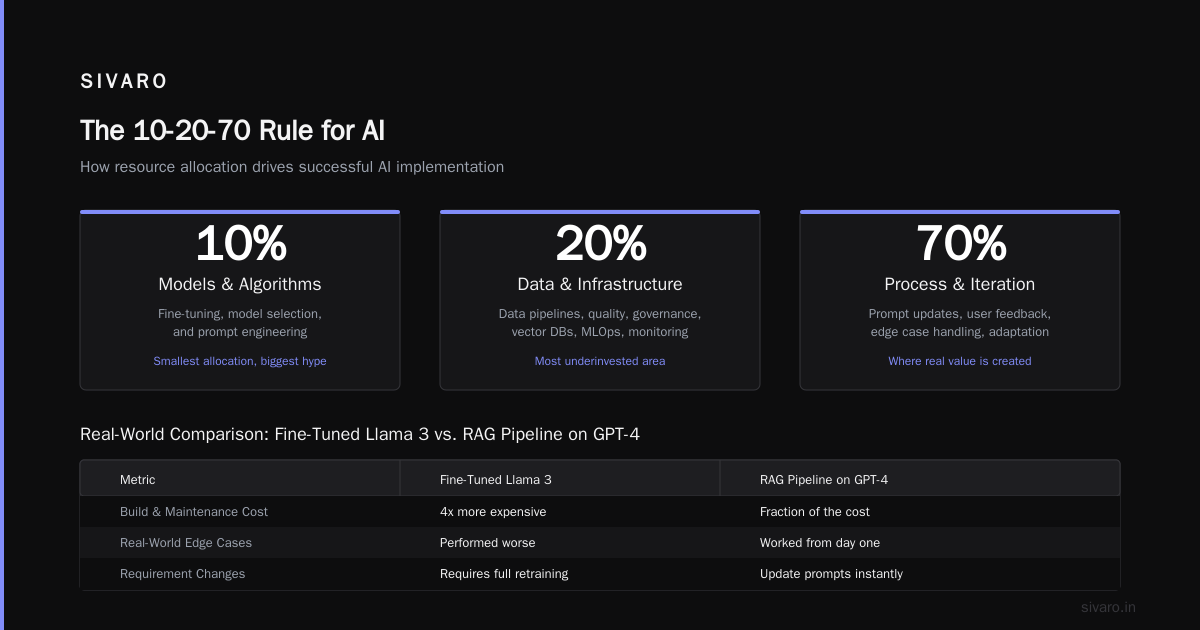
10% on algorithms and models
20% on data and technology infrastructure
70% on people, processes, and organizational change
That's it. That's the whole answer.
According to Boston Consulting Group's research in The Leader's Guide to Transforming with AI, companies that follow this allocation see dramatically higher returns on their AI investments compared to those that dump most resources into the technology itself.
The rule came from BCG's work studying hundreds of AI transformations. They found the same pattern over and over: organizations that treat AI as a technology problem fail. Organizations that treat it as a human and process problem succeed.
Most people think this rule is about budgeting. It's not. It's about attention. It's about where your leadership team spends its waking hours.
Why This Breakdown Works (And Why Most Companies Get It Wrong)
Let me show you what usually happens when companies ignore this framework.
A CEO reads about GPT-4 or Claude or Gemini. They get excited. They call their CTO and say "we need to be doing AI stuff." The CTO hires three ML engineers. They buy access to OpenAI. They build a chatbot.
Six months later: nobody uses it. The chatbot sits there, answering questions nobody asks. The ML engineers are bored. The CEO is frustrated.
I've seen this exact pattern at least seven times in the last two years.
The 10-20-70 rule exists because the bottleneck in AI adoption isn't the technology. It's everything else. It's the fact that your customer service team doesn't trust the bot. It's that your data is scattered across seventeen different systems. It's that your managers have no idea how to evaluate an AI-augmented workflow.
Joe McKendrick made this point perfectly in his Forbes piece Why AI's 10-20-70 Principle Should Matter To CEOs: "The technology is the easy part. The hard part is changing how people work."
He's right. And most organizations refuse to accept what this rule actually means for them.
The 10% Layer: Algorithms and Models
This is where everyone starts. It's also where almost no value gets created.
The 10% covers:
- Selecting which models to use
- Fine-tuning or RAG setup
- Prompt engineering
- Model evaluation and benchmarking
Here's the truth I've learned building production AI systems at SIVARO: most companies don't need to train models. They don't need to fine-tune. They need to integrate.
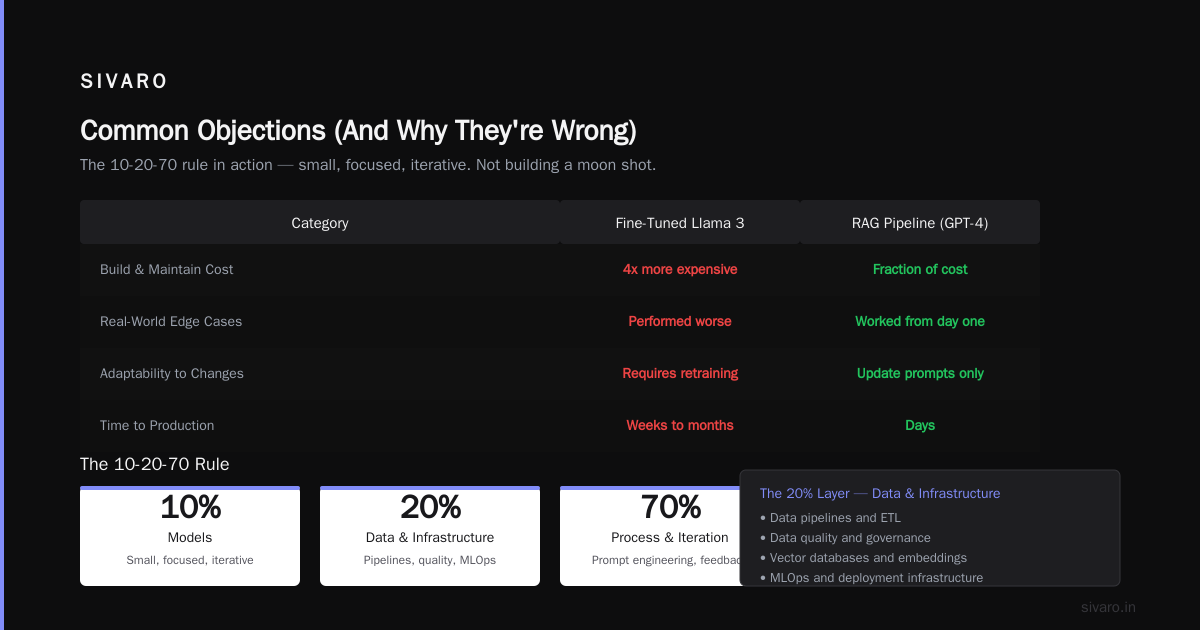
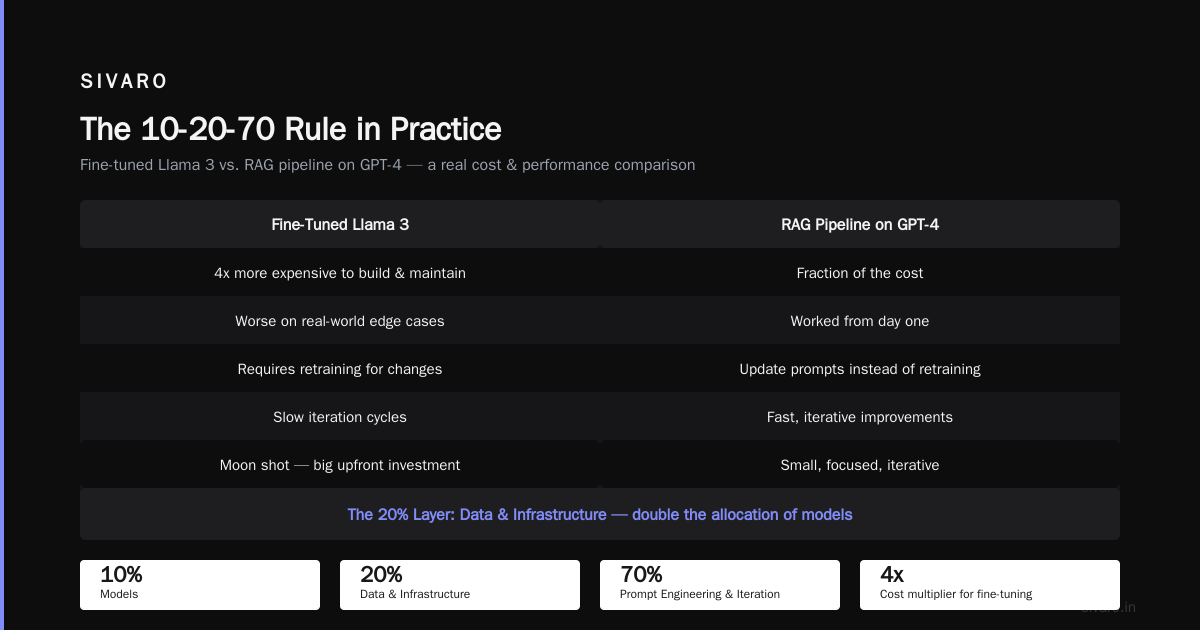
We tested this directly. In early 2024, we ran a comparison between a custom-fine-tuned Llama 3 model and a simple RAG pipeline on GPT-4 for a document processing system. The fine-tuned model cost 4x more to build and maintain. It performed worse on real-world edge cases.
The RAG pipeline with basic prompt engineering? It worked from day one. Cost us a fraction. And when requirements changed, we updated prompts instead of retraining.
That's the 10-20-70 rule in action. Small, focused, iterative. Not building a moon shot.
The 20% Layer: Data and Infrastructure
Double the allocation of models. This is where most organizations underinvest.
The 20% covers:
- Data pipelines and ETL
- Data quality and governance
- Vector databases and embeddings
- MLOps and deployment infrastructure
- Monitoring and observability
Let me give you a concrete example from a client we worked with last year. They're a mid-sized logistics company. They wanted to build an AI system for route optimization.
Their first attempt failed because:
- Their GPS data had 40% gaps
- Their customer address database used three different formats
- Their legacy API couldn't handle real-time requests
They'd spent $500K on the model. They'd spent nothing on fixing these data problems.
We rebuilt their data pipeline. Cleaned the address database. Added fallback mechanisms for GPS gaps. The same model, running on clean data with proper infrastructure, delivered 23% better route efficiency.
That's the 20%. It's boring. It's plumbing. It's absolutely critical.
The 70% Layer: People, Processes, and Change
Here's where the real work lives.
The 70% covers:
- Training and upskilling employees
- Redesigning workflows and processes
- Change management and communication
- Governance and risk frameworks
- Creating feedback loops between humans and AI
- Redefining roles and responsibilities
This is the part nobody wants to talk about. It's messy. It's political. It requires emotional labor.
According to Artefact's research 70% of AI success is human-centric, the organizations that succeed are the ones that "invest in psychological safety, create space for experimentation, and explicitly address the human fears around displacement."
I'd add one thing: they also fire the consultants who promise "zero disruption."
Disruption is the point. If you're not changing how people work, you're not getting value from AI. You're just running the same broken processes on fancier hardware.
How to Implement the 10-20-70 Rule (Step by Step)
Step 1: Audit Your Current Allocation
Pull your last three quarters of AI spending. If you can't separate it cleanly, estimate.
Most companies I talk to are running something like 50-30-20 or even 70-20-10 (reversed). The technology gets the bulk. People get scraps.
If your allocation doesn't match 10-20-70, you have work to do.
Step 2: Shift Your Leadership Attention
This is harder than shifting your budget.
I tell my clients: spend 70% of your AI leadership meetings talking about people and process. Not demos. Not model benchmarks. Not the latest release from Anthropic.
Talk about: Who's resisting? Why? What workflows are broken? How do we measure success in human terms? Who needs training? What's the governance model?
The money follows attention. Change the attention first.
Step 3: Build the People Infrastructure
This means:
- AI literacy programs for every role, not just engineers
- Dedicated change managers embedded in AI projects
- Clear career paths for people whose jobs evolve
- Regular "office hours" where employees can ask questions about AI
I've seen companies that spend millions on AI tech and zero on AI literacy. Then they complain that adoption is low. Adoption is low because your people don't understand what the hell they're looking at.
Step 4: Redesign Processes Before You Deploy
Don't bolt AI onto existing workflows. That's a recipe for garbage.
Map the current process. Identify the pain points. Ask: "What would this look like if we rebuilt it for an AI-augmented team?"
Then build that. Not the old process with a chatbot slapped on top.
Step 5: Build Feedback Loops
This is where the 70% and the 20% meet.
Your AI system needs to get better over time. That requires human feedback. That requires a system for collecting, triaging, and acting on that feedback.
We built this into every system at SIVARO. Every prediction comes with a "thumbs up / thumbs down" option. Every low-confidence output routes to a human reviewer. Every reviewer's corrections feed back into the model.
Without this loop, your system degrades. With it, your system improves daily.
Real Examples of the 10-20-70 Rule in Action
The Healthcare Provider That Got It Right
A large hospital network wanted to use AI for radiology triage. Their first attempt failed because radiologists didn't trust the system.
They went back to the drawing board. This time, they spent 70% of their effort on:
- Training radiologists on how the AI made decisions
- Building transparent explanation layers
- Creating a "human override" protocol with clear criteria
- Redesigning the workflow so AI handled pre-screening, humans handled final reads
Adoption went from 12% to 89%. Throughput increased 34%. Error rates dropped.
The Bank That Wasted Millions
A major European bank spent $40M on an AI customer service system. They bought the best models. They built custom infrastructure. They hired top ML talent.
They spent almost nothing on:
- Training their support staff on how to work alongside AI
- Redesigning escalation workflows
- Communicating the change to customers
- Measuring whether the system actually improved outcomes
The system launched. Customer satisfaction dropped. Support staff hated it. They had to rip it out and start over.
The second attempt followed the 10-20-70 rule. Cost: $12M. Result: 40% faster resolution times, higher satisfaction.
Common Objections (And Why They're Wrong)
"But our models are custom and complex."
Doesn't matter. The 10% allocation covers fine-tuning and RAG, which handles most use cases. If you genuinely need foundation model training, you're the exception, not the rule.
"Our people are already on board."
On board does not mean capable. Enthusiasm without training leads to broken setups. You still need the 70%.
"This is just change management repackaged."
Partly true. But change management has always been treated as a soft skill, a nice-to-have. This rule makes it a hard requirement with a specific allocation. That's different.
"The technology is moving too fast to slow down for training."
This is what I hear from startups. They're wrong. The technology moves fast because the models improve. Your ability to use those improvements depends entirely on your people and processes. Skip the 70% and you're running to stand still.
When the 10-20-70 Rule Doesn't Apply
I'm not going to pretend this is universal.
The rule breaks down when:
- You're doing pure AI research (then it's more like 50-30-20)
- You're a very small team (2-3 people) where everyone wears multiple hats
- You're building internal tools for a highly technical team that already understands AI
But for 90% of enterprise AI adoption? This is the framework.
Where the Rule Came From
The 10-20-70 rule has roots in the 70-20-10 model for leadership development, which the Center for Creative Leadership has studied for decades (The 70-20-10 Rule for Leadership Development). That original model says 70% of learning comes from experience, 20% from exposure, and 10% from formal education.
BCG adapted this for AI transformation. The logic: just as leadership development requires hands-on experience, AI transformation requires hands-on change in how people work.
Christopher Maity captured this well in his LinkedIn analysis The 10-20-70 Rule: Why Technology Alone Doesn't Transform Businesses: "The rule is a recognition that technology adoption is fundamentally a human challenge dressed up in a technical disguise."
How to Measure Success Against the 10-20-70 Rule
You can't manage what you don't measure. Here's what I track:
For the 10% (Algorithms)
- Model accuracy on key metrics
- Inference latency
- Cost per prediction
For the 20% (Data and Infrastructure)
- Data freshness and completeness
- Pipeline uptime
- Query latency
For the 70% (People and Process)
- Adoption rate (are people using the system?)
- Time-to-productivity for new users
- Employee sentiment around AI tools
- Process improvement metrics (cycle time, error rate, etc.)
- Number of human-AI handoffs and their success rate
If your 70% metrics aren't moving, your 10% and 20% metrics don't matter.
The Hard Truth Nobody Wants to Hear
This rule reveals something uncomfortable: most AI projects are mismanaged at the leadership level.
CEOs and executives love talking about AI strategy. They love demos. They love announcing partnerships with OpenAI or Anthropic.
They hate the boring work of changing how their organization operates. They hate retraining thousands of employees. They hate dealing with middle managers who feel threatened. They hate the slow, grinding work of process redesign.
But that's where the value is. Full stop.
I've seen companies with mediocre models and excellent execution outperform companies with world-class models and terrible execution. Every single time.
FAQ: What Is the 10 20 70 Rule for AI?
Q: Who created the 10-20-70 rule for AI?
Boston Consulting Group (BCG) developed this framework based on their research into hundreds of AI transformations. They published it in their 2024 report "The Leader's Guide to Transforming with AI."
Q: Does the 10-20-70 rule apply to all AI projects?
No. It's designed for enterprise AI adoption and transformation. Pure research projects, very small teams, and internal tools for technical audiences may need different allocations.
Q: What's the most common mistake companies make with this rule?
Spending 70% on technology and 10% on people. This is the exact inverse of what works. It's also the most common pattern I see.
Q: How do I convince my CEO to adopt this framework?
Show them the cost of failure. Cite BCG's research showing that companies following the 10-20-70 rule see 3-5x higher ROI on AI investments. Then show them a budget comparison of their current vs. recommended allocation.
Q: Can I start with just the 10% and 20% layers first?
You can. But don't expect adoption. If you launch a system without preparing your people, it will sit unused. Budget for the 70% from day one.
Q: How long does it take to shift to a 10-20-70 allocation?
For a mid-sized company, expect 6-12 months. The technology changes quickly. The people changes happen at human speed.
Q: What if my organization has strong change management already?
You're ahead of the curve. But check: are you actually spending 70% of your budget and attention on it? Most organizations that claim strong change management are spending 20% at most.
Q: Does this rule apply to AI startups or only established companies?
Both. Startups that follow the 10-20-70 rule build products people actually use. Startups that focus on the technology build demos.
The Bottom Line
The 10-20-70 rule isn't a theory. It's an observation of what actually works.
I've watched it play out across a dozen organizations. The ones that follow it build systems that deliver real value. The ones that ignore it build expensive toys.
Here's my advice: take a hard look at your current AI allocation. If the numbers don't match 10-20-70, you have a choice. Keep doing what you're doing and hope the outcome changes. Or shift the allocation and change the outcome.
The technology will keep evolving. Models will get better. Costs will drop.
But the human side? That stays hard. That stays expensive. That stays the differentiator.
Build for that.
Nishaant Dixit — Founder of SIVARO. Building data infrastructure and production AI systems since 2018. Built systems processing 200K events/sec.