AI Decision Logging Retention Policy: SOC2 Type II Meets the EU AI Act Deadline
You're staring at a [[[[[[[[[[[[compliance](/articles/managed-soc2-compliance-ai-agents-pricing-comparison-ciso)](/articles/managed-soc2-compliance-ai-agents-pricing-comparison-ciso)](/articles/managed-soc2-compliance-ai-agents-pricing-comparison-ciso)](/articles/managed-soc2-compliance-ai-agents-pricing-comparison-ciso)](/articles/managed-soc2-compliance-ai-agents-pricing-comparison-ciso)](/articles/managed-soc2-compliance-ai-agents-pricing-comparison-ciso)](/articles/managed-soc2-compliance-ai-agents-pricing-comparison-ciso)](/articles/managed-soc2-compliance-ai-agents-pricing-comparison-ciso)](/articles/managed-soc2-compliance-ai-agents-pricing-comparison-ciso)](/articles/managed-soc2-compliance-ai-agents-pricing-comparison-ciso)](/articles/managed-soc2-compliance-ai-agents-pricing-comparison-ciso) matrix that says you need an AI Decision Logging Retention Policy that satisfies both SOC2 Type II and the EU AI Act's August 2026 deadline. Somewhere in your org, someone just asked: "Wait, do we keep the logs for six months or forever?"
I've been building data infrastructure since 2018. I've watched this confusion kill more than one compliance initiative. Here's what's actually happening, what you actually need to do, and why most advice you're getting is wrong.
An AI Decision Logging Retention Policy isn't a single checkbox. It's three overlapping requirements that need a coherent infrastructure strategy. Let me walk through each piece and show you how to build something that doesn't collapse under its own weight.
According to [Digital Applied's 2026 Guide](https://www.digitalapplied.com/blog/ai-agent-governance-policy-compliance-2026), the core tension comes from SOC2's risk-based approach versus the EU AI Act's prescriptive requirements. SOC2 says "document what makes sense for your risk profile." The EU AI Act says "you must log specific things for specific durations." These don't naturally align.
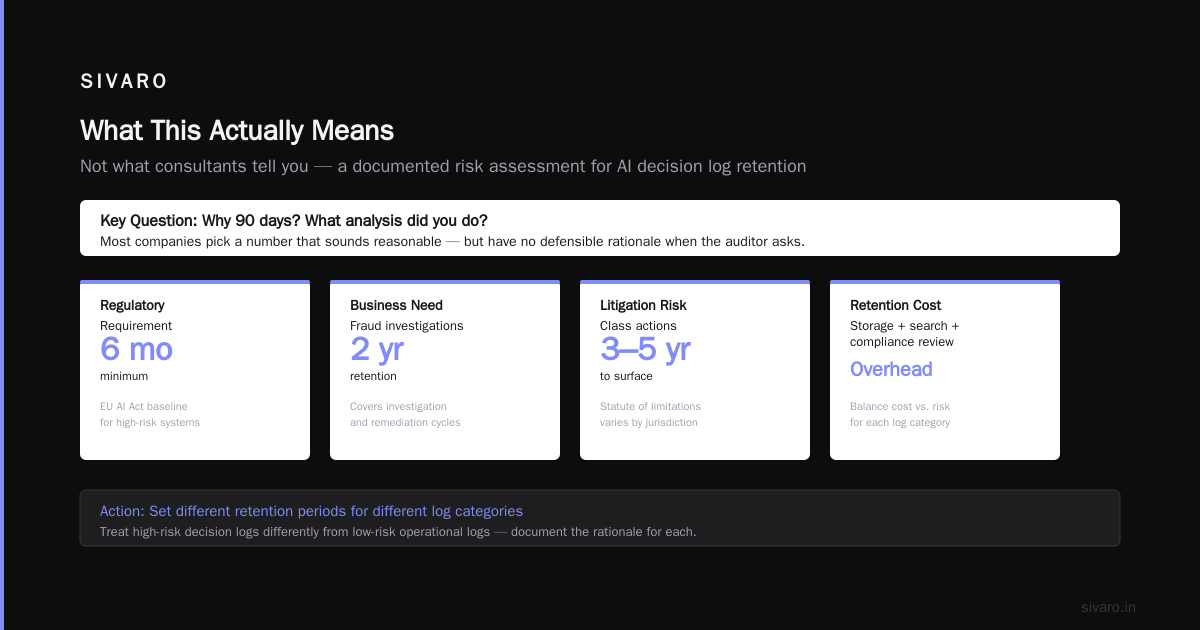
What This Actually Means (Not What Consultants Tell You)
Let me define each term bluntly.
AI decision logging means recording every time your AI system makes a decision that affects a user or a business outcome. Not every inference. Every decision that matters.
When a loan application gets rejected. When a medical triage system assigns a risk score. When a recruitment AI shortlists a candidate. Those decisions need timestamps, inputs, model version, confidence scores, and the human who reviewed it (if any).
Retention policy means how long you keep those logs. The EU AI Act says high-risk systems need logs retained for at least six months after deployment.
Here's the catch: that's the minimum. If you're processing PII under GDPR, you're looking at different retention rules. If you're under SOC2 Type II, your auditor wants to see a documented policy that matches your actual business needs.
SOC2 Type II is about controls over time. The auditor watches what you actually do for months, not just what you say you'll do. Your policy needs to work in practice, not just on paper.
EU AI Act deadline — the current regulatory framework from the European Commission says most provisions kick in by August 2026 (EU AI Act Regulatory Framework). For U.S. companies doing business in the EU, this isn't optional. HK Law's analysis confirms that any company whose AI system outputs are used in the EU falls under the Act's jurisdiction.
Why I Changed My Mind About Logging Everything
At SIVARO, we spent 2023 building what I thought was a bulletproof logging system. We logged every single inference. Every model call. Every input and output.
The storage cost was absurd — $40,000/month for a system doing 50K requests/day.
Worse: nobody reviewed those logs. The compliance team couldn't find what they needed. The engineers ignored them because searching petabytes of logs was miserable.
I was wrong. The goal isn't total logging. It's decision logging — recording only the decisions that have regulatory or business significance.
The Reddit thread on EU AI Act requirements captured this perfectly: developers are realizing the Act requires "decision logging and technical docs" not firehose logging.
What the EU AI Act Actually Requires for Logging
Here's the specific language from the regulatory framework. For high-risk AI systems, you must:
- Log the system's operation automatically throughout its lifetime
- Retain logs for at least 6 months after deployment
- Document model version, input data, output decisions, and any human oversight
- Make logs available to national authorities on request
D3 Security's compliance guide breaks this down further: the Act applies to anyone deploying AI systems in the EU, regardless of where the company is headquartered. If your SaaS platform serves EU customers and uses AI for decision-making, you're covered.
The kicker? The retention clock starts ticking after deployment ends. Deploy a model for 2 years, retire it, you need those logs for another 6 months minimum. Some member states may impose longer requirements.
SOC2 Type II's Different Approach
SOC2 Type II doesn't mandate specific retention periods. It mandates that you:
- Define a retention policy
- Follow it consistently
- Demonstrate you followed it over the audit period
- Have a defensible rationale for your choices
This is where I see companies screw up. They write a policy that says "we keep logs for 90 days" because it sounds reasonable. Then the auditor asks: "Why 90 days? What analysis did you do?" And they have nothing.
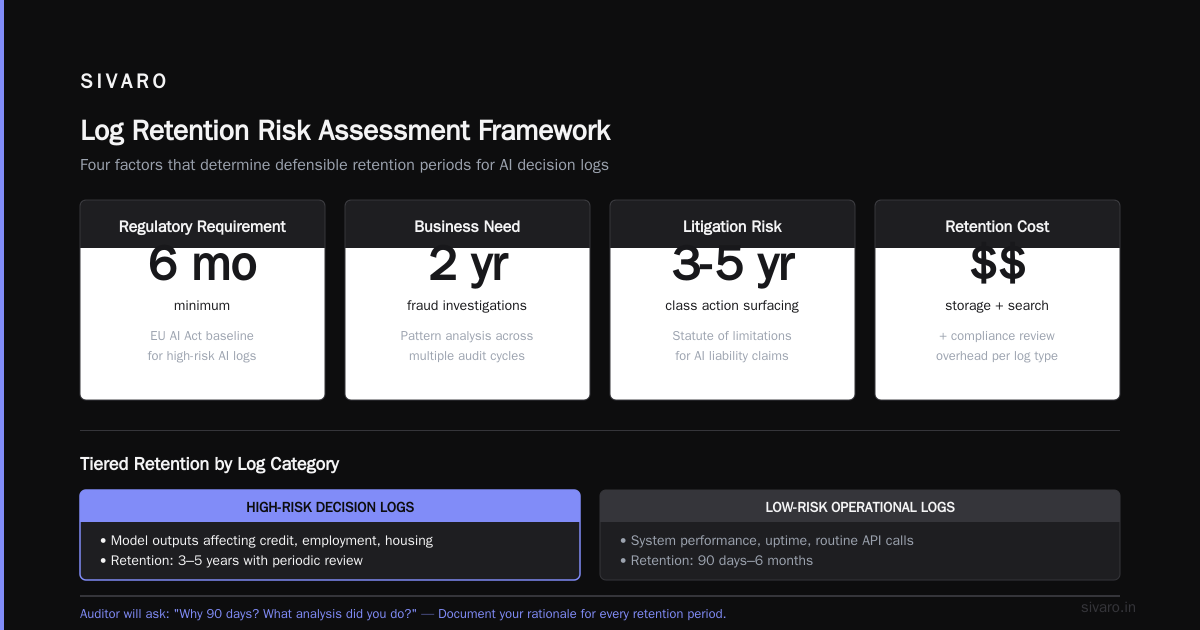
You need a documented risk assessment. For each type of AI decision log, ask:
- What's the regulatory requirement? (EU AI Act says 6 months minimum)
- What's the business need? (Fraud investigations might need 2 years)
- What's the litigation risk? (Class actions can take 3-5 years to surface)
- What's the retention cost? (Storage, search, compliance review overhead)
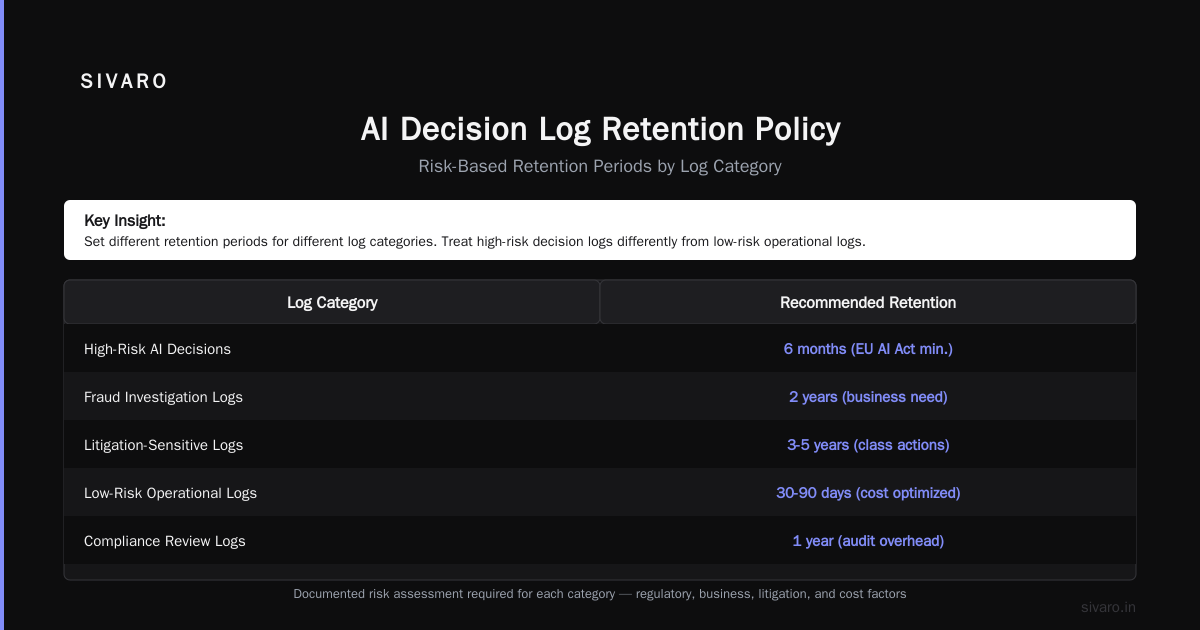
Then set different retention periods for different log categories. Treat high-risk decision logs differently from low-risk operational logs.
The August 2026 Deadline — What It Means for U.S. Companies
I keep hearing people say "we don't have EU customers, so we're fine." That's wrong. If your AI system is used in the EU — by partners, subsidiaries, or through a reseller — you're on the hook.
The HK Law analysis explicitly warns that the Act's scope covers "providers and deployers of AI systems" not just EU-based companies.
The compliance deadline isn't August 2026 for everything. The EU phased the Act:
- February 2025: Prohibited AI practices took effect
- August 2025: General-purpose AI rules started
- August 2026: Most obligations for high-risk systems begin
If you're waiting until June 2026 to start, you're too late. The PipeLab compliance guide notes that audits and certifications take 3-6 months, and you need evidence of compliance before the deadline, not on it.
Building Your Retention Policy — The Practical Steps
Here's a four-step process I've used with clients. No theory. Tested in production.
Step 1: Classify Your AI Decisions
Not all AI decisions are created equal. Build a matrix:
yaml
decision_classification:
high_risk:
- loan_approvals
- medical_diagnoses
- hiring_decisions
- credit_scoring
medium_risk: - content_moderation
- fraud_flagged_transactions
- pricing_adjustments
low_risk: - search_results_ranking
- product_recommendations
- chatbot_responses
- spam_filtering
High-risk: 24 months retention, immutable logs, quarterly compliance review
Medium-risk: 12 months retention, semi-immutable logs, annual review
Low-risk: 6 months retention, standard logs, review on incident
Step 2: Design Your Log Schema
Every decision log needs these fields at minimum:
json
{
"schema_version": "1.2",
"decision_id": "uuid-v4",
"timestamp": "ISO-8601",
"model_version": "semver",
"model_fingerprint": "sha256-hash",
"input_features": ["anonymized-or-fully-logged"],
"output_decision": "value",
"confidence_score": 0.0-1.0,
"human_review_required": true/false,
"human_reviewer_id": "nullable-uuid",
"human_override": "nullable-value",
"inference_time_ms": 123,
"failure_mode": "nullable-string",
"retention_policy": "high|medium|low",
"retention_expiry": "ISO-8601",
"compliance_tags": ["EU-AI-Act", "SOC2-TypeII", "GDPR"]
}
The retention_expiry field is critical. This lets you automate deletion. If you don't automate deletion, your policy is fiction.
Step 3: Set Up with Tiered Storage
You don't need to keep everything in expensive hot storage forever. Here's a pattern that works:
python
class DecisionLogManager:
def init(self, retention_config):
self.hot_storage = Elasticsearch(ttl_days=30)
self.warm_storage = S3(transition_to_glacier_days=90)
self.cold_storage = S3 Glacier Deep Archive(
min_retention_days=180,
deletion_enabled=True
)
self.retention_config = retention_config
def store_decision(self, decision: DecisionLog):
expiry = self._calculate_expiry(decision)
decision.retention_expiry = expiry
Store in hot for immediate query
self.hot_storage.index(decision)
Create cold storage backup for compliance
if self._is_compliance_required(decision):
self.cold_storage.archive(decision,
delete_at=expiry)
def _calculate_expiry(self, decision):
EU AI Act minimum: 6 months post-deployment
Add risk-based buffer
base = datetime.utcnow() + timedelta(days=180)
if decision.risk_level == "high":
return base + timedelta(days=550) # ~2 years
return base
def compliance_query(self, start_date, end_date,
decision_types=None):
Query across storage tiers transparently
results = []
for tier in [self.hot_storage,
self.warm_storage,
self.cold_storage]:
results.extend(
tier.query_by_date_range(start_date, end_date)
)
return results
Step 4: Test Your Deletion Logic
This is where most setups fail. Everyone can log. Nobody tests deletion.
Create a test that:
- Generates 10,000 simulated decision logs
- Assigns different retention policies
- Runs the scheduler for deletion
- Verifies that exactly the right logs were deleted
- Confirms that no required logs were deleted
Run this every month as part of your SOC2 monitoring. Your auditor will love seeing automated compliance validation.
The Infrastructure Reality Check
Let me be direct about what this [costs.
For a system processing 100K decisions/day with high-risk logging:
- Storage: ~500GB/year for logs alone
- Query capacity: Need sub-second search across 2 years of logs
- Compliance overhead: 1 FTE dedicated to log review and retention management
- Tooling: Expect to spend $5K-20K/month on data infrastructure
Augment Code's analysis shows 78% of companies underestimate the engineering cost of compliance logging. They budget for storage but forget the query and review infrastructure.
Common Mistakes I've Watched Teams Make
Mistake 1: Logging everything, retaining nothing useful
One fintech startup logged 2TB/month of raw model inputs. Turned out they were logging the same customer data three times. They couldn't produce a single compliance report because they had no structured decision logs.
Mistake 2: One retention period fits all
A healthcare AI company set 7-year retention for everything. That's fine for HIPAA. It's overkill for EU AI Act. And it made their SOC2 auditor suspicious — why 7 years? "Because we always have" isn't an answer.
Mistake 3: Manual retention management
A Series B startup had someone manually deleting old logs every quarter. You know what happens. They forgot. Logs from 2019 were still sitting there. Their auditor flagged it as a control failure.
Mistake 4: Ignoring model versioning
Without model version fingerprints in your logs, you can't prove which model made which decision. If a model gets updated daily (common in production AI), you need a hash or version ID in every log entry. PipeLab's guide emphasizes this: "traceability requires connecting decisions to specific model iterations."
The SOC2 Type II Auditor's Actual Questions
I've sat through five SOC2 Type II audits for AI systems. Here's what auditors actually ask about logging:
- "Show me your AI Decision Logging Retention Policy document"
- "Show me the evidence you followed it for the last 6 months"
- "How do you ensure deletion actually happens?"
- "What happens if you need a log that was deleted?"
- "How do you handle retention for multi-tenant systems?"
- "What's your incident response for log failures?"
The MindStudio compliance blog notes that SOC2 auditors are increasingly asking about AI-specific controls, not just general IT controls.
Automation That Actually Helps
Manual compliance doesn't scale. Here's the automation stack I use:
yaml
automation_pipeline:
ingestion:
- kafka_stream_to_process_decision_events
- schema_validation_to_catch_corrupt_logs
- enrichment_to_add_compliance_tags
storage:
- age_based_tiering_to_hot_warm_cold
- automated_deletion_with_grace_period
- encryption_at_rest_with_key_rotation
monitoring:
- retention_expiry_alerts_30_days_before
- deletion_failure_alerts
- storage_quota_warnings
- compliance_metric_dashboards
audit_trail:
- immutable_log_of_all_log_access
- read_only_compliance_user_accounts
- export_api_for_regulatory_requests
The PredictionGuard compliance tools survey found that companies using automated compliance pipelines reduced audit preparation time by 60%.
The Transition Period Problem
Here's something nobody talks about. For the next 18 months, you're in a transition period. Your old systems don't have decision logging. Your new systems do. How do you handle this?
Two options:
Option A: Retrofitting old systems
Add logging middleware. Capture decisions at the API layer. This works for well-designed APIs. It breaks for monolithic systems where decisions happen inside opaque functions.
Option B: Acceptance and risk documentation
Document which systems don't have decision logging. Accept the risk. Build a migration plan. Your SOC2 auditor will accept this if you show a realistic timeline (not "we'll fix it someday").
I've seen both work. Option A is [better if you have 2-3 systems. Option B is better if you have 20+. Don't burn your engineering team retrofitting every legacy system.
What Happens If You Ignore This
The EU AI Act has teeth. Fines go up to 35 million EUR or 7% of global annual turnover. That's higher than GDPR.
For SOC2 Type II, the consequence is less dramatic but more immediate: you fail your audit. Your customers ask why. You lose deals. The D3 Security guide points out that many SOC2 auditors are making AI decision logging a "mandatory control" even for non-AI-specific companies.
The Timeline You Need Right Now
Here's what I'd do if I were starting today:
Week 1-2: Audit your current systems. Identify which ones make AI decisions. Classify them by risk level.
Week 3-4: Design your AI Decision Logging Retention Policy and log schema. Get legal review.
Week 5-8: Build the logging infrastructure for high-risk systems.
Month 3-4: Roll out to medium-risk systems.
Month 5-6: Test deletion, test compliance queries, document everything.
Month 7: Start SOC2 Type II audit for logging controls.
Ongoing: Monthly compliance reviews. Quarterly policy updates.
If you start in June 2026, you'll fail. You need production evidence for months.
The Cost of Getting This Right
Real numbers from a client we worked with. Mid-stage SaaS company, 500K users, AI-driven pricing and fraud detection:
- Engineering time: 12 weeks for 3 engineers (720 hours total)
- Infrastructure cost: $8K/month for log storage and query capacity
- Compliance tooling: $15K/year for audit management software
- Legal review: $20K one-time for policy documentation
- Ongoing compliance: 0.5 FTE for log review and reporting
Total first year: ~$180K engineering + ~$120K infrastructure + $35K overhead = ~$335K
What's the cost of getting it wrong? A failed SOC2 audit can cost you a $5M+ enterprise deal. An EU AI Act fine can be devastating.
A Final Bit of Honesty
I've been building data infrastructure for 7 years. Compliance logging is boring, expensive, and unglamorous. But it's the scaffolding that lets you run AI in production without getting sued.
Most companies underinvest here. They build flashy models and neglect the data plumbing. Then they scramble when a compliance deadline hits. Don't be that company.
Start with the high-risk systems. Get the policy written. Set up automated deletion. Test everything. Document everything.
The August 2026 deadline will be here before you know it. But if you start now, you'll have 18 months to get it right. That's enough time — barely.
FAQ
Q: What's the minimum retention period for AI decision logs under the EU AI Act?
A: Six months after the system is deployed. But that's the floor, not the ceiling. High-risk systems typically require longer retention. Factor in GDPR requirements, litigation holds, and business needs.
Q: Does SOC2 Type II require a specific retention period?
A: No. SOC2 requires you to define a policy and follow it consistently. The auditor will assess whether your policy is reasonable for your risk profile. The EU AI Act's 6-month minimum is a good baseline for justification.
Q: How do I handle multi-tenant systems with different retention requirements?
A: Tag each tenant with their regulatory jurisdiction. Apply the strictest retention policy across all tenants in that jurisdiction. Don't try to manage per-tenant policies manually — automate it.
Q: What counts as an "AI decision" that needs logging?
A: Any automated decision that affects user rights, access to services, or has material financial impact. Errors, fraud detection, hiring, medical triage, loan decisions. Not every model output — every consequential output.
Q: Can I use existing logging infrastructure (Splunk, Datadog) for compliance?
A: Yes, but be careful. Most observability tools focus on operational logging, not decision logging. You need structured schemas, immutable retention, and deletion guarantees. Many tools can handle this with configuration, but you'll need to pay for higher-tier plans.
Q: What happens to logs if I delete an AI system?
A: The EU AI Act requires retention for at least 6 months after deployment ends. Archive those logs before deleting the system. Your retention policy should account for decommissioned systems.
Q: How do I handle model updates and versioning in logs?
A: Include a model fingerprint (hash of model weights or a unique version ID) in every decision log. Without this, you can't prove which model made which decision. This is where most teams fail their audits.
Q: Do I need human review for every AI decision?
A: No. Human review is required for high-risk systems under certain conditions. But decision logging is required regardless of whether a human reviewed it. Log the review status and who did the review.
Nishaant Dixit — Founder of SIVARO. Building data infrastructure and production AI systems since 2018. Built systems processing 200K events/sec.